
Deck Cost in Woodbridge (2026)
What does a deck cost in Woodbridge, NJ? Get 2026 pricing by material, per-square-foot breakdowns, labor rates, and tips to save on your new deck.
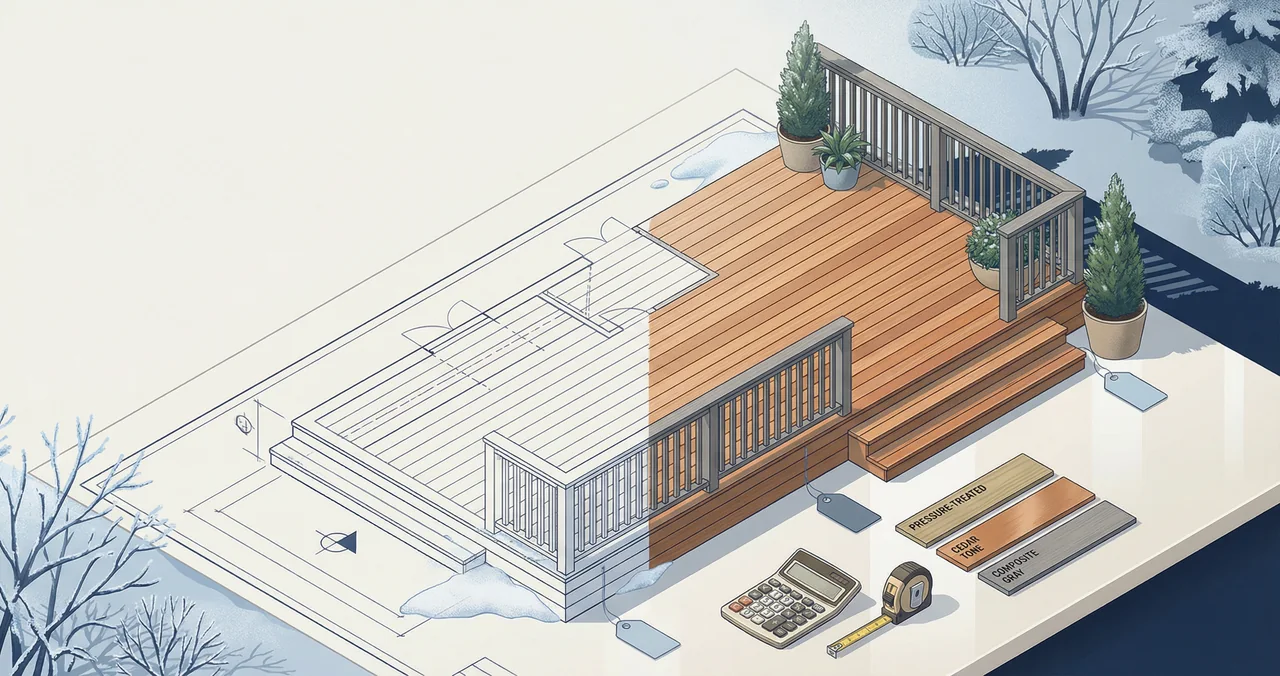
Deck Cost in Woodbridge: What Homeowners Are Paying in 2026
A new deck in Woodbridge typically runs between $8,000 and $30,000 for a standard 12×16 build, depending on the material you choose and how complex the design gets. That's a wide range — and the gap between the low end and the high end comes down to decisions you'll make in the next few weeks.
🏗️ Planning a deck project?
Get a free manual project review, or visualize your dream deck with AI before requesting quotes.
🧮 Tool Alert: Deck Cost Calculator
Estimate your project costs in seconds based on local pricing bands for your area.
Calculate My Cost →Woodbridge sits in one of the trickier climate zones for outdoor construction. Freeze-thaw cycles punish cheap materials. Snow loads stress undersized framing. And because the building season here runs roughly May through October, contractors pack their schedules tight. If you're planning a 2026 build, the time to get quotes is now — ideally by March.
Here's what Woodbridge homeowners are actually paying this year, broken down by material, labor, and the factors that move the needle most.
<!-- slot:after-intro -->
For a broader look at deck pricing across different materials and regions, see our deck cost guide. Timing your build right can also save thousands — check our guide on the best time to build a deck.
Average Deck Cost in Woodbridge by Material
Material choice is the single biggest cost driver. Here's what installed pricing looks like across Woodbridge in 2026:
| Material | Installed Cost Per Sq Ft | 200 Sq Ft Deck | 320 Sq Ft Deck |
|---|---|---|---|
| Pressure-Treated Wood | $25–$45 | $5,000–$9,000 | $8,000–$14,400 |
| Cedar | $35–$55 | $7,000–$11,000 | $11,200–$17,600 |
| Composite (mid-range) | $45–$75 | $9,000–$15,000 | $14,400–$24,000 |
| Trex (premium line) | $50–$80 | $10,000–$16,000 | $16,000–$25,600 |
| Ipe (hardwood) | $60–$100 | $12,000–$20,000 | $19,200–$32,000 |
A few things to note. Pressure-treated lumber is the cheapest upfront, but in Woodbridge's climate, you'll spend $200–$400 per year on staining and sealing to keep it from splitting. Cedar looks gorgeous in year one and gray in year three without maintenance. Composite and PVC boards handle New Jersey winters with almost zero upkeep — that's why roughly 60% of new Woodbridge decks now use engineered materials.
If you're comparing sizes in more detail, our guide on 12×16 deck costs breaks down the math for one of the most popular configurations.
Cost Per Square Foot Breakdown
When contractors quote you a per-square-foot price, that number bundles several things together. Here's what's actually inside that figure:
Materials (40–50% of total cost)
- Decking boards: The surface you walk on. Ranges from $3/sqft for pressure-treated to $25+/sqft for Ipe.
- Framing lumber: Joists, beams, ledger board. Usually pressure-treated regardless of surface material. Budget $4–$8/sqft.
- Hardware: Joist hangers, structural screws, post brackets, flashing. Roughly $2–$4/sqft.
- Railings: Basic wood railings add $20–$35 per linear foot. Composite or aluminum systems run $40–$75 per linear foot.
Labor (35–45% of total cost)
Woodbridge labor rates fall in the $20–$40/sqft range for installation, depending on complexity. More on this below.
Permits and Inspections (2–5% of total cost)
Deck permits in Woodbridge Township typically cost $100–$500 depending on project size. Structures over 200 square feet or 30 inches above grade require a permit — check with Woodbridge's Building/Development Services department before breaking ground.
Site Prep and Footings (5–10% of total cost)
Woodbridge's frost line sits at 36 inches or deeper, which means your footings need to extend well below grade to avoid frost heave. Helical piers or sono tube footings at this depth add $150–$300 per footing compared to shallower climates.
Labor Costs in Woodbridge
Labor is where Woodbridge pricing diverges from national averages. Here's why.
Shorter season, higher demand. With reliable building weather limited to about six months, contractors in Middlesex County stay booked. A crew that might charge $18/sqft in a year-round market can command $22–$35/sqft here simply because the calendar compresses demand.
Complexity multipliers push labor costs higher:
- Multi-level decks: Add 15–25% to base labor costs
- Wraparound designs: Add 10–20%
- Built-in seating or planters: Add $500–$2,000 per feature
- Hot tub reinforcement: Requires beefed-up framing, typically $1,500–$3,500 extra
- Demolition of existing deck: $5–$15/sqft depending on access and disposal
How to Get Better Labor Rates
Book early. Signing a contract in February or March — before the rush — often shaves 5–10% off labor. Many Woodbridge-area builders offer off-season discounts to lock in spring starts.
Bundle projects. If you're also adding a fence or doing landscaping, hiring one general contractor for everything usually costs less than separate crews.
Don't chase the cheapest bid. A lowball quote in Woodbridge often means corners get cut on footings or flashing — exactly the details that matter most in a freeze-thaw climate. Get three quotes minimum and compare scope, not just price.
<!-- slot:mid-content -->
What Affects Your Total Price
Beyond material and labor, these factors shape your final number:
Deck Size and Layout
A simple rectangle is the most cost-effective shape. Every angle, curve, or level change increases both material waste and labor time. A 320 sqft L-shaped deck can cost 20–30% more than a 320 sqft rectangle using the same materials.
Height and Access
Ground-level decks are cheapest. Once your deck sits 4+ feet above grade, you need deeper posts, more bracing, and often stairs — which add $1,000–$3,000 depending on length and material. Second-story decks attached to raised foundations (common in parts of Woodbridge near the waterfront) can push framing costs up significantly.
Railings and Stairs
Railings are required on any deck surface 30 inches or more above grade per New Jersey building code. Options range widely:
- Wood railings: $20–$35/linear foot
- Composite railings: $40–$60/linear foot
- Aluminum or cable rail: $50–$75/linear foot
- Glass panels: $75–$120/linear foot
Stairs typically cost $75–$200 per step, installed.
Soil and Drainage Conditions
Parts of Woodbridge — particularly areas closer to the Woodbridge River and Arthur Kill — have clay-heavy or poorly draining soil. If your yard pools water, you may need grading work or a drainage solution beneath the deck, adding $500–$2,000 to prep costs.
Permit and Inspection Fees
Budget $100–$500 for permits. If your project requires engineered drawings (common for elevated or large decks), add another $500–$1,500 for a structural engineer's stamp. Don't skip the permit — building without one in Woodbridge creates real problems at resale. Our post on risks of building without a permit covers what can go wrong.
Composite vs Wood: Cost Comparison
This is the decision most Woodbridge homeowners wrestle with. Here's how the numbers actually play out over time:
| Factor | Pressure-Treated Wood | Composite (Mid-Range) |
|---|---|---|
| Installed cost (320 sqft) | $8,000–$14,400 | $14,400–$24,000 |
| Annual maintenance | $200–$400 (stain/seal) | $0–$50 (occasional wash) |
| 10-year maintenance total | $2,000–$4,000 | $0–$500 |
| 10-year total cost | $10,000–$18,400 | $14,400–$24,500 |
| Expected lifespan | 15–20 years | 25–30+ years |
| Warranty | None typical | 25–50 years |
The upfront gap narrows considerably over a decade. And in Woodbridge's climate — where salt trucks run from November through March and freeze-thaw cycles hammer exposed wood — composite decking simply lasts longer without the annual maintenance headache.
That said, pressure-treated wood makes sense if you're on a strict budget and willing to put in the upkeep time. Cedar hits a middle ground: better rot resistance than pressure-treated, warmer aesthetic, but still needs regular staining to hold up.
For a deeper look at which composite brands perform best in cold climates, we've tested and reviewed the top options.
What About Ipe?
Ipe (Brazilian hardwood) is the premium choice. It's naturally rot-resistant, incredibly dense, and lasts 40+ years. But at $60–$100/sqft installed, a 320 sqft Ipe deck runs $19,200–$32,000. It also requires specialized fasteners and experienced installers — not every Woodbridge crew works with it. If budget allows, it's hard to beat. Otherwise, premium composite lines from Trex, TimberTech, or Fiberon deliver similar longevity at lower cost.
How to Save Money on Your Woodbridge Deck
1. Time Your Build Strategically
March contracts, May starts — this is the sweet spot. You lock in pricing before peak season markups while still building in good weather. Late-season builds (September–October) can also yield discounts as crews try to fill remaining calendar slots.
2. Choose a Standard Size and Shape
Stick with common dimensions like 12×16 or 16×20. Standard sizes minimize material waste and use lumber efficiently. That 16×20 deck layout is one of the most cost-effective footprints for entertaining.
3. Mix Materials
Use composite for the decking surface (what you see and touch) but pressure-treated lumber for the frame (what's hidden underneath). This is already standard practice and saves thousands compared to an all-composite system.
4. Skip the Extras — For Now
Built-in benches, pergolas, and lighting are nice but add up fast. Build the deck now, add features later. Many accessories like deck lighting kits can be retrofitted without structural changes.
5. Visualize Before You Commit
Use PaperPlan to visualize different decking materials on your own home before committing. Seeing composite vs. cedar vs. Ipe on your actual house helps you decide where to spend and where to save — before any money changes hands.
6. Get Multiple Quotes (But Compare Apples to Apples)
Request at least three detailed quotes. Make sure each one specifies:
- Board brand and product line
- Footing type and depth
- Railing system included
- Whether permit fees are covered
- Warranty on workmanship
A $15,000 quote with engineered footings and composite railings is a better deal than a $12,000 quote using basic wood railings and shallow piers — even though the sticker price says otherwise.
<!-- slot:before-faq -->
🎨 Not sure which material to pick?
Upload a photo of your backyard and see exactly how Trex, TimberTech, or cedar would look — free and instant.
Frequently Asked Questions
How much does a 12×16 deck cost in Woodbridge?
A 12×16 (192 sqft) deck in Woodbridge costs between $4,800 and $8,640 for pressure-treated wood, or $8,640 to $14,400 for composite, fully installed. These ranges include standard railings, stairs, and permit costs. Multi-level designs or premium railings push the price higher. For elevated decks requiring deep footings, add $1,000–$2,500 for the additional structural work Woodbridge's frost line demands.
Do I need a permit to build a deck in Woodbridge, NJ?
Yes, in most cases. Woodbridge Township requires permits for decks over 200 square feet or more than 30 inches above grade. Even smaller decks may need a zoning review. Contact Woodbridge's Building/Development Services department before starting — unpermitted work can result in fines, forced removal, and complications when you sell your home. The permit process typically takes 2–4 weeks, so factor that into your timeline.
What is the best decking material for New Jersey winters?
Composite and PVC decking handle New Jersey's freeze-thaw cycles best. They won't crack, split, or absorb moisture the way natural wood does. Brands like Trex Transcend, TimberTech Advanced PVC, and Fiberon Paramount are all engineered for harsh winter climates. If you prefer real wood, Ipe is the most durable option — but budget accordingly. Pressure-treated and cedar both work if you commit to annual sealing and staining, but most Woodbridge homeowners find the maintenance trade-off isn't worth it long-term.
When is the best time to build a deck in Woodbridge?
The building season in Woodbridge runs May through October, but the best time to *start the process* is January through March. This gives you time to get quotes, secure permits, and lock in a contractor before spring demand spikes. Builders who are booked by April may not have openings until midsummer. If you're flexible on timing, September and October builds sometimes come with lower labor rates as contractors wrap up their season.
How long does it take to build a deck in Woodbridge?
A straightforward 200–300 sqft deck typically takes 3–5 days of actual construction time once footings are set. However, the full timeline — from first quote to finished deck — usually spans 6–10 weeks when you include design, permitting, material ordering, and scheduling. Larger or multi-level decks in the 400+ sqft range may require 7–10 days of construction. Weather delays are common in spring, so build buffer into your schedule.
<!-- slot:end -->
📋 Planning a deck project?
Get a free manual project review from our team — no obligation, no spam.
Get Free Project Review →Upload a backyard photo and preview real decking materials with AI — free, instant, no sign-up.
Permits, costs, material comparisons, and questions to ask before requesting quotes — delivered to your inbox.