
Best Deck Builders & Installers in Montreal
Compare Montreal deck builders, installers, and contractors across Mont-Royal, the Plateau, and the West Island.
TL;DR
- Choose a Montreal deck builder whose specialty matches your borough, from Plateau rooftop terraces to West Island clay-soil yards.
- Verify every contractor's active RBQ licence subcategory (such as 1.2 or 4.1) and CNESST safety clearance before signing a contract.
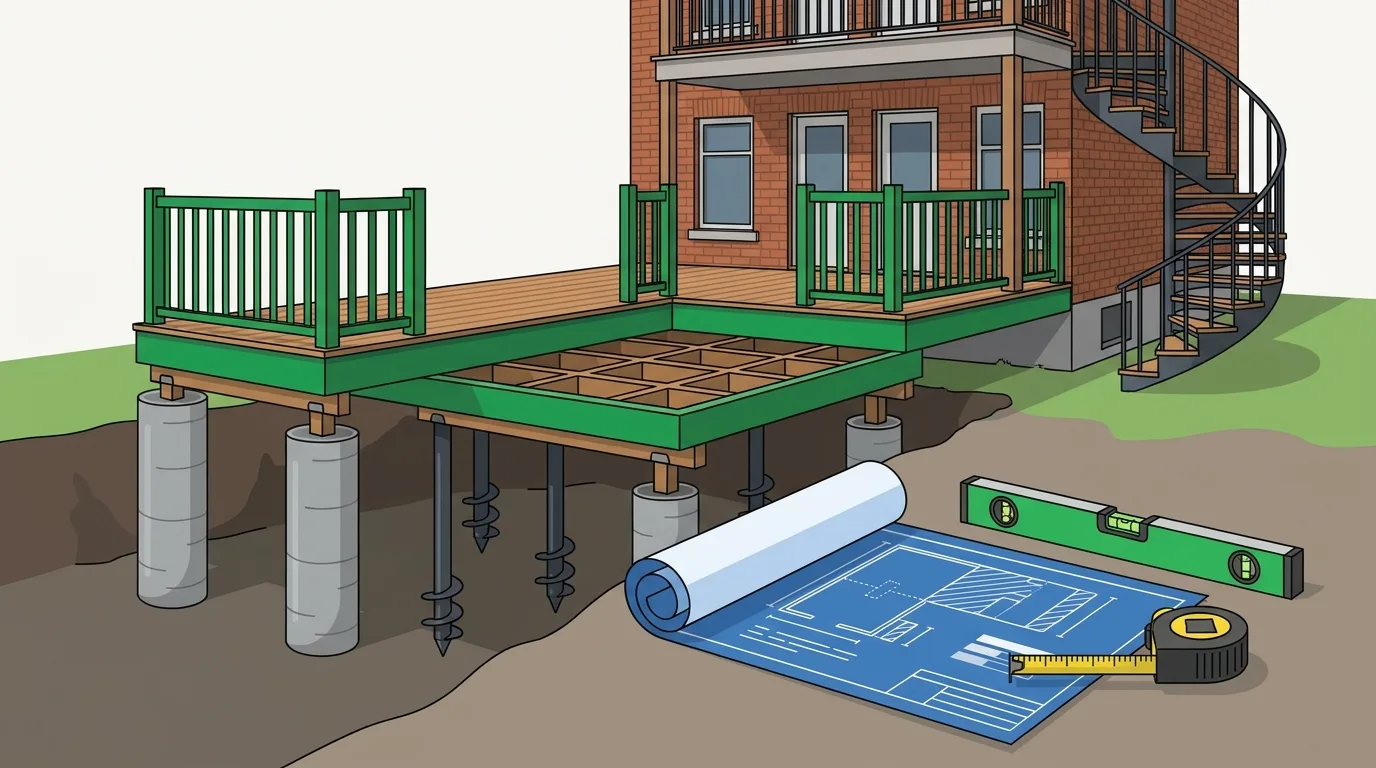
- Ensure foundations use 48-to-60-inch poured concrete bell footings or deep thermal helical piles set below the Montreal frost line.
🏗️ Planning a deck project?
Get a free manual project review, or visualize your dream deck with AI before requesting quotes.
How We Evaluated Deck Contractors and Installers in Montreal
Finding reliable deck builders in Montreal means looking past polished summer photos to see how a structure survives January. Between heavy wet snow, road salt, and deep ground frost, Quebec winters punish shortcuts. A contractor who builds to warmer provincial standards or skips soil checks in clay-heavy boroughs will leave you with heaving posts by spring.
Not every general renovator advertising patio work is qualified for exterior structural carpentry. You need a specialist who understands borough zoning bylaws, holds active provincial credentials, and builds specifically for local soil conditions. Browse our Montreal deck planning hub to compare regional building requirements before you request estimates.
- Active RBQ licensing: Every legitimate builder must hold a verified licence from the provincial building board covering exterior carpentry.
- Frost-ready foundation capability: Installers must use 48-to-60-inch poured concrete tubes or thermal helical piles suited to your lot.
- Borough permit familiarity: Top companies handle urban planning submissions, heritage board reviews, and stamped engineering drawings directly.
- Written structural warranties: Vetted contractors provide clear written guarantees on both framing labour and manufacturer decking materials.
Patio et Terrasse Montreal: Best for Custom Multi-Level Cedar and Composite Builds
Patio et Terrasse Montreal focuses on custom residential carpentry across the central island, specializing in split-level layouts that connect raised kitchen exits to grade-level gardens. Their crews work frequently with Western Red Cedar and capped polymer boards, building enclosed under-deck storage and privacy screens that match existing brick and stone exteriors.
Homeowners in dense neighbourhoods appreciate their structured design process, which includes digital framing layouts before demolition starts. They manage municipal permit filings and coordinate directly with screw pile installers when backyard access is too narrow for excavation machinery.
- Service territory: Central Montreal boroughs including Rosemont, Villeray, and Ahuntsic.
- Material focus: Select structural cedar, capped composite boards, and tempered glass railings.
- Key advantage: Dedicated design-build workflow with custom privacy walls and integrated stair lighting.
- Things to note: Spring production schedules fill quickly during late winter booking windows.
Les Entreprises de Patio du Grand Montreal: Best Deck Builders in Mont-Royal and Outremont
If you are searching for who are the best deck builders in Mont-Royal, Les Entreprises de Patio du Grand Montreal stands out for high-end architectural woodwork. Detached homes in Ville Mont-Royal and Outremont face rigorous urban planning committees, strict rear-yard setback formulas, and rocky limestone soil conditions on the mountain slopes.
This builder prepares complete architectural packages tailored to local planning boards, matching tropical hardwoods like Ipe or architectural composites to classic stone facades. Their crews use specialized rock-drilling equipment to anchor deep foundations where standard augers fail against shallow bedrock.
- Service territory: Ville Mont-Royal, Outremont, Westmount, and Hampstead.
- Material focus: Exotic hardwoods, premium PVC decking, and custom masonry skirtings.
- Key advantage: Deep familiarity with suburban heritage committees and bedrock foundation anchoring.
- Things to note: Focused on larger architectural projects rather than small balcony repairs.
Balcons et Terrasses du Plateau: Best for Rooftop Decks and Plex Fiberglass Balconies
Duplexes and triplexes in central boroughs present challenges that suburban contractors rarely encounter. Balcons et Terrasses du Plateau specializes in elevated rear structures, spiral exterior staircases, fibreglass balcony resurfacing, and rooftop terraces built over flat elastomeric membranes.
Because tight green alleys prevent heavy machinery from reaching the yard, their installers hand-carry materials and use portable hydraulic equipment to drive foundations. They also partner with structural engineers to calculate load distribution over existing roof joists and masonry walls.
- Service territory: Le Plateau-Mont-Royal, Mile End, Hochelaga-Maisonneuve, and Sud-Ouest.
- Material focus: Fibreglass decks, cedar rooftop tiles, and structural steel framing.
- Key advantage: Equipped for zero-lot-line alley access and multi-unit co-ownership properties.
- Things to note: Rooftop builds require stamped engineering plans before borough permits are issued.
Construction Deck Ouest: Best Deck Installers in the West Island and NDG
Homeowners comparing deck installers in Montreal for larger suburban lots in Notre-Dame-de-Grâce, Lachine, Pointe-Claire, or Beaconsfield need crews who understand heavy marine clay. Construction Deck Ouest builds expansive single-level and wrap-around layouts engineered to resist soil shifting near the river.
Their installation teams emphasize low-maintenance synthetic surfaces and metal framing systems that stay flat across wide spans. If you are weighing substructure upgrades for damp ground, read our breakdown of aluminum deck framing systems to see how metal joists prevent moisture rot.
- Service territory: NDG, Côte-Saint-Luc, Lachine, Dorval, Pointe-Claire, and Kirkland.
- Material focus: Capped composite boards, PVC planks, and powder-coated aluminum railings.
- Key advantage: Fast turnaround on wide suburban footprints with helical pile foundations.
- Things to note: Does not service third-story plex balconies or downtown rooftop installations.
Patio Design Inc.: Best Turnkey Deck Company in Montreal for Pool and Spa Surrounds
Integrating an above-ground pool, recessed hot tub, or outdoor kitchen requires specialized framing and electrical coordination. Patio Design Inc. operates as a full-service deck company in Montreal that coordinates carpentry, reinforced spa pads, and compliant safety enclosures under one contract.
Quebec residential pool safety rules mandate strict self-closing gate hardware and specific railing heights around water features. Their builders construct slip-resistant synthetic boardwalks with hidden fasteners and removable access hatches so technicians can service pool pumps and heaters easily.
- Service territory: Island of Montreal, Laval, and the South Shore.
- Material focus: Slip-resistant PVC, moisture-shielded composite, and glass windbreaks.
- Key advantage: Reinforced framing for heavy hot tubs and code-compliant pool fencing.
- Things to note: Turnkey landscaping and electrical coordination require early winter design booking.
2026 Deck Building Costs in Montreal by Material and Size
Base estimates include framing, 48-to-60-inch frost footings, standard railings, and basic stairs.
What Drives 2026 Montreal Quotes Higher
- Rocky or alley excavation: Hand-digging in narrow Plateau alleys or drilling through Outremont limestone requires specialized portable machinery.
Verifying RBQ Licensing, CNESST Coverage, and Quebec Contract Rules
In Quebec, any contractor performing residential construction or renovation work must hold an active licence from the provincial building regulator with the proper RBQ license subcategories. Always verify your builder on the Régie du bâtiment du Québec licence registry before signing a quote, as holding a valid licence confirms the company carries mandatory licence security bonding.
For residential deck construction, confirm the contractor holds RBQ general contractor subcategories 1.1.1, 1.1.2, or 1.2 (or 1.3 for multi-unit buildings), or the specialized carpentry subcategory 4.1 (Charpenterie). If a company subcontracts helical piles or concrete formwork, ensure those trades hold specialized foundation or concrete subcategories as well.
You should also check workplace safety registration and consumer contract protections. Under Office de la protection du consommateur renovation rules, a written contract with clear specifications, start dates, and total costs is mandatory for itinerant or major home improvement agreements.
- RBQ licence subcategories: Confirm active coverage under general contractor subcategories (1.1.1, 1.1.2, or 1.2) or specialized carpentry subcategory 4.1.
- CNESST clearance: Verify workplace safety registration via the CNESST conformity check service so you are never liable for site injuries.
Watch out: Never accept cash-only discounts or under-the-table arrangements. Working without an invoice and written contract voids your recourse with the RBQ financial guaranty fund if the builder abandons the site or builds defective footings.
Montreal Borough Permit Rules: Mont-Royal, the Plateau, NDG, and West Island
Permit rules vary across the island because Montreal's 19 boroughs and independent municipalities each enforce their own urban planning bylaws. Generally, you need a municipal permit for any deck over 24 inches (60 cm) above grade or larger than 100 square feet (9.3 m²). You can review baseline municipal rules on the City of Montreal residential permits portal or contact your local permit counter before finalizing your layout.
Elevated builds, rooftop terraces, and structures attached to brick masonry walls frequently require stamped plans from a member of the Ordre des ingénieurs du Québec.
- Ville Mont-Royal and Outremont: Strict architectural integration rules, rear-yard lot coverage caps, and mandatory planning committee (CCU) reviews.
- Le Plateau-Mont-Royal: Tight lateral setback limits, courtyard green-space minimums, and heritage rules for front and rear plex balconies.
- NDG and Côte-des-Neiges: Specific regulations governing rear extensions, duplex exit stairs, and sightline privacy screens between neighbours.
- West Island and Verdun: Marine clay soil drainage rules, shoreline setbacks, and strict municipal pool enclosure bylaws in Pointe-Claire, Beaconsfield, and Dorval.
Engineering for Montreal Winters: 48-to-60-Inch Frost Footings, Helical Piles, and Snow Loads
Ground frost in the Montreal region penetrates much deeper than in southern coastal regions, requiring every structural post to sit 48 to 60 inches below grade. Any deck contractor who quotes 36-inch post holes or sets concrete blocks directly on topsoil is cutting corners and will leave your framing vulnerable to severe winter frost heave.
The National Building Code of Canada establishes baseline structural safety rules for snow loads, guardrails, and foundations that Quebec adapts into its provincial construction code.
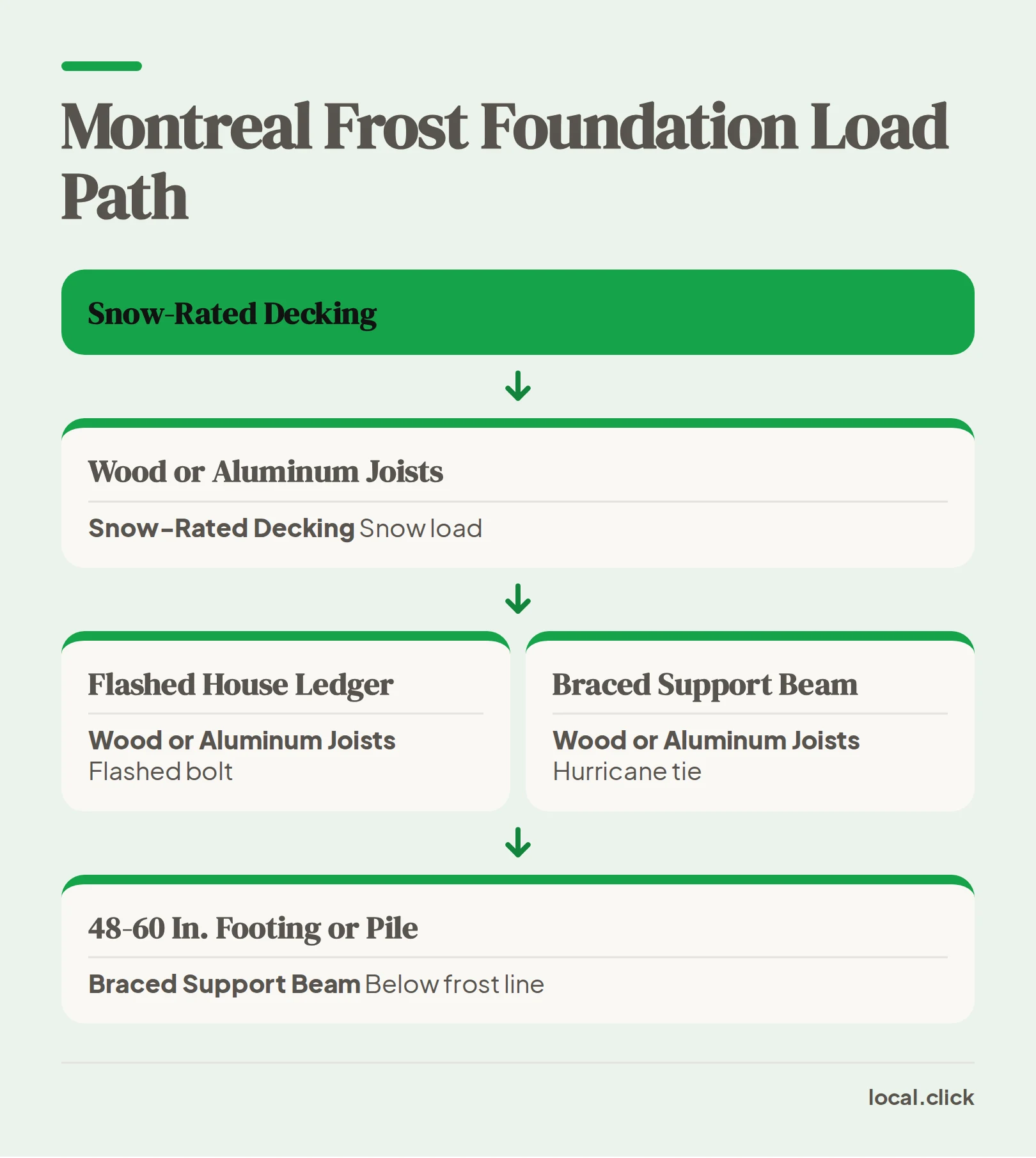
- 48-to-60-inch bell-shaped concrete footings: Poured concrete sonotubes excavated 48 to 60 inches deep with a flared bell base at the bottom to anchor against upward frost jacking.
- Deep thermal helical screw piles: Galvanized steel shafts driven below the 48-to-60-inch frost zone into stable soil with a helical blade and an insulated upper sleeve.
- Flashed ledger attachments: Ledger boards bolted to the house rim joist must use metal cap flashing and waterproof membranes to stop melting snow from rotting the wall.
- Snow load framing and code railings: Joists and beams must support heavy wet snow, paired with 42-inch (107 cm) minimum guardrail heights and maximum 4-inch (10 cm) baluster spacing.
Choosing Decking Materials That Survive Quebec Freeze-Thaw Cycles
Montreal regularly swings from freezing rain to deep sub-zero temperatures within a single day. When water seeps into unsealed wood fibres and freezes, it expands and splits the board from the inside out, while de-icing salt tracked from walkways accelerates surface breakdown.
Synthetic boards encased in polymer shells block moisture absorption completely, making them the lowest-maintenance choice for local homeowners. Compare cold-weather board ratings in our guide to the best composite decking brands in Canada before picking a product line.
- Capped composite and PVC: Impervious to freeze-thaw splitting and road salt, backed by 25-year+ manufacturer warranties with zero annual staining.
- Western Red Cedar: Contains natural oils that resist decay better than spruce or pine, though it requires annual UV sealing to prevent greying and cracking.
When to Book a Montreal Deck Contractor and How to Spot Hiring Traps
Because Montreal's frost-free outdoor building window is compressed between May and October, the most reputable deck contractors fill their spring schedules by March. Starting your design consultations and permit filings between January and March ensures your project breaks ground as soon as the soil thaws.
High seasonal demand also brings out unqualified operators who cut structural corners. Watch closely for warning signs during your site consultations so you do not end up with an unpermitted or unsafe structure.
- Late winter (January to March): Compare builder portfolios, verify RBQ credentials, finalize layouts, and lock in your spring construction slot.
- Early spring (April): Submit architectural plans to your borough urban planning office (allow 2 to 6 weeks for processing) and order materials.
- Prime build window (May to August): Ideal weather for 48-to-60-inch footing excavation, framing, and finishing ready for summer use.
- Autumn shoulder season (September to October): Cooler working conditions and reliable contractor availability before the ground freezes in November.
Tip: Reject any contractor who quotes a fixed price over the phone without inspecting your backyard access, checking clay soil drainage, and measuring existing ledger conditions in person.
🎨 Not sure which material to pick?
Upload a photo of your backyard and see exactly how Trex, TimberTech, or cedar would look — free and instant.
FAQ
Do I need a municipal permit to build or replace a deck in Montreal?
Most Montreal boroughs require a building permit for any deck over 24 inches (60 cm) above grade or larger than 100 square feet (9.3 m²), as well as rooftop terraces or elevated balconies.
How deep do deck footings need to be in Montreal, and why are helical piles popular?
Deck footings in the Montreal region must reach 48 to 60 inches below grade to sit beneath the frost line and prevent winter frost heave. Thermal helical screw piles are popular alongside poured concrete sonotubes because compact hydraulic equipment fits through narrow Plateau green alleys, requires zero concrete curing time, and uses smooth sleeves to stop freezing clay from lifting the post.
How can I verify if a Montreal deck contractor holds the right RBQ licence?
Ask the builder for their Régie du bâtiment du Québec (RBQ) licence number and look it up on the official provincial registry to confirm it is active under general construction subcategories (1.1.1, 1.1.2, or 1.2) or specialized carpentry subcategory 4.1.
📋 Planning a deck project?
Get a free manual project review from our team — no obligation, no spam.
Get Free Project Review →📋 Planning a deck project?
Get a free manual project review from our team — no obligation, no spam.
Get Free Project Review →Upload a backyard photo and preview real decking materials with AI — free, instant, no sign-up.
Permits, costs, material comparisons, and questions to ask before requesting quotes — delivered to your inbox.