
Do You Need a Permit to Build a Deck in Ontario? (2026 Rules + 3 Exemptions)
Most Ontario decks over 24\" need a permit — but 3 exemptions could save you $800. Exact rules by municipality, permit costs ($150-400), and what happens if you skip it.
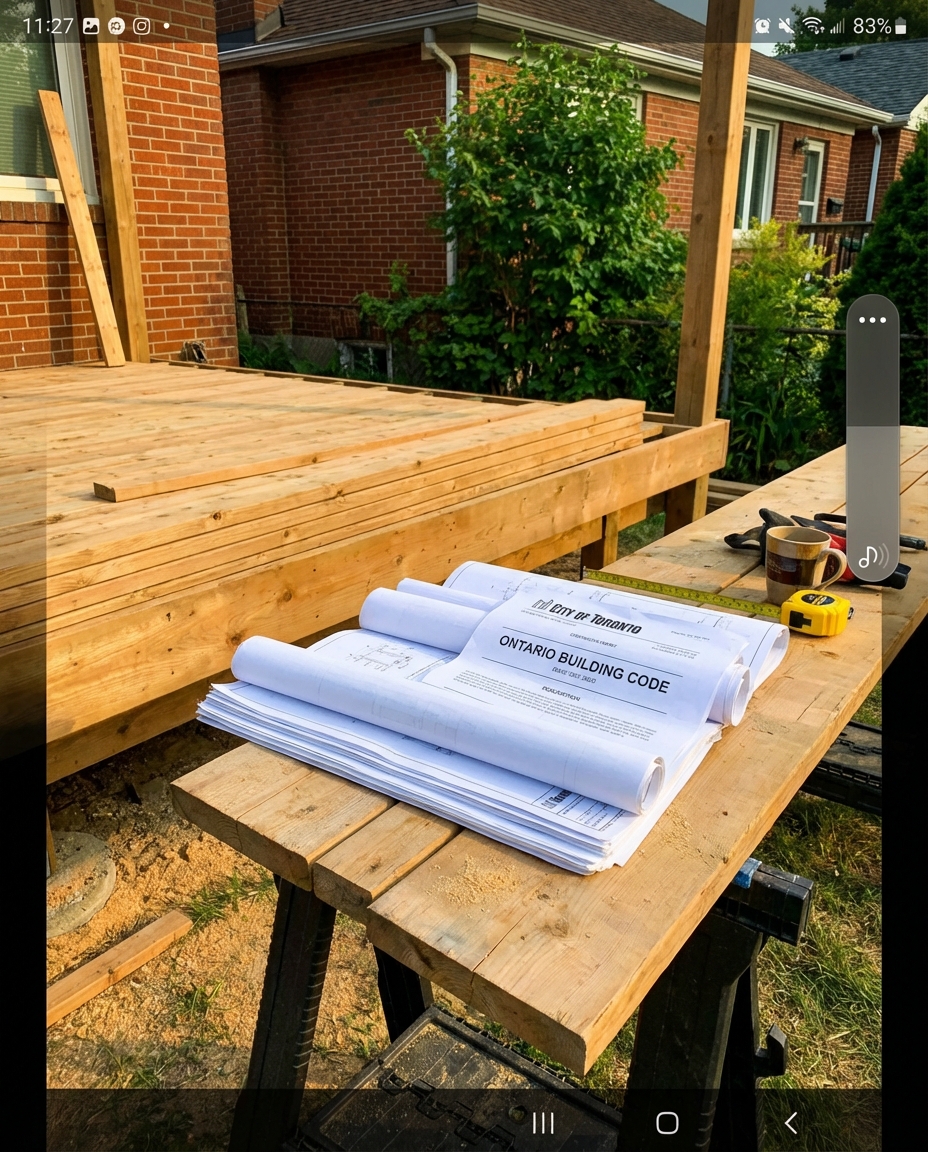
Do you need a permit to build a deck? If you're in Ontario, the short answer is yes — most decks require a building permit. But the rules vary by municipality, and there are important exceptions that could save you $300-$800 in permit fees.
Here's what actually triggers a permit requirement, what the process looks like, and how to avoid costly mistakes. Planning your budget? See our complete Ontario deck cost guide for full pricing.
When You Need a Deck Permit in Ontario
Under the Ontario Building Code (OBC), you need a building permit for any deck that:
🏗️ Planning a deck project?
Get a free manual project review, or visualize your dream deck with AI before requesting quotes.
- Is more than 24 inches (0.6 m) above grade at any point
- Attaches to your house (ledger-attached)
- Has a roof or permanent cover (like a pergola with solid panels)
- Sits over a basement window well or utility area
The 24-inch rule is the most common trigger. If your deck platform sits more than 2 feet above the ground at its highest point—even just at the stairs—you need a permit.
Ground-Level Decks (Under 24 Inches)
If your deck is 24 inches or less above grade and meets these conditions, you typically don't need a permit:
- Freestanding (not attached to the house)
- Open to the sky (no roof or cover)
- Not over a basement entrance or window well
But check with your municipality. Some have stricter rules. Waterloo, for example, requires permits for certain ground-level decks in flood zones or near property lines. Learn more about Waterloo's deck permit rules here.
Why the 24-Inch Rule Exists
Once a deck is high enough to require guardrails (over 24 inches), it becomes a life-safety issue. The OBC requires structural inspections to confirm:
- Footings are below the frost line (48 inches / 1.2 m minimum in Ontario)
- Joists are properly sized and spaced
- Guardrails meet height and spacing requirements
- Ledger boards are flashed and attached correctly
Falling from a deck is one of the most common home injuries. Permits exist to make sure decks won't collapse or fail.
What the Permit Process Looks Like
Every municipality in Ontario follows the same basic steps, but timelines and fees vary.
1. Prepare Your Drawings
You'll need to submit:
- Site plan showing the deck location, property lines, setbacks, and easements
- Framing plan with joist sizes, spacing, and footing locations
- Elevation drawing showing deck height, railing, and stair details
- Connection details for ledger board attachment and flashing
Most municipalities provide templates or checklists. You don't need an architect—homeowners can draw their own plans as long as they're clear and accurate. Here's a full checklist of what to include.
2. Submit Your Application
You can apply online or in person. You'll need:
- Completed permit application form
- Your drawings (PDF or printed)
- Proof of property ownership
- Permit fee (typically $150–$400 depending on the municipality and deck size)
For detailed walkthroughs, see:
- Kitchener deck permit application guide
- Cambridge deck permit application guide
- Waterloo deck permit application guide
3. Wait for Plan Review
Building departments review your drawings to confirm they meet the OBC. This takes 2–6 weeks in most KWC municipalities, depending on the season. Spring and early summer are the busiest times. Learn more about typical permit timelines.
If the reviewer finds issues, they'll send back a deficiency letter. You'll need to revise your drawings and resubmit.
4. Schedule Inspections
Once your permit is issued, you can start building. You'll need two inspections:
- Footing/framing inspection before you install decking boards
- Final inspection after railings, stairs, and all finishes are complete
Inspectors check that the work matches your approved drawings and meets code. Here's what inspectors look for during the framing inspection.
What Happens If You Skip the Permit
Building without a permit is risky. Here's what can go wrong:
Fines and Stop-Work Orders
If a neighbour or inspector notices unpermitted construction, the municipality can issue a stop-work order and fine you $500–$5,000 depending on the violation. You'll still need to get a permit and pass inspections—but now you'll pay penalties on top of the regular fees.
Insurance Complications
Most home insurance policies require that major structural work complies with local building codes. If your deck collapses or causes damage, and it was built without a permit, your insurer may deny the claim.
Problems When Selling
When you sell your home, buyers often ask for proof that decks were built with permits. If you can't provide one, buyers may demand:
- A price reduction to cover the cost of bringing it up to code
- A retroactive permit (which involves tearing off decking for inspections)
- Complete demolition and rebuild
In competitive markets, unpermitted work can kill a sale.
Special Cases and Exceptions
Second-Storey Decks
Any deck accessed from the second floor always requires a permit, even if it's technically less than 24 inches above the ground on one side. The fall hazard and structural load requirements make these high-priority for building departments.
Hot Tubs on Decks
Adding a hot tub to an existing deck often requires a new permit or permit amendment. Hot tubs add significant point loads (1,500–2,500 lbs when filled), and most decks aren't structurally designed for that weight. You'll need to confirm that joists, beams, and footings can handle it. Learn more about hot tub structural requirements.
Covered Decks and Pergolas
Open pergolas (with slatted roofs) usually don't trigger additional permits. But if you add a solid roof, polycarbonate panels, or fabric canopy, many municipalities classify it as a covered structure, which requires:
- A building permit
- Additional snow load calculations
- Setback compliance review
Read more about pergola and covered deck permit rules.
Replacement Decks
If you're replacing an existing deck in the same footprint, you still need a permit in most cases. The exception: if the original deck was permitted and you're only replacing surface boards and railings without changing the structure, some municipalities allow this as maintenance.
But if you're changing the size, height, or layout, it's a new build—permit required.
Permit Costs in KWC Municipalities
Here's what to expect for permit fees in 2026:
| Municipality | Typical Deck Permit Fee | Processing Time |
|--------------|------------------------|-----------------|
| Kitchener | $200–$350 | 3–5 weeks |
| Waterloo | $180–$320 | 2–4 weeks |
| Cambridge | $150–$300 | 3–6 weeks |
Fees depend on deck size and complexity. Larger decks or second-storey decks cost more. These fees do not include:
- Engineering reports (if required for unusual soil or design)
- Permit drawing prep (if you hire a designer)
- Inspection re-visits (if you fail the first inspection)
See a full breakdown of deck permit costs and hidden fees.
How to Check if You Need a Permit for Your Specific Property
Even if your deck meets the general exemption criteria, there are property-specific factors that can change the rules:
Zoning and Setbacks
Every property has setback requirements—minimum distances from property lines, easements, and structures. Even if your deck is under 24 inches, it still needs to comply with setbacks.
If your property is in a:
- Flood zone or conservation area, you may need Conservation Authority approval
- Heritage district, additional design approvals may apply
- HOA or condo, you'll need board approval before applying for a municipal permit
Learn how to check your property's zoning and setback rules.
Call Ontario One Call (811)
Before digging footings, you're legally required to call Ontario One Call (811) to locate underground utilities. This is free and takes 3–5 business days. Hitting a gas line or fiber optic cable can result in fines, service outages, and expensive repairs. Read more about the 811 process.
DIY vs. Hiring a Builder: Who Pulls the Permit?
You can apply for a permit yourself, even if you hire a contractor to build the deck. But in practice:
- DIY builders usually pull their own permits
- Licensed contractors typically include permit fees in their quote and handle the entire process
If you're hiring a builder, confirm in writing who's responsible for:
- Permit application and fees
- Drawing preparation
- Scheduling inspections
- Correcting deficiencies if inspections fail
Here's what should be in your deck builder contract.
What Inspectors Actually Look For
Understanding what inspectors check helps you avoid common failures:
Footing Inspection
- Footings are at least 48 inches (1.2 m) deep below grade
- Sonotubes or footing forms are properly sized and aligned
- Rebar is installed (if required by your design)
- Concrete mix meets OBC standards
Framing Inspection
- Joists are the correct size and spacing per your drawings (typically 16" or 12" on center)
- Ledger board is properly attached with lag screws or bolts
- Flashing is installed above the ledger to prevent water infiltration
- Beams and posts are correctly sized and braced
- Joist hangers and hardware meet code
See a full framing inspection checklist.
Final Inspection
- Guardrails are at least 42 inches (1,067 mm) high
- Balusters are spaced no more than 4 inches (100 mm) apart
- Stairs meet rise/run requirements and have proper handrails
- All fasteners are corrosion-resistant
- No sharp edges or protruding screws
Regional Differences: Kitchener vs. Waterloo vs. Cambridge
While all three municipalities follow the OBC, there are local variations:
Kitchener
Kitchener enforces the 24-inch rule strictly and requires permits for all ledger-attached decks regardless of height. They also have specific setback rules for corner lots and through-lots.
Waterloo
Waterloo has additional scrutiny for decks near environmentally sensitive areas and watercourses. If you're close to a creek or wetland, you may need Conservation Authority approval before your building permit is issued.
Cambridge
Cambridge processes permits slightly slower (3–6 weeks) but tends to be more flexible on minor plan deficiencies. They also allow emailed inspection requests, which can speed up scheduling.
Alternatives to Traditional Footings
If your property has challenging soil or drainage issues, you might consider helical piles instead of concrete footings. Helical piles:
- Install faster (no curing time)
- Work in tight or wet areas
- Cost $150–$300 each installed
- Still require a building permit
Some municipalities require a Professional Engineer's stamp for helical pile designs. Learn more about helical pile permit requirements.
How Long Does the Whole Process Take?
From application to final inspection, expect:
- Permit review: 2–6 weeks
- Footing/foundation work: 1–2 days
- Framing and decking: 3–7 days (depending on deck size)
- Inspection scheduling: 2–5 business days per inspection
In total, plan for 6–10 weeks from permit application to completed deck. Building during peak season (May–July) adds time.
Tips for a Smooth Permit Process
1. Measure Your Property Accurately
Use a tape measure and your property survey to confirm setbacks. Guessing can lead to rejections or costly relocations. Here's how to measure for a deck quote.
2. Use Code-Compliant Materials
Specify pressure-treated lumber rated for ground contact for posts and beams. Use galvanized or stainless steel fasteners. Inspectors will check this.
3. Don't Start Before Permit Approval
It's tempting to dig footings while waiting for approval, but if your design is rejected or requires changes, you'll have to redo the work.
4. Schedule Inspections Early
Inspectors book up fast in summer. Request your inspection at least 48 hours in advance (most municipalities require 2 business days' notice).
5. Take Photos
Document your footing depths, ledger installation, and joist framing before covering them. If there's ever a dispute or question, photos are your proof of compliance.
🎨 Not sure which material to pick?
Upload a photo of your backyard and see exactly how Trex, TimberTech, or cedar would look — free and instant.
FAQ
Do I need a permit for a ground-level floating deck in Ontario?
If your deck is 24 inches or less above grade, freestanding, and open to the sky, you typically don't need a permit in most Ontario municipalities. However, some cities have stricter rules for properties in flood zones, near easements, or close to property lines — always confirm with your local building department before starting.
How much does a deck building permit cost in Ontario?
Deck permit fees in Ontario range from $150 to $800 depending on your municipality and deck size. Kitchener charges $150–$300, Waterloo $200–$400, and Cambridge $150–$350. Larger or more complex builds (multi-level, covered) may cost more. Budget for permit fees as part of your total deck cost.
Can I add a roof or pergola to my deck without a new permit?
No. Adding a roof or permanent cover to an existing deck requires a new or amended building permit. Covered structures trigger additional Ontario Building Code requirements for snow load, wind resistance, and setbacks. Learn more about pergola and covered deck permits.
What happens if you build a deck without a permit in Ontario?
Building without a required permit can result in stop-work orders, fines of $500–$25,000, forced removal of the structure, and complications when selling your home. Insurance companies may also deny claims for unpermitted structures. It's always cheaper and safer to get the permit upfront.
What happens if I fail a deck inspection?
The inspector will issue a deficiency report listing what needs to be fixed. You'll correct the issues and request a re-inspection. Most municipalities don't charge for the first re-inspection, but repeat failures may incur fees of $100–$200 per visit.
Do I need an engineer's report for my deck?
Most residential decks under 200 sqft don't require engineering. But you'll need a Professional Engineer's stamp if your deck spans more than 16 feet without intermediate support, uses unconventional materials (steel, aluminum), sits on challenging soil (clay, fill, steep slopes), or uses helical piles in certain municipalities.
How long is a deck permit valid in Ontario?
In most Ontario municipalities, deck permits are valid for 12 months from the issue date. If you don't complete the work and pass final inspection within that window, you may need to renew or reapply. Extensions are sometimes available for a small fee.
How deep do deck footings need to be in Ontario?
Deck footings in Ontario must extend at least 48 inches (1.2 metres) below finished grade to sit below the frost line. Shallower footings will heave during freeze-thaw cycles, causing structural damage. See our frost line guide for detailed requirements.
Permit Requirements by Neighbourhood
Permit rules and enforcement vary by municipality. Find deck permit details specific to your area:
Kitchener Neighbourhoods: Doon | Forest Heights | Stanley Park | Downtown Kitchener | Pioneer Park | Highland West | Rockway | Bridgeport
Waterloo Neighbourhoods: Beechwood | Laurelwood | Eastbridge | Uptown Waterloo | Lakeshore | Columbia
Cambridge Neighbourhoods: Hespeler | Blair | Preston | Galt | Riverside
Upload a backyard photo and preview real decking materials with AI — free, instant, no sign-up.
Permits, costs, material comparisons, and questions to ask before requesting quotes — delivered to your inbox.