
Do You Need a Permit to Build a Deck in Waterloo, Ontario?
A plain-English checklist for when Waterloo deck permits are typically required, what triggers review (height/attachment/guards), and what to prep.
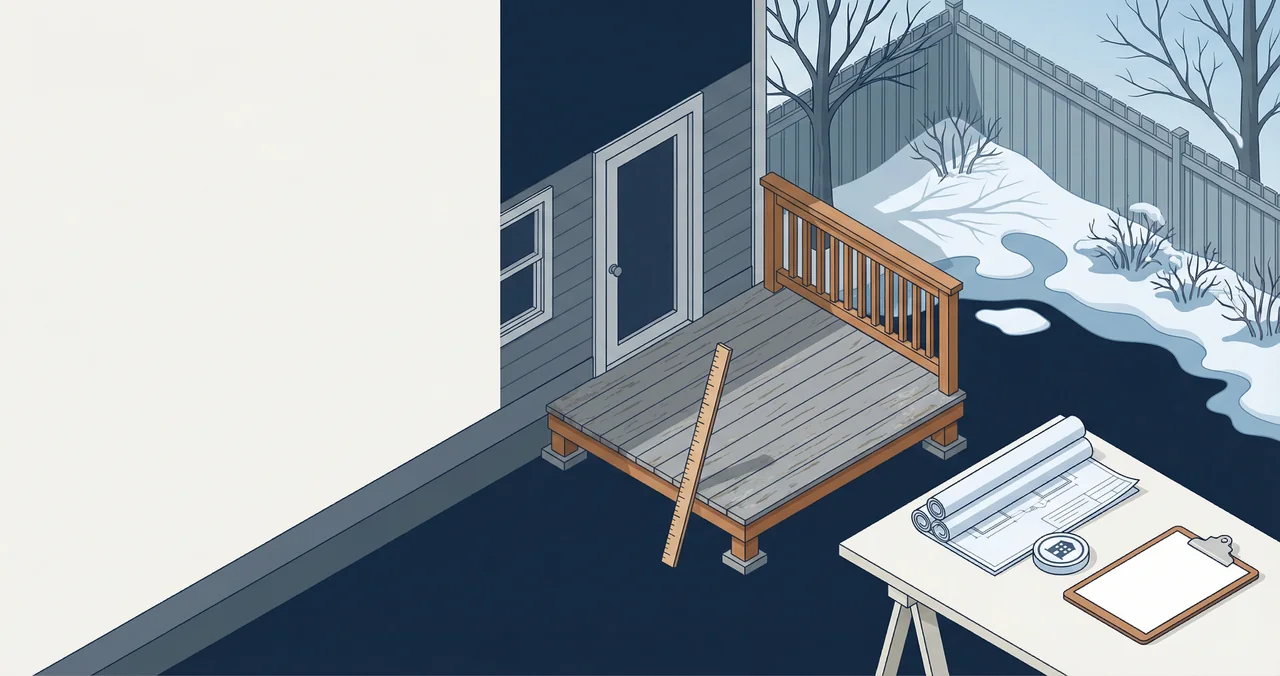
If you are planning a deck in the City of Waterloo, the permit question comes up early — and the answer is usually "yes, unless your deck is very low and very simple." This guide explains how Waterloo's building department handles deck permits, what triggers review, and how to submit a clean application.
For the neighbouring cities, see:
Waterloo building department: where to go
The City of Waterloo's building division handles residential deck permits.
🏗️ Planning a deck project?
Get a free manual project review, or visualize your dream deck with AI before requesting quotes.
- In-person: Waterloo City Centre, 100 Regina Street South, Waterloo
- Online portal: Applications can be submitted through the City of Waterloo's online building permit portal (search "Waterloo building permit" on the city website)
- Phone: 519-886-1550 (building division)
- Pre-consultation: Waterloo offers pre-application consultations — worth using if your deck is close to a property line, involves a walkout basement, or includes a roof/pergola
A quick call or email before you design anything is the fastest way to avoid delays.
When does Waterloo require a deck permit?
Like most Ontario municipalities, Waterloo follows the Ontario Building Code (OBC). In practice, the triggers are:
Height above grade
- If the deck surface is more than 24 inches (600 mm) above finished grade at any point, a permit is typically required
- Measured from the ground to the top of the decking surface, not to the railing
- If your yard slopes, the highest point is what matters — a deck that is 18 inches up on one side may be 30 inches on the other
Attachment to the house
- Any deck connected to the house via a ledger board usually requires a permit, even below 24 inches
- A ledger connection involves waterproofing, flashing, and load transfer into the house framing. Done wrong, it causes water damage and structural failure. See our ledger board guide.
Other triggers
- Covered structures: A roof, pergola, or solid shade structure typically triggers a separate permit. See our pergola permit guide.
- Hot tub loads: Significant concentrated load — usually needs structural review
- Privacy screens: Tall or structurally attached screens can trigger review. See our privacy screen guide.
- Stairs and landings: Stair geometry and handrails become part of the permit scope
When you probably do NOT need a permit
- A ground-level platform (24 inches or less above grade at all points) that is not attached to the house and does not support a roof or heavy load
- Zoning setback requirements still apply even without a building permit
Waterloo permit fees and processing time
For a typical residential deck:
- Permit fee: Generally $150-$400, depending on scope and declared construction value
- Plan review time: Approximately 2-4 weeks for a complete application
- Incomplete applications: Each round of revisions adds 1-3 weeks
Fees can change, so confirm with the building division before budgeting. For a deeper look at costs beyond the permit fee (drawings, engineering, surveys), see our deck permit cost breakdown and our Ontario deck pricing breakdown for the full project picture.
The biggest cause of delay is incomplete submissions. A package that answers every question on the first round can save 2-3 weeks compared to one that bounces back.
What drawings and documents does Waterloo require?
1. Site plan
- Property boundaries, house footprint, and proposed deck location
- Setback dimensions from the deck to all property lines
- A recent survey works best; otherwise, a clean measured sketch with accurate dimensions
2. Plan view (top-down deck layout)
- Overall deck dimensions
- Joist layout with direction and spacing (typically 16" on centre)
- Beam locations and sizes
- Post and footing locations
- Location of stairs, railings, and any screen or pergola attachments
3. Cross-section / elevation drawing
- Height above grade at the highest point
- Guard/railing height (36 inches minimum for decks under 1.8 m above grade; 42 inches for higher)
- Stair details: rise, run, and handrail height
- Footing depth below grade (minimum 4 feet / 1.2 metres to get below frost line)
4. Structural details
- Footing size (diameter and depth)
- Post-to-beam connection method
- Ledger attachment details if attached — flashing, fastener type, and spacing
- Joist span tables or engineering reference for lumber sizing
For a detailed drawing checklist, see our deck permit drawings guide.
Zoning setbacks in Waterloo
Even without a building permit, the deck must comply with zoning bylaws. Setback rules determine how close you can build to property lines.
- Rear yard: Often 7.5 metres for the principal structure, but uncovered decks may project into this setback (commonly 1.5-2 metres). Check your specific zone.
- Side yard: Interior side yards often require 1.2 metres minimum, varying by zone and lot type
- Corner lots: The exterior side yard (street-facing) usually has a larger setback, often 4.5 metres or more
- Elevated decks: Some zones treat raised decks differently than ground-level platforms for setback purposes
Setback rules vary by zoning designation. A lot in Uptown Waterloo may have different rules than one near Laurelwood. Always confirm your specific zoning before you design.
For more detail, see our KWC setback rules guide.
Common Waterloo deck permit mistakes
1. Missing or vague site plan. No property lines or setback dimensions shown. The reviewer cannot confirm zoning compliance without this.
2. No footing depth shown. Waterloo's frost depth is 1.2 metres (4 feet). Drawings without footings below this will get a correction request.
3. Ledger detail missing. If attached, flashing and fastener details are non-negotiable. "Attach to house" is not a detail.
4. Guard/railing height wrong. Mixing up the 36-inch and 42-inch thresholds based on deck height is common.
5. Changing scope after submission. Adding stairs, a screen, or a hot tub after the permit is issued usually requires a revision. Plan for everything upfront.
6. Ignoring lot grading. Waterloo pays attention to drainage. If the deck changes how water flows on your lot, you may need to address grading.
The inspection process in Waterloo
Once your permit is approved and construction starts, expect three inspections:
You may also want to read How Close to the Property Line Can You Build a Deck in Ontario?.
Make sure to also review Deck Electrical Permit in Ontario: Outlets and Lighting for local requirements.
You may also want to read What Is the Cheapest Deck to Build in Ontario?.
Footing inspection
- Called before pouring concrete or backfilling around piles
- Inspector checks diameter, depth (below frost line), and location vs. approved drawings
- Do not pour or cover footings before this inspection
Framing inspection
- Called after substructure is complete but before decking boards go on
- Inspector checks joist size/spacing, beam connections, ledger attachment, and guard post mounting
- This is where most issues are caught — especially ledger flashing and joist hanger installation
Final inspection
- Called when the deck is fully complete (decking, guards, stairs, handrails)
- Inspector checks guard height, baluster spacing, stair rise/run consistency, and compliance with approved plans
Practical inspection tips
- Book early during peak season (May-August) — wait times can stretch to a week or more
- Have approved drawings on site for the inspector to compare against
- Do not skip the framing inspection — if you deck over the framing first, boards may need to come off
- Keep the permit posted visibly at the job site during construction
Quick decision checklist
You likely need a Waterloo deck permit if any of these apply:
- [ ] Deck surface is more than 24 inches above grade at any point
- [ ] Deck is attached to the house via a ledger board
- [ ] Deck includes a roof, pergola, or covered structure
- [ ] Deck will support a hot tub or other concentrated load
- [ ] Deck includes stairs from a raised surface to grade
If none apply, you may not need a permit — but confirm with the City of Waterloo building division before you start.
---
🎨 Not sure which material to pick?
Upload a photo of your backyard and see exactly how Trex, TimberTech, or cedar would look — free and instant.
Want a fast deck quote in Kitchener-Waterloo?
If you're planning a deck and want a ballpark price + a builder-ready scope quickly, submit your details here:
- Get a deck quote: Get a deck quote
The more info you include (approx size, height, material preference, stairs/rail, photos), the more accurate the estimate.
Upload a backyard photo and preview real decking materials with AI — free, instant, no sign-up.
Permits, costs, material comparisons, and questions to ask before requesting quotes — delivered to your inbox.