
Deck Permits in Kitchener: The 24-Inch Rule Explained
Do you need a permit for a deck in Kitchener? Here's what the 24-inch (600mm) rule really means, what drawings you'll need, fees, timelines, and common mistakes.
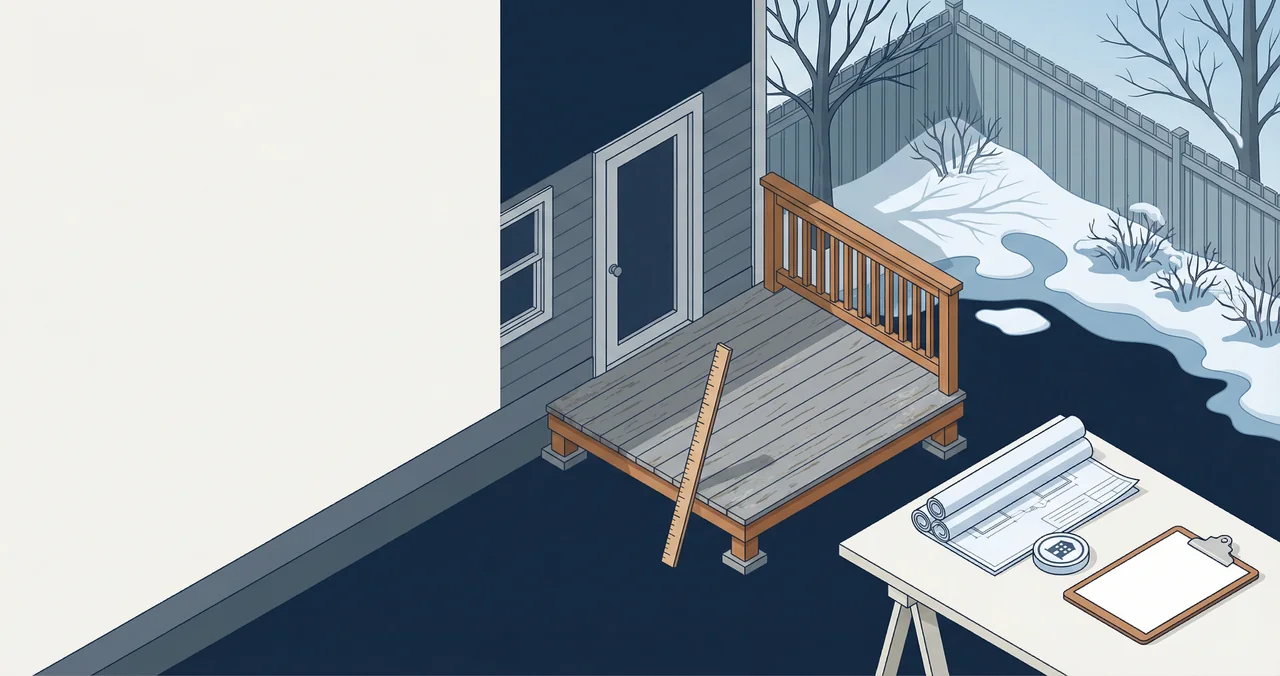
If you're planning a new deck in Kitchener, Ontario, the first question is usually: Do I need a permit? The short answer is: *sometimes* — and the threshold most homeowners and builders talk about is the 24-inch rule.
This guide breaks down what the "24-inch rule" actually means in practice, how the City of Kitchener handles deck permits, what fees and timelines to expect, and how to avoid the most common issues that delay builds.
Related guides (to avoid permit delays)
- KWC permit fees + hidden costs: deck permit cost guide
- Drawings checklist (what you actually need to submit): permit drawings checklist
- Property line and setback rules: setback rules guide
- Get quotes from local builders (permit-aware): /decks
🏗️ Planning a deck project?
Get a free manual project review, or visualize your dream deck with AI before requesting quotes.
What is the "24-inch rule" for deck permits?
In Kitchener (and broadly across Ontario building departments), the rule of thumb is:
- If your deck surface is more than 24 inches (600 mm) above grade, you'll typically need a building permit.
Why 24 inches? Because once you're above that height, guard/railing safety requirements and structural risk become much more significant. The Ontario Building Code treats anything above 600 mm as a surface where a fall could cause injury, which triggers guards, structural review, and inspections.
How the 24 inches is measured
The measurement is from the highest point of finished grade directly under the deck to the top of the finished walking surface (top of decking boards) — not the top of the railing or bottom of joists.
- "Finished grade" means the final ground level after landscaping, grading, and any fill — not raw excavated soil. If you plan to add topsoil or a gravel pad under the deck, the measurement starts from that finished surface.
- The "highest point" matters. If your yard slopes, the measurement is taken where the ground is closest to the deck surface. A deck might be 30 inches off grade at the back yard but only 20 inches near the house — the 30-inch point is what counts, and the entire deck is treated as elevated.
- Building departments measure conservatively. If you're close to the 24-inch line, expect the inspector to treat it as over. There is no benefit to designing right at the boundary.
When you may need a permit even under 24 inches
The height rule is the headline, but it's not the only trigger. You may still need a permit if your deck is:
- Attached to the house (ledger connection and waterproofing affect the building envelope)
- Supporting a roof or covered structure
- Supporting a hot tub or unusually heavy loads (see our hot tub structural checklist)
- Part of a bigger project (altering exits, stairs, landings, or the home's exterior)
If you're close to 24 inches, treat it as "permit likely."
When freestanding decks under 24 inches still need attention
A ground-level, freestanding deck under 24 inches is often permit-exempt for building code purposes. But that does not mean anything goes:
- Zoning setbacks. Even a permit-exempt deck must respect property line setbacks. See our setback rules guide.
- Lot coverage. Kitchener's zoning bylaw limits how much of your lot can be covered by structures. A large low deck adds to lot coverage, and exceeding the maximum can trigger a minor variance application.
- Drainage. A deck close to grade can trap moisture against the foundation. Proper gravel drainage and slope away from the house matter even without a permit.
- Utility access. If the deck covers a basement window well, cleanout, or gas meter, you may need removable panels or maintained clearance.
For more, see our low deck vs elevated deck guide.
Kitchener building department: contact info and online portal
The City of Kitchener handles building permits through its Building Division (Development Services).
- Phone: 519-741-2426
- Email: building@kitchener.ca
- In person: Kitchener City Hall, 200 King Street West, 6th Floor
- Online portal: Submit applications, upload drawings, and track status at kitchener.ca/building
The online portal is the fastest route. If you're a first-time applicant, a 10-minute call before you submit is worth the time.
For neighbouring municipalities, see our guides for Waterloo and Cambridge.
Permit fees in Kitchener
Deck permit fees in Kitchener are based on the estimated construction value of the project:
- Small, simple decks (low, no stairs, basic railing): $150–$250
- Mid-size decks (elevated, stairs, standard railing): $250–$350
- Larger or complex projects (multi-level, hot tub support, extensive stairs): $350–$400+
The fee is calculated from the declared project value and paid at submission (non-refundable). Keep in mind the permit fee is only part of the total cost — drawing preparation, engineering, and potential survey costs add more. For a full breakdown, see our permit cost guide.
Plan review timeline: what to expect
- Complete application: 2–4 weeks for plan review and permit issuance
- Incomplete application: Add 2–6 additional weeks while deficiency letters go back and forth
The most common cause of delays is missing information, not a slow building department. If the plans examiner sends a deficiency letter for a missing beam size or setback dimension, the review clock restarts.
Seasonal timing matters. Spring (March–May) is peak permit season. Submit in January or February for a summer build. By April, review timelines stretch toward the longer end. See our permit timeline guide for more.
Required drawings: what the city wants to see
Expect to prepare four drawing components. The more detail you provide, the faster the review.
1. Site plan
Shows where the deck sits on the property:
- Property lines with dimensions
- House footprint with proposed deck location
- Setback dimensions to all property lines (front, rear, sides)
- Easements — show any utility or drainage easements and confirm the deck doesn't encroach
- Lot coverage calculations if the deck is large relative to the lot
- North arrow and street name
If you don't have a recent survey, lot dimensions can be found on your tax assessment or the Region of Waterloo's GIS mapping tool.
2. Plan view (framing plan)
Top-down view of the deck structure:
- Overall deck dimensions
- Joist sizes and spacing (e.g., 2x10 at 16" o.c.)
- Beam locations, sizes, and spans (e.g., triple 2x10, 8' span between posts)
- Post and footing locations with sizes
- Ledger board location (if attached)
- Stair location and width
For joist span references, see our joist span table guide.
3. Section / elevation drawings
Side view cut through the structure:
- Deck height above grade (the 24-inch measurement)
- Footing depth below grade (minimum 4 feet / 1.2 m in KWC for frost line)
- Footing diameter (typically 10"–12" sonotubes, or helical pile specs)
- Guard/railing height (36" min under 1.8 m drop, 42" min over 1.8 m)
- Stair profile with rise, run, and handrail height
- Post-to-beam and post-to-footing connections
See our footing depth guide for frost line details.
4. Structural connection details
This section gets the most scrutiny.
- Ledger board attachment is the number one item inspectors focus on. Show fastener type (lag bolts or through-bolts), spacing, flashing, and how the ledger connects to the rim joist or foundation. A vague ledger detail is the top reason for deficiency letters. See our ledger board attachment guide.
- Post-to-beam connections (notched post vs. post cap hardware)
- Beam-to-post and post-to-footing hardware (Simpson Strong-Tie or equivalent)
- Guard post attachment to the rim joist (bolted, not just screwed)
For a full submission checklist, see our permit drawings checklist.
The inspection process: what happens after approval
You (or your contractor) must book each inspection before moving to the next construction phase.
Footing inspection
- When: After holes are dug but before concrete is poured
- What they check: Hole depth (below the 4-foot frost line), diameter, soil conditions, and that locations match approved drawings
- Common fail: Holes too shallow, standing water, or footings shifted from the approved layout
For helical piles, the process differs slightly — see our footing options guide.
Framing inspection
- When: After framing is complete but before decking hides the connections
- What they check: Joist sizes/spacing, beam spans, post connections, ledger attachment and flashing, hardware, and blocking
- Common fail: Missing joist hangers, inadequate ledger fastening, no flashing behind the ledger
This is where ledger details get the most scrutiny. See our framing inspection guide.
You may also want to read Deck Boards in Kitchener: Where to Buy and What to Choose.
Final inspection
- When: After the deck is complete — decking, guards, and stairs all finished
- What they check: Guard height and baluster spacing (4" sphere rule), stair rise/run consistency, handrail graspability, and overall compliance
- Common fail: Guard openings too wide, inconsistent risers, or railings too short
After passing final inspection, the permit is closed and the deck is legally compliant. This record becomes part of the property's building history.
Zoning setbacks in Kitchener
Zoning is separate from the building permit but checked as part of the application. In Kitchener's most common residential zones:
- Rear yard projection: Decks can project into the rear yard setback, but typically only 2.0–3.0 metres from the rear wall of the house, depending on zone and total rear yard depth.
- Side yard minimums: Interior side yards are typically 1.2 metres minimum. The deck (including stairs) cannot encroach.
- Corner lot exterior side yard: Exterior side yard setbacks are larger — often 4.5 metres — and the deck must respect that line.
- Front yard: Decks are generally not permitted in the front yard setback.
These vary by zone. Confirm your property's zoning through Kitchener's zoning bylaw or by calling planning. For a walkthrough, see our zoning setbacks guide.
What happens if you build without a permit
Building without a required permit creates problems from day one through to resale.
- Stop work orders if the building department finds out (often through a neighbour complaint).
- Fines under the Ontario Building Code Act can reach several thousand dollars.
- Retroactive permits are possible but harder. The city may require exposing framing and footings for inspection. If work doesn't meet code, you remediate at your cost — worst case, partial or full teardown.
- At home sale, lawyers and inspectors check for missing permits. An unpermitted deck can delay a sale, and title insurance may not cover it.
A permit costs a few hundred dollars and a few weeks. Skipping it can cost thousands.
Guardrails and stairs: why height matters
Once above 24 inches, Ontario Building Code guard rules apply:
- Guard height: 36" minimum (under 1.8 m drop), 42" minimum (over 1.8 m)
- Baluster spacing: No opening that allows a 4" sphere to pass through
- Lateral load: Guard posts must resist 200 lbs of lateral force — this drives post attachment method
- Stairs: More than 2 risers (or 600 mm total rise) triggers guards and a graspable handrail
Even *just* over 24 inches, build as if the inspector will enforce everything — because they will. See our railing height code guide and stair code guide.
Common mistakes that cause permit delays
1. Vague measurements — no reference to grade level or finished surface height
2. Missing beam/joist sizes or spacing not specified
3. No footing detail — missing depth, diameter, or reinforcement
4. Ignoring setbacks — especially on narrower or corner lots
5. Ledger attachment details missing — the single most common deficiency item
6. No flashing detail — ledger flashing and waterproofing must be shown
7. Guard details incomplete — post attachment, height, and baluster spacing all required
8. Stair geometry not calculated — rise/run and handrail details need to be shown
Make the inspector's job easy. A complete drawing set submitted in January or February is the best way to have a permit in hand before spring.
Related guides (what to do next)
- Permit application walkthrough (Kitchener): step-by-step permit guide
- If you’re pricing the whole build: Ontario deck cost calculator
- If you need a contractor quote package: deck quote checklist
Quick checklist: do I likely need a permit?
You're likely in permit territory if any of these are true:
- Deck surface > 600 mm (24 in) above finished grade at the highest point
- Deck is attached to the house via a ledger board
- You're building stairs from a raised surface
- You're adding a roof, pergola, or covered structure
- The deck supports a hot tub or concentrated loads
If unsure, contact Kitchener Building Division at 519-741-2426 or building@kitchener.ca before buying materials.
🎨 Not sure which material to pick?
Upload a photo of your backyard and see exactly how Trex, TimberTech, or cedar would look — free and instant.
Next step
- If you're in Kitchener and want a fast sanity-check: measure grade-to-deck-surface at the highest point and note whether the deck is attached to the house.
- If you're shopping quotes: ask contractors for the permit plan set they'll submit — it's a good proxy for professionalism.
Want help planning the deck layout before you commit? Start with our Decks hub: /decks
Upload a backyard photo and preview real decking materials with AI — free, instant, no sign-up.
Permits, costs, material comparisons, and questions to ask before requesting quotes — delivered to your inbox.