
Deck Boards in Kitchener: Where to Buy and What to Choose
Find deck boards in Kitchener. Compare pressure-treated, cedar, and composite options. Local suppliers, pricing, and what to buy for Ontario winters.
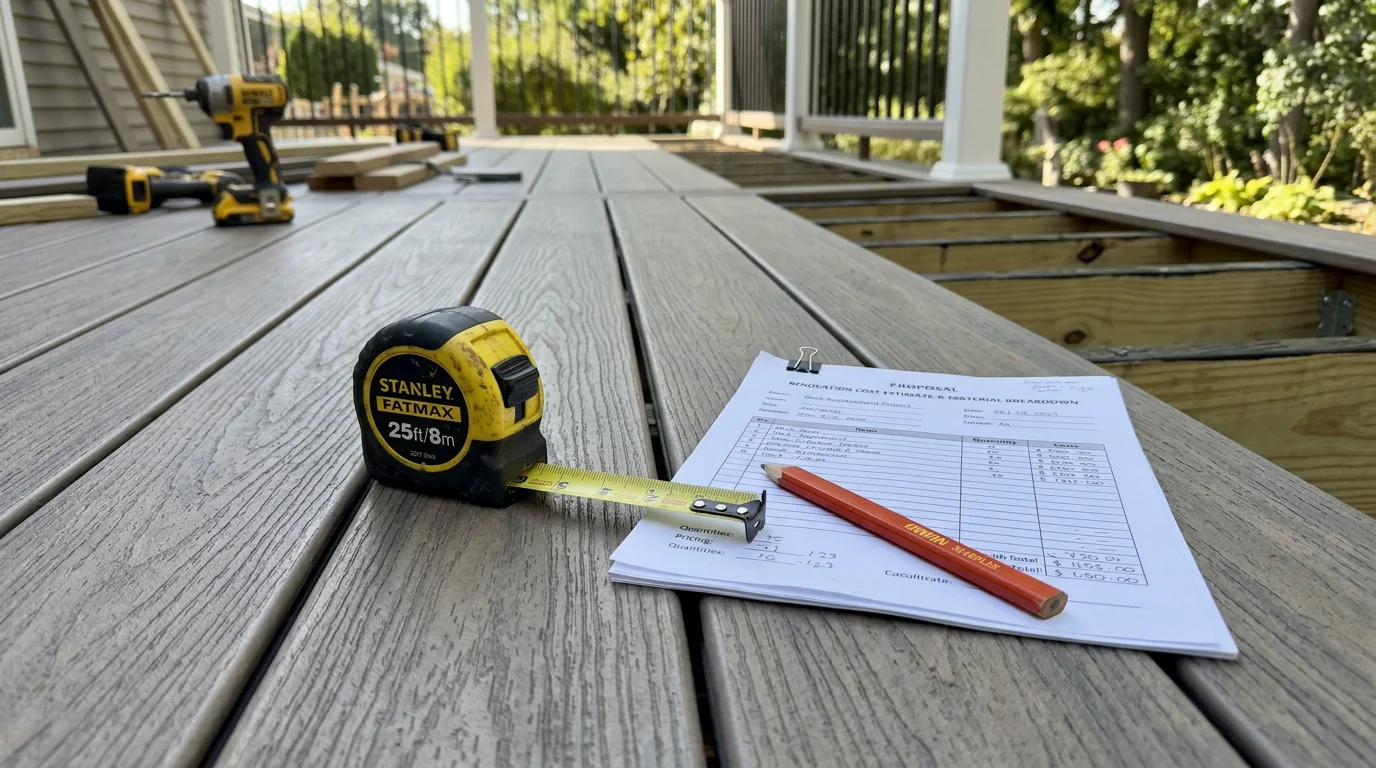
Shopping for deck boards in Kitchener means choosing between three main categories: pressure-treated lumber, natural wood (usually cedar), and composite materials. Each performs differently in Ontario's freeze-thaw cycles, costs a different amount upfront and over time, and is available from different local suppliers.
This guide covers where to buy deck boards locally, what each material actually costs in 2026, and how to choose based on your budget, maintenance tolerance, and how long you plan to stay in your home.
Where to Buy Deck Boards in Kitchener
Big-Box Retailers
Home Depot (multiple Kitchener-Waterloo locations) carries pressure-treated pine, cedar, and the full Trex composite line. You'll find standard 12-foot and 16-foot lengths for pressure-treated and cedar. Trex boards come in 12, 16, and 20-foot lengths. Expect to pay $8-12 per linear foot for Trex Enhance or Select, $3-5 per linear foot for pressure-treated, and $6-9 per linear foot for cedar.
🏗️ Planning a deck project?
Get a free manual project review, or visualize your dream deck with AI before requesting quotes.
Home Depot stocks boards year-round, but selection narrows in winter. Spring (April-May) sees the widest inventory and occasional promotions on composite materials.
Lowe's (Ottawa Street South, Kitchener) has similar pricing and carries TimberTech composite alongside pressure-treated and cedar. Their composite selection is smaller than Home Depot's, but they often have competitive pricing on pressure-treated 5/4x6 deck boards.
Local Lumber Yards
Turkstra Lumber (Cambridge location serves Kitchener) specializes in treated lumber and natural wood. They stock higher-grade cedar (fewer knots, tighter grain) than big-box stores, which matters if you're staining or leaving wood natural. Pricing runs $7-11 per linear foot for premium cedar deck boards.
They'll also deliver bulk orders (100+ linear feet) for $75-150 depending on distance and load size. Helpful if you're DIYing a larger deck and don't want to make multiple truck rentals.
Lansink Building Supplies (Elmira, 20 minutes from Kitchener) carries pressure-treated, cedar, and limited composite inventory. Their pressure-treated prices are competitive, and they cut custom lengths on-site, which reduces waste if your deck dimensions don't align with standard board lengths.
Specialty Deck Suppliers
Deck Depot (Waterloo) focuses entirely on decking and railing materials. They carry Trex, TimberTech, Fiberon, and Deckorators composite lines, plus aluminum and glass railing systems. If you want to see different composite colours and textures side-by-side, this is your best option in the region.
Pricing is comparable to Home Depot on major brands, but they stock more colour options and can special-order less common profiles (grooved boards for hidden fasteners, fascia boards, specialty trim).
Staff here actually build decks or have deck-building backgrounds, so you'll get better technical advice than at big-box stores. They can calculate joist spacing requirements, recommend appropriate screw types, and flag potential code issues based on your deck design.
Imperial Building Supplies (Kitchener) carries composite and PVC decking alongside traditional lumber. They're smaller than Deck Depot but stock Azek PVC decking, which handles heat and snow better than standard composite. Azek runs $10-14 per linear foot, significantly more than wood-plastic composite, but it doesn't absorb water or fade as quickly.
Buying Direct from Contractors
Some deck builders in Kitchener buy materials at contractor pricing and pass along a markup (10-20%) if you're using them for installation. This isn't cheaper than retail, but it saves you the logistics of ordering, transporting, and storing materials before your build date.
If your builder offers material supply, compare their quoted board prices against Home Depot or Turkstra to verify the markup is reasonable. $4 per linear foot for pressure-treated or $10 per linear foot for mid-range Trex are fair 2026 prices with a modest contractor markup included.
Pressure-Treated Deck Boards
What You're Actually Buying
Pressure-treated boards are softwood (usually pine or spruce) infused with preservatives that resist rot and insects. In Canada, modern treated lumber uses alkaline copper quaternary (ACQ) or copper azole (CA-B) as preservatives, not the older arsenic-based formulas banned in the early 2000s.
Standard deck boards are 5/4x6 (actual dimensions: 1 inch thick, 5.5 inches wide). They're sold in 8, 10, 12, and 16-foot lengths.
Pricing Breakdown (2026 Kitchener)
- 5/4x6 pressure-treated, 12-foot length: $15-22 each ($1.25-1.85 per linear foot)
- 5/4x6 pressure-treated, 16-foot length: $20-28 each ($1.25-1.75 per linear foot)
- 2x6 pressure-treated (thicker, used for structural framing but sometimes used as decking): $18-26 for 12 feet
Longer boards cost slightly less per foot but are harder to transport and create more waste if your deck width doesn't align with 12 or 16-foot lengths.
Budget 15-20% extra for culling warped or damaged boards. You'll almost always find a few twisted or cupped boards in any bundle.
Performance in Ontario Climate
Pressure-treated wood performs well in freeze-thaw cycles if maintained. Water absorption is the issue. Treated boards soak up moisture, freeze, expand, thaw, and contract. Over 3-5 years, this creates surface cracks, splinters, and cupping (edges curling up higher than the center).
Staining or sealing every 2-3 years slows this down. Unsealed treated decks last 10-15 years before boards need replacement. Sealed and maintained treated decks can hit 20+ years.
Treated wood doesn't handle constant shade well. North-facing decks or those under tree cover stay damp longer, which accelerates rot even with preservative treatment. If your deck gets less than 4 hours of direct sun daily, composite is a safer long-term choice.
Installation Notes
Treated lumber requires corrosion-resistant fasteners. ACQ and CA-B preservatives corrode standard steel screws. Use hot-dipped galvanized, stainless steel, or coated deck screws rated for ACQ contact. Budget $40-70 per 1,000 screws for quality fasteners.
Boards are wet when purchased (high moisture content from the treatment process). Let them dry for 2-4 weeks before installation if possible. Wet boards shrink as they dry, creating gaps between boards that are wider than planned. Experienced builders account for this by spacing wet boards tight (1/16 inch apart) so they gap properly (1/8 to 3/16 inch) after drying.
For more on proper gapping, see deck board spacing in Ontario.
Cedar Deck Boards
What You're Buying
Western red cedar is naturally rot-resistant due to oils in the wood. It's softer and lighter than pressure-treated pine, which makes it easier to cut and fasten, but also more prone to denting from furniture or dropped tools.
Cedar is sold in clear, select, and common grades. Clear has no knots and uniform colour. Select has small tight knots. Common (sometimes called "deck grade") has larger knots and colour variation. Clear cedar costs 2-3x more than common grade.
Pricing Breakdown (2026 Kitchener)
- Common-grade cedar 5/4x6, 12 feet: $35-50 each ($2.90-4.15 per linear foot)
- Select-grade cedar 5/4x6, 12 feet: $50-70 each ($4.15-5.85 per linear foot)
- Clear-grade cedar 5/4x6, 12 feet: $80-110 each ($6.65-9.15 per linear foot)
Cedar prices fluctuate more than treated lumber based on supply from BC mills. Expect higher prices in winter and early spring.
Performance in Ontario Climate
Cedar handles freeze-thaw well but weathers quickly. Unfinished cedar turns silver-grey within 6-12 months. This doesn't harm the wood structurally, but it's a visual change some homeowners dislike.
Staining or sealing preserves the natural reddish-brown colour. Cedar needs re-sealing every 1-2 years to maintain colour and prevent surface cracking. That's more frequent than pressure-treated wood.
Knots in common-grade cedar can shrink and fall out over time, leaving holes. This is cosmetic, not structural, but it accelerates on decks with full sun exposure.
Cedar is lighter and less dense than treated pine, so it's more prone to surface wear. High-traffic areas (near doors, stairs) show scuffing and denting faster than composite or treated wood.
When Cedar Makes Sense
Cedar is the best choice if you want natural wood aesthetics and are committed to annual maintenance. It's also the lightest common deck board, which matters if you're building on a roof deck or another structure with weight limits.
For a 200-square-foot deck, material cost for common-grade cedar runs $1,200-1,700 vs. $500-750 for pressure-treated. Add $200-400 annually for stain and sealer if you DIY the maintenance.
Composite Deck Boards
Composite boards are wood fiber mixed with plastic (polyethylene or polypropylene) and extruded into planks. They don't rot, splinter, or require staining. They cost more upfront but need virtually no maintenance beyond occasional washing.
Major Brands Available in Kitchener
Trex is the most common composite at local retailers. Their product lines (Enhance, Select, Transcend) differ in warranty length, colour fade resistance, and scratch resistance. Enhance is the entry-level line; Transcend is the premium option with the best fade and stain warranty.
TimberTech (owned by Azek) is Trex's main competitor. Similar tiered product lines. Their Advanced PVC line (AZEK brand) is capped with pure PVC instead of composite, which makes it more stain-resistant and cooler underfoot in direct sun.
Fiberon and Deckorators are mid-tier brands with pricing between Trex Enhance and Trex Transcend. Both are available at specialty suppliers like Deck Depot.
For detailed comparisons of composite brands available in Canada, see best composite decking in Canada.
Pricing Breakdown (2026 Kitchener)
- Trex Enhance (basic composite), 12 feet: $40-55 each ($3.35-4.60 per linear foot)
- Trex Select (mid-tier), 12 feet: $50-65 each ($4.15-5.40 per linear foot)
- Trex Transcend (premium), 12 feet: $65-85 each ($5.40-7.10 per linear foot)
- TimberTech Advanced PVC, 12 feet: $75-95 each ($6.25-7.90 per linear foot)
Grooved boards (for hidden fastener systems) cost the same as square-edge boards, but hidden fasteners add $1.50-2.50 per linear foot in hardware costs.
For a 200-square-foot deck, composite material cost runs $1,350-2,850 depending on brand and tier.
Performance in Ontario Climate
Composite handles freeze-thaw better than wood. It doesn't absorb significant moisture, so it won't crack, warp, or splinter from ice expansion. Snow and ice can sit on composite all winter without damage.
Early-generation composite (pre-2010) had major issues with mold, fading, and ice damage. Modern composite from major brands performs significantly better. Trex, TimberTech, and Fiberon all carry 25-year warranties against structural defects, fading, and staining on their mid- and upper-tier products.
Composite gets hotter than wood in direct sun. Dark colours (walnut, mahogany, dark grey) can reach 60-70°C (140-160°F) on sunny July afternoons. Bare feet aren't comfortable. Lighter colours (grey, tan, sandy brown) stay 5-10°C cooler. PVC-capped boards (AZEK, TimberTech Advanced) stay cooler than standard composite.
Composite is slippery when wet or icy. Textured finishes help, but you'll still want to salt or sand stairs and high-traffic areas in winter. For winter care details, see winter deck maintenance in Ontario.
Installation Notes
Composite expands and contracts more than wood with temperature swings. Manufacturers specify end-to-end gapping (usually 1/4 inch) and side-to-side gapping (usually 3/16 inch). Ignore these specs and boards will buckle in summer heat.
Use only fasteners approved by the composite manufacturer. Most brands require stainless steel or coated composite screws. Standard deck screws void warranties.
Composite boards can't be installed directly over joists spaced wider than 16 inches on center for most residential products. Some premium lines allow 20-inch joist spacing. Check manufacturer specs before framing. For joist span requirements, see deck joist span table for Ontario.
When Composite Makes Sense
Composite is the best choice if you want zero annual maintenance and plan to stay in your home long enough to recover the higher upfront cost. Break-even vs. pressure-treated (including labour for staining/sealing wood) is usually 7-10 years.
Composite is also better if your deck is shaded, near trees, or in a damp area. It won't rot or mold in low-light, high-moisture conditions that destroy treated wood.
For installed cost comparisons, see composite deck cost in Waterloo, Ontario.
How to Choose Deck Boards
Budget
If you're keeping costs under $8,000 for a 200-square-foot deck (installed), pressure-treated is your only realistic option. Composite and cedar push installed costs to $10,000-15,000+ for the same size deck.
Maintenance Tolerance
Rate your willingness to stain/seal on a 1-10 scale.
- 1-3 (I'll never do it): Composite only
- 4-6 (I'll do it if it's easy): Pressure-treated with realistic expectations; you'll likely skip years and accept faster deterioration
- 7-10 (I enjoy weekend projects): Cedar or pressure-treated; you'll maintain it properly and get full lifespan
Time Horizon
Selling in 5 years? Pressure-treated makes financial sense. You won't recoup composite's premium in resale value.
Staying 10+ years? Composite pays off in avoided maintenance costs and time. A deck that never needs staining adds legitimate value over a decade of ownership.
Aesthetic Preference
If you want natural wood grain, texture, and warmth underfoot, composite won't satisfy you. Even premium composite with realistic grain patterns still looks and feels like plastic up close.
If you want a clean, uniform appearance with zero splinters and consistent colour, composite wins. Wood always has knots, grain variation, and colour shifts from weathering.
Sun Exposure
Full-sun decks (6+ hours daily) work fine with any material, but composite will get hot in dark colours.
Shaded decks (under 4 hours daily sun) or decks under tree cover perform much better with composite. Treated wood and cedar stay damp, promoting rot and mold in shaded conditions.
Existing Home Style
Composite works with modern, contemporary, and newer builds. It looks out of place on heritage homes or rustic properties unless you choose a wood-tone colour.
Cedar fits traditional, craftsman, and heritage home styles better. Pressure-treated is neutral and works with any architecture if stained to match.
Fasteners, Joist Tape, and Hidden Hardware
Fasteners
Never use standard screws with pressure-treated or composite boards. ACQ preservatives and composite materials corrode untreated steel.
Approved options:
- Hot-dipped galvanized (HDG) screws: Minimum for pressure-treated; adequate for cedar
- Stainless steel screws: Best for coastal areas or high-moisture environments; overkill for most KWC decks
- Coated composite screws (GRK, FastenMaster, Deckmate): Required for composite board warranties
Budget $50-90 per 1,000 screws for quality HDG or coated screws. A 200-square-foot deck needs roughly 600-800 screws for decking (plus more for framing).
Joist Tape
Joist tape is a sticky membrane applied to the top of joists before installing deck boards. It prevents water from sitting on joist surfaces and accelerates joist rot.
It costs $25-40 per 50-foot roll. A 200-square-foot deck needs 3-4 rolls. Some builders consider it essential; others think it's unnecessary if you're using treated lumber for framing.
Ontario's Building Code doesn't require it, but it extends joist life by 5-10 years in decks that see heavy snow or rain. For details, see deck joist tape in Ontario.
Hidden Fasteners
Hidden fastener systems (Camo, Tiger Claw, Cortex, Trex Hideaway) clip into grooved deck boards and eliminate visible screws. They create a cleaner look but add $1.50-2.50 per square foot in material costs and 10-20% more labour time vs. face-screwing.
Hidden fasteners only work with grooved deck boards, which cost the same as square-edge boards but limit your ability to flip or reorient boards during installation (grooves must face down).
Most hidden fastener systems still require face-screwing the first and last board on each end of the deck, so you won't achieve a completely screw-free surface.
Calculating How Much to Buy
Deck board coverage isn't 1:1 with square footage due to board width and spacing gaps.
For 5.5-inch-wide boards spaced 3/16 inch apart, actual coverage is 5.69 inches per board. Divide your deck width by 5.69 to get the number of boards needed for one run.
Example: 16-foot-wide deck ÷ 5.69 inches per board = 33.7 boards (round up to 34 boards per run).
If your deck is 12 feet deep, you need 34 boards at 12 feet each = 408 linear feet of deck boards.
Add 10% for waste (end cuts, damaged boards, mistakes): 408 × 1.10 = 449 linear feet total.
Most suppliers sell by the piece, not linear foot. A 12-foot board is 12 linear feet, so 449 ÷ 12 = 37.4 boards (round up to 38 boards).
For complex deck shapes (angled cuts, stairs, multiple levels), increase waste to 15-20%.
Delivery and Transport
Picking Up Yourself
A 12-foot deck board fits in most full-size pickup trucks with the tailgate down. Rent a truck from Home Depot ($29 for 75 minutes) if you don't own one.
Boards are heavy. A bundle of ten 12-foot pressure-treated boards weighs 120-150 pounds. Get help loading and unloading.
Secure boards properly. Loose boards shift during transport and cause accidents. Use ratchet straps, and flag any boards extending past your tailgate (required by law in Ontario if extending more than 1 meter).
Delivery from Suppliers
Home Depot and Lowe's deliver for $79-129 depending on order size and distance. Delivery includes curbside drop-off only. They won't carry materials to your backyard.
Local lumber yards (Turkstra, Lansink) deliver to your property and often place materials closer to your work area. Delivery fees run $75-150 based on distance and load size.
Specialty suppliers (Deck Depot, Imperial) deliver and will sometimes stack materials where you need them for an additional fee ($50-100).
Schedule delivery close to your start date. Storing deck boards outdoors for weeks before installation exposes them to moisture, warping, and UV damage. If you must store materials, keep them elevated (on 2x4s), covered with a tarp, and weighted down to prevent wind lift.
🎨 Not sure which material to pick?
Upload a photo of your backyard and see exactly how Trex, TimberTech, or cedar would look — free and instant.
Common Questions
Can I mix pressure-treated and composite on the same deck?
Yes, but it looks odd. Some homeowners use pressure-treated for framing and less-visible deck areas (under stairs, side sections) and composite for the main walking surface. This saves money but creates a visual mismatch.
If budget is tight, use all pressure-treated and upgrade to full composite when you replace the deck in 10-15 years.
Do I need a permit to replace deck boards in Kitchener?
Replacing existing deck boards (re-decking) without changing the structure usually doesn't require a permit. Replacing both decking and framing, or expanding the deck footprint, does require a permit.
Kitchener's Building Division clarifies permit requirements by phone (519-741-2345). Cambridge and Waterloo have similar rules. For permit details, see deck permits in Kitchener.
What's the best deck board colour for resale value?
Neutral greys, tans, and medium browns appeal to the widest buyer pool. Avoid bold colours (reds, dark walnut, black) unless they match your home's exterior palette.
Buyers care more about condition than colour. A well-maintained pressure-treated deck adds more value than a neglected composite deck, regardless of colour.
How long do deck boards last in Kitchener's climate?
- Pressure-treated (sealed every 2-3 years): 15-20 years
- Pressure-treated (unsealed): 10-15 years
- Cedar (sealed annually): 20-25 years
- Cedar (unsealed): 15-20 years
- Composite (major brands): 25-30+ years with minimal maintenance
Real-world lifespan depends on sun exposure, drainage, snow load, and maintenance consistency. Shaded decks or decks with poor drainage deteriorate faster.
Should I buy extra boards for future repairs?
Yes, especially for composite. Manufacturers discontinue colours every 5-7 years. If you need to replace a damaged board in 10 years, you won't find an exact match.
Buy 5-10% extra boards and store them in a dry location (garage, shed). This costs an extra $100-300 upfront but saves you from a mismatched deck later.
For pressure-treated or cedar, colour matching is less critical since natural weathering creates variation anyway. Extra boards are still useful for repairs, but exact colour match matters less.
Upload a backyard photo and preview real decking materials with AI — free, instant, no sign-up.
Permits, costs, material comparisons, and questions to ask before requesting quotes — delivered to your inbox.