
Deck Joist Span Table (Ontario): 2x8 vs 2x10 vs 2x12 — How to Think About Spans
Choosing deck framing in Ontario? Learn how joist spans work, what changes the allowable span, and when to get an engineer — explained for homeowners and KWC deck projects.
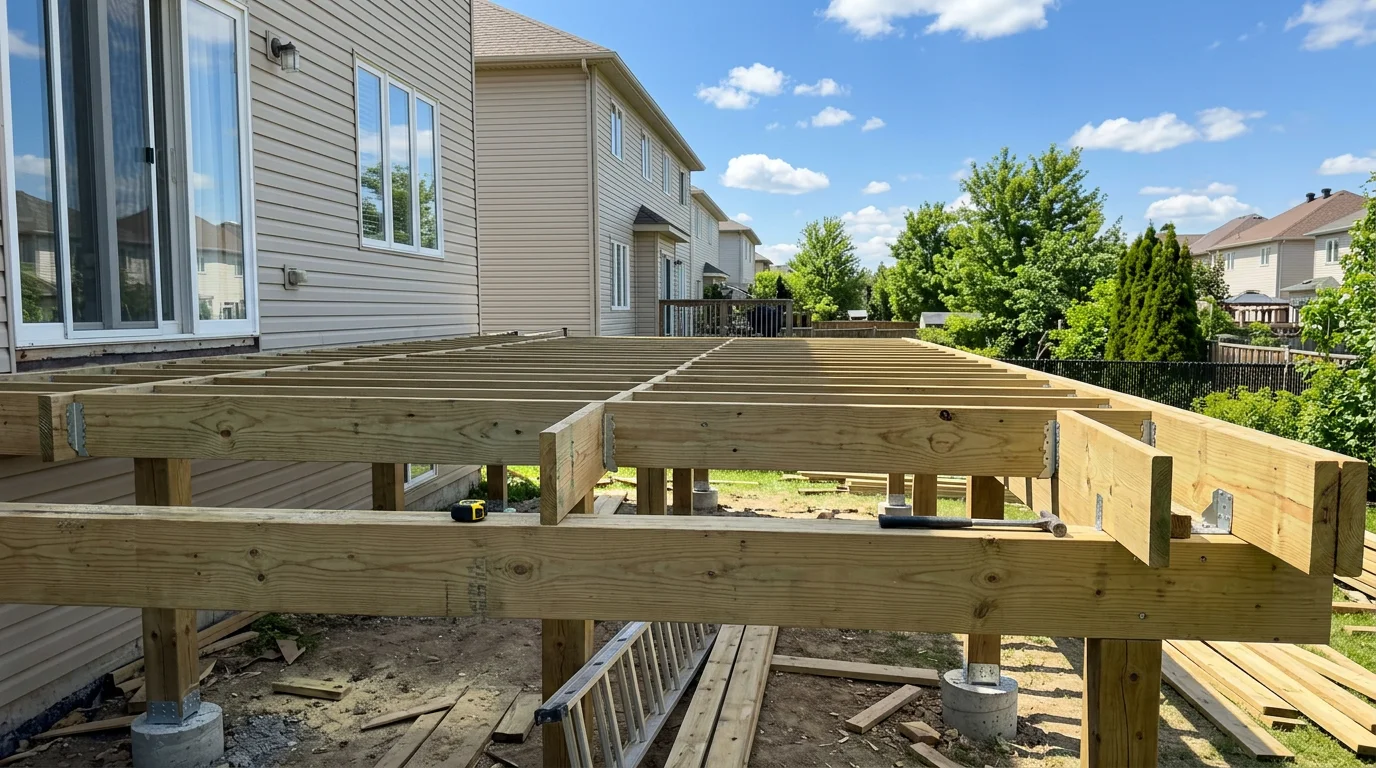
If you’re building a deck in Ontario, one of the biggest hidden quality differences between “cheap” and “solid” decks is the framing.
Homeowners in Kitchener-Waterloo-Cambridge often ask:
- Can I use 2x8 joists?
- Do I need 2x10?
- What about 2x12?
This post isn’t a legal span table (you should confirm with a qualified builder/engineer and your permit drawings), but it will help you understand how spans actually work, what inputs matter, and why “just use 2x10” is sometimes wrong. For the big-picture numbers on how much a deck costs in Ontario, framing choices are a key driver.
The key idea: span is not just board size
A joist’s allowable span depends on:
🏗️ Planning a deck project?
Get a free manual project review, or visualize your dream deck with AI before requesting quotes.
- lumber species/grade
- spacing (12" vs 16" vs 24")
- live load assumptions
- dead load (composite is heavier)
- cantilevers
- condition (wet service)
So instead of memorizing a number, learn how to reason about it.
Why this matters in KWC specifically
In Kitchener, Waterloo, and Cambridge, deck permits (when required) often require:
- a framing plan
- footing strategy
- ledger details
If you’re pulling a permit, start here:
2x8 vs 2x10 vs 2x12: practical differences
2x8 joists
Pros:
- cheaper
- easier handling
- can be perfectly fine for small spans
Cons:
- shorter spans (often forces more beams/posts)
- can feel bouncy if pushed too far
2x10 joists
Pros:
- common “default” for many decks
- good stiffness for moderate spans
Cons:
- more cost
- can still be wrong if spacing or loads increase
2x12 joists
Pros:
- longer spans and higher stiffness
- good for bigger decks or heavy features
Cons:
- more expensive
- heavier
- may be overkill (and still needs correct connections)
The two decisions that change everything
Decision #1: joist spacing
Going from 16" OC to 12" OC can significantly increase stiffness and reduce bounce.
Composite decking often recommends tighter spacing than wood to reduce sag.
If you’re choosing materials, read:
Decision #2: beam placement / number of spans
If your deck has:
- a ledger on the house
- and one beam
…your joists span from the house to the beam.
If you add a second beam (or move a beam closer), you reduce joist span — sometimes allowing 2x8 safely.
This is why “use 2x10” isn’t always the right solution. Sometimes the right solution is a smarter beam layout.
Don’t forget the weak links: connection details
A strong joist can still fail if connections are wrong.
Key connection risk areas:
- ledger attachment (if attached)
- joist hangers and fasteners
- guard post blocking
Ledger detail is critical:
Special cases that require extra attention
1) Hot tubs
Hot tubs are heavy and usually require a specific framing design.
Start here:
2) Elevated decks
Elevated decks increase the consequences of bounce and failure.
Read:
3) Long cantilevers
Cantilevers can be safe if designed correctly, but they are easy to overdo.
If a quote says “we’ll cantilever to avoid posts,” ask for framing details and permit drawings.
A homeowner-friendly framing sanity checklist
When reviewing a quote or framing plan:
- What joist size and spacing is specified?
- What is the joist span (ledger to beam)?
- Is composite decking planned (heavier + often tighter spacing)?
- Are there any concentrated loads (hot tub, outdoor kitchen)?
- Are connections and hardware specified?
If you’re comparing builders, use:
What makes a deck feel “bouncy” (even if it’s technically safe)
Homeowners usually complain about bounce when:
- spans are long
- joist spacing is wide
- beam/joist connections allow rotation
Two decks can both “pass” but one feels premium.
Simple upgrades that often improve feel:
- tighten joist spacing (where compatible with decking)
- add blocking/bridging mid-span
- move a beam to reduce span
Example framing questions to ask a builder
- What is the joist spacing and why?
- Where are the beams located relative to the house?
- Is there mid-span blocking?
- How are guard posts being reinforced?
🎨 Not sure which material to pick?
Upload a photo of your backyard and see exactly how Trex, TimberTech, or cedar would look — free and instant.
FAQ
Is 24" OC joist spacing ever okay?
Sometimes for certain materials and spans, but many composite boards require tighter spacing. Ask for the manufacturer guidance.
Does bigger lumber always mean better?
Not always. Better layout and connections can beat bigger joists used inefficiently.
Decking direction and patterns can change framing needs
If you plan to lay decking on a diagonal, do picture framing, or use complex patterns, you may need:
- extra framing members
- tighter joist spacing
- cleaner alignment
Bring the intended deck board layout into the framing conversation early.
Don’t forget beam sizing
Joists get all the attention, but beams often control post/footing counts and can be the cost driver. If a quote is light on structural detail, ask for the beam spec and layout, not just joist size.
Want a quick framing sanity check for your KWC deck?
If you tell us your approximate deck size, height, and material, we can sanity-check whether the framing approach is reasonable for Kitchener/Waterloo/Cambridge projects.
Submit details here: /#quote-form.
Looking for local pros? Check out Deck Builder Insurance in Ontario: What to Verify.
Upload a backyard photo and preview real decking materials with AI — free, instant, no sign-up.
Permits, costs, material comparisons, and questions to ask before requesting quotes — delivered to your inbox.