
Composite vs Wood Decking in Ontario: Which Is Worth It? (2026 Costs)
Composite costs $65-95/sqft vs wood at $45-65/sqft in Ontario — but composite wins by year 7. Full 10-year cost comparison with maintenance, freeze-thaw durability & real numbers.
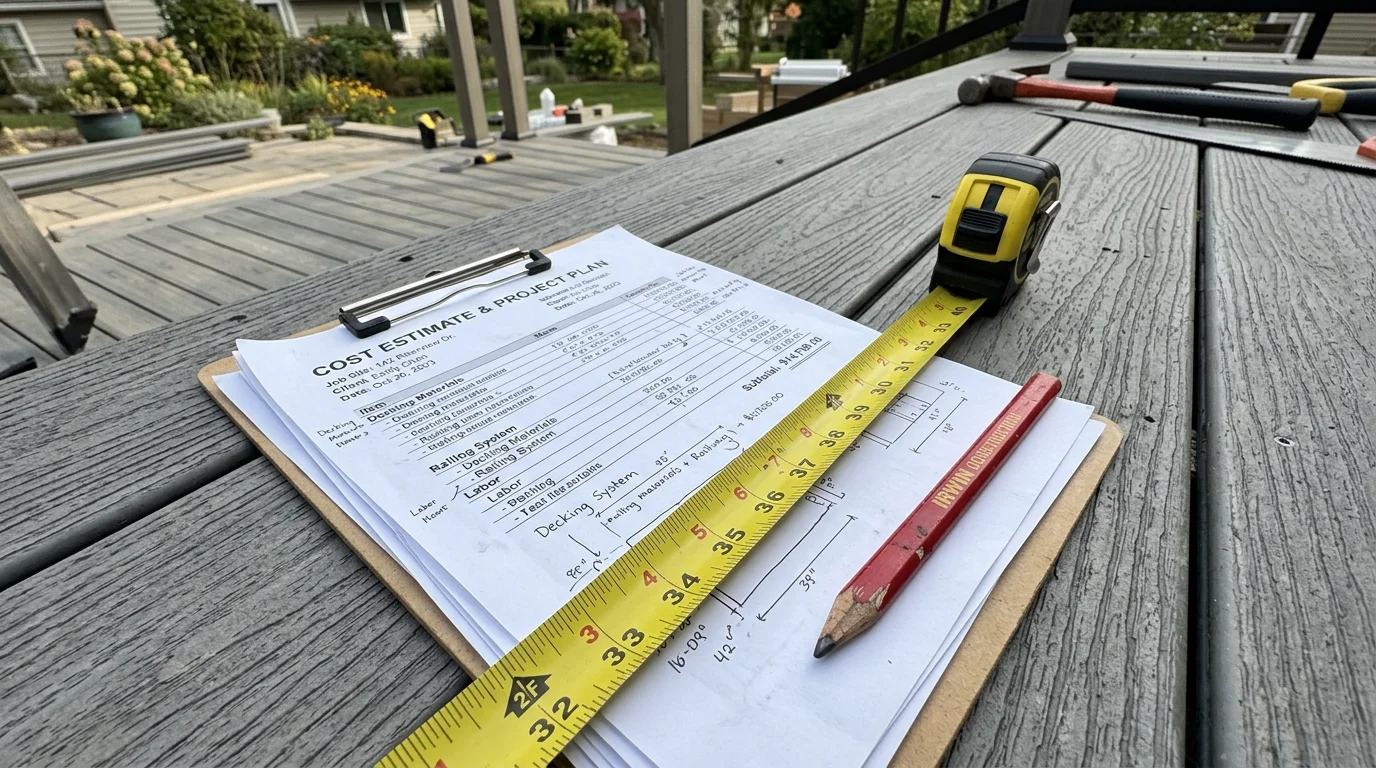
Choosing between composite and wood decking in Ontario isn't just about looks — it's about how the material behaves through freeze/thaw, how much maintenance you'll actually do, and what the deck costs over 10-15 years.
This guide covers the real numbers: installed costs, maintenance schedules, lifespan, and a 10-year total cost comparison so you can make the right call for your home in Kitchener-Waterloo-Cambridge. For detailed pricing, see our complete Ontario deck cost guide.
Side-by-side comparison table
Before diving into the details, here's a high-level snapshot of how the three main decking materials stack up in Ontario.
🏗️ Planning a deck project?
Get a free manual project review, or visualize your dream deck with AI before requesting quotes.
| Factor | Pressure-Treated (PT) | Cedar | Composite |
|---|---|---|---|
| Installed cost (per sqft) | $35-55 | $45-65 | $55-100 |
| Maintenance cost over 10yr | $3,000-7,500 (300 sqft deck) | $2,500-6,000 | $300-600 |
| Lifespan | 15-25 years | 15-25 years | 25-50 years |
| Appearance | Natural wood, grays without stain | Warm reddish tone, weathers to silver | Consistent colour, many profiles |
| Slip resistance | Moderate when maintained | Moderate when maintained | Good (textured surface) |
| Splinter risk | High after a few years | Moderate | Very low |
| Eco impact | Chemical treatment (ACQ/MCA) | Naturally rot-resistant, less chemical | Recycled content (varies by brand) |
| Resale value | Neutral | Slight positive | Positive in KWC market |
| Freeze-thaw durability | Checking and splitting common | Some checking, less splitting | Minimal surface damage |
That table gives you the overview. The sections below break down what those numbers actually mean for your project.
Pressure-treated wood: the budget workhorse
Pressure-treated lumber is the most common decking material in Ontario by a wide margin. It's affordable, widely available, and every deck builder in Kitchener-Waterloo-Cambridge knows how to work with it.
Installed costs
Expect to pay $35-55 per square foot fully installed for a PT wood deck in the KWC area. That range accounts for differences in deck height, complexity, railing type, and site access. A simple ground-level deck with basic wood railing lands near the lower end. An elevated deck with aluminum railing and stairs pushes toward the upper end.
For a detailed breakdown of what goes into those numbers, see the Kitchener price guide, Waterloo price guide, or Cambridge price guide.
Maintenance schedule
PT wood requires a real maintenance commitment to hold up in Ontario. Here's what that looks like:
- Year 1: Let the wood dry out for 3-6 months after installation before applying any stain or sealer. Some builders recommend waiting a full season.
- Every 1-2 years: Power wash or scrub the deck to remove mildew, dirt, and organic buildup.
- Every 2-3 years: Apply a quality semi-transparent stain or solid stain. Budget $2-5 per square foot per application if you hire it out — that includes cleaning, prep, and stain. DIY cuts the cost but not the time.
- Every 5-8 years: Replace any boards that have cupped, split beyond repair, or developed structural softness. Inspect and replace corroded fasteners.
Over 10 years, a 300 sqft PT deck will cost you roughly $3,000-7,500 in maintenance depending on whether you DIY the staining or hire a contractor. That's on top of the original build cost.
For a full maintenance schedule, check out the pressure-treated deck maintenance guide.
Ontario-specific problems with PT wood
Pressure-treated lumber handles Ontario winters, but not without showing it. The problems that come up most often in the KWC region:
- Checking and splitting from freeze-thaw: Water penetrates the wood grain, freezes, expands, and cracks the surface. This is the single biggest complaint from homeowners with PT Ontario deck guides. The Kitchener-Waterloo-Cambridge area experiences roughly 40-60 freeze-thaw cycles per year, which is significantly more than a single hard freeze in colder but more stable climates.
- Stain failure: When stain peels, flakes, or wears unevenly, it looks worse than bare wood. Ontario's UV exposure in summer combined with moisture in spring and fall makes stain adhesion a constant battle. Applying stain too early (before the wood is dry enough) or too late (after the grain has raised) accelerates failure.
- Fastener corrosion: The preservative chemicals in modern PT lumber (ACQ and MCA) are more corrosive to metals than the older CCA treatment. You need hot-dipped galvanized or stainless steel screws and connectors. Standard zinc-plated fasteners will corrode within a few years, leaving black streaks and weakened connections.
- Cupping and warping: Boards that were wet at installation will cup as they dry, especially if they're not properly fastened. Ontario's wet spring and dry summer cycle makes this worse.
Lifespan
A well-maintained PT deck in Ontario lasts 15-25 years before the framing needs replacement. The deck boards themselves may need partial replacement sooner — typically in the 10-15 year range for boards that take the most weather exposure.
Cedar: the premium wood option
Cedar is the upgrade pick for homeowners who want a natural wood deck with better built-in durability. Western red cedar contains natural oils that resist rot and insect damage, giving it an advantage over PT lumber without the chemical treatment.
Installed costs
Budget $45-65 per square foot installed in the KWC area. Cedar boards cost more than PT, and they can be harder to source consistently — not every lumber yard stocks deck-grade cedar in the quantities a project needs.
Maintenance in Ontario
Cedar still needs maintenance. The natural oils slow decay, but they don't stop it — especially in Ontario's climate. You'll still need to clean and apply a UV-protective stain or oil every 2-3 years. Without it, cedar weathers to a silver-gray within 1-2 seasons. Some homeowners prefer the silver look, but be aware that unfinished cedar will still develop surface checking and can soften in high-moisture areas.
Cedar is less prone to the aggressive checking that PT lumber shows, and it doesn't have the fastener corrosion issue since there are no chemical preservatives. However, cedar is softer than PT spruce, so it dents and scratches more easily — something to consider if you're moving furniture or grills on the surface regularly.
Lifespan
15-25 years in Ontario, similar to PT lumber. The structural framing underneath (typically PT lumber even on cedar decks) is usually the limiting factor.
Composite decking: the low-maintenance option
Composite decking has improved dramatically over the past decade. Modern capped composite boards use a polymer shell over a wood-plastic core, which protects against moisture, staining, fading, and mould. That cap is what separates current-generation composite from the uncapped products that gave composite a bad reputation 15 years ago.
Installed costs
$55-100 per square foot installed is the realistic range in Kitchener-Waterloo-Cambridge. The spread is wide because composite comes in distinct tiers:
- Entry-level boards (e.g., Trex Enhance Basics, Fiberon Good Life): $5-8/sqft for boards only. Fewer colour options, thinner cap, but solid performance.
- Mid-range boards (e.g., Trex Enhance Naturals, TimberTech Pro, Deckorators Voyage): $8-12/sqft for boards. Better colour variation, improved scratch resistance, longer warranties.
- Premium boards (e.g., Trex Transcend, TimberTech Legacy, Fiberon Paramount): $12-18/sqft for boards. Deep wood-grain textures, the widest colour palette, and the best fade/stain resistance.
The board cost is only part of the installed price. Framing, footings, railing, stairs, and labour make up a significant portion — often more than the boards themselves. For a full cost breakdown, see the composite deck cost guide for Waterloo.
Brands available in Ontario
The major composite brands you'll find stocked at Ontario dealers and builder supply yards:
- Trex: The most widely available. Most KWC lumber yards and big-box stores carry Enhance and Transcend lines. Strong dealer network.
- TimberTech (by AZEK): Popular with custom builders. The Pro and Legacy lines are the most common in the KWC area. AZEK also makes a PVC (fully synthetic) line for homeowners who want zero wood content.
- Fiberon: Gaining market share. Good mid-range options. Available through some specialty dealers and builders.
- Deckorators: Mineral-based composite (uses mineral filler instead of wood fibre). Less common in KWC but available through order. Known for moisture resistance.
Warranty comparison
Composite warranties are longer than wood, but read the fine print:
- Structural warranty: 25-50 years depending on brand and line. Covers board integrity — cracking, splitting, structural failure.
- Fade and stain warranty: 25-30 years on mid and premium lines. Covers colour change beyond a specified threshold.
- Labour warranty: Almost never included. The manufacturer covers the boards; the builder covers the installation.
Keep in mind that warranties are prorated on most entry-level products, meaning coverage decreases over time. Mid-range and premium lines tend to offer non-prorated coverage for 25 years.
Maintenance
Composite decks still need cleaning. Mould and mildew can grow on the surface (they feed on organic debris, not the board itself), and pollen and dirt will accumulate. Plan on:
- Twice a year: Sweep debris, especially in spring after snowmelt and in fall after leaves drop.
- Once a year: Wash with a composite deck cleaner or diluted oxygen bleach solution. A pressure washer on a fan tip (under 1,500 PSI) works, but go easy — too much pressure can damage the cap.
- Never: Stain, seal, sand, or paint. These can actually damage the cap layer.
For a detailed maintenance guide, see composite deck maintenance in Ontario.
10-year total cost comparison
This is where the math gets interesting. Here's what a 300 square foot deck costs over 10 years in the KWC area, including the initial build and ongoing maintenance.
Pressure-treated wood (300 sqft)
| Cost item | Amount |
|---|---|
| Initial build (at $45/sqft mid-range) | $13,500 |
| Staining every 2.5 years (4 applications at $3.50/sqft) | $4,200 |
| Annual cleaning (10 years at $150) | $1,500 |
| Board replacement (estimate) | $500 |
| 10-year total | $19,700 |
Composite (300 sqft)
| Cost item | Amount |
|---|---|
| Initial build (at $75/sqft mid-range) | $22,500 |
| Annual cleaning (10 years at $100) | $1,000 |
| No staining, sealing, or board replacement | $0 |
| 10-year total | $23,500 |
The gap between PT and composite over 10 years is roughly $3,800 on a 300 sqft deck at mid-range pricing. At the 15-year mark, the costs converge further because PT requires another full round of staining and likely more board replacements, while composite just keeps going.
If you DIY the staining on a PT deck, you can cut the maintenance cost significantly — but you're trading money for your own time, which is worth factoring in.
Ontario climate: why it matters more than you think
Ontario's climate is one of the toughest environments for any decking material in North America. The Kitchener-Waterloo-Cambridge corridor sits in a zone where winters are cold enough to freeze but warm spells come frequently enough to thaw — and that cycle repeats dozens of times per season.
Freeze-thaw cycles in KWC
The KWC area typically experiences 40-60 freeze-thaw cycles per year. Each cycle pushes moisture into material surfaces, freezes it (expanding about 9% in volume), and then releases it. Over a season, that's the equivalent of 40-60 micro-stress events on every exposed surface.
How each material responds
Pressure-treated wood absorbs moisture readily. Freeze-thaw opens surface checks (cracks along the grain) that deepen over time. The checking is cosmetic at first but eventually allows more water penetration, accelerating decay. Boards that face south or west — where sun melts snow during the day and refreezing happens at night — show the worst checking.
Cedar absorbs less moisture than PT spruce, so it fares somewhat better through freeze-thaw. The natural oils provide some internal water resistance. However, cedar's softer grain structure means it can develop a rougher surface texture over time as the softer wood between growth rings erodes.
Composite handles freeze-thaw the best of the three. The polymer cap sheds water rather than absorbing it, so there's minimal expansion and contraction at the surface. The core can absorb some moisture at cut ends and edges, which is why builders should seal exposed cuts with manufacturer-supplied end sealant. Cheaper uncapped composites (now rare) had moisture issues, but modern capped boards handle Ontario winters well.
Ice and snow removal
All three materials can be damaged by aggressive snow removal. Metal shovels will gouge composite and tear cedar grain. Use a plastic shovel or a leaf blower for light snow. Calcium chloride ice melt is safe on all three materials. Avoid rock salt on wood — it accelerates moisture cycling. For more on winter care, see the winter deck care guide.
When to choose wood
Wood is the right call when:
- Budget is the primary constraint. If you need a deck built and your budget tops out at $40-50/sqft installed, PT wood gets you there. Composite at that price point is not realistic for most builds.
- You genuinely enjoy maintenance. Some homeowners like the annual ritual of staining their deck. It's a weekend project, the deck looks great after, and you get to choose the colour. If that sounds like you rather than a chore, wood makes sense.
- You want a traditional aesthetic. Real wood grain, real texture, and the ability to change the stain colour every few years gives you a flexibility that composite doesn't offer. Once you pick a composite colour, you're locked in.
- You're selling the home within 3-5 years. If you won't be around long enough to recoup the maintenance savings from composite, the lower upfront cost of PT wood makes more financial sense.
- The deck is small or simple. On a small deck (under 150 sqft), the maintenance burden is minimal — a couple hours of staining every few years. The cost savings of wood are real, and the maintenance isn't a big deal at that scale.
When to choose composite
Composite is the right call when:
- Low maintenance is a priority. If you know you won't stain the deck (be honest), composite stays presentable without it. A neglected wood deck deteriorates quickly.
- You're building a large deck. On a 400+ sqft deck, labour is the dominant cost regardless of material. The upgrade from PT boards to composite boards adds a smaller percentage to the total project cost than it does on a small deck, but the maintenance savings are proportionally larger.
- You're staying in the home 7+ years. The longer you live with the deck, the more the maintenance math favours composite. Around the 10-year mark, the total cost of ownership starts to converge.
- You have kids or go barefoot on the deck. Splinters are not a theoretical risk with aged PT wood — they're a certainty. Composite eliminates that issue.
- You're building a pool deck. Composite's slip resistance, splinter-free surface, and resistance to pool chemical splash make it the preferred choice around water.
Resale value in the KWC market
Deck additions generally return 50-75% of their cost at resale in the Kitchener-Waterloo-Cambridge market, depending on the neighbourhood and the quality of the build. A few things that affect the return:
- A well-maintained PT deck adds value, but buyers discount it if they can see it needs staining or repairs. A neglected wood deck can actually hurt the listing.
- A composite deck in good condition is a selling feature that resonates with buyers who don't want a maintenance project. Real estate agents in the KWC area report that composite decks photograph better for listings and attract fewer questions during showings.
- Railing quality matters more than board material for curb appeal. Upgrading to aluminum or glass railing — whether on wood or composite — has an outsized impact on how the deck is perceived. See the deck railing cost guide for pricing.
Neither material is a bad investment. The difference at resale is modest. Choose based on how you'll use and maintain the deck while you live there, not based on what a buyer might think years from now.
🎨 Not sure which material to pick?
Upload a photo of your backyard and see exactly how Trex, TimberTech, or cedar would look — free and instant.
FAQ
Is composite decking worth it in Ontario?
Yes for most homeowners — composite costs 40–60% more upfront but eliminates the $300–$600 annual staining and sealing cycle that Ontario's freeze-thaw weather demands for wood. Over 15 years, total cost of ownership is comparable, and composite retains its appearance without maintenance. The trade-off: wood feels more natural underfoot and is easier to repair board-by-board.
How long does composite decking last in Ontario?
Premium composite decking (Trex Transcend, TimberTech Advanced PVC) carries 25–50 year warranties and handles Ontario winters well. Capped composite resists moisture absorption that causes the freeze-thaw splitting common with pressure-treated wood. Expect 25+ years with occasional cleaning. Uncapped or budget composite from the early 2000s fared poorly — modern capped products are a different category.
Does composite decking get hot in the sun?
Yes — composite absorbs more heat than wood and can be uncomfortable barefoot on south-facing decks in July and August. Lighter colours stay 10–15°F cooler than dark tones. If your deck gets full afternoon sun and you go barefoot often, consider lighter composite shades or pressure-treated wood, which stays noticeably cooler.
What is the cheapest decking material in Ontario?
Pressure-treated (PT) wood at $35–$55 per square foot installed is the most affordable option. Cedar runs $45–$65 installed. Mid-range composite starts around $55–$75. PT is the default choice for budget-conscious builds, but factor in $300–$600 per year for staining and maintenance when comparing total cost.
Can you build a composite deck yourself in Ontario?
Yes, but it's more challenging than wood. Composite boards require specific fastening systems (hidden clips or grooved edges), precise gapping for thermal expansion, and specialized cutting techniques (carbide-tipped blades). Most composite warranties also require installation according to manufacturer specs. Labour is typically 50–60% of total deck cost, so DIY saves significantly — but mistakes with composite are expensive since individual boards cost $4–$8 per linear foot.
Which is better for resale value — composite or wood?
The difference at resale is modest. Both add 50–75% of cost back in the KWC market. Composite photographs better for listings and attracts buyers who want low maintenance. Well-maintained wood decks also sell fine, but neglected wood (peeling stain, grey boards) actively hurts a listing. Choose based on how you'll maintain it while living there.
Next step
Want to budget the choice properly?
You may also want to read Recycled Composite Decking: Eco-Friendly Options in Ontario.
You may also want to read Can You Put Composite Decking Over Existing Wood?.
See our comparison in PVC vs Composite Decking in Ontario: Key Differences for more details.
- Price guide (Kitchener): /decks/blog/how-much-does-a-deck-cost-in-kitchener-2026-price-guide
- Price guide (Waterloo): /decks/blog/deck-cost-waterloo-2026-price-guide
- Price guide (Cambridge): /decks/blog/deck-cost-cambridge-2026-price-guide
- Composite deck cost (Waterloo): /decks/blog/composite-deck-cost-waterloo-ontario-installed-vs-material
- PT maintenance guide: /decks/blog/pressure-treated-deck-maintenance-ontario-stain-seal-schedule
- Composite maintenance guide: /decks/blog/composite-deck-maintenance-ontario-cleaning-mold-snow-salt
- Pool deck ideas: /decks/blog/pool-deck-ideas-ontario-composite-vs-wood-slip-heat
- Deck hub: /decks
Upload a backyard photo and preview real decking materials with AI — free, instant, no sign-up.
Permits, costs, material comparisons, and questions to ask before requesting quotes — delivered to your inbox.