
Can You Put Composite Decking Over Existing Wood?
Technically possible but rarely smart. Learn why overlaying composite on wood decking creates problems and what Ontario deck builders actually recommend.
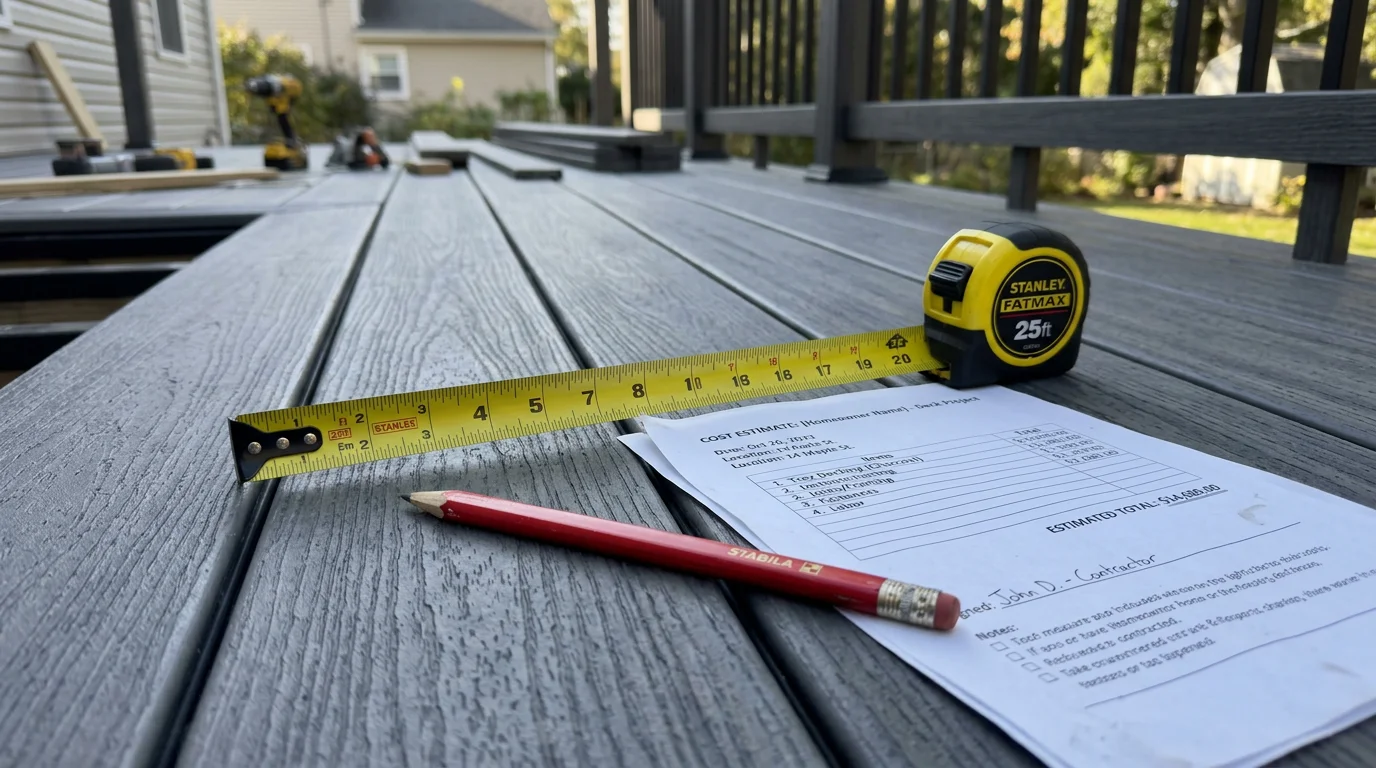
You can physically install composite decking over existing wood deck boards, but professional deck builders in Ontario almost never recommend it. The short answer: you'll create more problems than you solve, and you won't save meaningful money or time.
The real question isn't whether you *can* do it—it's whether you *should*. Here's what happens when you overlay composite on wood, why the framing matters more than the surface, and what Ontario homeowners actually need to know before upgrading to composite.
Why Overlaying Composite on Wood Rarely Works
The appeal seems obvious: skip the demolition, save on labour, upgrade to low-maintenance composite. But composite decking requires a structurally sound foundation, and your existing wood deck likely doesn't qualify.
🏗️ Planning a deck project?
Get a free manual project review, or visualize your dream deck with AI before requesting quotes.
Composite boards are heavier than wood. Trex, TimberTech, and other hollow-core composites weigh 2-3 lbs per linear foot for a 5.5" board. Solid composite or capped polymer boards can hit 3.5-4 lbs per linear foot. If your existing joists were sized for lightweight cedar or pressure-treated pine, adding composite on top exceeds their load capacity.
Your old deck boards are deteriorating. If the visible surface shows wear, the underside and joist structure are worse. Wood decking in Ontario sees freeze-thaw cycles, moisture trapped under snow cover, and UV damage. After 8-12 years, boards sag, joists rot, and fasteners loosen. Laying new composite over failing wood doesn't fix the structural issues—it hides them until catastrophic failure.
Composite needs proper airflow and drainage. Trapping old wood boards underneath creates a moisture sandwich. Water penetrates composite (it's not waterproof), soaks into the wood below, and can't evaporate. You'll accelerate rot in the framing and create ideal conditions for mold between layers.
Building code requires structural integrity. Ontario Building Code Section 9.4.4 mandates that deck structures support live loads of 1.9 kPa (40 lbs per square foot) plus dead load. Inspectors don't care what's on the surface—they care whether the joists, beams, and footings meet current standards. Overlaying composite doesn't bring a 15-year-old deck up to code.
When Builders Might Overlay Composite (Rare Exceptions)
A handful of scenarios exist where overlaying makes marginal sense, but even then, most contractors would rather rebuild:
Brand-new wood deck with installation defects. If a builder installed the wrong decking material or you immediately regret choosing wood, and the framing is less than 1-2 years old with engineer-stamped drawings and proper joist spacing for composite loads, you could theoretically overlay. You'd still lose deck height and create drainage headaches.
Fully enclosed porch conversion. If you're converting an open deck into a screened porch or sunroom and plan to install subfloor and finished flooring anyway, leaving the old decking as a structural base might work. But this isn't really "overlaying composite decking"—it's repurposing the old deck as rough framing.
Temporary stage or event platform. Commercial builders sometimes overlay composite on wood for short-term installations where aesthetics matter but longevity doesn't. Not relevant for residential decks in KWC.
What Actually Needs Replacing: It's Not Just the Boards
When Ontario homeowners consider upgrading to composite, the deck boards are usually the least of their problems. Here's what matters:
Joist Spacing and Sizing
Composite manufacturers specify 12" or 16" on-center joist spacing depending on board thickness and whether you're running boards at 45-degree angles. Most older wood decks used 16" spacing for dimensional lumber, which works for composite running perpendicular to joists. But if your joists are 24" on-center (common on budget decks from the 2000s), you'll need to add blocking or sister joists—which means tearing up the old deck boards anyway.
If your existing joists are 2x6, they're undersized for composite. You need 2x8 minimum for most spans, or 2x10-2x12 for longer runs. Check the deck joist span table to see if your framing meets composite requirements.
Ledger Board and Flashing
The ledger board (where the deck attaches to your house) is the #1 failure point on Ontario decks. If it wasn't installed with proper flashing, it's rotting behind the siding. Ledger board rot starts invisible and becomes catastrophic.
Composite decking lasts 25-30 years. Your ledger board needs to match that lifespan. If it's 10+ years old, pulling off the deck boards to inspect and re-flash is non-negotiable. You can't overlay composite and ignore a rotting ledger—it'll fail mid-deck, pulling the entire structure away from the house.
Footings and Foundation
Ontario's 48-inch frost line (1.2 m) means deck footings must extend below freezing depth. Older decks often have shallow footings (36" or less), which heave during freeze-thaw cycles. If your deck has developed a slope, doors don't close properly, or joists are no longer level, your footings are failing.
Composite decking won't fix heaving footings. You'll spend $65-95/sqft on composite boards and installation, then watch the deck settle unevenly because the foundation is shot. Better to address deck footing options first.
Framing Hardware and Fasteners
Galvanized joist hangers from 15 years ago are corroding. Nails backing out. Simpson Strong-Tie hardware has advanced—modern composite decks use hidden fasteners, stainless hardware, and corrosion-resistant coatings rated for decades.
Overlaying composite means your structural connections remain substandard. When inspectors review deck failures, fastener corrosion and inadequate hardware cause half the collapses.
What Professional Builders Recommend Instead
Every deck contractor in Kitchener-Waterloo-Cambridge we've spoken to says the same thing: tear off the old decking, inspect the framing, and upgrade what needs upgrading.
Here's the phased approach that makes sense:
1. Remove existing deck boards. Labour cost: $2-4/sqft for demolition and disposal. You'll immediately see the condition of joists, beams, and ledger. If framing is solid (rare after 10+ years), you can proceed. If not, you've saved yourself from building new decking over a failing structure.
2. Assess and reinforce framing. Budget $15-30/sqft to sister joists, add blocking, replace rotted rim joists, or upgrade hardware. If the entire frame needs replacement, you're looking at $25-40/sqft for new pressure-treated framing that meets current composite load requirements.
3. Install composite decking. Material + labour for composite boards and hidden fasteners: $30-50/sqft depending on brand. Trex Enhance runs $28-35/sqft installed. TimberTech PRO runs $38-48/sqft. Premium lines like Trex Transcend or Fiberon Paramount hit $45-55/sqft.
Total cost for a proper composite upgrade on existing framing (if structurally sound): $47-84/sqft. If framing needs replacement too, you're at $65-95/sqft—the same as a composite deck built from scratch.
That's why overlaying makes no financial sense. You don't save enough to justify the compromises.
Hidden Costs of Overlaying (That Kill the "Savings")
Let's say you overlay composite boards on old wood decking. You've skipped $2-4/sqft in demolition. What did you lose?
Deck height increases by 1.5-2 inches. Composite boards are thicker than 5/4" wood decking. Your door threshold is now a trip hazard, or you need to adjust the threshold (carpentry cost: $300-600). Stair stringers no longer match—the top step is now shorter than the rest, violating Ontario deck stair code (7" max variance). You'll rebuild stairs anyway ($1,200-2,800 depending on size).
Railings don't fit. If your existing railing posts bolt through the deck boards into rim joists, adding 1.5" of composite means posts are too short or connections are compromised. You'll need taller posts, new rail sections, or complete railing replacement. Budget $40-120/linear foot for new railing.
Warranty is void. Trex, TimberTech, Fiberon—every major composite manufacturer requires installation over code-compliant framing with proper fasteners and spacing. Overlaying on old wood violates installation specs. When boards fade, warp, or fail, your warranty claim gets denied. You've spent $30-50/sqft on materials with zero manufacturer backing.
Inspection failure. If you're in Kitchener, Waterloo, or Cambridge and pulled a permit for "deck resurfacing," the framing inspection will fail if the underlying structure doesn't meet current OBC standards. You'll tear everything apart anyway. If you didn't pull a permit (required for structural changes in all three municipalities), you've created a code violation that surfaces during home sale inspections.
Add it up: threshold adjustment, stair rebuild, railing replacement, voided warranty, and permit headaches cost $3,000-6,000 on a typical 200-sqft deck. You "saved" $400-800 skipping demolition.
The Right Way to Upgrade to Composite in Ontario
If your wood deck is 8+ years old and you want composite, here's the decision tree:
Scenario 1: Deck is 5-10 years old, no visible sag, built to permit
Remove deck boards ($2-4/sqft), inspect framing, replace ledger flashing ($800-1,500), add joist tape or membrane if missing ($1-2/sqft), install composite boards and hidden fasteners ($30-50/sqft). Total: $50-75/sqft.
Scenario 2: Deck is 10-20 years old, minor sagging, no permit records
Full teardown and rebuild. Old framing won't meet current code. Budget $65-95/sqft for complete composite deck with engineered framing, proper footings, and code-compliant railings. Get quotes from three licensed builders and verify permit history with your municipality.
Scenario 3: Deck is 20+ years old
Demo and rebuild, no exceptions. Footings are heaving, joists are rotted, and ledger is suspect. Trying to salvage anything creates liability. See deck rebuild vs. resurface for when replacement makes sense.
Most KWC homeowners fall into Scenario 2. A 12x16 deck (192 sqft) costs $12,500-18,200 for full composite rebuild including permits, demolition, and railings. That's the honest number—plan accordingly.
What About Just Replacing Wood With Wood?
If your framing is solid and you want to avoid composite costs, replacing wood deck boards with fresh pressure-treated or cedar is a viable option.
Pressure-treated decking (installed): $18-28/sqft for boards only, $45-65/sqft for full deck with framing. You'll need to stain and seal annually, but upfront cost is 30-40% less than composite.
Cedar decking (installed): $25-38/sqft for boards, $55-80/sqft for complete deck. Cedar looks better than PT and weathers to silver-grey if left untreated, but still requires maintenance every 2-3 years.
If you plan to stay in your home 5-10 years, wood makes sense. If this is a 20-year deck, composite's lack of maintenance justifies the premium. See composite vs. wood decking for the full breakdown.
🎨 Not sure which material to pick?
Upload a photo of your backyard and see exactly how Trex, TimberTech, or cedar would look — free and instant.
Common Questions
Can I use my old deck joists for new composite boards?
Only if the joists are 2x8 or larger, spaced 12-16" on-center, and structurally sound with no rot, sag, or insect damage. You'll also need to verify the joists meet composite manufacturer span tables—most require shorter spans than wood decking. If your joists are 2x6 or spaced 24" apart, you need new framing.
Will composite decking prevent my deck from rotting?
No. Composite boards don't rot, but the wood framing underneath still does. If your joists, beams, and ledger are rotting, composite surface boards won't stop it. You need to address structural rot before installing any new decking material, composite or wood.
How much does it cost to remove old deck boards in KWC?
Demolition and disposal for deck boards only (leaving framing intact): $2-4/sqft. A 200-sqft deck costs $400-800 to strip. Full demo including framing, railings, and stairs: $5-9/sqft, or $1,000-1,800 for the same 200-sqft deck. Disposal fees at Region of Waterloo facilities add $50-120 depending on volume.
Can I install composite decking myself over old wood to save money?
You can, but it's a bad idea for all the reasons above: added height, structural unknowns, voided warranties, and code violations. If you're DIY-capable, spend your time tearing off old boards and inspecting the framing instead. Installing composite correctly requires hidden fastener systems, proper gapping for thermal expansion, and fascia trim details—mistakes are expensive to fix.
Do I need a permit to overlay composite on my existing deck?
In Kitchener, Waterloo, and Cambridge, any structural work or material change to a deck requires a permit. "Resurfacing" with composite counts as a structural change because it adds load. Inspectors will want to see framing compliance. Skipping permits creates problems during home sales and leaves you liable for injuries if the deck fails. Always permit deck work in KWC.
Upload a backyard photo and preview real decking materials with AI — free, instant, no sign-up.
Permits, costs, material comparisons, and questions to ask before requesting quotes — delivered to your inbox.