
Deck Permits in London (2026)
Need a deck permit in London, Ontario? Learn requirements, fees, setback rules, and how to apply. Avoid fines and delays with this 2026 guide.
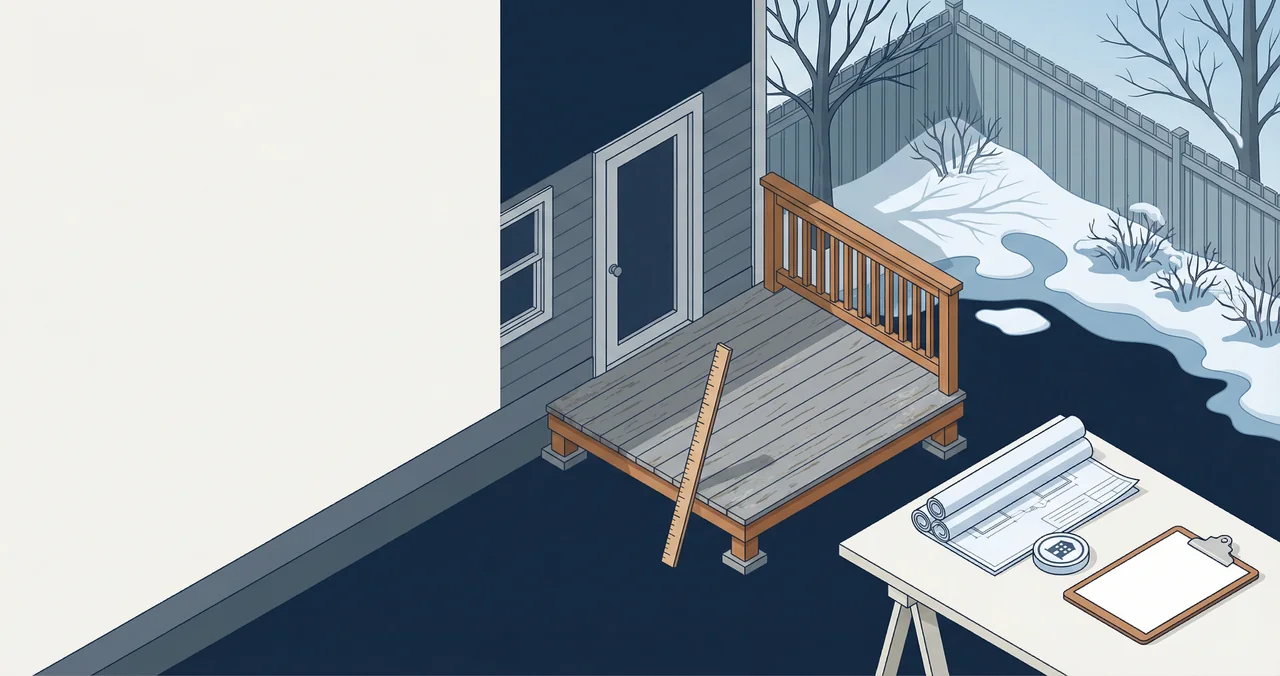
Planning to build a deck at your London, Ontario home? Before you price out lumber or call contractors, there's one question you need to answer first: do you need a deck permit?
Looking for more regional information? Check out our Ontario Decking Hub.
Skip this step, and you risk fines, forced removal, or a nasty surprise when you try to sell your house. Get it right, and the process is straightforward — a few forms, a fee, and a couple of inspections.
Here's exactly what London homeowners need to know about deck permits in 2026.
📋 Tool Alert: Permit Checker
Do you really need a permit? Check the exact rules for your city or township.
Check Permits →Do You Need a Deck Permit in London?
Yes, in most cases. The City of London requires a building permit for decks that meet either of these thresholds:
🏗️ Planning a deck project?
Get a free manual project review, or visualize your dream deck with AI before requesting quotes.
- More than 24 inches (0.6 m) above finished grade at any point
- Larger than 100 square feet (9.3 m²) in total area
If your deck is both under 24 inches high and under 100 square feet, you likely don't need a permit. But that's a small deck — roughly 10×10 feet. Most functional decks exceed one or both limits.
Attached decks almost always require a permit, regardless of size. Connecting a structure to your home's ledger board affects the building envelope, and London's Building Division wants to verify the connection meets the Ontario Building Code (OBC).
Even if your project falls below the thresholds, you still need to comply with zoning bylaws, setback requirements, and lot coverage limits. A permit exemption doesn't mean a rule exemption.
What About Freestanding Decks?
A common misconception: freestanding decks don't need permits. That's not automatically true in London. A freestanding deck over 24 inches high or over 100 square feet still requires a permit. The advantage of freestanding is that you avoid the ledger board connection — which simplifies the build but doesn't eliminate the permit requirement. For a deeper comparison, see our guide on attached vs. freestanding deck permits in Ontario.
When a Permit Is Required
Here's a quick breakdown of common London deck projects and whether they trigger a permit:
| Project | Permit Required? |
|---|---|
| 12×16 deck, 30" above grade | Yes — exceeds both thresholds |
| 10×10 ground-level patio deck (under 24") | No — under both limits |
| 16×20 attached deck | Yes — exceeds size and attached to house |
| 8×10 elevated balcony deck | Yes — exceeds height |
| Replacing deck boards on existing frame | No — cosmetic repair, not structural |
| Adding stairs to existing deck | Possibly — if stairs change height access or add structural load |
| Covering a deck with a roof or pergola | Yes — roof structures require a separate permit |
When in doubt, call London's Building Division at 519-661-4555. A quick phone call can save you weeks of uncertainty. They'll tell you whether your specific project needs a permit — no charge for asking.
Permit Fees & Processing Time
How Much Does a Deck Permit Cost in London?
London's building permit fees are based on construction value. For residential decks, expect:
- Permit fee: Approximately $8.50–$12.00 per $1,000 of construction value (confirm current rates with the city, as fees are updated periodically)
- Minimum permit fee: Around $120–$180 CAD
To estimate your construction value, here's what London decks typically cost in 2026:
| Material | Installed Cost (CAD/sq ft) | 200 sq ft Deck | 320 sq ft Deck |
|---|---|---|---|
| Pressure-treated | $30–$55 | $6,000–$11,000 | $9,600–$17,600 |
| Cedar | $40–$65 | $8,000–$13,000 | $12,800–$20,800 |
| Composite | $50–$85 | $10,000–$17,000 | $16,000–$27,200 |
| Trex | $55–$90 | $11,000–$18,000 | $17,600–$28,800 |
| Ipe (hardwood) | $70–$120 | $14,000–$24,000 | $22,400–$38,400 |
For a typical $15,000 composite deck, your permit fee would be roughly $130–$180 CAD. That's a fraction of the total project cost — and well worth the protection it provides.
For detailed cost breakdowns by size, check out our guides on 12×16 deck costs in Ontario or 16×20 deck costs in Ontario.
How Long Does It Take to Get a Deck Permit?
London's Building Division typically processes residential deck permits within 10 to 15 business days. During peak season (April through June), timelines can stretch to 3–4 weeks as applications surge.
Pro tip: Submit your application by early March if you want to break ground in May. London's building season is short — roughly May through October — and contractor schedules fill fast. Late permit applications mean late starts, and a late start in London means you're racing against frost.
Building Codes & Setback Rules
Ontario Building Code Requirements for Decks
London decks must comply with the Ontario Building Code (OBC), which covers structural, safety, and accessibility standards. Key requirements:
Structural:
- Footings must extend below the frost line — in the London area, that's 48 inches (4 feet) minimum, though some areas may require deeper depending on soil conditions. Frost heave is a real threat with London's freeze-thaw cycles
- Beam and joist sizing must match OBC span tables for your specific lumber species and spacing
- Ledger board connections (for attached decks) require lag bolts or through-bolts with flashing to prevent water intrusion
Safety:
- Guardrails are mandatory on any deck surface more than 24 inches above grade — minimum 36 inches high for residential, with balusters spaced no more than 4 inches apart
- Stairs need a handrail on at least one side, with consistent riser height (max 7.87 inches) and tread depth (min 9.06 inches)
- Load capacity: Minimum 40 psf live load for residential decks
Climate-specific (critical for London):
- Snow load: London receives significant snowfall. Your deck structure must support the local ground snow load, which the OBC specifies by region. Undersized joists can sag or fail under heavy wet snow
- Ice dam prevention: Where a deck attaches to the house, proper flashing prevents ice dams from forcing water behind siding
- Drainage: Deck boards should allow water and snowmelt to drain freely. Composite and PVC materials handle London's moisture and road salt better than untreated wood — pressure-treated lumber needs annual sealing to survive
For material options that handle London's freeze-thaw climate well, see our guide on the best decking materials for Ontario's freeze-thaw conditions.
Setback Rules in London
London's zoning bylaws dictate where on your lot you can build. Standard residential setback requirements:
- Rear yard setback: Typically 1.2 metres (4 feet) from the rear property line — but this varies by zone
- Side yard setback: Usually 0.6–1.2 metres from side property lines
- Lot coverage: Your deck counts toward maximum lot coverage. If your house, garage, shed, and deck combined exceed the allowable percentage, your permit will be denied
- Easements: Check your lot survey for utility or drainage easements. You generally cannot build within an easement
Get a lot survey before you design your deck. London's Building Division will ask for one with your permit application, and discovering setback issues after you've already drawn plans wastes time and money.
How to Apply for a Deck Permit in London
Step 1: Gather Your Documents
London's Building Division requires:
- Completed application form (available online at london.ca or in person at City Hall)
- Site plan showing your property boundaries, existing structures, setbacks, and the proposed deck location — drawn to scale
- Construction drawings including plan view, elevation, cross-section, and structural details (footing depth, joist size/spacing, beam spans, railing design)
- Lot grading/drainage plan if required by your property conditions
- Proof of property ownership or authorization from the owner
Your contractor should handle the drawings. If you're building it yourself, you'll need to produce drawings that meet OBC standards — check our guide on building your own deck in Ontario for what's involved.
Step 2: Submit Your Application
You can submit:
- Online through London's building permit portal
- In person at the Development & Compliance Services counter, City Hall, 300 Dufferin Avenue
Online submissions are faster and let you track your application status.
Step 3: Review and Approval
The Building Division reviews your application for OBC compliance and zoning conformity. If everything checks out, you'll receive your permit. If there are issues, you'll get a deficiency notice listing what needs to be corrected.
Common reasons for rejection:
- Setback violations
- Inadequate footing depth (especially common — London's frost line catches people off guard)
- Missing structural calculations
- Incomplete drawings
Step 4: Schedule Inspections
London typically requires two inspections for a deck:
- Footing inspection — before you pour concrete. The inspector verifies hole depth, diameter, and soil conditions
- Final inspection — after the deck is complete. The inspector checks guardrails, structural connections, stair compliance, and overall OBC adherence
Don't backfill footings or install decking until you pass the footing inspection. If the inspector can't see the footings, you may be required to dig them up.
Step 5: Get Your Occupancy
Once you pass the final inspection, your permit is closed out and you're clear to use your deck. Keep your permit documents — you'll need them when you sell your home.
What Happens If You Build Without a Permit
It's tempting to skip the permit process. Don't. Here's what you're risking in London:
Immediate consequences:
- Stop work order — the city can force you to halt construction at any stage
- Fines — Ontario municipalities can impose fines, and repeat violations escalate. London's fines can reach up to $50,000 for individuals under the Building Code Act
- Forced removal — if your deck doesn't meet code, you may be ordered to tear it down. At your expense
Long-term consequences:
- Insurance issues — your homeowner's insurance may deny a claim if someone is injured on an unpermitted structure
- Sale complications — home inspectors flag unpermitted work. Buyers walk away, or their lenders refuse to finance. You'll either need a retroactive permit (if the deck meets code) or demolition
- Neighbour complaints — an unpermitted deck that violates setbacks gives neighbours legal grounds to file a complaint. The city must investigate
We've covered this topic in detail — read about the risks of building a deck without a permit in Ontario before you consider skipping the process.
The bottom line: A permit costs $130–$180 on a deck that costs $10,000–$30,000. It protects your investment, your safety, and your ability to sell. There's no rational reason to skip it.
Planning Your London Deck Project
Once your permit is secured, a few London-specific considerations will shape your project:
Timing matters. With a building season of roughly May through October, and permit processing taking 2–4 weeks, submit your application no later than March to start building in May. Contractors in the London area book up quickly — the shorter season compresses demand into fewer months.
Material choice matters more here. London's freeze-thaw cycles are brutal on decking. Composite and PVC materials resist moisture absorption, so they won't crack or split when trapped water freezes and expands. Pressure-treated wood is the budget option at $30–$55/sq ft installed, but you'll spend time and money on annual staining and sealing. Composite at $50–$85/sq ft costs more upfront but needs almost zero maintenance over its lifespan.
Use PaperPlan to visualize different decking materials on your own home before committing — seeing composite vs. cedar on your actual backyard makes the decision much easier.
Footings are non-negotiable. London's frost line sits at 48 inches minimum. Shallow footings will heave, and a heaving deck pulls away from your house, cracks framing, and creates safety hazards. This is the one area where cutting corners costs the most.
🎨 Not sure which material to pick?
Upload a photo of your backyard and see exactly how Trex, TimberTech, or cedar would look — free and instant.
Frequently Asked Questions
How much does a deck permit cost in London, Ontario?
Deck permit fees in London are based on construction value, typically $8.50–$12.00 per $1,000. For an average residential deck project, expect to pay approximately $130–$180 CAD. The exact fee depends on your deck's size, materials, and total construction value. Contact London's Building Division at 519-661-4555 for a precise quote based on your project.
Can I build a small deck without a permit in London?
You may not need a building permit if your deck is both under 24 inches above finished grade and under 100 square feet in area. However, you must still comply with London's zoning bylaws, including setback requirements and lot coverage limits. Even a small ground-level platform needs to follow the rules — the permit exemption only applies to the building permit itself, not to zoning regulations.
How deep do deck footings need to be in London?
Deck footings in London must extend at least 48 inches (4 feet) below grade to get below the frost line. Some areas with specific soil conditions may require deeper footings. This is non-negotiable — shallow footings will heave during London's freeze-thaw cycles, causing structural damage to your deck. The footing inspection is one of the first things the building inspector checks.
How long does it take to get a deck permit approved in London?
Standard processing time is 10 to 15 business days. During peak season (April through June), expect 3 to 4 weeks. Incomplete applications or drawings that don't meet OBC standards will add delays. To stay on track for a spring build, submit your permit application by early March and make sure your drawings are thorough and accurate the first time.
What happens if my neighbour builds a deck without a permit?
If you believe a neighbouring property has an unpermitted structure that violates bylaws or building codes, you can file a complaint with London's Building Division. The city is obligated to investigate. Common concerns include setback violations (deck built too close to your property line) and structures that exceed lot coverage limits. The process is confidential — your neighbour won't be told who filed the complaint. For more on how neighbour disputes play out, see our post on whether a neighbour can complain about your deck in Ontario.
📋 Planning a deck project?
Get a free manual project review from our team — no obligation, no spam.
Get Free Project Review →Upload a backyard photo and preview real decking materials with AI — free, instant, no sign-up.
Permits, costs, material comparisons, and questions to ask before requesting quotes — delivered to your inbox.