
Building Near an Easement in Ontario: What You Can and Can't Do
Before you build that deck or fence near an easement in Ontario, understand what's allowed. Property rights, permits, and setback rules explained.
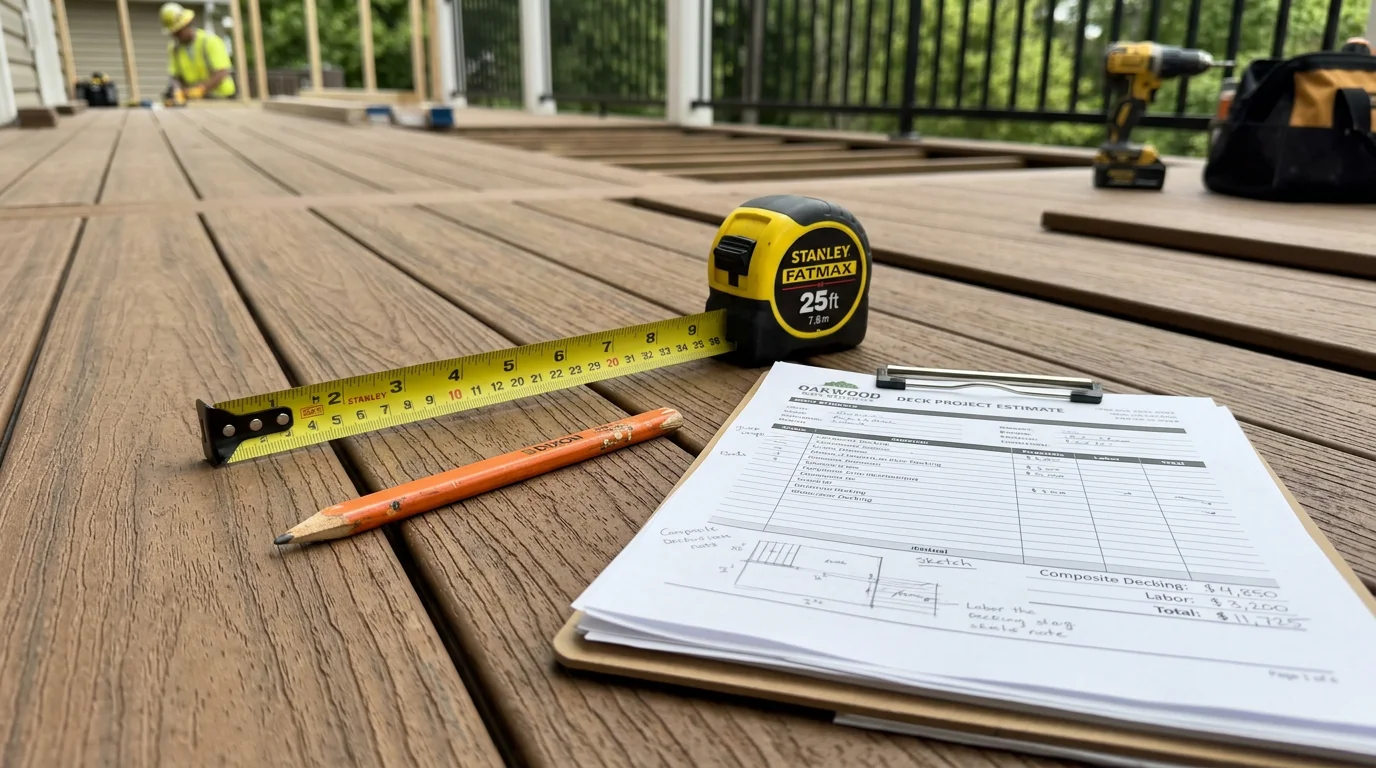
You've got plans for a new deck, fence, or shed—then you discover an easement running through your property. Can you still build? What happens if you ignore it? The answers depend on the type of easement, what's in the agreement, and your municipality's bylaws.
Easements grant someone else the right to use part of your property for a specific purpose. That "someone" could be a utility company, your municipality, a neighbour, or a previous property owner. The easement stays with the land, meaning it transfers to new owners. You'll find easement details on your property survey, your title deed, or through a title search at your local land registry office.
What Is an Easement and Why Does It Matter?
An easement is a legal right allowing a third party to access or use a portion of your property. It doesn't transfer ownership—you still own the land—but it limits what you can do on that land.
🏗️ Planning a deck project?
Get a free manual project review, or visualize your dream deck with AI before requesting quotes.
Common easement types in Ontario:
- Utility easements: Hydro lines, gas mains, water pipes, sewer lines, telecommunications cables
- Right-of-way easements: Access to landlocked properties or shared driveways
- Drainage easements: Stormwater management, swales, culverts
- Conservation easements: Environmental protection agreements (less common in urban KWC)
The easement agreement specifies the width, location, and permitted use. Utility easements in Kitchener-Waterloo-Cambridge typically range from 1.5 to 6 metres wide (5 to 20 feet). Wider easements may exist along rear lot lines for underground infrastructure or along property lines for overhead power lines.
Why easements restrict construction:
- Utility companies need equipment access for repairs and maintenance
- Heavy structures can damage underground infrastructure
- Roots from permanent landscaping can interfere with pipes and cables
- Municipalities must maintain drainage flow and access manholes or catch basins
If you build on an easement without permission, the easement holder can force you to remove the structure—at your expense. Homeowner's insurance typically won't cover removal costs because you violated the easement terms.
Can You Build a Deck Near or Over an Easement?
It depends on whether your deck sits inside the easement and whether it's considered a permanent structure.
Generally not permitted:
- Decks with concrete footings or helical piles within the easement area
- Attached decks with ledger boards spanning the easement
- Any structure requiring excavation within 1 metre of underground utilities
- Elevated decks that block access to above-ground infrastructure
Sometimes permitted with approval:
- Floating decks (resting on pre-cast blocks or gravel pads) that can be easily relocated
- Low platform decks under 24 inches high with minimal footings outside the easement zone
- Deck sections cantilevered over the easement if the support structure sits outside it
Before you assume your low deck qualifies, read your easement agreement. Some utility easements prohibit any structure, even removable ones. Others allow "non-permanent improvements" but define permanent differently than you might expect.
Your safest approach:
1. Request a copy of the registered easement agreement from your title documents or land registry
2. Call the easement holder (utility company, municipality, or neighbour) and describe your project
3. Submit a written request with site photos, deck plans, and proposed dimensions
4. Get written approval before you apply for your building permit
Most utility companies in Ontario will review your request within 2-4 weeks. If they deny it, ask whether relocating the deck footings outside the easement would satisfy their requirements.
For deck permit rules in KWC, see our guides: Kitchener, Waterloo, and Cambridge.
Setback Rules vs. Easement Restrictions
Setbacks and easements are separate requirements. You must satisfy both.
Municipal setback bylaws dictate how far your deck must sit from property lines, regardless of easements. In Kitchener-Waterloo-Cambridge, typical rear-yard deck setbacks are 0.6 to 1.5 metres (2 to 5 feet) from the property line, depending on your zoning district.
If an easement runs along your rear lot line, you face a double constraint:
- Your deck must meet the municipal setback from the property line
- Your deck must also stay outside the easement zone (or get easement holder approval)
Example scenario: Your property has a 3-metre utility easement along the rear lot line. Your municipality requires a 1-metre setback from the property line. You now have a 4-metre no-build zone unless the easement holder permits construction within their area.
Check your local zoning with our guide: KWC Deck Zoning Setbacks: How to Check Your Property.
Fences, Sheds, and Other Structures on Easements
Fences are usually allowed across utility easements, with conditions:
- No concrete footings—use metal fence posts or wood posts set in gravel
- Install the fence in removable sections so crews can access underground utilities
- Avoid chain-link fence bottom rails that require trenching
- Keep gates accessible for utility vehicles if the easement provides maintenance access
Most utility companies require removable fence panels within the easement area. Expect to remove and reinstall fence sections if the utility company needs access. They're not required to restore your fence after maintenance work, though some companies will as a courtesy.
Sheds, garages, and accessory buildings are almost never permitted on easements. These are permanent structures requiring foundation work, and they block access entirely.
Landscaping within easements:
- Allowed: Grass, groundcover, shallow-rooted perennials, mulch beds
- Usually allowed: Small shrubs under 1 metre tall, annuals, decorative rock
- Not allowed: Trees, large shrubs, raised garden beds with deep soil, retaining walls, permanent edging requiring excavation
Utility companies will cut down or remove vegetation that interferes with their infrastructure. Plant at your own risk.
What Happens If You Build Without Permission?
The easement holder can issue a removal order requiring you to tear down the structure. If you refuse, they can remove it themselves and bill you for the cost—plus legal fees. This isn't theoretical. Utility companies in Ontario routinely enforce easement violations.
Real-world consequences:
- Removal costs: $2,000-8,000+ depending on structure size and disposal fees
- Legal fees if the easement holder takes you to court
- Denied building permits for future projects until the violation is resolved
- Title issues when selling your home—buyers' lawyers will flag the easement violation during title search
Your municipality won't issue a deck permit if your plans show construction within an easement without easement holder approval. Some homeowners skip the permit to avoid this step. Bad idea. Building without a permit creates a separate bylaw violation, often resulting in stop-work orders and fines starting at $500-1,500 in KWC municipalities. You'll still need to get the permit retroactively, which means higher fees, engineer inspections, and potential structural corrections.
See our guide: Deck Permit Cost KWC: Fees and Hidden Costs.
How to Find Out If Your Property Has an Easement
Step 1: Check your property survey. Easements appear as shaded areas, dashed lines, or labelled zones on your survey drawing. If you don't have a copy, your lawyer should have provided one when you bought the property.
Step 2: Review your title deed. Easements are registered on title as "encumbrances" or "instruments." Your title document lists the registration number for each easement.
Step 3: Search the land registry. Visit ServiceOntario's OnLand property search or request a title search through a real estate lawyer. Registered easement agreements include details on width, purpose, and restrictions.
Step 4: Call utility locates. Ontario One Call (call 811 before you dig) will mark underground utilities on your property. This doesn't tell you where easements are registered, but it shows you where infrastructure actually runs. Sometimes the two don't match. See: Ontario One Call (811) Before Deck Footings in KWC.
Step 5: Contact your municipality. Planning departments keep records of municipal easements for drainage, sanitary sewers, and road access. These may not appear on older surveys.
If your property has an easement and you're planning any construction, get a current survey from an Ontario Land Surveyor. Surveys older than 10 years may not reflect infrastructure changes or updated easement boundaries. Expect to pay $800-1,500 for a residential survey in KWC.
Alternatives If You Can't Build on the Easement
If the easement blocks your ideal deck location, consider these options:
Relocate the deck. Move your design to the opposite side of the house or use the front yard if your municipality permits it and your zoning allows. Some KWC zoning bylaws restrict front-yard decks, but side-yard decks are often easier to permit.
Reduce the deck size. A smaller footprint might fit outside the easement while still providing usable outdoor space. A 10×12-foot deck costs $5,400-7,800 installed in pressure-treated wood, compared to $9,000-13,000 for a 12×16-foot deck.
Use a floating deck. A ground-level floating deck on precast blocks avoids deep excavation and may satisfy easement restrictions if it's truly removable. Confirm with the easement holder first—"floating" doesn't automatically mean "permitted."
Build a patio instead. Interlocking stone patios or poured concrete pads may face fewer easement restrictions than elevated decks, especially if they don't require excavation deeper than 12 inches. Check with the easement holder. Drainage easements often prohibit any hardscaping that disrupts water flow.
Cantilever over the easement. If the easement is narrow, design your deck so the support posts and footings sit outside the easement, with the deck joists cantilevered over it. Ontario Building Code allows cantilevers up to 1/4 of the joist span for residential decks. For a 10-foot joist span, you can cantilever 2.5 feet. This requires careful engineering to meet code, and the easement holder must approve the overhang. See: Deck Joist Span Table Ontario: 2×8, 2×10, 2×12.
Negotiate easement modification. In rare cases, you can ask the easement holder to amend the agreement or reduce the easement width. This typically requires legal fees ($1,500-3,000+), a new survey, and title registration. Utility companies rarely agree unless they no longer need the full easement area.
🎨 Not sure which material to pick?
Upload a photo of your backyard and see exactly how Trex, TimberTech, or cedar would look — free and instant.
Common Questions
Can I build a deck if part of it crosses an easement but the footings are outside it?
Possibly, but you need written approval from the easement holder. Even if your footings sit outside the easement, deck boards, joists, and beams extending over the easement may block access or interfere with maintenance equipment. Describe your full design when you request approval—don't just mention the footings.
Do I need a survey to apply for a deck permit if there's an easement on my property?
Most KWC municipalities require a site plan showing your deck's location relative to property lines and easements. If you're building near an easement, expect the building department to ask for a current survey or a letter from the easement holder confirming your deck doesn't violate the easement terms. Budget $800-1,500 for a survey from an Ontario Land Surveyor.
What's the penalty for building on an easement without permission in Ontario?
The easement holder can issue a removal order, forcing you to tear down the structure at your expense. If you refuse, they can remove it and bill you for costs plus legal fees. You may also face municipal bylaw fines if you built without a permit. Removal costs typically range from $2,000-8,000+ depending on the structure size.
Can I put a hot tub on my deck if the deck is near an easement?
If the deck itself is permitted outside the easement or has easement holder approval, you can place a hot tub on it—but you'll need to ensure the deck structure is engineered for the additional load. A filled hot tub weighs 3,000-6,000 lbs depending on size. This may require beefier joists, closer joist spacing, and additional footings, all of which must stay outside the easement (or get separate approval). See: Hot Tub on Deck Ontario: Structural Checklist (KWC).
Who do I contact to get easement approval for my deck project?
Check your easement agreement to identify the easement holder. For utility easements, contact the local utility company's land services or customer relations department. For municipal easements, contact your city's planning or engineering department. For private easements (neighbour access, shared driveway), contact the property owner who holds the easement rights. Always request written approval before submitting your building permit application.
Upload a backyard photo and preview real decking materials with AI — free, instant, no sign-up.
Permits, costs, material comparisons, and questions to ask before requesting quotes — delivered to your inbox.