
Can You Build a Deck on Top of a Concrete Patio?
Yes, you can build a deck on concrete. Learn the methods, permits, costs, and whether sleepers, footings, or blocking work best for your Ontario patio.
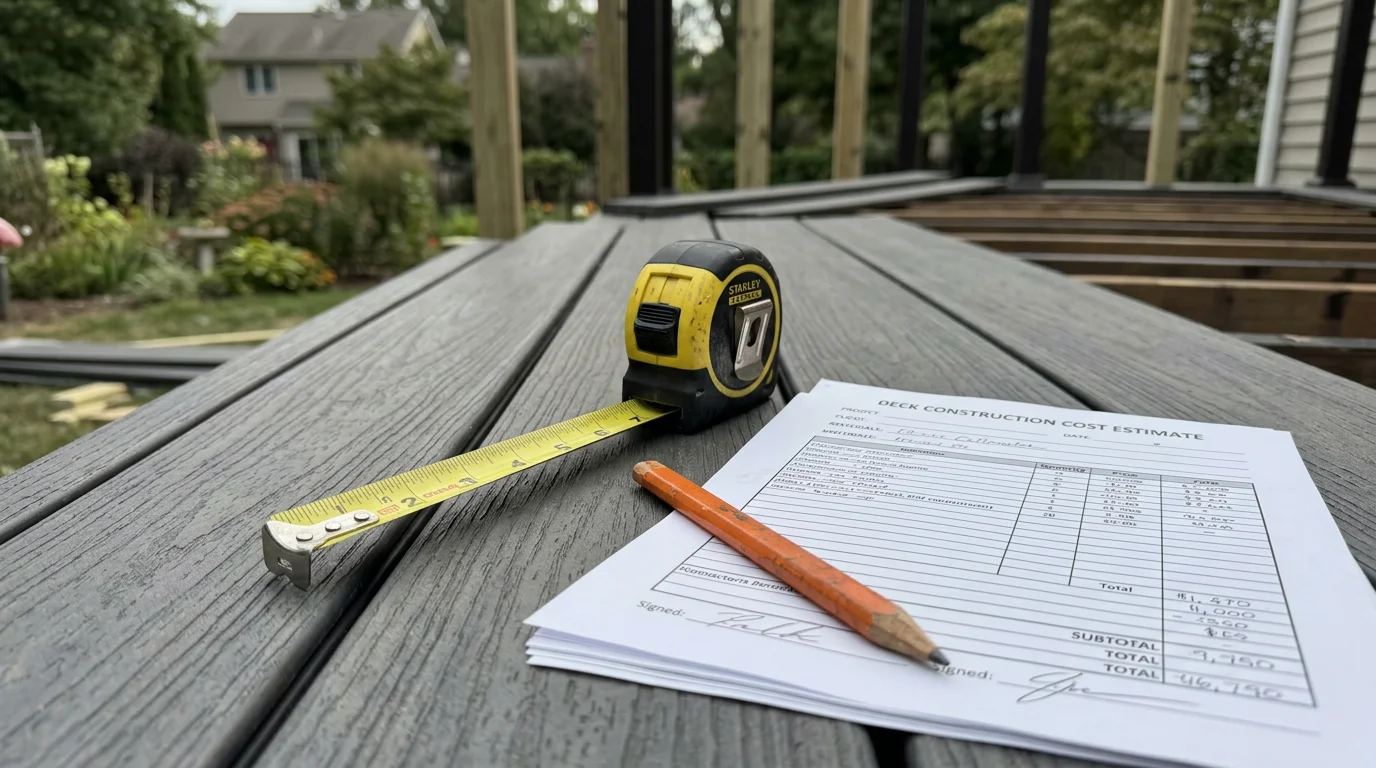
You've got a concrete patio that's showing its age or just doesn't match your vision anymore. Before you jackhammer it out, here's good news: you can build a deck directly on top of existing concrete — and it's often cheaper and faster than removal.
The catch? The method you choose depends on your concrete's condition, whether the patio is level, how high you want the finished deck, and what Ontario Building Code requirements apply.
Why Build Over Concrete Instead of Removing It
Concrete removal costs $3–$6 per square foot in Ontario, plus disposal fees that can hit $500–$1,200 depending on your distance from the dump. For a 200-square-foot patio, that's $600–$1,200 just to get rid of it.
🏗️ Planning a deck project?
Get a free manual project review, or visualize your dream deck with AI before requesting quotes.
Building over concrete skips that cost entirely. You also get:
- Better drainage foundation — concrete already sheds water better than soil
- No new footings required in most cases (if the slab is stable)
- Faster installation — no digging, no waiting for concrete to cure
- No excavation permits — you're working above grade
The concrete becomes your foundation. As long as it's structurally sound and properly sloped, it's a legitimate base.
Three Ways to Build a Deck on Concrete
Method 1: Sleeper System (Low Profile)
This is the most common approach for ground-level or near-ground decks where you want minimal height added.
How it works: Pressure-treated 2×4 or 2×6 sleepers are fastened directly to the concrete using Tapcon screws or concrete wedge anchors. Deck joists sit perpendicular on top of the sleepers. Deck boards run perpendicular to the joists.
Best for:
- Patios within 1–2 inches of finished grade
- Flat or gently sloped concrete
- Composite or wood decking where you want a low profile
Fastening requirements:
- Tapcon screws: 3–4 inches long, spaced 16–24 inches on center
- Pre-drill with a masonry bit slightly smaller than the screw diameter
- Sleepers must be pressure-treated lumber rated for ground contact
Cost: $4–$8 per square foot for materials (sleepers, fasteners, joists, decking).
Permit: If your finished deck surface is less than 24 inches above grade and not attached to your house, you typically don't need a permit in Kitchener, Waterloo, or Cambridge. Check local permit rules to confirm.
Method 2: Deck Blocks or Adjustable Pedestals
If your concrete is uneven or you want to create airflow beneath the deck, plastic deck blocks or adjustable pedestals let you level the framing without shimming.
How it works: Deck blocks sit on the concrete and support joists or a sleeper grid. Adjustable pedestals (common for composite deck tiles or modern low-profile systems) have threaded bases that let you dial in exact height.
Best for:
- Uneven concrete with minor slope issues
- Creating 1–4 inches of airflow under the deck
- Modular or tile deck systems
Spacing: Blocks or pedestals typically go every 16–24 inches along each joist.
Cost: Deck blocks run $3–$8 each; adjustable pedestals cost $8–$25 each depending on load rating.
Drawback: Blocks aren't fastened, so they can shift over time, especially with freeze-thaw cycles in Ontario. Some builders use construction adhesive or Tapcons through the block base for stability.
Method 3: New Footings Alongside or Through the Slab
If your concrete is cracked, settling, or you're building an elevated deck that extends beyond the patio, you'll need traditional footings.
How it works: Sonotubes or helical piles are installed around the perimeter of the concrete slab (or through it, if necessary). Posts and beams support the deck frame independently of the concrete.
Best for:
- Multi-level decks
- Decks attached to the house with a ledger board
- Patios with significant cracking or heaving
Footing depth: Must extend 4 feet below grade in Ontario to sit below the frost line. See how deep deck footings should be.
Cost: $150–$300 per footing (Sonotube + concrete), or $250–$500 per helical pile. Learn more about footing options.
Permit required: Yes. Any deck over 24 inches high or attached to your house needs a permit in KWC. Expect 2–6 weeks for approval. See how long deck permits take.
Does the Concrete Patio Need to Be Level?
Not perfectly, but slope matters.
Concrete patios are typically sloped 1–2% away from the house for drainage. That's ¼ inch per foot. If your patio follows this standard, you can:
- Accept the slope and build the deck parallel to the concrete (deck boards will follow the slope slightly)
- Shim the sleepers on the low side to level the frame
- Use adjustable pedestals to create a level surface
If the slope exceeds 2%, shimming becomes tedious and you're better off using pedestals or new footings.
Check for standing water: If your patio pools water, the slope is wrong or the slab has settled. Building a deck over it can trap moisture, leading to rot in wood framing or mold under composite boards. Fix drainage first or plan for ventilation gaps.
Permitting: When Do You Need Approval?
Most sleeper-based decks don't require a permit if:
- Finished surface is under 24 inches above grade
- Deck is not attached to the house
- No structural elements (like posts or guardrails) are added
You do need a permit if:
- The deck is attached to your house with a ledger board
- Finished height exceeds 24 inches
- You're adding stairs or guardrails
- You're installing new footings
See step-by-step permit guides for Kitchener, Waterloo, and Cambridge.
Best Decking Materials for Concrete Patios
Composite Decking
Pros:
- No rot risk from trapped moisture
- Low maintenance (no annual staining)
- Long lifespan (25+ years with warranty)
Cons:
- Higher upfront cost: $8–$14 per square foot installed
- Can trap heat in full sun (especially darker colors)
Composite is ideal for Ontario's freeze-thaw cycles. See composite vs. wood comparison and top composite brands.
Pressure-Treated Wood
Pros:
- Lowest cost: $4–$8 per square foot installed
- Easy to work with and widely available
Cons:
- Requires annual staining/sealing
- Moisture from concrete contact can accelerate rot if sleepers aren't properly treated
Use ground-contact rated PT lumber (0.60 retention level) for sleepers. Regular PT boards (0.40) will rot prematurely.
Cedar or Hardwood
Pros:
- Natural look, no chemicals
- Resists rot better than PT pine
Cons:
- Expensive: $10–$18 per square foot for cedar, $15–$25 for hardwoods like Ipe
- Still requires sealing every 1–2 years
Cedar works well if aesthetics matter and you're willing to maintain it. Learn more about deck maintenance schedules.
Moisture Management and Ventilation
Building directly on concrete reduces airflow under the deck. Without ventilation, you risk:
- Mold or mildew growth on joists (especially in shaded areas)
- Premature rot in wood framing
- Trapped moisture under composite boards
How to prevent it:
- Space sleepers 16–24 inches apart to allow cross-ventilation
- Use joist tape or membrane on top of sleepers to prevent direct wood-to-concrete contact (is joist tape worth it?)
- Leave gaps between deck boards — ⅛ inch for composite, 3/16 inch for wood (deck board spacing guide)
- Avoid skirting or use vented skirting panels to promote airflow
If your patio is in full shade or near a downspout, consider raising the deck 2–4 inches with pedestals instead of sleepers.
Cost Breakdown: Building a Deck Over Concrete
For a 200-square-foot deck using the sleeper method:
| Item | Cost |
|------|------|
| Pressure-treated sleepers (2×4 or 2×6) | $150–$250 |
| Tapcon screws / concrete anchors | $50–$100 |
| Joists (2×6 or 2×8) | $200–$350 |
| Composite deck boards | $1,200–$2,000 |
| Fasteners (hidden or screws) | $100–$200 |
| Total (DIY materials) | $1,700–$2,900 |
| Professional install (materials + labor) | $3,500–$5,500 |
If you need new footings or guardrails, add $1,500–$3,000 to the total.
Compare this to typical deck costs in Kitchener or Waterloo.
Step-by-Step: Sleeper Method Installation
1. Clean the concrete — power wash to remove dirt, algae, and loose material
2. Check for cracks — fill major cracks with concrete filler or epoxy
3. Lay out sleeper positions — mark lines with chalk, typically 16 inches on center
4. Drill pilot holes — use a masonry bit, then drive Tapcon screws every 16–24 inches
5. Install joists perpendicular to sleepers using joist hangers or screws
6. Run deck boards perpendicular to joists, maintaining proper gaps
7. Trim edges and install fascia boards if desired
If you're hiring out, expect 1–3 days for a 200-square-foot deck. DIY timing depends on your comfort with concrete fasteners and framing.
When You Shouldn't Build Over Concrete
Skip this approach if:
- The slab is severely cracked or settling — it won't provide stable support
- Drainage is poor and water pools regularly — fix the grading first
- You want significant height (over 30 inches) — new footings are safer and required by code
- The concrete is already at or above your door threshold — adding a deck would create a step-down instead of level access
In these cases, consider deck removal and rebuild or consult a structural engineer.
🎨 Not sure which material to pick?
Upload a photo of your backyard and see exactly how Trex, TimberTech, or cedar would look — free and instant.
Common Questions
Can I attach a ledger board to the house if I'm building over concrete?
Yes, but the ledger attachment is independent of the concrete patio. The ledger fastens to your house's rim joist using lag screws or structural screws, and must include proper flashing to prevent water infiltration. The concrete slab supports the deck's outer edge via sleepers or footings. See ledger board attachment requirements.
Do I need to drill weep holes in the concrete?
Not typically. The gaps between deck boards and the spacing between sleepers provide enough drainage. If your patio traps water, fix the slope or drainage before building the deck.
Can I use regular deck screws instead of Tapcon screws?
No. Regular screws won't grip concrete. Use Tapcon concrete screws or wedge anchors rated for outdoor use. Tapcons are easier for DIY projects; wedge anchors provide higher shear strength for heavier loads.
How much weight can a deck on concrete support?
A properly installed sleeper system on sound concrete can handle 50–60 pounds per square foot (the same live load as a traditional deck). That's enough for furniture, people, and even a hot tub if the concrete slab is reinforced. For heavy loads like hot tubs, consult an engineer and see hot tub structural requirements.
Will building a deck over concrete void my home insurance?
Not if the deck is built to code and permitted (if required). Unpermitted structures or decks that create water damage risk (poor drainage, rot) can complicate claims. Keep receipts and permit documentation if applicable.
Upload a backyard photo and preview real decking materials with AI — free, instant, no sign-up.
Permits, costs, material comparisons, and questions to ask before requesting quotes — delivered to your inbox.