
North Dumfries Deck Builders & Cost Estimates | local.click
Find trusted local deck builders in North Dumfries. Get cost estimates, framing guides, and free quote reviews for your deck project.
TL;DR
- Most North Dumfries decks require a building permit, especially attached structures or platforms exceeding the 24-inch rule.
- Rural properties in Ayr and Branchton require Ontario One Call locates plus checks for private septic, well, and propane lines.
- Fiberon Horizon saves $1–$1.50/sqft over comparable composites in Ontario, while three-layer capped composite runs $11–$13.50/sqft for materials.
- Always hire a licensed Ontario builder carrying at least $2M in liability insurance and get three written quotes.
🏗️ Planning a deck project?
Get a free manual project review, or visualize your dream deck with AI before requesting quotes.
Learn more about local.click
>
What Are the Most Common Deck Projects in North Dumfries?
Homeowners in North Dumfries planning to add outdoor living space face considerations shaped by the township's rural character, generous lot sizes, and Southern Ontario's climate extremes. Across villages like Ayr, Branchton, and Reidsville, spacious properties and rolling terrain give you room to plan, budget, and build with confidence.
With larger lots and fewer immediate neighbours than urban centres, property owners here have more freedom to design custom layouts that take advantage of country views and natural slopes. Whether you live in a century home near downtown Ayr or on an acreage along Cedar Creek Road, local contractors usually handle four main project types:
- Multi-level walkout decks: Sloped rural yards and walkout basements suit tiered platforms with distinct zones for dining, grilling, and lounging.
- Hot tub and pool surrounds: Private backyards frequently include reinforced framing for hot tubs, above-ground pool platforms, privacy screens, built-in benches, and wide stairs for equipment access and winter snow clearing.
- Covered porches and screened rooms: Homeowners looking for affordable porch construction in Cambridge and North Dumfries often add pergolas, gazebos, roofed extensions, or screened enclosures to block summer sun and mosquitoes.
- Aging deck replacements: Older pressure-treated wood structures in established neighbourhoods often need full structural rebuilds or upgrades to low-maintenance composite boards.
How Much Does a Deck Cost in North Dumfries and Cambridge?
Budgeting accurately starts with comparing material tiers, framing complexity, and electrical extras.
For composite decking, Fiberon's three-layer capped composite costs $11–$13.50/sqft for materials alone and includes a 50-year fade/stain and 50-year structural warranty. Meanwhile, Fiberon's Horizon line competes directly with Trex Enhance and TimberTech Pro while typically costing $1–$1.50/sqft less in Ontario markets.
If you are adding lighting, professional low-voltage installation runs $400–$1,200, while line-voltage 120V systems requiring an electrician cost $1,500–$4,000+. In neighbouring Cambridge, low-voltage plug-in kits are permit-exempt, whereas hardwired 120V lighting requires an electrical permit with a $130–$200 application fee and a 3–10 business day approval timeline.
Beyond board and fixture prices, several property-specific factors influence quotes across North Dumfries and Cambridge:
- Footings and soil conditions: Deep concrete tubes or engineered helical piles for high water tables add equipment and labour costs compared to basic shallow piers.
- Site access and distance: Long rural driveways or fenced yards that restrict machinery access require extra material handling time.
- Structural load upgrades: Framing a platform to support a heavy hot tub or a full roofed porch requires closer joist spacing, larger beams, and additional footings.
Do You Need a Deck Permit in North Dumfries?
Most deck and porch builds in North Dumfries require a permit from the Township office in Ayr before excavation begins. You can review our complete guide to Ontario deck permits to see how municipal bylaws and the Ontario Building Code regulations work together across the province.
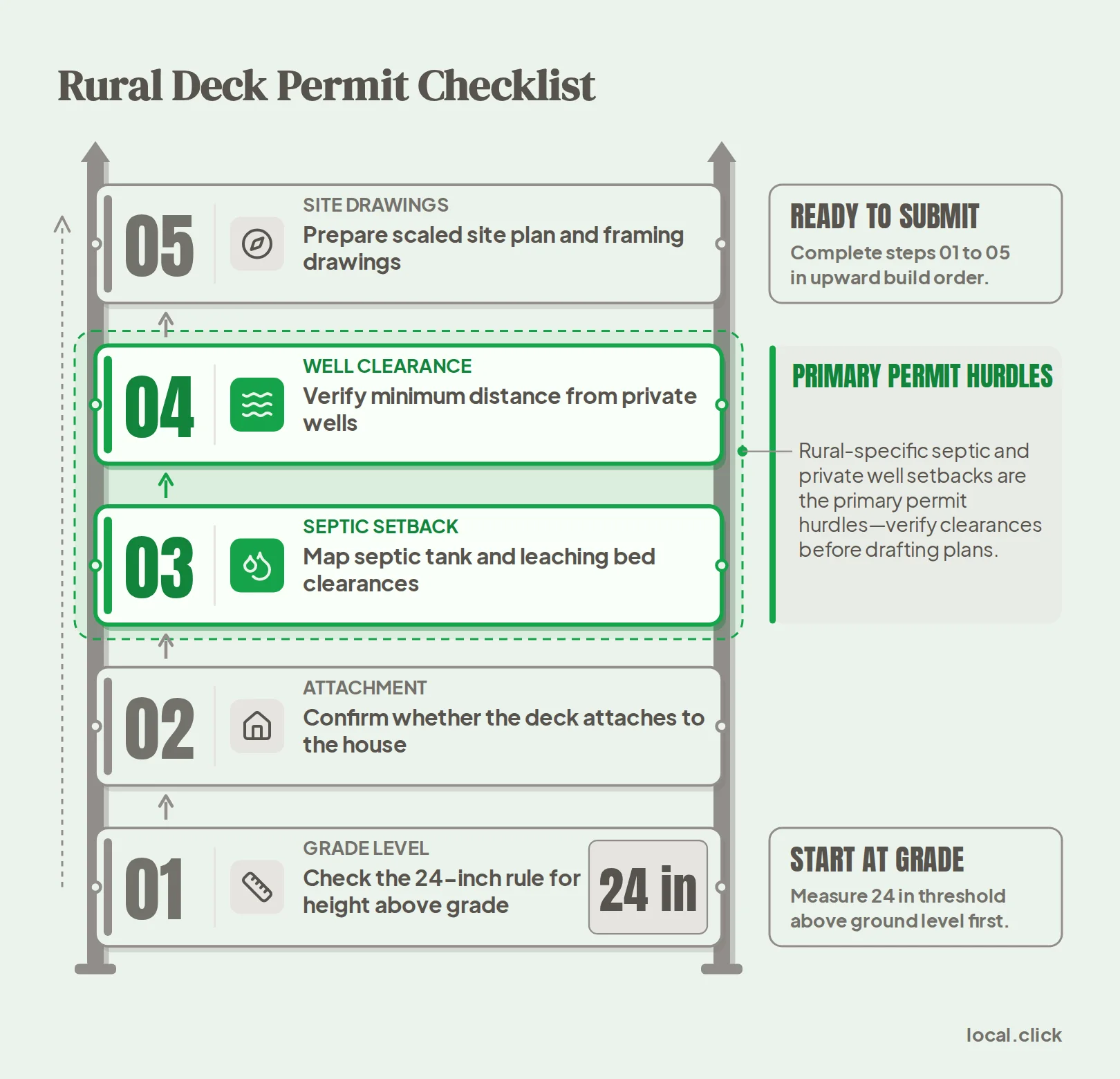
Processing times at the Township office are typically faster than in large urban centres, often taking two to three weeks for straightforward residential applications. When evaluating whether your design needs approval, pay close attention to the 24-inch rule and how the structure connects to your home:
- Ledger attachments: Decks attached to your house almost always require a permit because they affect the building envelope, whereas small, freestanding ground-level platforms under 100 square feet may be exempt.
- Heavy loads and roofs: Structures supporting a hot tub, enclosing a porch, or adding roof cover require engineered drawings and formal permit review.
- Septic and well clearances: Rural North Dumfries properties must maintain strict setbacks from septic leaching beds, tanks, and private wells so footings never compromise water quality or tile fields.
- Permit drawing package: Submitting an application requires a scaled site plan showing property line setbacks, framing and footing layouts, structural hardware details, and elevation views.
Watch out: Even if a low, floating platform qualifies for a permit exemption under the 24-inch rule, it must still obey all Ontario Building Code structural rules and township zoning setbacks.
Why Must Rural Homeowners Call Ontario 811 Before Digging Footings?
Before anyone sinks an auger into your yard, submitting a locate request through Ontario One Call is mandatory by law.
When you submit a ticket, Ontario One Call notifies every registered utility operating in your area, including Cambridge & North Dumfries Hydro, Enbridge for natural gas, Bell, Rogers, or Cogeco for telecom, and your municipality for water and sewer. However, acreages and farm properties around Ayr and Branchton also contain private buried infrastructure that crosses prime deck-building zones:
- Buried propane lines: Fuel lines connecting underground or yard storage tanks directly to your home.
- Well electrical feeds: Buried high-voltage cables powering submersible pumps in private wells.
- Septic distribution lines: Pipes running from the house to the septic tank and out across the leaching bed.
- Long driveway runs: Extended underground hydro or telecom conduits stretching hundreds of feet from the township road to the house.
Because public utility locators only mark lines up to the meter or property demarcation point, homeowners on country lots should review their property survey, septic installation records, and well records with their builder before marking final pier locations.
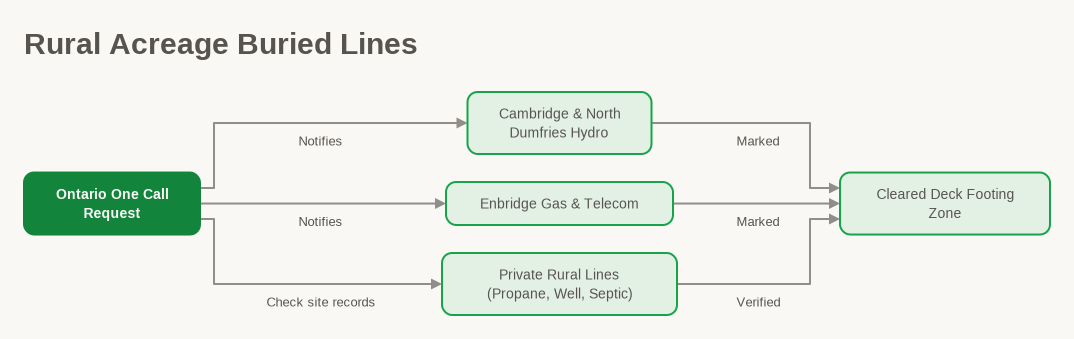
Rural North Dumfries properties have both public utility lines and private buried lines that must be located before digging deck footings.
Which Decking Materials Handle Southern Ontario Freeze-Thaw Cycles Best?
North Dumfries winters bring heavy snow loads, ice, and rapid spring temperature swings. When moisture seeps into joints or unsealed boards and freezes, it expands and punishes poorly built frames.
Choosing the right surface and substructure keeps your investment stable across decades of seasonal shifts. Compare the best composite decking brands in Ontario alongside traditional lumber before finalizing your quote:
Surface Decking Options
- Capped composite and PVC: Brands like Trex, TimberTech, and Fiberon resist moisture absorption, splintering, and mold without requiring annual staining. Keep in mind that while Fiberon offers strong mid-range value in Ontario, it has a smaller dealer network and is harder to find at retail for DIY builds than through specialty builders.
- Pressure-treated lumber: The lowest upfront cost for large rural multi-level decks, provided you clean and restain the boards every two to three years to check cracking and moisture damage.
- Western red cedar: Naturally resists decay and stays cooler underfoot in sunny country backyards, though it needs regular sealing to keep its warm colour.
Frost-Proof Footings and Drainage
- Deep concrete or helical footings: Ontario's frost line sits around four feet deep, so footings must extend below this depth using poured concrete sonotubes with embedded brackets or engineered helical piles to prevent winter frost heave.
- Preserved yard grading: Sloped lots in North Dumfries need clear under-deck drainage paths so spring snowmelt flows away from your house foundation without pooling or eroding the soil.
- Ledger flashing and airflow: Proper metal flashing at the house ledger board and adequate ground clearance underneath low platforms stop trapped dampness from rotting joists.
Who Are the Best Deck Builders in North Dumfries and What Should You Look For?
North Dumfries is served by specialized contractors across Waterloo Region, including many of the best deck builders in Cambridge, Kitchener, and Waterloo. Because rural builds involve septic clearances and deep frost footings, vetting a builder's credentials is essential.
The same vetting standards apply whether you are hiring a local crew in Ayr, comparing quotes for a deck builder in Hanover, or planning to transform your property with deck design in Welland.
Most licensed contractors in the region handle the building permit process for you: they draw and submit the plans, pay the municipal fee (which gets billed to you), book and attend site inspections, and maintain code compliance during the build. Before signing a contract, verify these qualifications:
- Licensing and insurance: Confirm the builder holds a valid Ontario builder's license, WSIB coverage, and at least $2M in liability insurance.
- Permitted rural references: Ask for references from recent permitted deck builds and check that the written contract clearly states who is responsible for permits and inspections.
- Electrical safety compliance: If your project includes hardwired 120V lighting or hot tub power, ensure the contractor pulls permits and arranges inspections with the Electrical Safety Authority (ESA).
- Lien protection awareness: Under Ontario's Construction Act, general contractors, subcontractors, material suppliers, and equipment rental companies can file a construction lien against your property title if they go unpaid—even if you already paid the general contractor in full.
How Do You Plan Your Timeline and Compare Quotes?
Whether you are comparing quotes in North Dumfries, planning affordable porch construction in Cambridge, or looking into deck design in Welland or Hanover, following a structured timeline keeps costs predictable. Start by exploring Ontario deck planning tools and contractor quotes to benchmark your project before the spring rush.
In Southern Ontario, the prime construction window runs from late spring through early fall when ground conditions are stable. If you have an aging wooden structure, an on-site assessment will also help you decide whether the frame is sound enough for resurfacing or requires a full rebuild from the footings up.
Follow these steps in order to take your project from initial sketch to final inspection:
- Preview materials and layouts: Use PaperPlan (paperplan.app) to upload a photo of your backyard and preview how Trex, TimberTech, or cedar will look on your home for free before committing to a builder.
- Request three written quotes: Gather at least three itemized bids that specify framing dimensions, decking brand, hardware, lighting fixtures, transformer and wire details, warranty terms, and payment schedules.
- Submit permits and 811 locates: Have your chosen contractor submit scaled drawings to the Township office and request utility locates prior to scheduling excavation.
- Complete staged inspections: Walk through the footing, framing, and final inspections with your contractor and the municipal inspector to confirm every detail meets code.
Tip: Book your design consultation and permit application in late winter so your project is first in line when ground conditions thaw in late spring.
🎨 Not sure which material to pick?
Upload a photo of your backyard and see exactly how Trex, TimberTech, or cedar would look — free and instant.
FAQ
How much does a municipal deck permit cost in Ontario?
Permit fees vary by municipality and project valuation. For example, residential deck permits in Welland typically run $200 to $500 CAD (with zoning variances adding $1,000 to $2,000 CAD), while an electrical permit application for hardwired deck lighting in Cambridge costs $130 to $200.
Can I build a low-level floating deck without a permit in North Dumfries?
Yes, a small, freestanding ground-level platform deck under 100 square feet (10 m²) that sits less than 24 inches (0.6 m) above finished grade at all points may not need a building permit. Always confirm directly with the township building department before starting work, because even permit-exempt decks must comply with the Ontario Building Code and local zoning bylaws.
How do I find reliable deck builders in Cambridge, Hanover, or Welland?
Whether you are hiring in North Dumfries, Cambridge, Hanover, or Welland, request at least three written quotes from contractors who hold a valid Ontario builder's license and at least $2M in liability insurance. Ask for references from recent permitted builds in your municipality to confirm they understand local frost depths and zoning rules.
Sources
Related reading
- Best Deck Builders in Ann Arbor, MI: Local Guide
- Best deck builders north charleston
- Deck cost north charleston
Drafted with AI, with what it says about local.click checked against local.click's documentation and product pages, and reviewed by Manpreet Garha. Its illustrations were generated with AI.
Upload a backyard photo and preview real decking materials with AI — free, instant, no sign-up.
Permits, costs, material comparisons, and questions to ask before requesting quotes — delivered to your inbox.