
Deck Cost in St. Paul (2026)
What does a deck cost in St. Paul in 2026? Get real pricing per square foot for composite, wood, and Trex decks — plus tips to save on your build.
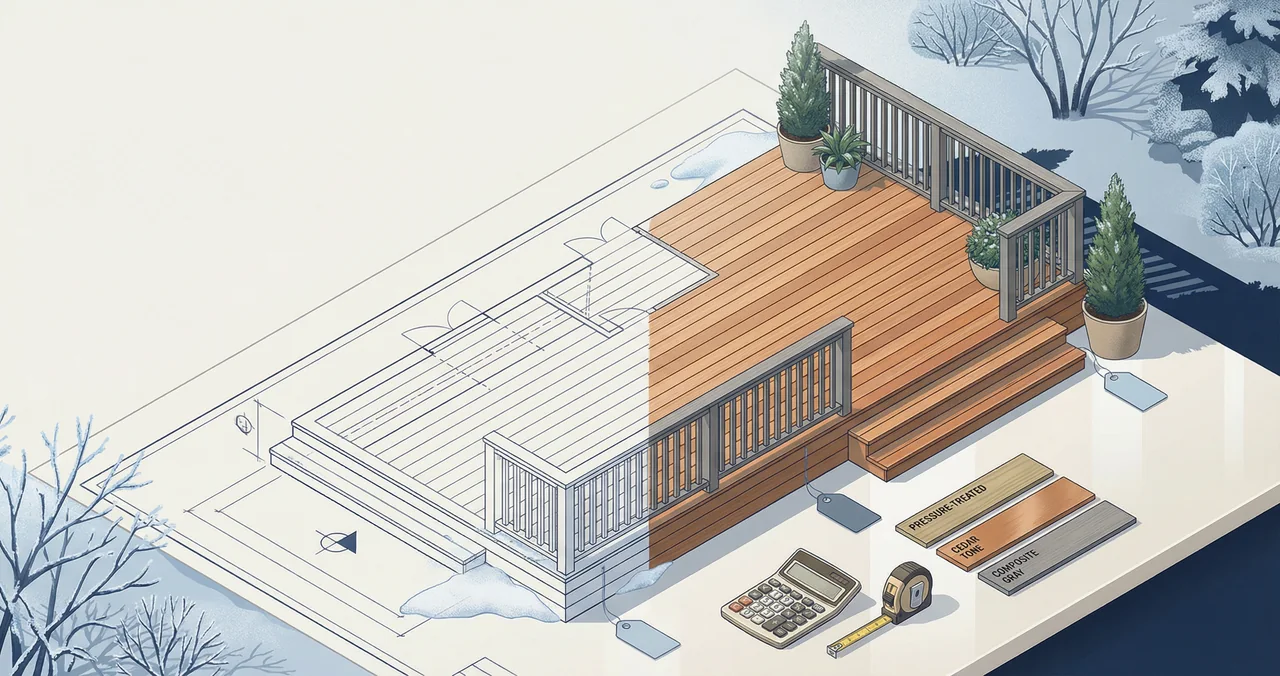
Deck Cost in St. Paul: What Homeowners Are Paying in 2026
You're getting quotes, and the numbers are all over the place. One contractor says $8,000. Another says $22,000 for what sounds like the same deck. What's actually reasonable for a deck build in St. Paul right now?
🏗️ Planning a deck project?
Get a free manual project review, or visualize your dream deck with AI before requesting quotes.
🧮 Tool Alert: Deck Cost Calculator
Estimate your project costs in seconds based on local pricing bands for your area.
Calculate My Cost →Here's the short answer: most St. Paul homeowners pay between $8,000 and $30,000 for a new deck in 2026, with the average landing around $15,000 to $18,000 for a standard 12x16 pressure-treated or composite build. But that range swings hard depending on material, size, height, and how complicated the design gets.
Below is what you should actually expect to pay — broken down by material, square footage, and the St. Paul-specific factors that push costs up or down.
<!-- slot:after-intro -->
For a broader look at deck pricing across different materials and regions, see our deck cost guide. Timing your build right can also save thousands — check our guide on the best time to build a deck.
Average Deck Cost in St. Paul by Material
Material choice is the single biggest cost driver. Here's what St. Paul homeowners are paying in 2026, fully installed:
| Material | Installed Cost (per sq ft) | 300 sq ft Deck | 500 sq ft Deck |
|---|---|---|---|
| Pressure-Treated Wood | $25–$45 | $7,500–$13,500 | $12,500–$22,500 |
| Cedar | $35–$55 | $10,500–$16,500 | $17,500–$27,500 |
| Composite | $45–$75 | $13,500–$22,500 | $22,500–$37,500 |
| Trex (mid-to-high tier) | $50–$80 | $15,000–$24,000 | $25,000–$40,000 |
| Ipe (Hardwood) | $60–$100 | $18,000–$30,000 | $30,000–$50,000 |
A few things to notice. Pressure-treated lumber is still the budget-friendly option, but it comes with a catch in St. Paul: you'll need to stain and seal it annually to protect against freeze-thaw damage and road salt residue that gets tracked onto the surface. Skip a year, and you'll see cracking and splintering fast.
Composite and Trex have become the most popular choice in the Twin Cities for good reason. They handle Minnesota winters without the maintenance headache. The upfront cost stings more, but you're not buying stain every spring.
Cost Per Square Foot Breakdown
Not all square footage costs the same. Here's how per-square-foot pricing typically breaks down for a St. Paul deck project:
- Decking material only: $3–$30/sq ft (pressure-treated on the low end, Ipe at the top)
- Substructure (joists, beams, posts): $5–$12/sq ft
- Hardware and fasteners: $1–$3/sq ft
- Railing: $20–$60 per linear foot (adds $2,000–$5,000+ to most projects)
- Labor: $10–$25/sq ft depending on complexity
The first 200 square feet are the most expensive per square foot. That's because mobilization, permits, footings, and ledger board attachment are fixed costs whether you're building 150 or 400 square feet. Once those are handled, additional square footage gets cheaper.
A 12x12 deck (144 sq ft) might run $35–$55/sq ft all-in, while a larger 16x20 deck (320 sq ft) could average $28–$45/sq ft with the same materials.
Labor Costs in St. Paul
Labor is where St. Paul's short building season hits your budget. Deck contractors in St. Paul typically charge $10–$25 per square foot for labor, depending on the scope and timing.
Here's the reality: the window for comfortable outdoor building in St. Paul runs roughly May through October. That's about six months, and every contractor in the metro is competing for the same window. Demand peaks from June through August, and that drives labor rates up.
How Timing Affects Labor Cost
- Book by March: You'll get better scheduling options and sometimes early-season pricing. Contractors are filling their calendars and may offer competitive rates to lock in work.
- Summer booking (June–August): Expect the highest labor rates and longer wait times. Some contractors add a 10–15% premium during peak months.
- Fall builds (September–October): You might catch a break on pricing as schedules open up, but you're racing the weather. An early frost can delay your project.
What Drives Labor Higher
- Elevated decks: Anything over 4 feet off the ground requires more structural engineering, more material for posts and bracing, and more time. Budget 20–40% more than a ground-level build.
- Multi-level designs: Each level change adds complexity, additional footings, and stairs.
- Demolition of an old deck: Removing an existing structure adds $1,000–$3,000 to most projects.
- Difficult access: If your backyard is fenced, has a steep grade, or can't accommodate equipment, labor hours go up.
If you're comparing quotes from builders in nearby cities, the labor market across the Twin Cities metro is fairly consistent. Builders in Minneapolis typically charge similar rates to St. Paul contractors since they pull from the same labor pool.
<!-- slot:mid-content -->
What Affects Your Total Price
Beyond material and labor, several St. Paul-specific factors push your final number around:
Footings and Frost Depth
This is a big one. Minnesota's frost line sits at 42 inches in the Twin Cities metro, and St. Paul enforces this strictly. Every footing needs to extend below that depth to prevent frost heave — the ground literally pushing your deck posts upward as it freezes and expands.
Deeper footings mean more concrete, more digging, and more labor. If you're on a hillside in neighborhoods like Cherokee Heights, Riverview, or the West Side bluffs, difficult soil conditions can push footing costs even higher. Some sites require sonotubes or helical piers instead of standard poured footings, adding $150–$400 per footing.
Permits and Inspections
In St. Paul, deck permits are typically required for structures over 200 square feet or 30 inches above grade. Contact St. Paul's Department of Safety and Inspections (DSI) before you start. Permit fees generally run $100–$500 depending on project value.
Don't skip this. Unpermitted decks create problems when you sell your home, and inspectors in St. Paul do check that footings hit frost depth.
Snow Load Requirements
St. Paul decks need to handle serious snow loads. The building code accounts for this, but it affects your substructure cost. Joists may need to be spaced at 12 inches on center instead of 16, and beams may need to be upsized. This adds roughly $500–$1,500 in additional structural lumber compared to builds in milder climates.
Lot Conditions
- Slope: A flat lot in Macalester-Groveland or Highland Park is straightforward. A sloped lot near the river bluffs requires retaining considerations and taller posts.
- Trees: Mature oaks and elms are everywhere in St. Paul's established neighborhoods. Building around them (or removing them) affects layout and cost.
- Setback requirements: Your deck can't extend into required setbacks from property lines. This sometimes limits size more than budget does.
Composite vs Wood: Cost Comparison
This is the decision most St. Paul homeowners wrestle with. Here's an honest comparison over a 10-year period for a standard 300 sq ft deck:
| Factor | Pressure-Treated Wood | Composite |
|---|---|---|
| Installed cost | $7,500–$13,500 | $13,500–$22,500 |
| Annual maintenance | $200–$400 (stain/seal) | $0–$50 (cleaning) |
| 10-year maintenance total | $2,000–$4,000 | $0–$500 |
| Board replacement (10 yr) | $500–$1,500 | Rare |
| 10-year total cost | $10,000–$19,000 | $13,500–$23,000 |
| Lifespan | 15–20 years | 25–30+ years |
The gap narrows fast. And in St. Paul specifically, wood takes a beating. The freeze-thaw cycle is relentless — water gets into grain, freezes, expands, splits the board. Road salt and sand tracked from sidewalks accelerate the damage. If you go with pressure-treated wood, commit to sealing it every single spring.
Composite handles all of this without complaint. Brands like Trex, TimberTech, and Fiberon offer 25-year warranties that cover structural integrity and fading. For a deeper look at how composite decking brands compare, that guide breaks down the differences between Trex, TimberTech, and others.
Use PaperPlan to visualize different decking materials on your own home before committing — seeing composite versus cedar on your actual house helps the decision click.
When Wood Still Makes Sense
- You're on a tight budget and willing to maintain it
- You want a natural look and feel (nothing quite matches real cedar)
- You're building a temporary structure or plan to upgrade later
- Your deck is covered/screened, limiting weather exposure
How to Save Money on Your St. Paul Deck
Smart savings that don't sacrifice quality:
1. Choose your timing carefully. Book your contractor in late winter (February–March) for a spring build. You'll avoid the summer premium and get first pick of scheduling.
2. Keep the shape simple. Rectangular decks are the most efficient to build. Every angle, curve, and multi-level step adds cutting waste and labor time. A straightforward rectangle can save 10–20% over a complex design.
3. Right-size the deck. Most families use a 12x16 or 14x16 space comfortably. Going to 20x20 doubles your cost but doesn't double the usability. Think about how you'll actually use the space — grilling, dining, seating — and size accordingly.
4. Reduce railing runs. Railing is one of the most expensive components per linear foot. If your deck is under 30 inches off the ground, St. Paul code doesn't require railing. Even on taller decks, designing fewer exposed edges (using the house wall or landscape walls as borders) cuts railing costs.
5. Use composite strategically. Some homeowners go composite on the decking surface but use pressure-treated lumber for the substructure (which is standard practice anyway). This gives you the low-maintenance surface where it counts.
6. Get at least three quotes. Pricing in St. Paul varies widely between contractors. Three quotes give you a realistic picture of the market. Make sure each quote breaks down material, labor, permits, and any site prep separately.
7. Do your own demo. If you're replacing an old deck, tearing it out yourself saves $1,000–$3,000. It's hard work but not complicated — a pry bar, a reciprocating saw, and a dumpster rental are all you need.
For homeowners on a tighter budget, affordable deck builders in Chicago and Indianapolis face similar Midwest pricing — those guides have additional cost-saving strategies that apply to St. Paul projects too.
<!-- slot:before-faq -->
🎨 Not sure which material to pick?
Upload a photo of your backyard and see exactly how Trex, TimberTech, or cedar would look — free and instant.
Frequently Asked Questions
How much does a 12x16 deck cost in St. Paul?
A 12x16 deck (192 sq ft) in St. Paul typically costs $5,500–$9,500 in pressure-treated wood and $9,500–$15,000 in composite, fully installed. These estimates include standard railing, footings to frost depth, and basic stairs. Add $1,000–$3,000 for features like built-in benches, planter boxes, or upgraded railing systems.
Do I need a permit to build a deck in St. Paul?
Yes, in most cases. St. Paul requires a building permit for decks over 200 square feet or 30 inches above grade. Even smaller decks may need a permit if they're attached to the house. Apply through St. Paul's Department of Safety and Inspections. Permit fees typically run $100–$500, and you'll need a site plan showing setbacks and property lines. Inspections are required for footings (before pouring concrete) and the final structure.
What is the best decking material for Minnesota winters?
Composite decking (Trex, TimberTech, Fiberon) performs best in St. Paul's climate. It resists moisture absorption, won't split from freeze-thaw cycles, and doesn't need annual sealing. PVC decking is another strong option — it's completely moisture-proof. Cedar holds up reasonably well but needs consistent maintenance. Pressure-treated wood is the most vulnerable to Minnesota's freeze-thaw punishment and requires annual staining and sealing to last. For a detailed material comparison, see our guide on composite decking brands and how they hold up.
When is the cheapest time to build a deck in St. Paul?
Late fall and early spring tend to offer the best pricing. Booking your project in February or March for a May start date gives you access to early-season rates before the summer rush. September and October builds can also be more affordable as contractor schedules open up. Avoid booking for June through August if cost is your primary concern — that's peak season with the highest labor premiums.
How long does it take to build a deck in St. Paul?
A standard 12x16 ground-level deck takes 3–5 days once work begins. Larger or elevated decks with complex features can take 1–3 weeks. The real timeline factor is scheduling — during peak season (June–August), you might wait 4–8 weeks from signing a contract to the start of construction. Getting your permit approved adds another 1–3 weeks depending on DSI's workload. Plan for a total timeline of 6–12 weeks from first call to finished deck during the busy season.
If you're exploring what permits involve in cities with similar requirements, our guides on deck permits in Minneapolis and deck permits in St. Paul walk through the full process.
<!-- slot:end -->
📋 Planning a deck project?
Get a free manual project review from our team — no obligation, no spam.
Get Free Project Review →Upload a backyard photo and preview real decking materials with AI — free, instant, no sign-up.
Permits, costs, material comparisons, and questions to ask before requesting quotes — delivered to your inbox.