
Best Composite Decking in Canada: Top 7 Brands Compared
Compare the best composite decking brands in Canada for 2026. Performance ratings, pricing, warranty coverage, and which performs best in Ontario winters.
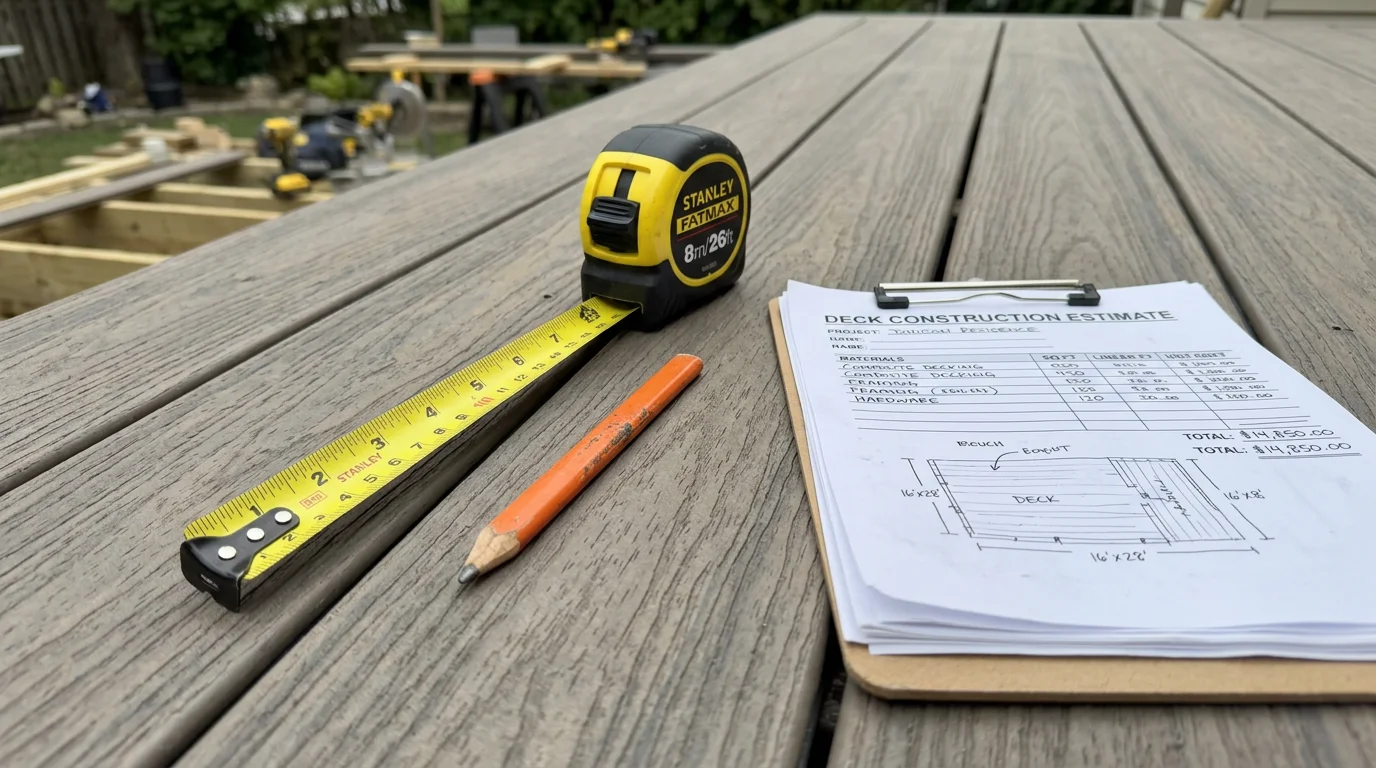
Composite decking costs $65-95/sqft installed in Ontario—roughly 30-50% more than pressure-treated lumber. That premium buys you no staining, no splinters, and 25+ years of low-maintenance use. But not all composite performs the same in Canadian winters.
Some brands fade in direct sun. Others expand and contract too much in freeze-thaw cycles. A few scratch easily or hold snow melt that refreezes into slippery patches. You need boards engineered for -30°C winters and 35°C summers, not just American mild climates.
This guide compares seven composite brands available across Canada on durability, warranty, heat retention, scratch resistance, and real-world pricing in the KWC market.
What Makes Composite Decking Different
Composite boards blend wood fiber (sawdust) with plastic resin—usually polyethylene or PVC. The wood gives it a natural texture and rigidity. The plastic makes it waterproof and rot-proof.
🏗️ Planning a deck project?
Get a free manual project review, or visualize your dream deck with AI before requesting quotes.
Three main types:
- Capped composite: Wood-plastic core wrapped in a polymer shell. The cap protects against stains, fading, and scratches. Premium option.
- Uncapped composite: No protective shell—just the wood-plastic blend. Cheaper but fades faster and stains more easily.
- PVC decking: No wood fiber—pure plastic. Lightest weight, doesn't absorb moisture at all, but lacks the natural look of wood-fiber boards.
Most brands sold in Canada now use capped composite. The cap thickness matters—0.5 mm is standard, but premium boards use 1+ mm caps that last longer.
Top 7 Composite Decking Brands in Canada
1. Trex (USA)
Market leader. Trex owns about 40% of the North American composite market. Their Transcend line uses a triple-layer cap that resists scratches better than most competitors.
Pros:
- 25-year fade and stain warranty (residential)
- Wide color range—12+ options in Transcend line
- Available at most Ontario lumber yards and big-box stores
- Proven track record in Canadian winters—used since the 1990s
Cons:
- Premium pricing: $8-12/sqft for materials in Ontario (2026)
- Heavier than some brands—requires standard 16" joist spacing
- Surface can get hot in direct sun (darker colors especially)
Best for: Homeowners who want the most proven brand and don't mind paying extra.
Ontario availability: Home Depot, Lowe's, most independent lumber yards in KWC.
2. TimberTech (USA)
Close second to Trex. TimberTech (owned by AZEK) offers both capped composite (TimberTech Pro) and PVC lines (AZEK). Their AZEK line is 100% PVC—no wood fiber—so it absorbs zero moisture and stays cooler underfoot than wood-composite boards.
Pros:
- 30-year limited fade/stain warranty on AZEK PVC line
- Stays cooler than most composites (especially AZEK line)
- Excellent color retention—minimal fading even in full sun
- Hidden fastener system creates clean, screw-free surface
Cons:
- $9-13/sqft for AZEK materials—most expensive option
- PVC boards can feel more plastic-like underfoot
- Fewer retail locations than Trex in Ontario
Best for: Homeowners with south-facing decks in full sun, or anyone prioritizing low surface temperature.
Ontario availability: Select Home Hardware stores, specialty decking retailers in KWC.
3. Fiberon (USA)
Mid-range value. Fiberon's Paramount line uses PermaTech capping—a thick polymer shell that resists scratches and stains. Their Concordia line offers a budget-friendly alternative with lighter capping.
Pros:
- 25-year stain/fade warranty (Paramount line)
- Good color variety—11 options in Paramount
- $6-10/sqft for materials—sits between budget and premium brands
- Performs well in Ontario freeze-thaw cycles
Cons:
- Less widely stocked than Trex or TimberTech in Canada
- Concordia line (budget option) has thinner capping—more prone to scratches
- Warranty claims process can be slow according to some installers
Best for: Homeowners who want premium performance without Trex pricing.
Ontario availability: Some Home Depot locations, independent lumber yards (call ahead).
4. Deckorators (Canada)
Canadian-owned brand. Deckorators sources from international manufacturers but tailors product lines for Canadian climates. Their Voyage and Heritage lines both use heavy polymer capping.
Pros:
- Designed specifically for Canadian weather—freeze-thaw rated to -40°C
- 25-year limited warranty on fade and stain
- $7-11/sqft for materials—competitive mid-range pricing
- Strong distribution across Ontario through independent dealers
Cons:
- Smaller color selection than Trex (7-8 options)
- Brand recognition lower than American competitors
- Some installers report more expansion/contraction than Trex
Best for: Homeowners who prefer supporting Canadian brands and need proven cold-weather performance.
Ontario availability: Independent lumber yards, specialty deck retailers in KWC.
5. Fibrix (Canada)
Quebec-based manufacturer. Fibrix produces composite decking specifically for the Canadian market. Their Oasis line uses a co-extruded cap (applied during manufacturing, not added later) for consistent thickness.
Pros:
- Made in Canada—shorter supply chain, better availability
- 25-year warranty covering fade, stain, and structural integrity
- $5-9/sqft for materials—more affordable than Trex
- Performs well in harsh Quebec winters (colder than KWC)
Cons:
- Limited color range—6 options
- Fewer retail locations in Ontario (stronger Quebec presence)
- Less installer familiarity compared to Trex
Best for: Budget-conscious homeowners who want Canadian-made products.
Ontario availability: Select independent lumber yards (more common in Eastern Ontario).
6. NewTechWood UltraShield (USA/Malaysia)
Budget-friendly option. NewTechWood offers capped composite at lower prices than Trex or TimberTech. Their UltraShield line uses a 360-degree polymer cap (covers all four sides, not just top and bottom).
Pros:
- $4-7/sqft for materials—among the most affordable capped composites
- 25-year limited warranty
- Full 360° capping protects edges from moisture
- Lighter weight than most brands—easier handling during install
Cons:
- Thinner boards—some installers report more flex between joists
- Color options limited (5-6 in Canada)
- Less proven track record in Canadian winters (newer to market)
Best for: DIY builders or homeowners with tight budgets who still want capped composite quality.
Ontario availability: Some Home Depot locations, online retailers.
7. Veranda (Home Depot house brand)
Entry-level composite. Veranda is Home Depot's private-label composite line. It's uncapped (no polymer shell), which means more maintenance than premium brands but still far less than wood.
Pros:
- $3-5/sqft for materials—cheapest composite option
- Widely available at every Home Depot
- 20-year warranty on structural integrity
- Good option for low-traffic areas (sheds, walkways)
Cons:
- No protective cap—stains and fades more than capped brands
- Absorbs more moisture than capped composites
- Warranty doesn't cover fade or stain (structural only)
- Not recommended for high-use decks
Best for: Homeowners building secondary structures or balancing very tight budgets.
Ontario availability: Home Depot stores across KWC.
Performance Comparison: Ontario Climate
| Brand | Fade Resistance | Freeze-Thaw Performance | Heat Retention | Scratch Resistance |
|-------|----------------|------------------------|----------------|-------------------|
| Trex Transcend | Excellent | Excellent | Moderate-High | Excellent |
| TimberTech AZEK | Excellent | Excellent | Low | Excellent |
| Fiberon Paramount | Excellent | Very Good | Moderate | Very Good |
| Deckorators Voyage | Very Good | Excellent | Moderate | Very Good |
| Fibrix Oasis | Very Good | Excellent | Moderate | Good |
| NewTechWood UltraShield | Good | Good | Moderate | Good |
| Veranda | Fair | Fair | Moderate-High | Fair |
Freeze-thaw performance matters most in Ontario. Look for brands rated to at least -30°C. Boards with thicker capping handle repeated expansion and contraction better—the cap prevents moisture from entering the wood-fiber core where it could freeze and cause microcracks.
Heat retention varies significantly. Dark colors on capped composites can reach 50-60°C in direct summer sun—uncomfortable for bare feet. AZEK PVC boards stay 10-15°C cooler than wood-composite boards. Choose lighter colors if your deck gets afternoon sun.
Pricing Breakdown: Material + Installation
Material costs (per square foot, 2026 KWC market):
- Premium capped composite (Trex Transcend, TimberTech AZEK): $8-13/sqft
- Mid-range capped composite (Fiberon Paramount, Deckorators, Fibrix): $5-10/sqft
- Budget capped composite (NewTechWood UltraShield): $4-7/sqft
- Uncapped composite (Veranda): $3-5/sqft
Installation costs add $25-45/sqft depending on deck complexity, height, and railing requirements. Total installed cost: $65-95/sqft for most composite decks in KWC.
A typical 12' × 16' deck (192 sqft) costs:
- Materials: $960-2,500 depending on brand
- Labour: $4,800-8,640
- Railing: $1,600-4,800 (40 linear feet at $40-120/ft)
- Permit: $150-400
- Total: $7,500-16,000+
See detailed pricing breakdowns in our composite deck cost guide for Waterloo.
Warranty Coverage Comparison
All major brands offer warranties, but coverage varies significantly:
Trex Transcend: 25-year fade/stain warranty, 25-year structural warranty. Covers fading beyond normal wear, mold growth, and structural failure. Residential use only—commercial use voids warranty.
TimberTech AZEK: 30-year fade/stain warranty (AZEK PVC line), 25-year structural. One of the best warranties in the industry.
Fiberon Paramount: 25-year stain/fade, 25-year structural. Requires professional installation for full warranty coverage.
Deckorators: 25-year fade/stain, 25-year structural. Transferable to new homeowners (rare in the industry).
Fibrix Oasis: 25-year comprehensive warranty covering fade, stain, and structure.
NewTechWood UltraShield: 25-year limited warranty. Coverage details less transparent than premium brands.
Veranda: 20-year structural warranty only—no fade or stain coverage.
Important: Most warranties require proof of purchase, proper installation (often professional installation), and regular cleaning. They don't cover damage from snow shovels, furniture scratches, or neglect. Read the fine print before assuming full coverage.
Installation Considerations for Ontario
Joist Spacing
Most composite brands require 16-inch on-center joist spacing for residential decks. Some lighter brands (NewTechWood, Veranda) allow 24-inch spacing at certain angles, but 16" is safer and reduces flex underfoot.
Gapping
Composite boards expand and contract with temperature changes. In Ontario, you'll see winter-to-summer temperature swings of 60-70°C. Follow manufacturer gapping guidelines—usually 3-6 mm between board ends and 6-10 mm at fixed objects (house ledger, posts, stairs).
Poor gapping causes buckling in summer heat or excessive gaps in winter cold. Learn more in our deck board spacing guide for Ontario.
Fastening
Hidden fasteners create cleaner surfaces and protect the boards from moisture entry at screw holes. Most premium brands include proprietary hidden fastener systems. Expect to pay $1-2/sqft extra for hidden fasteners over face screws.
Face screws work fine for budget builds. Use stainless steel or coated composite screws—regular deck screws rust and leave stains.
Ventilation
Composite decks need airflow underneath to prevent moisture buildup. Leave 6+ inches of clearance between ground and deck boards. If you're adding deck skirting, include vent panels or gaps every 4-6 feet.
Footings
Ontario Building Code requires footings below the 48-inch (1.2 m) frost line. Concrete sonotubes or helical piles both work. Helical piles install faster and work better in clay-heavy KWC soil but cost $150-300 per pile installed.
Maintenance: What to Expect
Composite decking isn't maintenance-free—it's low-maintenance. You'll still need to:
Clean 2-3 times per year with mild soap and water. Remove leaves, pollen, and debris before they stain. Power washers work but keep pressure below 1,500 PSI and the nozzle at least 12 inches away.
Remove snow carefully. Use a plastic shovel, not metal—metal scrapes the protective cap. Don't use rock salt (calcium chloride is better). See our winter deck care guide for details.
Watch for mold in shaded areas or under furniture. Composite doesn't rot but mold still grows on surface dirt. Clean with oxygen bleach or composite deck cleaner—not chlorine bleach (damages capping).
Expect some fading even with premium brands. All composites fade slightly in the first 12-18 months as UV exposure stabilizes the polymer cap. After that, color should remain stable for 20+ years.
Read the full maintenance guide: Composite deck maintenance in Ontario.
Composite vs. Pressure-Treated: Still Worth It?
Composite costs 45-60% more upfront than pressure-treated lumber ($45-65/sqft for PT installed vs. $65-95/sqft for composite). But composite saves long-term:
No staining or sealing: PT decks need refinishing every 2-3 years. DIY costs $200-400 in materials per deck plus a weekend of work. Hiring out costs $800-1,500 per treatment. Over 25 years, that's $6,000-12,000 in maintenance.
Longer lifespan: PT lumber lasts 15-20 years in Ontario climate. Composite lasts 25-30+ years. You'll rebuild a PT deck at least once; composite might last your entire homeownership.
Resale value: Real estate agents report composite decks increase home value more than PT. Buyers see them as premium features requiring less work.
Better underfoot: No splinters, no cupping or warping boards. Surface stays more consistent across the deck's life.
Full comparison with cost modeling: Composite vs. wood decking in Ontario.
Which Brand Should You Choose?
Best overall: Trex Transcend. Proven performance in Canadian winters, widest color selection, available everywhere, excellent warranty. Worth the premium if budget allows.
Best value: Fiberon Paramount or Deckorators Voyage. Mid-range pricing with premium performance. Great balance for most homeowners.
Best for Canadian climate: Deckorators or Fibrix. Both designed specifically for harsh Canadian winters. Better freeze-thaw performance than American brands optimized for milder climates.
Best budget option: NewTechWood UltraShield. Still offers protective capping at significantly lower cost than premium brands. Good for first-time builders or secondary structures.
Best for hot decks: TimberTech AZEK (PVC line). Stays coolest underfoot in direct sun. Ideal for south-facing decks or pool areas.
Skip: Veranda. The price gap between uncapped Veranda and budget capped brands (NewTechWood) is small enough that you should step up to capped composite. The performance difference is significant.
🎨 Not sure which material to pick?
Upload a photo of your backyard and see exactly how Trex, TimberTech, or cedar would look — free and instant.
Common Questions
How long does composite decking last in Ontario?
Premium capped composite (Trex, TimberTech, Fiberon) lasts 25-30+ years in Ontario climate. Budget uncapped composite lasts 15-20 years. Pressure-treated wood lasts 15-20 years. Lifespan depends on maintenance—regular cleaning and careful snow removal extend durability.
Can I install composite decking myself?
Yes, if you're comfortable with basic carpentry. Composite installs similarly to wood decking but requires careful attention to gapping (boards expand/contract with temperature) and proper fastening. Hidden fastener systems take longer than face screws but create cleaner results. Expect 2-3 days for a typical 12' × 16' deck. You'll still need permits in most KWC municipalities even for DIY builds.
Does composite decking get hot in summer?
Yes, especially darker colors. Dark brown and grey composite can reach 50-60°C in direct sun—uncomfortable for bare feet. Lighter colors (tans, light greys) stay 10-15°C cooler. PVC boards (TimberTech AZEK) retain less heat than wood-fiber composite. If your deck faces south or west with afternoon sun exposure, choose light colors or consider shade structures like pergolas.
Which composite brand has the best warranty?
TimberTech AZEK offers the longest warranty at 30 years for fade and stain coverage (PVC line only). Most premium capped composites (Trex, Fiberon, Deckorators, Fibrix) offer 25-year warranties. Budget brands offer 20-25 years. Check whether warranties cover both staining and fading—some only cover structural failure. Most warranties require professional installation and regular maintenance to remain valid.
Can you refinish or stain composite decking?
No. Composite decking can't be sanded or refinished like wood. The protective polymer cap is only 0.5-1 mm thick—sanding removes it and exposes the wood-plastic core underneath. If boards get damaged or scratched, you replace individual boards rather than refinishing the entire deck. This is why choosing a quality brand with thick capping matters upfront.
You may also want to read Where to Get Composite Decking Samples in Canada.
You may also want to read Non-Slip Composite Decking for Canadian Winters.
Planning a pool area? See Composite Decking Around a Pool in Canada: Best Options.
Upload a backyard photo and preview real decking materials with AI — free, instant, no sign-up.
Permits, costs, material comparisons, and questions to ask before requesting quotes — delivered to your inbox.