
Where to Get Composite Decking Samples in Canada
Find out where to get free composite decking samples in Canada, what to look for when comparing brands, and how to test them before committing to your deck project.
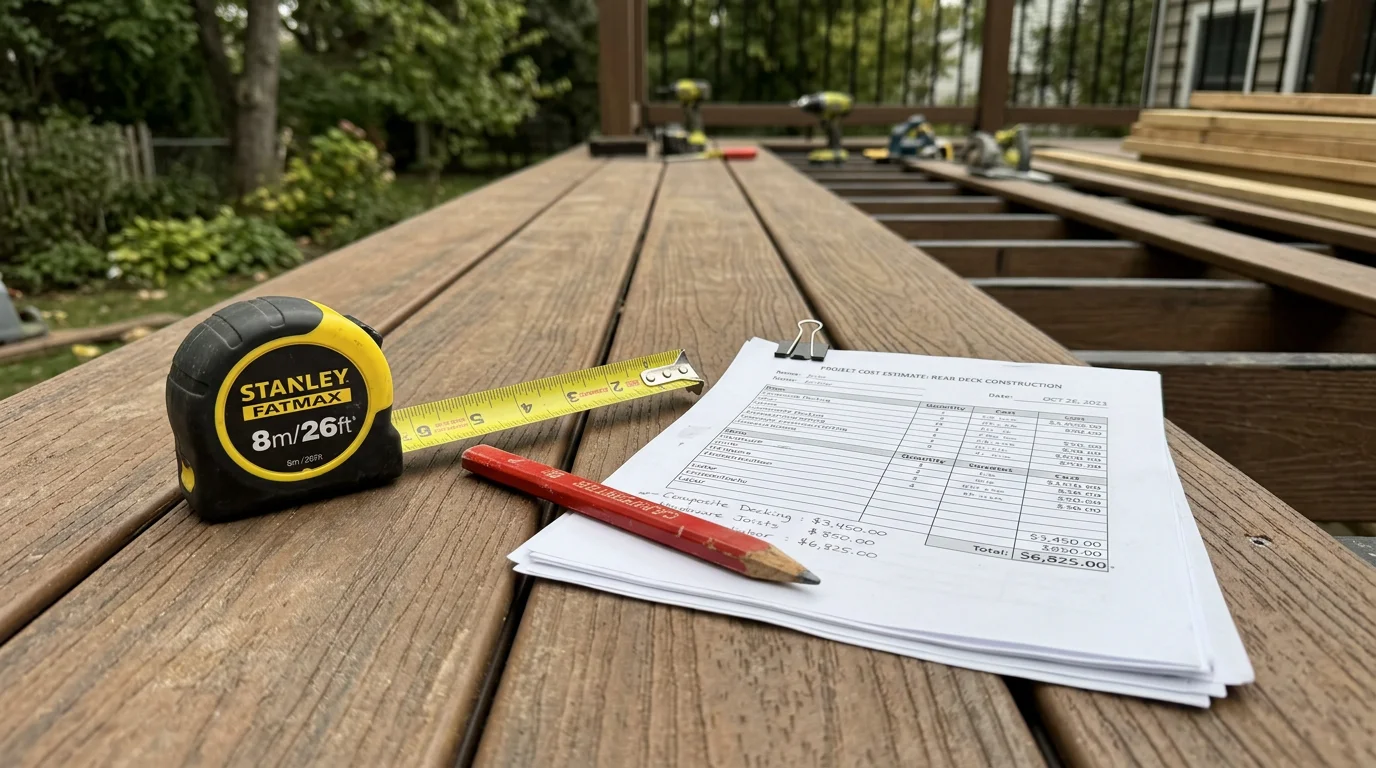
You're about to spend $65-95 per square foot on a composite deck, and choosing the wrong board colour or texture means living with a regret for 25+ years. Smart move getting samples first.
Here's exactly where Ontario homeowners can get composite decking samples, what to request, and how to test them properly before you commit.
Where to Get Free Composite Decking Samples
Direct from Manufacturers
Most major composite brands ship samples directly to Canadian addresses. You'll get actual deck board pieces — usually 6-12 inches long — in the exact colour and finish you're considering.
🏗️ Planning a deck project?
Get a free manual project review, or visualize your dream deck with AI before requesting quotes.
Trex offers free sample chips through their website. Request up to 5 colours at once. Delivery takes 7-14 business days to Ontario addresses. The samples are small (roughly 4" x 6"), but show the real texture and colour.
TimberTech (now Azek) provides larger samples through their "Order Samples" portal. You can request samples from their entire product line including AZEK, TimberTech PRO, and TimberTech EDGE collections. They ship within 5-10 business days.
Fiberon sends sample chips free through their website. Their samples show the three-dimensional wood grain texture clearly — important if you're comparing their Horizon or Paramount lines.
Deckorators offers sample chips and also maintains a "Where to Buy" locator that shows which retailers stock display boards you can see in person.
Canadian manufacturers also ship samples:
Duradek (BC-based) provides composite samples for their decking products. Since they're Canadian, shipping is often faster to Ontario.
Royal Building Products ships samples of their Royal Composite Decking line. As a Canadian company, they understand our climate requirements better than most.
Big-Box Retailers
Home Depot and Lowe's both stock composite decking display boards in-store. You can see and touch full-size boards in multiple colours. Staff won't typically let you take display boards home, but they can often provide small cut pieces or order manufacturer samples through their systems.
The advantage here: you see boards under store lighting and can compare 6-8 options side by side in minutes.
Local Building Supply Yards
Specialty lumber yards in Kitchener-Waterloo-Cambridge often stock composite decking and keep sample boards on hand. Places like Johnson Lumber & Home Hardware, Cora Building Supplies, and regional Timber Mart locations carry multiple composite brands.
Call ahead and ask if they provide take-home samples. Many will cut you a 12-18 inch piece from a damaged board at no charge.
Deck Builders and Contractors
Contractors who install composite decking regularly keep sample collections. If you're getting quotes anyway, ask each builder to bring samples to your site visit.
Bonus: seeing samples in your actual outdoor space, next to your house siding and under natural light, gives you the most accurate colour preview. Grey composite that looks perfect under fluorescent lights might clash badly with your brick.
When requesting quotes for your project, check out our deck quote checklist for Kitchener-Waterloo to ensure you're comparing builders fairly.
What to Request When Ordering Samples
Don't just order one colour and call it done. Here's what to request:
Your top 3 colours — What looks good online rarely looks identical in person. Order multiple options.
Different product lines — Trex Enhance looks and feels completely different from Trex Transcend. If a brand offers basic, mid-tier, and premium lines, sample all three.
Matching railing samples — If you're planning composite or PVC railings, get those samples too. A "colour match" between decking and railing from the same manufacturer is never perfect. See the difference before you order.
Fascia board samples — Fascia (the vertical trim covering your deck frame perimeter) comes in fewer colours than decking. Make sure your preferred deck colour has a fascia match you like.
Current production runs — Composite manufacturers adjust formulas occasionally. Ask specifically for samples from current inventory, not old discontinued colours.
How to Test Composite Samples Properly
Getting samples is easy. Testing them correctly takes more effort, but it's worth it.
Outdoor Exposure Test
Tape samples to a south-facing surface (fence, deck railing, house wall) and leave them for 2-3 weeks minimum. This shows you:
- Real outdoor colour — Composite looks dramatically different under natural light versus indoor showroom lighting
- Heat absorption — Dark colours (especially browns and greys) get scorching hot in July sun. Walk barefoot on your deck? This matters
- Fade preview — Some samples will start showing slight colour shift even after a few weeks of UV exposure
- Weather resistance — Check for water spotting, staining, or texture changes after rain
Place samples horizontally (like an actual deck board) and vertically (like fascia). Horizontal surfaces collect more dirt and show weathering faster.
Water and Stain Testing
Composite is marketed as low-maintenance, but it's not stain-proof. Test your samples:
Wine, ketchup, mustard, coffee — Drop small amounts on samples. Let sit for 24 hours. Try to clean with just water and a cloth. If staining remains, try mild dish soap. This simulates real deck life.
Grease — Barbecue grease is the enemy of composite decking. Apply a small amount, wait 48 hours, then clean. Some cheaper composites absorb grease permanently.
Mold and mildew — Wet a sample, place it in a plastic bag, and leave it somewhere dark and humid for a week. Quality composite resists mold growth. Cheaper boards may show black spots.
For more on maintaining composite Ontario deck guides's climate, see our guide to composite deck maintenance in Ontario.
Snow and Ice Simulation
Ontario winters are brutal. Put samples in your freezer, then move them to room temperature. Repeat 5-6 times. This mimics freeze-thaw cycling.
Quality composite won't crack, warp, or change texture. Lower-grade products may develop surface cracks or texture changes.
Texture Comparison
Run your hand across samples. Walk on them barefoot. Consider:
Slip resistance — Smooth composite gets dangerously slippery when wet. Textured or embossed boards provide better traction, especially important for stairs and pool decks.
Comfort — Deep wood-grain textures look realistic but trap more dirt. Very smooth finishes feel artificial but clean easily.
Splinter potential — Run your hand along cut edges and corners. True splinter-free construction means even cut edges are smooth.
Expansion and Contraction Test
Composite expands and contracts with temperature. Leave samples in direct sun for several hours, then measure the board length with a ruler or tape measure. Move to shade or bring inside to cool completely. Measure again.
Most composites expand roughly 0.05-0.1 inches per 10 feet with temperature swings. This affects deck board spacing requirements in Ontario.
What to Look for When Comparing Samples
Colour Consistency
Look at the sample from different angles. Quality composite shows consistent colour throughout. Cheaper products sometimes have colour streaking or blotchy areas where the wood fibre content varies.
If the sample has a "capped" or "shell" construction (plastic shell over composite core), check that the cap layer extends fully to all edges.
Core Composition
Break or cut a sample in half if possible. The core should show:
- Consistent density — No air pockets or voids
- Even wood-fibre distribution — Not clumpy or separated
- Capped products — Clear distinction between the cap layer and core
Weight and Density
Heavier composite generally (not always) indicates higher quality and durability. Weigh samples of similar size from different brands.
Very lightweight composite often contains more plastic filler and less wood fibre. It may be less durable and more prone to fading.
Manufacturing Quality
Check sample edges and corners:
- Clean, consistent edges — No ragged fibres or rough spots
- Uniform thickness — Measure at multiple points
- Straight boards — Lay the sample on a flat surface; it shouldn't rock or wobble
Warranty Comparison
Samples should include warranty information. Compare:
- Stain and fade coverage — 25+ years is standard for premium products
- Structural warranty — Should be 25-50 years
- Transferability — Does warranty transfer if you sell your home?
- Canadian validity — Some US warranties have different terms for Canadian installations
For a detailed breakdown of Canadian composite options, check our complete guide to composite decking in Canada.
Understanding Sample Limitations
Samples are essential but imperfect:
Colour variation — Real deck boards come from different production batches. Your installed deck will show slight colour variation between boards. Samples show one board only.
Length and appearance — A 6-inch sample looks different than a 16-foot board spanning your entire deck. Patterns and colour variations become more apparent at full length.
Aging — Samples can't show you what the deck looks like after 5, 10, or 20 years. Read online reviews and look at installed decks in your neighbourhood.
Installation factors — How composite looks depends partly on installation quality. Proper joist spacing, ventilation, and drainage affect long-term appearance.
Cost Considerations for Composite Decking
While you're comparing samples, keep realistic budget numbers in mind:
Material cost — Premium composite (Trex Transcend, TimberTech AZEK, Fiberon Paramount): $8-14 per square foot. Mid-tier (Trex Select, TimberTech PRO): $5-9 per square foot. Budget composite: $4-7 per square foot.
Installed cost — Total project cost including framing, labour, and materials: $65-95 per square foot in the KWC market as of 2026.
For detailed pricing breakdowns, see our guides for deck costs in Kitchener, Waterloo, and Cambridge.
Don't forget permit costs ($150-400) and potential site work expenses. Review our article on deck permit costs in KWC for full budget planning.
Sample Cost vs. Project Cost
Manufacturers provide samples free because they know once you're holding real boards, comparing textures, and visualizing your deck, you're far more likely to commit to the purchase.
Spending 2-3 weeks testing samples thoroughly can save you thousands in regret. Changing your mind after boards are delivered — or worse, after installation begins — gets expensive fast.
Best Brands to Sample First
If you're overwhelmed by options, start with these proven performers in the Canadian market:
Trex — The market leader. Extensive colour selection, proven durability, widely available in Ontario. Sample their Transcend line for premium quality or Enhance for mid-tier value.
TimberTech (AZEK) — Premium products with excellent fade and stain warranties. Their AZEK line is 100% PVC (not composite) and performs exceptionally in Ontario weather.
Fiberon — Strong mid-market option. Good colour selection, realistic wood-grain textures, competitive pricing. Sample their Paramount line for high-end or Horizon for value.
For Canadian-made options, sample Royal Building Products composite decking. Supporting domestic manufacturing means easier warranty service and better supply chain reliability.
Our best composite decking in Canada comparison breaks down these brands in detail.
🎨 Not sure which material to pick?
Upload a photo of your backyard and see exactly how Trex, TimberTech, or cedar would look — free and instant.
Common Questions
How long does it take to get composite decking samples in Canada?
Most manufacturers ship samples within 5-14 business days to Ontario addresses. Trex and TimberTech typically arrive in 7-10 days. Ordering during spring (peak deck season) may add a few extra days. Local building supply stores provide samples immediately if they have stock.
Can I return composite decking if I don't like the colour after installation?
No. Once composite decking is cut and installed, it's not returnable. This is exactly why sampling is critical. Some suppliers accept returns of unopened, undamaged board bundles, but expect restocking fees of 15-25%. Always confirm return policies in writing before ordering materials.
Do composite deck samples show the real colour or will my deck look different?
Samples show accurate colour at the time of production, but expect slight variation between boards in your actual order due to different production batches. More importantly, composite fades during the first 12-18 months of outdoor exposure, settling into a slightly lighter, more uniform colour. Samples can't show you this aging process. Look at installed decks in your area that are 2-3 years old for the most realistic colour preview.
Should I get samples of cheaper composite brands or stick with premium?
Sample both. Budget composite ($4-7/sqft material cost) works fine for some applications, but the quality difference is real. Cheaper products often fade faster, stain more easily, and may have less realistic textures. Testing samples side-by-side makes these differences obvious. For context on pricing, review our composite decking cost per square foot in Canada breakdown.
Can I install composite decking myself or do I need a contractor?
Composite installation is DIY-friendly for experienced builders, but mistakes get expensive. Board spacing requirements, hidden fastener systems, and proper ventilation all affect long-term performance. In KWC, you'll need a permit for most decks regardless of who installs them. Professional installation costs $25-45 per square foot for labour but includes warranty coverage and code compliance. If you're considering DIY, still get quotes from contractors — sometimes the cost difference is smaller than expected, and you'll know your deck is built correctly.
Upload a backyard photo and preview real decking materials with AI — free, instant, no sign-up.
Permits, costs, material comparisons, and questions to ask before requesting quotes — delivered to your inbox.