
Composite Decking in Canada: Complete Buyer's Guide (2026)
Compare composite decking brands, costs, and warranties for Canadian climates. Real 2026 pricing, freeze-thaw performance, and Ontario installation tips.
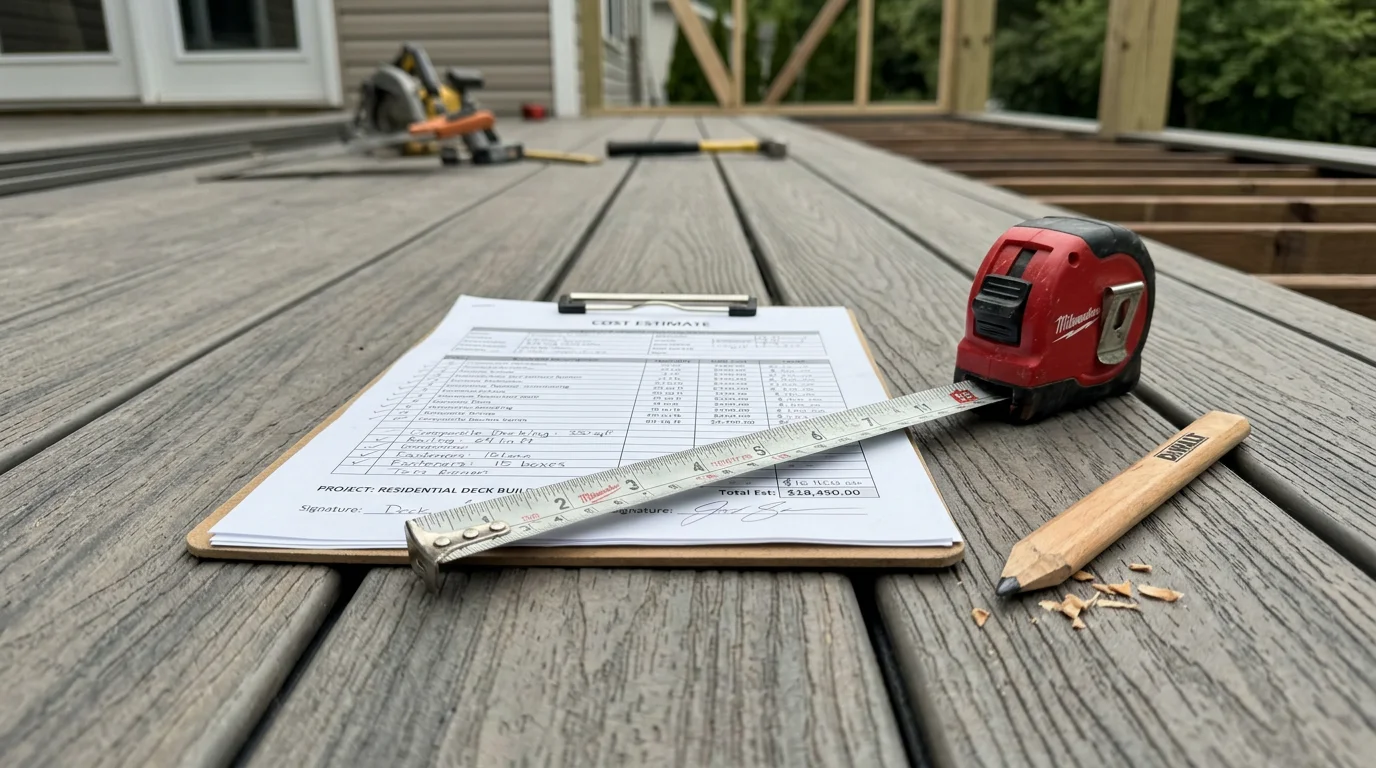
You're standing in a big-box store staring at composite decking samples. They all look similar, the prices vary wildly, and the sales rep is quoting figures that seem disconnected from reality. You need to know: which composite brands actually hold up in Canadian winters, what you'll really pay installed, and whether the upgrade from pressure-treated lumber is worth it.
Here's everything you need to make an informed decision about composite decking in Canada.
What Makes Composite Decking Different in Canadian Climates
Composite decking is a manufactured blend of wood fiber and plastic (usually polyethylene or polypropylene). The ratio and quality of these materials determine how the board performs in freeze-thaw cycles, holds up to UV exposure, and resists fading.
🏗️ Planning a deck project?
Get a free manual project review, or visualize your dream deck with AI before requesting quotes.
Canadian winters stress composite differently than southern U.S. climates:
- Freeze-thaw cycling: Ontario sees 40-80 freeze-thaw cycles per winter. Water absorbed into lower-grade composites expands when frozen, causing surface cracking and edge splitting
- Ice scraping damage: Snow shovels and ice chippers scratch softer composite surfaces more easily than capped products
- UV exposure on snow: Reflected UV from snow cover accelerates fading in uncapped or thin-capped boards
- Temperature swings: Summer deck surface temps can hit 65°C (150°F), winter lows reach -30°C — a 95°C swing that tests material stability
Premium composite brands use capped construction — a solid polymer shell over a composite core. This cap (0.5-2.0mm thick depending on brand) blocks moisture penetration and provides scratch resistance. Budget composites skip the cap or use thin coatings that wear through in 3-5 years.
Top Composite Decking Brands Available in Canada (2026)
Trex
The most widely available premium composite in Canada. Trex Transcend (their top tier) uses a high-density polyethylene cap that performs well in freeze-thaw conditions.
Pros:
- 25-year fade and stain warranty with meaningful coverage
- Widely stocked — easier to get additional boards mid-project
- Proven 15+ year track record in Canadian climates
- Grooved edge boards for hidden fastener systems
Cons:
- Premium pricing: $8.50-12.00/sqft material-only for Transcend (2026 KWC suppliers)
- Surface gets hot in direct sun (common to all composites)
- Some early-generation boards (pre-2010) had mold issues; resolved in current products
TimberTech (AZEK)
Owned by AZEK, TimberTech offers AZEK (100% PVC) and TimberTech (capped composite) lines. AZEK's all-plastic construction handles moisture better than wood-fiber composites.
Pros:
- AZEK is fully waterproof (zero wood content)
- Excellent scratch resistance on capped TimberTech lines
- 30-year fade/stain warranty on premium tiers
- Cooler surface temps than some competitors (still hot, just less so)
Cons:
- $9.00-14.00/sqft material-only for AZEK; $7.50-11.00/sqft for TimberTech Premier
- Limited availability outside major markets — special order delays common
- AZEK expands/contracts more than composites (requires proper gapping)
Fiberon
Mid-to-premium composite with good Canadian distribution through building supply dealers.
Pros:
- PermaTech cap uses multi-layer protection
- $6.50-10.00/sqft material-only — slightly lower than Trex/TimberTech for comparable tiers
- 25-year warranty on Sanctuary and Horizon lines
- Good color consistency batch-to-batch
Cons:
- Fewer color options than Trex
- Hidden fastener clips sold separately (adds $0.30-0.50/sqft)
Wolf Decking (Canadian Brand)
Lesser-known but solid performer manufactured in Canada specifically for northern climates.
Pros:
- Priced for Canadian market: $5.50-8.50/sqft material-only
- Designed around freeze-thaw durability
- Supports Canadian manufacturing
Cons:
- Limited color range (6-8 options vs. 12-16 for Trex)
- Less brand recognition affects resale perception
- Availability concentrated in Ontario/Quebec
MoistureShield
Unique selling point: solid plastic core means boards can be installed at ground level or partially submerged (useful for pool decks and dock applications).
Pros:
- Only composite rated for ground contact
- Won't rot even if constantly wet
- $7.00-10.50/sqft material-only
Cons:
- Heavier than standard composites (harder to handle during install)
- Requires more support — can't span 16" on center in all profiles
- Surface texture can trap dirt in high-traffic areas
Real 2026 Composite Decking Costs in Ontario
Material costs are only 40-50% of your total project budget. Here's what you'll actually pay for a composite deck installed in the KWC region:
Material Costs (2026)
| Component | Budget Composite | Mid-Range Composite | Premium Composite |
|-----------|------------------|---------------------|-------------------|
| Decking boards | $4.50-6.50/sqft | $6.50-9.00/sqft | $9.00-14.00/sqft |
| Hidden fasteners | $0.30-0.50/sqft | $0.40-0.60/sqft | $0.50-0.70/sqft |
| Composite railing | $50-80/linear ft | $75-110/linear ft | $110-160/linear ft |
| Framing (PT lumber) | $3.50-5.00/sqft | $3.50-5.00/sqft | $3.50-5.00/sqft |
Note: Composite requires the same pressure-treated framing as wood decks — you're only replacing the visible decking and railing materials.
Total Installed Costs (KWC Market)
For a typical 12' × 16' (192 sqft) second-story deck with stairs and composite railing:
- Budget composite (Wolf, entry Fiberon): $12,500-15,000 installed
- Mid-range (TimberTech Premier, Fiberon Horizon): $15,000-18,500 installed
- Premium (Trex Transcend, AZEK): $18,000-22,000 installed
This includes framing, decking, railing, stairs, permits, and labor. Add $150-400 for deck permits depending on your municipality. See our Cambridge, Kitchener, and Waterloo permit guides for specific requirements.
Ground-level decks (under 24" height) cost $65-85/sqft installed with mid-range composite — slightly less than elevated decks since you skip complex framing and may avoid permits in some municipalities.
Compare this to pressure-treated deck costs at $45-65/sqft installed or cedar at $55-80/sqft.
Composite vs. Wood: The Real Cost Comparison Over 20 Years
The initial premium for composite is $20-40/sqft over pressure-treated lumber. Here's how maintenance costs change the math:
Pressure-Treated Pine Deck (20-Year Ownership)
- Year 0: $9,600 installed (192 sqft at $50/sqft)
- Year 2: $450 (power wash + stain)
- Year 5: $500 (power wash + stain + minor board replacement)
- Year 8: $500 (power wash + stain)
- Year 11: $650 (power wash + stain + railing repair)
- Year 14: $500 (power wash + stain)
- Year 17: $750 (power wash + stain + more board replacements)
Total 20-year cost: $13,950
Mid-Range Composite Deck (20-Year Ownership)
- Year 0: $16,500 installed (192 sqft at $86/sqft)
- Year 3: $120 (deep clean with composite cleaner)
- Year 7: $120 (deep clean)
- Year 12: $120 (deep clean)
- Year 17: $120 (deep clean)
Total 20-year cost: $17,280
The composite deck costs $3,330 more over 20 years, but you spend zero hours scraping, sanding, or staining. If you hire out maintenance, composite breaks even around year 15. If you hate deck maintenance, composite wins immediately.
Installation Requirements for Composite Decking in Ontario
Composite boards install over standard pressure-treated framing — you're not changing the structural requirements. But there are critical differences:
Joist Spacing
Most composite manufacturers specify maximum 16" on center for perpendicular installation, 12" on center for 45-degree diagonal patterns. Some premium lines (Trex Transcend, AZEK) allow 16" for diagonals.
Budget composites often require 12" OC for all installations — this increases framing lumber costs by 30-40%. Check manufacturer specs before pricing materials.
Standard joist span tables still apply for the framing itself.
Gapping Requirements
Composite expands and contracts with temperature more than wood. Manufacturer specs typically require:
- End-to-end gap: 6-8mm (1/4") for boards up to 16' long
- Side-to-side gap: 3-5mm (1/8") between boards
- Perimeter gap: 10-12mm (3/8-1/2") where decking meets house, posts, or fixed objects
In winter, those gaps widen by 1-2mm. In summer, they close. Don't push boards tight during installation — you'll get buckling when temperatures rise.
See our guide on deck board spacing in Ontario climates for seasonal adjustment strategies.
Hidden Fastener Systems
Most composite decks use hidden fastener clips that attach to the grooved edges of boards. Benefits:
- No visible screws or plugs
- Automatic spacing (clips set the gap)
- Boards can expand/contract without fastener interference
Cost: $0.30-0.70/sqft depending on system. Popular brands include Cortex, Tiger Claw, Camo, and EB-TY.
Face-screwing composite is possible (picture-frame borders, first/last boards) but requires composite-specific screws with cutting tips and wide heads to prevent mushrooming. Standard deck screws crack composite.
Blocking and Ventilation
Composite needs full-length blocking at board ends to prevent sagging — PT 2×8 or 2×10 rim joists work. Unlike wood, composite doesn't stiffen over time, so inadequate edge support causes visible waviness.
Ventilation under the deck matters more with composite because the surface doesn't breathe. Ensure 6-12" minimum clearance between ground and lowest framing member, and use deck skirting with ventilation if enclosing the area.
How to Choose the Right Composite for Your Project
Match the Product to Your Priorities
Pick premium capped composite (Trex Transcend, AZEK, TimberTech Premier) if:
- You want maximum fade resistance (south or west exposure)
- You're in a high-visibility location where appearance matters for resale
- You plan to stay in the home 15+ years
- You have pets (better scratch resistance)
Pick mid-range capped composite (Fiberon Horizon, Wolf, entry TimberTech) if:
- You want low maintenance but need to control budget
- The deck is north-facing or partially shaded (less UV stress)
- You're fine with some fading over 10-15 years
- This is your first composite deck and you're testing the concept
Skip composite entirely if:
- Your budget tops out at $50-60/sqft installed — pressure-treated makes more sense
- You like the look of natural wood grain (composite imitates but doesn't replicate)
- You're building a low ground-level deck in a wooded area where aesthetics matter less than cost
Warranty Reality Check
Composite warranties sound impressive — 25-50 years against material defects, fading, and staining. Read the fine print:
- Fade/stain coverage is prorated: A board that fades 30% in year 15 might only get you a 40% credit toward replacement material (not labor)
- "Normal weathering" isn't covered: Expect color shift of 5-10% over 5-10 years even with premium products
- Labor is never covered: If you need to replace a defective board, you pay to remove and reinstall surrounding boards
Warranties protect against catastrophic failures (splitting, rotting, structural breakdown). They don't keep your deck looking showroom-new for 25 years.
Color Selection Strategy
Composite decking comes in earth tones (grays, browns, tans) with embossed wood-grain textures. Lighter colors show less fading because there's less pigment to break down. Darker colors (walnut, Brazilian hardwood tones) look stunning year one but shift noticeably by year 5-7.
For Ontario climates:
- Light/medium grays: Best fade resistance, hide pollen and dust, modern aesthetic
- Medium browns: Balanced fade performance, traditional look, good dirt camouflage
- Dark browns/reds: Highest visual impact but most fading, show scratches more readily
Order samples and leave them outside for 2-3 weeks. The color will shift slightly — that's what you'll see in year 2-3.
Composite Deck Maintenance in Canadian Winters
"Maintenance-free" is marketing speak. Composite needs less maintenance than wood, not zero.
Seasonal Cleaning
Spring (April-May):
- Sweep off winter debris, salt residue, and organic matter
- Hose down with water
- For mold spots (common on north-facing boards), use a composite deck cleaner (not bleach — it damages the cap)
Summer (June-August):
- Sweep weekly to prevent pollen and dirt from embedding in grain texture
- Spot-clean spills immediately (grease, wine, BBQ sauce) — composite stains less than wood but not zero
Fall (September-October):
- Remove leaves daily if under trees — wet leaves cause tannin staining
- Rinse before first frost
Winter (November-March):
- Shovel with a plastic blade — metal edges scratch composite
- Use calcium chloride or magnesium chloride ice melt, not rock salt (sodium chloride damages some composites)
- Don't pile snow against the house where it contacts the ledger board
See our full composite deck maintenance guide for seasonal deep-cleaning protocols.
What Damages Composite
- Metal shovels/scrapers: Gouge the cap layer
- Pressure washers above 1500 PSI: Erode surface texture
- Bleach: Weakens the plastic cap over time
- Prolonged standing water: Causes mold growth even on capped products
- Grills placed directly on boards: Melts or discolors the surface (use a grill mat)
- Flower pots without risers: Trap moisture and create dark rings
Composite is tougher than wood but not indestructible. The cap layer is 0.5-2mm thick — once you scratch through it, the core is exposed.
Building Code and Permit Considerations
Composite decking doesn't change structural permit requirements. You still need:
- Footings below frost line: 1.2m (48") minimum depth in Ontario
- Ledger board attachment: Properly flashed to prevent water infiltration behind siding
- Railing height: 36" minimum for decks over 24" above grade (42" recommended)
- Guard spacing: Maximum 4" gap between balusters
Composite railing systems are engineered assemblies — they come with ICC-ES reports or Canadian product evaluations showing they meet code. Custom-built wood railings with composite infill may not pass inspection unless engineered.
Deck permit applications require material specifications. Note "composite decking per manufacturer specs" on drawings and include fastener details.
If you're building near property lines, check setback requirements — composite doesn't exempt you from zoning rules.
🎨 Not sure which material to pick?
Upload a photo of your backyard and see exactly how Trex, TimberTech, or cedar would look — free and instant.
Common Questions
Does composite decking get too hot to walk on in summer?
Yes. Composite surfaces reach 60-70°C (140-160°F) in direct sun during July/August in Ontario. Lighter colors run 5-10°C cooler than dark browns, but all composites heat up more than wood.
Solutions:
- Choose light gray or tan colors for south/west-facing decks
- Add a pergola or shade sail over high-traffic areas
- Hose down the deck before use (cools surface temporarily)
- Wear sandals or keep a outdoor rug in the walking path
This is the #1 complaint about composite. If your deck gets full sun and you walk barefoot often, it's a real consideration.
Can you install composite decking in winter?
Manufacturers recommend installing when air temperature is above 5°C (40°F). Below that, composite boards become brittle and can crack when cut or fastened.
Winter installation challenges:
- Boards are contracted to minimum size — you risk over-tightening gaps
- Hidden fastener clips can snap in freezing temps
- Difficult to verify proper gapping (boards will expand 3-5mm when summer hits)
Best practice: install composite May-September when boards are near average temperature. If you must build off-season, store boards in a heated space for 48 hours before installation.
See our best time to build a deck in Ontario guide for seasonal trade-offs.
How long does composite decking actually last in Canada?
Premium capped composite (Trex Transcend, AZEK, TimberTech Premier) should last 25-30 years in Ontario climates before requiring replacement. You'll see gradual fading (10-15% color shift over 15 years) and possible surface scratching in high-traffic areas, but the structural integrity holds.
Mid-range capped composite: 20-25 years with more noticeable fading by year 12-15.
Uncapped or budget composite: 12-18 years — moisture penetration accelerates breakdown in freeze-thaw cycles.
For comparison, pressure-treated decks last 15-20 years with maintenance, cedar lasts 20-25 years.
Can you refinish or restain composite decking?
No. Composite can't be sanded or refinished like wood. Once the surface is scratched, faded, or stained, your options are:
- Clean aggressively with composite deck cleaner (removes some surface stains)
- Replace individual damaged boards (labor-intensive — requires removing fasteners and possibly adjacent boards)
- Live with it (most people choose this)
This is why color selection matters — you're committing to that color (plus 10-15% lighter) for 20+ years.
Is composite decking slippery when wet or icy?
Composite has molded texture that provides traction when wet — better than smooth painted wood, worse than rough-sawn cedar. Most manufacturers meet ASTM slip-resistance standards for wet surfaces.
Ice is a different story: Frozen composite is slippery. Use calcium chloride ice melt (safe for composite) and clear snow promptly. Consider deck lighting around stairs — ice buildup on composite steps is a real slip hazard.
Should I use composite for deck stairs?
Yes, if you're using composite for the main deck surface. Mixing materials (composite deck, wood stairs) creates maintenance inconsistency and looks odd.
Composite stair considerations:
- Use solid-core composite stair treads (thicker and stronger than standard decking boards)
- Install closed risers — prevents snow/ice buildup underneath treads
- Add aluminum stair nosing for extra slip resistance and edge protection
- Follow Ontario deck stair code for rise/run dimensions
Composite stairs cost $200-400 per step installed vs. $120-180 for pressure-treated.
See our comparison in Ipe vs Composite Decking in Canada: Worth the Premium? for more details.
You might also find Janka Scale for Decking: Wood Hardness Ratings Explained helpful.
Upload a backyard photo and preview real decking materials with AI — free, instant, no sign-up.
Permits, costs, material comparisons, and questions to ask before requesting quotes — delivered to your inbox.