
Low Deck vs Elevated Deck in Ontario: Cost, Safety, and Permit Triggers
How deck height changes everything: guards, stairs, footings, attachment, and price. A planning guide for KWC homeowners.
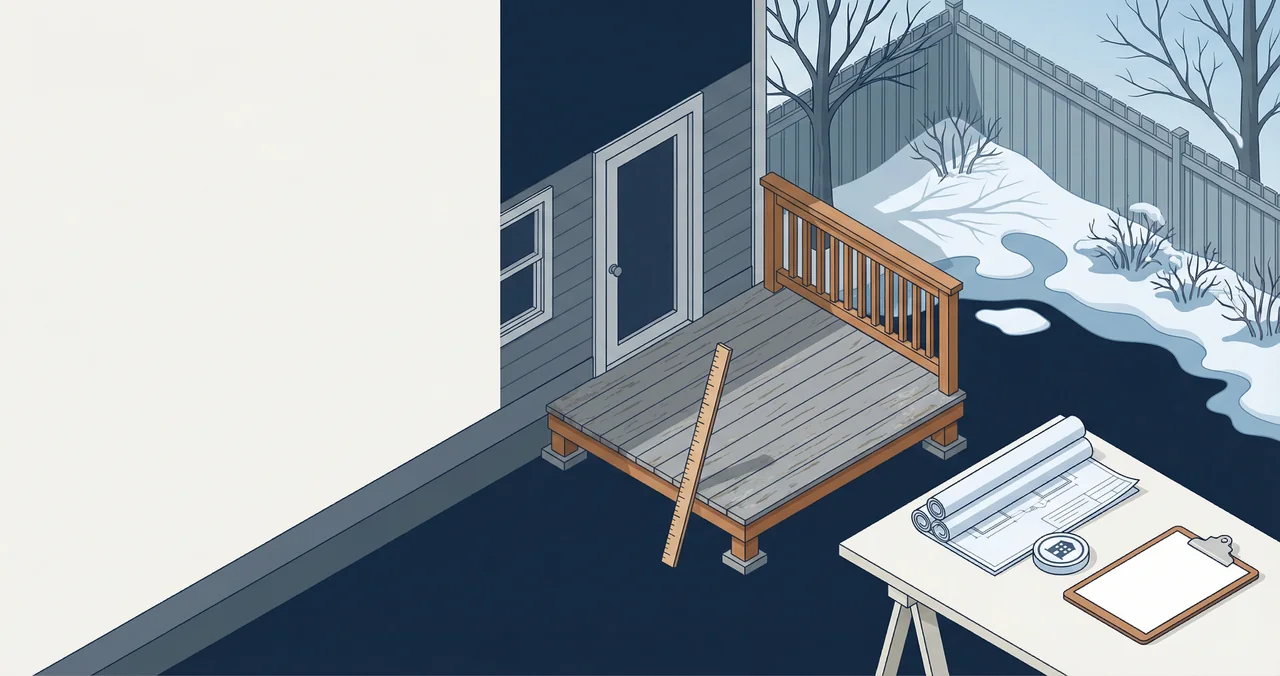
If you’re planning a deck in Kitchener-Waterloo-Cambridge, the single decision that changes cost, safety, and complexity the most is deck height.
A low platform deck and an elevated walkout deck might look similar in photos, but they are not the same project. Height changes:
- whether guards/railings are required
- how many stairs you need
- how the deck is braced and supported
- what tends to trigger permit review
- how the deck feels in winter (ice risk)
This guide explains the difference, the real cost drivers, and how to choose the right option for your yard.
Internal links:
- Deck services + estimates: /decks
- Deck planning hub: /decks/blog
- City pages: /decks/kitchener, /decks/waterloo, /decks/cambridge
What counts as a “low deck” vs an “elevated deck” in practice?
Homeowners use different definitions, but in practical planning terms:
🏗️ Planning a deck project?
Get a free manual project review, or visualize your dream deck with AI before requesting quotes.
- Low deck: close to grade, often a step or two, feels more like a “wood patio.”
- Elevated deck: clearly above grade, often required when the back door is high or the yard slopes away.
Regardless of the exact measurement, the principle is consistent: as height increases, you add guards + stairs + structure—so cost rises.
Cost: why elevated decks are usually more expensive (even at the same size)
Square footage matters, but height multiplies scope.
1) Guards/railings become a major line item
On many low platforms, railing may be minimal or not needed depending on layout. On elevated decks, guards are a life-safety component.
Railing cost drivers (KWC): /decks/blog.
2) Stairs get longer—and more complex
More height = more risers.
And stair cost isn’t just “steps.” It includes:
- stringers and framing
- landings (if needed)
- handrails and guard sections
Stair count planning guide: /decks/blog.
3) Structure, bracing, and the “bounce factor”
Low decks can feel solid with relatively simple framing.
Elevated decks need stronger:
- posts and beams
- bracing
- connections
If an elevated deck is framed too lightly, homeowners notice it immediately as bounce/vibration.
4) Support strategy (footings/piles)
Support choice matters more as height increases.
Concrete footings and helical piles can both work, but access and soil conditions can change what’s practical.
Footing options guide: /decks/blog.
Safety: what changes when height increases
Height changes the consequences of failure. That’s why elevated decks demand:
- sturdier guards/railings
- safe stair geometry and handrails
- better lighting
- better drainage control
In KWC winters, icy stairs are a top complaint.
Lighting planning guide: /decks/blog.
Drainage guide (under-deck water management): /decks/blog.
Permit triggers: what KWC homeowners should watch for
Permit requirements vary by municipality and by design, but elevated decks tend to trigger review more often because:
- guards/railings are safety-critical
- stairs and landings must be detailed
- attached decks require clear ledger/flashing details
If your deck is attached, ledger attachment is a key safety and durability detail. Ledger guide: /decks/blog.
Local context:
- Kitchener: /decks/kitchener
- Waterloo: /decks/waterloo
- Cambridge: /decks/cambridge
When a low deck is the better choice
A low deck can be ideal if you want:
- a budget-friendly project
- easy yard access (no long stairs)
- fewer winter safety issues
- a “patio-like” outdoor living space
Low deck caution: airflow and moisture
Low decks can trap moisture, especially in shaded yards. That can create:
- slippery film
- faster framing aging
- pests or damp under-deck conditions
If your yard is flat or drainage is poor, plan ventilation and water management early.
When an elevated deck makes more sense
Elevated decks are often the right call when:
- the back door is high off grade
- the yard slopes away from the house
- you want a view and airflow
- you want to create usable space underneath
Under-deck usability is a huge value lever
If you want a dry patio or storage under the deck, plan drainage early. Retrofits are harder.
Under-deck drainage options: /decks/blog.
A quick decision framework
Choose low deck if:
- you’re prioritizing cost control
- you want minimal stairs
- your door height allows it
Choose elevated deck if:
- you need walkout access
- you want a view
- you want usable space below
If you’re unsure, measure your door height and send photos of the yard slope. Those two details usually clarify the best path.
KWC examples (how this plays out in real backyards)
- Example 1: High back door, sloped yard (common in newer subdivisions): an elevated deck may be unavoidable, so the budget conversation becomes about simplifying stairs/railings and choosing materials wisely.
- Example 2: Modest door height, flat yard: a low platform can often deliver the same usable space with fewer stairs and less railing—often the most cost-effective outcome.
- Example 3: Walkout basement: an elevated deck can create a sheltered patio below, but only if you plan under-deck drainage and lighting early.
Cost-control tips (without compromising safety)
1) Keep the shape simple (fewer corners = less railing/post complexity)
2) Keep stairs straightforward (avoid unnecessary turns)
3) Choose a railing system that fits your budget and maintenance tolerance
4) Don’t cut corners on structure, footings, and drainage—those are what make decks feel solid and last
If you’re trying to hit a target budget, a useful approach is to price two versions of the same deck:
- Version A: simpler stairs + a cost-effective railing system
- Version B: premium railing and add-ons (lighting, privacy screens, dry-under-deck)
Seeing the delta helps you decide where upgrades actually matter for how you’ll use the space. For broader context on deck construction costs in Ontario, our complete guide covers all height categories and material options.
🎨 Not sure which material to pick?
Upload a photo of your backyard and see exactly how Trex, TimberTech, or cedar would look — free and instant.
FAQs
Does an elevated deck always cost more?
Usually, yes. Height adds structure, stairs, and railings.
Is a low deck always “permit-free”?
Not necessarily. Permit needs depend on the full design, location on the lot, attachment to the house, and local rules.
What’s the most common regret?
Underestimating the cost of stairs and railings—or underestimating drainage issues on a low deck.
---
Want a recommendation for your Kitchener-Waterloo-Cambridge property?
If you share your approximate door height, rough deck size, and a few photos, we can help you compare low vs elevated options with realistic cost ranges.
You may also want to read Best Deck Lighting Ideas for Ontario: Solar vs Low-Voltage vs Hardwired.
- Get a deck estimate: Get a deck quote
Upload a backyard photo and preview real decking materials with AI — free, instant, no sign-up.
Permits, costs, material comparisons, and questions to ask before requesting quotes — delivered to your inbox.