
Helical Piles for Decks in Kitchener-Waterloo-Cambridge: Permits, Engineering, and When They Make Sense
Helical piles can speed up deck builds in KWC, but permits and inspections still matter. Learn when piles are a good idea, what paperwork you may need, and common pricing traps.
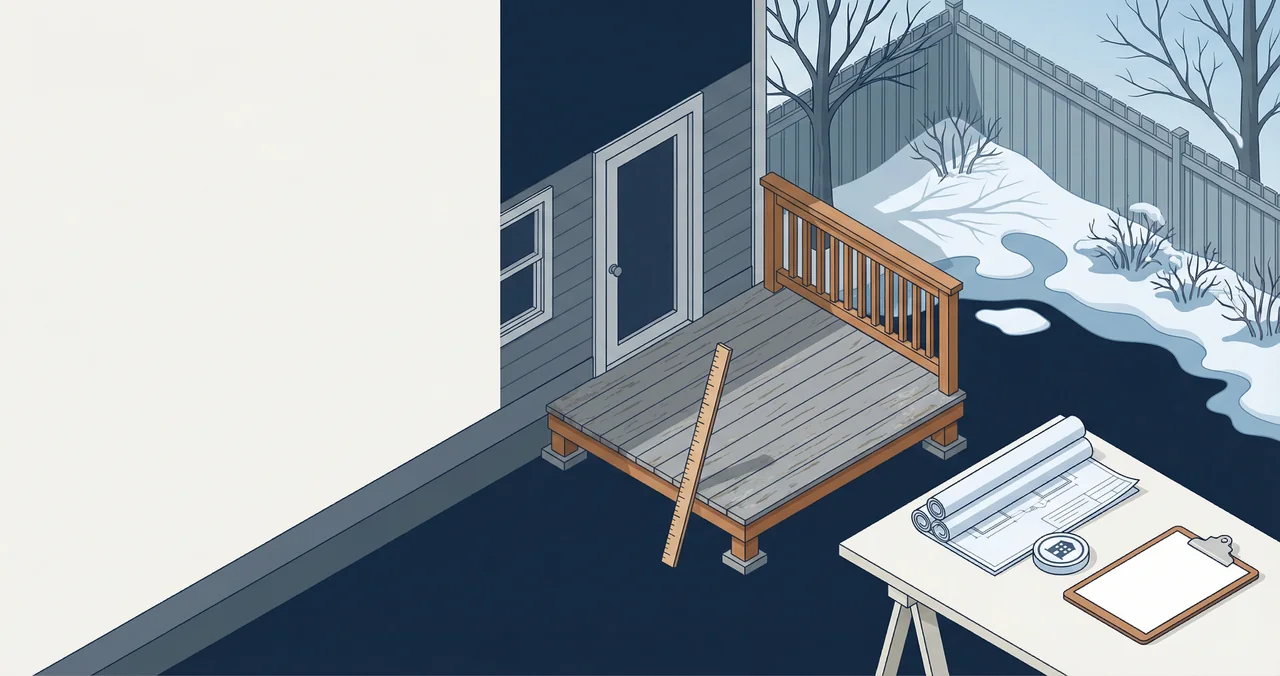
Helical piles are everywhere in Kitchener-Waterloo-Cambridge right now — especially for:
- sloped yards
- tight access lots
- faster spring builds
But homeowners often assume piles are a loophole that avoids permits or inspections.
They aren’t.
This guide explains when helical piles make sense for KWC decks, what the permit/engineering conversations usually look like, and what to watch for in quotes.
What are helical piles?
A helical pile is a steel shaft with helices (screw-like plates) that’s driven into the ground until it reaches a target torque/capacity.
🏗️ Planning a deck project?
Get a free manual project review, or visualize your dream deck with AI before requesting quotes.
Pros:
- fast install
- often less excavation mess
- can be installed in more seasons
Cons:
- needs correct design and placement
- not always cheaper
- still needs proper framing connections
If you want a broader footing overview:
Do helical piles avoid deck permits in KWC?
No. Permit requirements are usually driven by:
- deck height above grade
- attachment to the house
- guards/railings
- stairs
- roofs/pergolas
Start here:
- /decks/blog/deck-permits-kitchener-24-inch-rule
- /decks/blog/do-you-need-a-permit-to-build-a-deck-waterloo-ontario
- /decks/blog/do-you-need-a-permit-to-build-a-deck-cambridge-ontario
Do I need an engineer for helical piles?
Sometimes.
Common cases where engineering or pile documentation is requested:
- large decks
- tall decks
- complex loads (hot tub, roof)
- weak soils or fill
Hot tub load context:
Even when an engineer isn’t explicitly required, the City may want:
- pile capacity info
- installation records
- layout details on the framing plan
If you’re preparing drawings:
When helical piles are a good idea (KWC examples)
- Tight backyard access (no mini-excavator access)
- High water table / wet yards (less open excavation)
- Early spring builds (less concrete curing drama)
- Sloped yards where digging footings is messy
Common quote traps
Trap #1: piles priced without scope clarity
A pile quote may not include:
- brackets
- beams/posts
- required hardware
- inspection coordination
Trap #2: pile spacing assumed
The number of piles should be driven by a framing plan, not a guess.
Framing + joist spans matter:
Trap #3: “piles mean no frost concerns”
Piles deal with frost differently than concrete, but you still need a design that considers Ontario frost behavior.
If you’re comparing, read:
Inspection readiness still matters
Whether you use piles or concrete, the inspector still cares about:
- layout matches drawings
- post-to-beam connections
- ledger attachment (if attached)
- bracing on tall decks
Inspection checklist:
Cost: are piles cheaper in KWC?
Sometimes, but not always.
Piles can save cost when:
- excavation access is difficult
- soil conditions make concrete messy
- schedule speed matters (less waiting for concrete)
Concrete can be cheaper when:
- access is easy
- the deck is small
- you already have excavation equipment on site
What to ask a pile installer
- What design capacity per pile are you assuming?
- How will pile locations be laid out relative to beams/posts?
- Do you provide installation records (torque, depth)?
- What bracket type is included?
How piles interact with setbacks and site constraints
Piles still need to sit within allowed setbacks and avoid easements.
If you’re near a property line: /decks/blog/deck-setback-rules-kitchener-waterloo-cambridge-property-lines
DIY note: helical piles are rarely a true DIY job
Even if you can buy piles, installation quality depends on:
- equipment
- soil reading
- layout accuracy
- records for capacity
If you’re DIY-ing parts of a deck, consider having a pro install piles and then framing yourself.
How piles affect your schedule
Piles can accelerate timelines because you avoid concrete cure time. That can matter if you’re trying to hit a weather window.
Best timing in Ontario: /decks/blog/best-time-to-build-a-deck-ontario-spring-summer-fall-winter
A realistic decision framework (3 questions)
1. Access: can excavation equipment reach the footing locations easily?
2. Schedule: does the timeline benefit from avoiding concrete cure time?
3. Design: does your framing layout naturally align with pile placement?
If access is hard and the build window is tight, piles often win.
What to include in your quote request
To get comparable quotes, provide:
- deck dimensions and height
- whether it’s attached to the house
- expected loads (hot tub, roof)
- your city (Kitchener/Waterloo/Cambridge)
Then ask each contractor to specify:
- number of piles and assumed capacity
- bracket type
- who is responsible for permit drawings/engineering
Quote checklist: /decks/blog/deck-quote-checklist-kitchener-waterloo-questions-to-ask
Red flags when a helical pile quote is too cheap
- no mention of capacity/torque records
- no bracket details
- vague count (“we’ll see on site”)
- no coordination language for inspections/permits
Cheap piles can become expensive if the deck layout changes mid-install.
One more thing: piles don’t fix bad layout
Piles are a foundation element. If the framing layout is inefficient (too many spans, awkward beam locations), piles can multiply cost because every post wants a pile.
A good builder will design the framing first, then place piles to match — not the other way around.
Related guides (to avoid footing/inspection surprises)
- Start here (permit triggers): Kitchener vs. Waterloo vs. Cambridge deck bylaws
- Deck footing options in Ontario: sonotube vs helical piles
- Ontario One Call 811 before deck footings (KWC)
- Deck permit drawings checklist (KWC)
- Deck framing inspection in KWC: what inspectors look for
🎨 Not sure which material to pick?
Upload a photo of your backyard and see exactly how Trex, TimberTech, or cedar would look — free and instant.
Want help deciding piles vs concrete?
If you’re in Kitchener/Waterloo/Cambridge and you’re deciding between helical piles and concrete footings, submit your project details here: /#quote-form.
Include:
See our comparison in Helical Piles vs Concrete Footings for Decks in Ontario for more details.
You may also want to read Where to Buy Decking Materials in Kitchener-Waterloo.
You may also want to read Noise Bylaws for Construction in KWC: Work Hours and Rules.
- city
- deck size/height
- access constraints (tight gate, slope)
- any special loads (hot tub, roof)
Upload a backyard photo and preview real decking materials with AI — free, instant, no sign-up.
Permits, costs, material comparisons, and questions to ask before requesting quotes — delivered to your inbox.