
Deck Footing Options in Ontario: Sonotubes vs Helical Piles (Pros & Cons)
When to choose concrete footings vs helical piles in Ontario soil/climate, how pricing works, and what to ask about engineering.
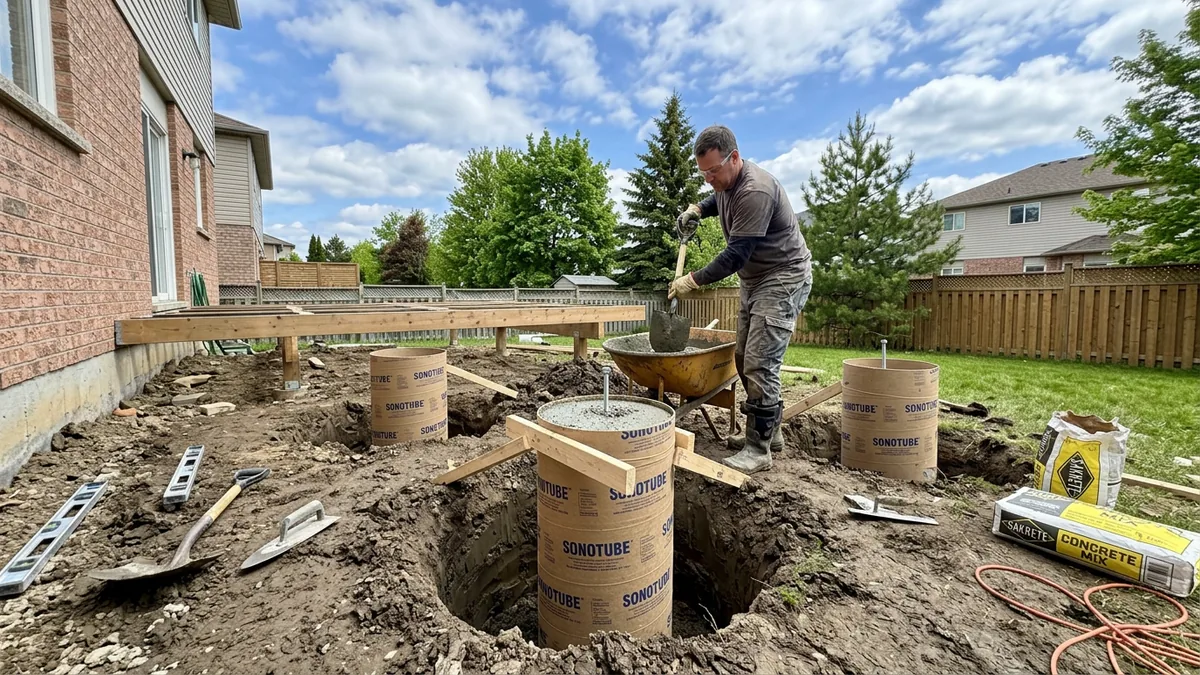
Footings are where decks become "real construction." In Ontario, freeze-thaw and soil conditions mean your support system matters more than the surface boards. A beautiful composite deck on underbuilt footings will heave, crack, and pull away from the house within a few winters.
This guide breaks down the two most common footing types used in Kitchener-Waterloo-Cambridge (KWC): sonotube concrete footings and helical piles.
Why Footings Matter More in Ontario
Ontario's climate puts unique stress on deck foundations. The ground in KWC freezes and thaws dozens of times per winter, and that cycle pushes shallow footings upward — a process called frost heave that can shift a deck several inches in a single season.
🏗️ Planning a deck project?
Get a free manual project review, or visualize your dream deck with AI before requesting quotes.
Three factors make this region especially demanding:
- Frost depth requirement: The Ontario Building Code (OBC) requires footings to sit a minimum of 48 inches (4 feet) below finished grade in KWC. This places the base below the frost line, where temperatures stay stable year-round.
- Clay soils: Much of Kitchener, Waterloo, and Cambridge sits on heavy clay that expands when wet and shrinks when dry. Footings in clay need proper drainage and sometimes oversized bases to spread the load.
- Water table: Low-lying areas near the Grand River or in parts of Cambridge can have high water tables, complicating digging and concrete curing.
If footings are too shallow, too narrow, or poorly drained, the deck will move. The fix is almost always more expensive than doing it right the first time. For more detail on depth requirements, see the frost depth guide.
Sonotube Concrete Footings
Sonotubes are waxed cardboard cylinders used as forms for poured concrete. They have been the standard deck foundation method in Ontario for decades.
Installation Process
1. Mark and dig: Holes are dug to a minimum of 48 inches, plus a few extra inches for a gravel pad. In KWC clay, this often means a 54-60 inch total dig.
2. Set the form: A 10" or 12" diameter sonotube is placed in the hole on a compacted gravel base and levelled.
3. Add rebar: Two or three pieces of 15M rebar are tied together and placed inside the tube, extending from the gravel base to near the top.
4. Pour concrete: Ready-mix concrete fills the tube, is rodded to remove air pockets, and finished flush. A post bracket is set into the wet concrete.
5. Cure: In warm weather, footings can typically be loaded after 3-7 days. Below 10C, curing slows significantly and may need frost blankets.
6. Inspection: Most KWC municipalities require a footing inspection before framing begins. The inspector checks depth, diameter, rebar, and bracket placement.
Pros and Cons
Strengths: Proven and well-understood by inspectors, high load capacity (a 12" tube can carry well over 5,000 lbs), no specialized equipment needed, and lower per-footing cost on easy-access sites.
Limitations: Excavation is difficult in tight backyards or sloped lots. Concrete should not be poured below -10C. Each 48" hole produces a pile of spoil that needs hauling. Curing time and inspection scheduling add days to the project.
Helical Piles
Helical piles (sometimes called screw piles) are steel shafts with helical plates. A hydraulic drive head on a compact excavator rotates them into the ground like a giant screw.
Installation Process
1. Machine setup: A compact excavator with a hydraulic torque head fits through a 36-inch gate opening, making backyard access easier than a full excavation crew.
2. Drive the pile: The operator rotates the pile into the ground. A single pile takes 5-15 minutes depending on soil.
3. Torque monitoring: The machine monitors torque throughout. When the target torque is reached past frost depth, installation is complete.
4. Cap and bracket: A steel bracket is welded or bolted to the top, trimmed to the correct height.
5. Engineering certificate: Most installers provide a torque log and engineering certification documenting depth, torque, and calculated load capacity for each pile.
Pros and Cons
Strengths: A typical deck (6-8 piles) installs in half a day. Works in frozen ground, so late fall and winter builds are feasible. Minimal site disruption — no spoil, no concrete truck. Framing can start the same day.
Limitations: Higher per-unit cost, especially on small projects. Requires a certified installer. Rocky ground can force pile relocation. Less familiar to some inspectors, though KWC acceptance has grown significantly.
Side-by-Side Comparison
| Factor | Sonotube | Helical Pile |
|---|---|---|
| Cost per footing (KWC) | $150 - $250 | $200 - $400 |
| Install time per footing | 1-2 hours + curing | 5-15 minutes |
| Time before framing | 3-7 days (curing) | Same day |
| Season flexibility | Spring through early fall | Year-round |
| Min. temperature | Above -10C | No practical limit |
| Site access needed | Excavator or hand dig | Compact machine (36" wide) |
| Spoil / cleanup | Significant | Minimal |
| Clay soil performance | Good with proper base | Good; torque confirms bearing |
| Rocky soil | Manageable (jackhammer) | Difficult; may need relocation |
For how footing costs fit into total deck pricing, see the Kitchener deck cost guide, the Waterloo pricing guide, or the full cost guide for Ontario decks.
Ontario Frost Depth by Region
- Kitchener-Waterloo-Cambridge: 48 inches (1.2 m)
- Guelph: 48 inches
- Hamilton / Toronto: 42 inches
- Ottawa: 60 inches
- Northern Ontario (Sudbury, Thunder Bay): 60-72 inches
Always confirm with your local building department — site-specific conditions sometimes push the requirement deeper.
When You Need an Engineer's Stamp
Not every footing needs a professional engineer, but several situations make it necessary in KWC:
- High loads: Hot tubs, large cantilevers, or heavy pergola structures. See the hot tub structural checklist.
- Unusual soil: Organic fill, peat, or very soft clay may require a geotechnical report.
- Elevated decks: Decks 8+ feet above grade put higher lateral loads on footings.
- Helical piles: Reputable pile companies include engineering. If yours does not, that is a red flag.
For full permit requirements, check the deck permit drawings checklist.
What to Ask Your Builder About Footings
- What footing depth are you designing for? The answer should be at least 48 inches in KWC.
- What diameter or pile size, and what load rating? This should tie back to beam spans and post spacing in the deck plan.
- How are you protecting posts from moisture? Posts should sit on metal brackets above the concrete or pile cap — not buried in the ground. Buried posts rot, even pressure-treated ones.
- What happens if you hit rock, water, or bad soil? A good builder has a plan B.
- Who handles the inspection or engineering cert? This should be in the builder contract.
- Are you calling Ontario One Call (811) before digging? Legally required. See the One Call guide.
The Bottom Line
Both sonotubes and helical piles build solid Ontario deck guides when installed correctly. Sonotubes are the budget-friendly default for sites with good access and warm-weather timelines. Helical piles cost more per unit but save time, work in more seasons, and cause less disruption. The right choice depends on your site, your timeline, and your budget.
---
🎨 Not sure which material to pick?
Upload a photo of your backyard and see exactly how Trex, TimberTech, or cedar would look — free and instant.
Want a fast deck quote in Kitchener-Waterloo?
If you're planning a deck and want a ballpark price + a builder-ready scope quickly, submit your details here:
- Get a deck quote: Get a deck quote
The more info you include (approx size, height, material preference, stairs/rail, photos), the more accurate the estimate.
For upkeep tips, read Wind Damage Fence Repair in Ontario: Insurance and Costs.
You may also want to read Ontario Consumer Protection for Home Renovations.
Upload a backyard photo and preview real decking materials with AI — free, instant, no sign-up.
Permits, costs, material comparisons, and questions to ask before requesting quotes — delivered to your inbox.