
Mold on Composite Decking in Canada: Prevention and Cleaning
Composite decking can grow mold in Canada's humid climate. Learn why it happens, how to clean it, and proven prevention methods for Ontario decks.
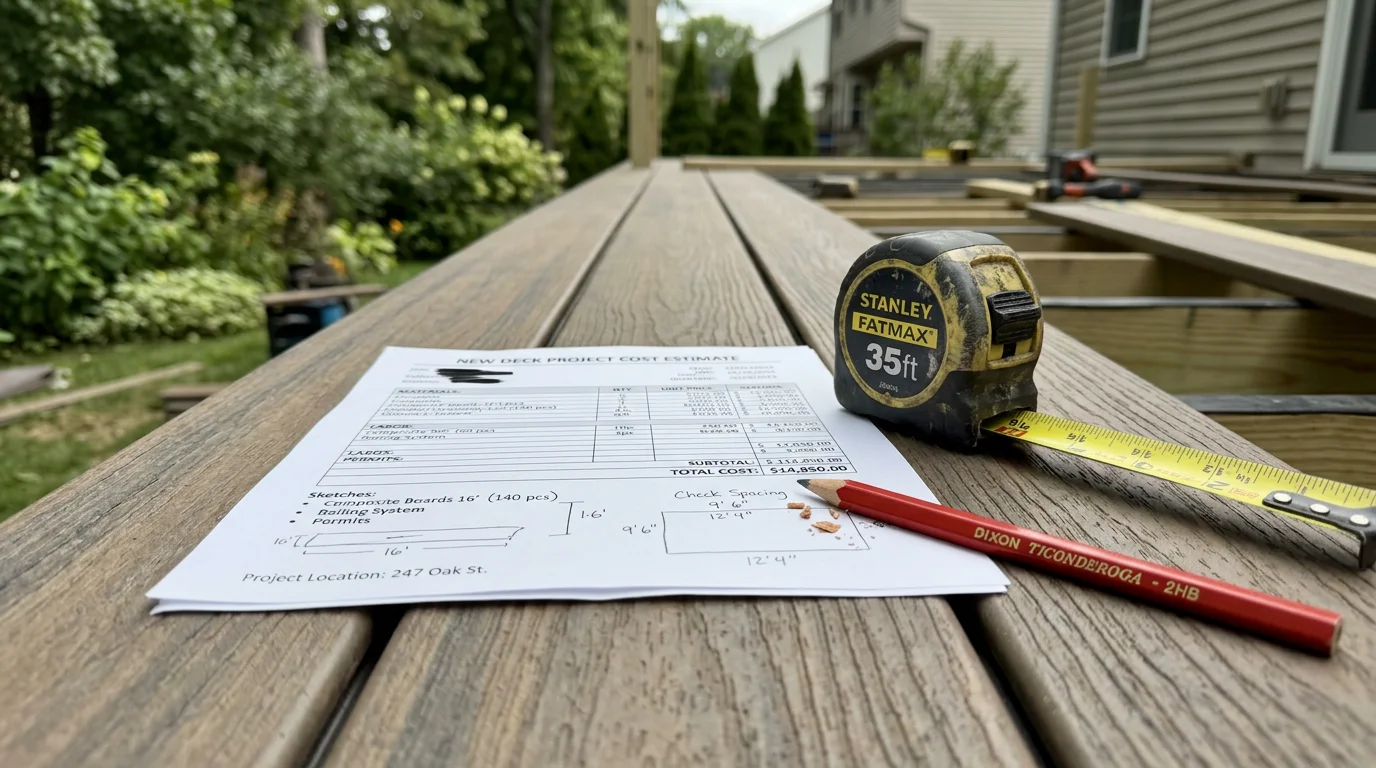
You spot dark streaks or fuzzy patches on your composite deck. It's mold, and you're not imagining it—composite decking absolutely can grow mold and mildew, especially in Ontario's humid summers and shaded areas.
Manufacturers market composite as "low-maintenance," which is true compared to wood. But low-maintenance doesn't mean zero-maintenance. Organic matter sits on the surface—pollen, leaves, dirt—and when moisture lingers, mold spores find a home.
Here's what causes it, how to clean it properly, and how to prevent it from coming back.
Why Composite Decking Gets Moldy in Canada
Composite boards are made from wood fibers mixed with plastic. The plastic encases the wood, but the surface still has tiny pores where moisture can sit. When you add:
🏗️ Planning a deck project?
Get a free manual project review, or visualize your dream deck with AI before requesting quotes.
- Humid Ontario summers (60-80% humidity in KWC from June through August)
- Tree canopy shade blocking sunlight and airflow
- Organic debris from trees, planters, or grass clippings
- Poor drainage allowing water to pool
...you get conditions where mold and mildew thrive.
Mold appears as dark spots, streaks, or greenish-black patches. Mildew is lighter—usually gray or white powdery film. Both are fungi. Both need moisture and food (organic material) to grow.
Not all composite brands are equal. Early-generation composites (pre-2010) had higher wood content and were more porous. Modern capped composites like Trex or TimberTech have a protective polymer shell that resists moisture better—but they're not immune, especially if dirt accumulates.
How to Clean Mold Off Composite Decking
Don't pressure-wash composite at full blast. High PSI (above 3,000) can damage the surface, void warranties, and embed dirt deeper into grooves.
Step 1: Sweep and Clear Debris
Remove all furniture, planters, and loose dirt. Use a stiff-bristle brush or leaf blower to clear surface debris. You want bare boards.
Step 2: Mix a Cleaning Solution
Option A: Soap and Water (mild cases)
- Mix 2 tablespoons dish soap in a bucket of warm water
- Use a soft-bristle brush to scrub affected areas
- Rinse thoroughly with a garden hose
Option B: Oxygen Bleach (moderate to heavy mold)
- Use oxygen bleach (sodium percarbonate), not chlorine bleach
- Mix per package instructions (typically 1 cup per gallon of warm water)
- Let it sit for 10-15 minutes, scrub, then rinse
Do NOT use chlorine bleach. It can discolor composite, damage the polymer cap, and harm nearby plants.
Option C: Commercial Composite Deck Cleaner
- Products like Olympic Deck Cleaner or Trex Deck Cleaner are formulated for composite
- Available at Home Depot or Lowe's in Canada for $15-25 per bottle
- Follow label directions—usually spray, scrub, rinse
Step 3: Scrub With the Grain
Use a stiff nylon brush (not wire—it scratches). Scrub in the direction of the board grain. For stubborn spots, let the cleaner sit longer before scrubbing.
Step 4: Rinse Thoroughly
Use a garden hose or pressure washer on low setting (under 1,500 PSI) at a wide fan spray. Hold the nozzle 12+ inches from the deck. Rinse until no soap residue remains.
Step 5: Let It Dry Completely
Allow 24-48 hours of dry weather before replacing furniture. Sunlight helps kill remaining spores.
Preventing Mold and Mildew on Composite Decks
Cleaning solves the symptom. Prevention addresses the cause.
1. Sweep Your Deck Weekly
Dead leaves, pollen, and dirt feed mold. A quick sweep with a stiff broom once a week—especially in spring and fall—removes organic material before it breaks down.
2. Wash Your Deck Twice a Year
Even if you don't see mold, wash your deck in spring and fall using soap and water or oxygen bleach. This removes invisible biofilm (the slimy layer mold grows on). For more seasonal tips, see composite deck maintenance in Ontario.
3. Improve Airflow and Sunlight
Mold needs shade and stagnant air. If possible:
- Trim overhanging branches to let sunlight hit the deck
- Space deck boards properly during installation—most manufacturers require 1/8 to 1/4 inch gaps for drainage and airflow (see deck board spacing rules)
- Don't store items under the deck where they trap moisture
- Avoid solid deck skirting—use lattice or vented panels for airflow (details in deck skirting ventilation)
4. Manage Water Drainage
Standing water = mold food. Check:
- Deck slope: Boards should slope 1/8 inch per foot away from the house for drainage
- Gutters and downspouts: Don't let them dump water onto your deck
- Grade around the deck: Soil should slope away so water doesn't pool underneath (covered in deck drainage systems)
5. Use Joist Tape During Construction
If you're building a new deck, apply butyl joist tape to the tops of joists before screwing down boards. It seals the screw penetration and prevents water from sitting on the joist—reducing mold growth on the underside of boards. More on this in deck joist tape guide.
6. Choose a Capped Composite
If you're selecting materials, invest in capped composite instead of uncapped. Capped boards have a full polymer shell that resists moisture, staining, and mold better than hollow or uncapped composites. Expect to pay $65-95/sqft installed for quality capped composite in KWC—compare costs in composite deck pricing.
Does Warranty Cover Mold?
Most composite warranties do not cover mold or mildew. They cover structural defects, fading, and staining from manufacturing issues—but mold is considered a maintenance issue.
Trex, TimberTech, and Fiberon all explicitly state that cleaning is the homeowner's responsibility. Check your specific warranty document, but expect no coverage.
Can You Prevent Mold Completely?
No. Mold spores exist everywhere. In Ontario's humid climate with frequent rain, some mold growth is inevitable—especially in shaded areas or if you have mature trees nearby.
The goal isn't zero mold. It's manageable levels through routine cleaning. A well-maintained composite deck in KWC should need serious mold cleaning once or twice a year at most.
If you're getting heavy mold growth every few weeks, the problem is environmental—too much shade, poor drainage, or debris accumulation. Address those factors.
Composite vs. Wood for Mold Resistance
Wood decks also grow mold. In fact, pressure-treated lumber is more porous than capped composite, which means it absorbs moisture deeper and requires annual staining/sealing to protect against rot and mold.
Composite doesn't rot, which is a huge advantage. Surface mold on composite is cosmetic and easy to clean. Wood mold often indicates deeper moisture problems that can compromise structural integrity.
That said, composite holds onto dirt and pollen more than smooth-sanded wood, which makes surface mold more visible. Trade-off: composite needs less maintenance overall, but requires occasional cleaning to look its best. Compare both materials in composite vs. wood decking.
When to Call a Professional
Most homeowners can clean mold themselves. But call a deck cleaning company if:
- Mold covers more than 50% of your deck—it may be faster and more effective to hire a pro with commercial cleaners
- You see structural damage (boards sagging, soft spots, loose railings)—mold might indicate water infiltration behind the ledger board or in the framing
- You've cleaned multiple times and mold returns within weeks—could signal a drainage or material defect
Deck cleaning services in KWC typically charge $150-400 depending on deck size and condition.
🎨 Not sure which material to pick?
Upload a photo of your backyard and see exactly how Trex, TimberTech, or cedar would look — free and instant.
Common Questions
Can I use vinegar to clean mold off composite decking?
Yes, but it's less effective than oxygen bleach. Mix 1 part white vinegar to 1 part water, spray on mold, scrub, and rinse. Vinegar is safe for composite and non-toxic, but it may take multiple applications for heavy mold.
How often should I clean my composite deck in Ontario?
Twice a year minimum—once in spring after winter salt and debris, once in fall before snow. Add a third cleaning mid-summer if you have heavy tree cover or notice dirt buildup. Weekly sweeping between deep cleans prevents most problems.
Does composite decking need to be sealed or stained?
No. Composite doesn't absorb stain and doesn't need sealing like wood. Manufacturers specifically warn against using sealers, as they can trap moisture and void warranties. Cleaning with soap or oxygen bleach is the only maintenance required.
Will mold damage my composite deck permanently?
No. Mold on composite is surface-level only. It won't rot the boards or compromise strength. It's purely cosmetic. Clean it when you see it, and the deck is fine. Untreated mold can become harder to remove over time, but it won't destroy the material.
Can I pressure-wash composite decking?
Yes, but carefully. Use under 1,500 PSI with a 40-degree fan tip, held at least 12 inches away. Never use a zero-degree or turbo nozzle—you'll gouge the surface and void the warranty. Many manufacturers recommend against pressure-washing entirely and suggest garden hose + brush instead.
Related: Composite Decking Calculator: How Much Material Do I Need?.
You may also find Composite Decking Manufacturers in Canada: Full List helpful.
Upload a backyard photo and preview real decking materials with AI — free, instant, no sign-up.
Permits, costs, material comparisons, and questions to ask before requesting quotes — delivered to your inbox.