
Composite Decking Manufacturers in Canada: Full List
Complete list of composite decking manufacturers available in Canada in 2026, including Trex, TimberTech, Fiberon, and Canadian-made brands with pricing and availability.
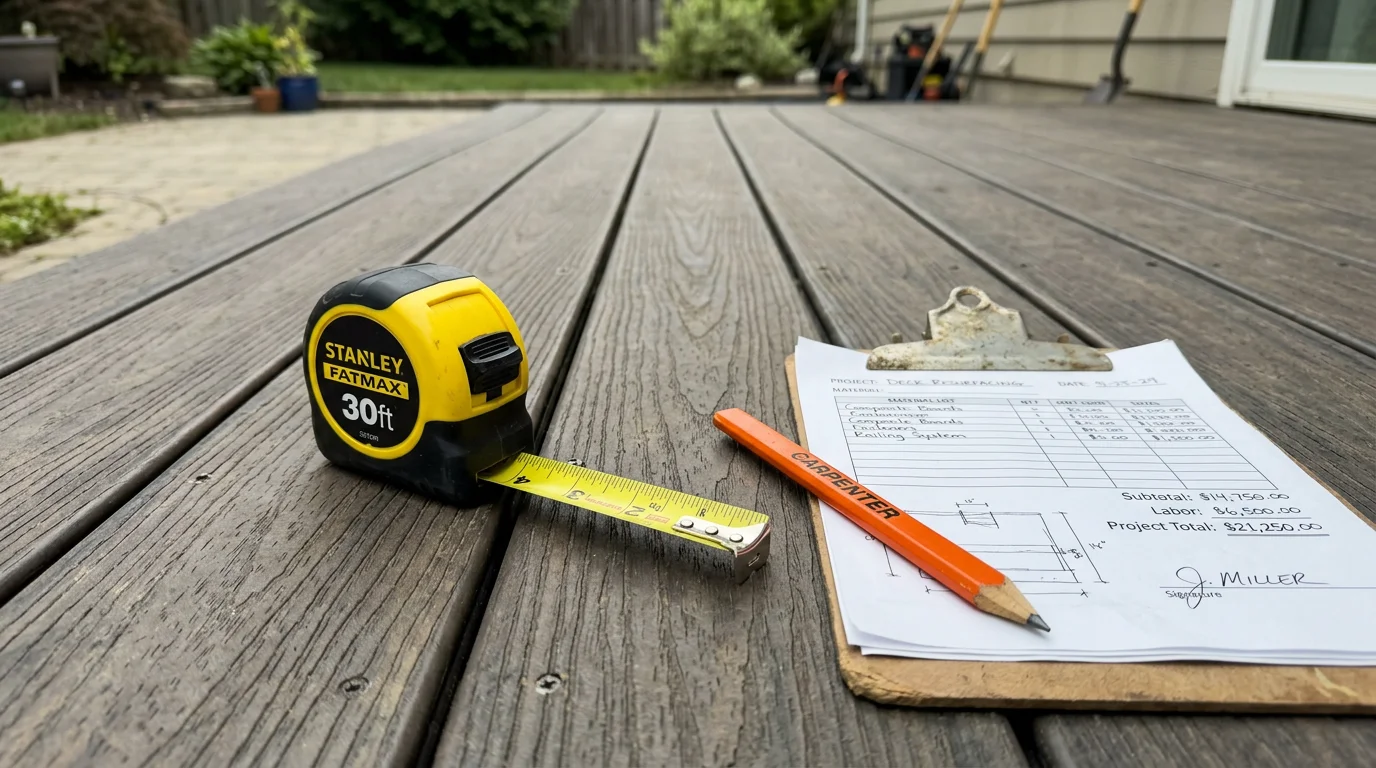
Shopping for composite decking in Canada means navigating dozens of brands, each claiming to be the best. Some manufacturers sell directly through big-box stores, others only through specialty dealers, and a few are actually made in Canada.
Here's every major composite decking manufacturer you can buy in Canada right now, organized by where you'll find them and what makes each one different.
North American Market Leaders
These brands dominate the Canadian market with the widest dealer networks and longest track records.
🏗️ Planning a deck project?
Get a free manual project review, or visualize your dream deck with AI before requesting quotes.
Trex
Manufacturing: Winchester, Virginia and Fernley, Nevada
Canadian availability: Home Depot, specialty dealers
Price range: $8-14/sqft material only
Trex invented wood-alternative decking in 1996 and remains the largest manufacturer. Their Transcend line uses a three-sided shell that resists fading and staining better than older composites. Trex boards come in 12', 16', and 20' lengths—longer spans mean fewer seams.
Canadian pricing runs $65-85/sqft installed depending on complexity. Trex offers a 25-year residential warranty covering fade and stain, plus a 25-year structural warranty.
The company's newer Lineage line (launched 2024) targets the premium market with deeper grain patterns and matte finishes that look less like plastic. Expect to pay 15-20% more than Transcend.
Read our detailed Trex review for Ontario-specific pricing and performance data.
TimberTech (AZEK)
Manufacturing: Ohio and Pennsylvania
Canadian availability: Specialty dealers, some Lowe's locations
Price range: $9-16/sqft material only
TimberTech merged with AZEK in 2020, creating a product lineup that ranges from basic composite (AZEK Harvest) to pure PVC capped boards (AZEK Vintage). The PVC-capped lines resist moisture absorption better than wood-fiber cores, which matters in Ontario's freeze-thaw climate.
Their Pro line uses random-length planks to eliminate repeating grain patterns—boards range from 12' to 20' in the same bundle. Installers either love this or hate it depending on how they frame.
Installed pricing: $70-95/sqft in KWC. TimberTech's 30-year fade/stain warranty includes coverage for mold, which most competitors exclude.
Fiberon
Manufacturing: North Carolina
Canadian availability: Lowe's, specialty dealers
Price range: $7-12/sqft material only
Fiberon positions between Trex and budget brands. Their Paramount line uses PermaTech capping (similar to Trex's shell technology) and comes with a 25-year warranty.
The Horizon line offers the same capping at a lower price by using hollow boards instead of solid cores. This cuts weight and cost but also rigidity—you'll need closer joist spacing (12" on center instead of 16") for the same performance.
Fiberon's Concordia line launched in 2025 as their entry into the ultra-premium market, competing directly with Trex Lineage and TimberTech Reserve. Canadian pricing data is still limited.
Expect $60-80/sqft installed for Paramount, less for Horizon.
Wolf Decking
Manufacturing: Kansas
Canadian availability: Specialty dealers
Price range: $8-13/sqft material only
Wolf competes on density—their boards weigh 15-20% more than equivalent Trex products, which translates to better scratch resistance and less flexing. The trade-off is harder installation (cutting and drilling requires carbide blades and pre-drilling for fasteners).
Canadian distribution remains spotty outside major metros. If you find a dealer, expect similar installed pricing to Trex: $65-85/sqft.
MoistureShield
Manufacturing: Arkansas
Canadian availability: Limited specialty dealers
Price range: $7-11/sqft material only
MoistureShield's core claim is submersible performance—you can install their boards directly on the ground or even partially underwater. The solid polymer shell keeps water from reaching the wood-fiber core regardless of cuts or drilled holes.
This matters for Ontario decks that see heavy snow loads followed by spring melting. Standard composites can absorb moisture through cut ends and fastener holes, leading to freeze-thaw expansion over time.
The Vision line uses coconut husk fiber instead of wood, which the company claims improves moisture resistance further. Canadian installers report mixed results—some love it, others find it too flexible for typical joist spacing.
Mid-Tier Brands
These manufacturers offer solid performance at lower prices by simplifying product lines or reducing distribution costs.
NewTechWood
Manufacturing: China and Malaysia
Canadian availability: Home Depot, online retailers
Price range: $5-9/sqft material only
NewTechWood (formerly UltraShield) delivers surprisingly good performance for the price. Their boards use four-sided capping and come with a 25-year warranty that matches premium brands.
The catch: heavier grain patterns that look more artificial, and limited color selection (usually 6-8 options versus 15+ for Trex). For $50-70/sqft installed, many Ontario homeowners accept these trade-offs.
EverGrain (Tamko)
Manufacturing: Missouri
Canadian availability: Specialty dealers, declining
Price range: $6-10/sqft material only
Tamko Building Products manufactures EverGrain as part of their building materials portfolio. Quality sits between budget brands and premium manufacturers, with 25-year warranties on most lines.
Canadian distribution has shrunk since 2022—call ahead to verify dealer stock. Where available, installed pricing runs $55-75/sqft.
Clubhouse by Fiberon
Manufacturing: North Carolina
Canadian availability: Lowe's
Price range: $4-7/sqft material only
This is Fiberon's entry-level line using older manufacturing tech (capped three sides instead of four). The product works fine if you install it carefully—cut ends need sealing, and you'll want to stain-test before placing furniture.
Installed pricing: $45-65/sqft, overlapping with premium pressure-treated options. Compare composite versus wood costs to see if the upgrade makes sense for your budget.
ChoiceDek
Manufacturing: Alabama
Canadian availability: Independent dealers
Price range: $5-8/sqft material only
ChoiceDek manufactures private-label composite for various distributors under multiple brand names. Quality varies by production run—some dealers report excellent consistency, others complain about color matching between batches.
The 25-year warranty covers material defects but excludes fade and stain after the first five years. If color consistency matters, buy all materials at once with matching lot numbers.
Canadian-Made Options
Want to support domestic manufacturing? These brands produce composite decking in Canada.
SmartDeck by Thermal Industries
Manufacturing: Ajax, Ontario
Canadian availability: Specialty dealers in Ontario and Quebec
Price range: $6-10/sqft material only
SmartDeck manufactures near Toronto, cutting shipping costs for Ontario projects. Their boards use recycled plastic and wood fiber sourced from Canadian lumber mills.
The product lineup focuses on three core colors (grey, brown, redwood) instead of the dozen-plus options from American brands. Boards come in standard 12' and 16' lengths.
Installed pricing runs $55-75/sqft in KWC, competitive with mid-tier imports. The 25-year limited warranty covers structural integrity but only five years for fade/stain.
Local availability matters for warranty claims—you're dealing with a company two hours away instead of filing paperwork with an American headquarters.
Dura Composites (Canadian Division)
Manufacturing: Burnaby, BC
Canadian availability: Western Canada primarily
Price range: $7-11/sqft material only
Dura manufactures in BC but distributes nationally through specialty dealers. Their Dura Deck line uses hollow boards similar to Fiberon Horizon, requiring 12" joist spacing.
The company also produces marine-grade composite for commercial docks and boardwalks—same material, different branding. If you need submersible performance, ask about their Dura Marine line.
Ontario availability remains limited. Expect $60-80/sqft installed if you find a dealer willing to ship from BC.
EcoGen by BeauLieu Canada
Manufacturing: Acton Vale, Quebec
Canadian availability: Quebec, limited Ontario distribution
Price range: $6-9/sqft material only
BeauLieu manufactures flooring and building products across Canada. Their EcoGen composite decking launched in 2023 using recycled materials from their flooring operations.
Product availability outside Quebec remains spotty. If you're in Eastern Ontario, this might be worth investigating—otherwise, expect long lead times and higher shipping costs.
Big-Box Store Brands
MasterMark (Home Depot house brand)
Manufacturing: Various (rebadged NewTechWood and others)
Canadian availability: Home Depot
Price range: $4-7/sqft material only
Home Depot's house brand changes suppliers based on pricing negotiations. Current MasterMark boards come from NewTechWood's factories but lack four-sided capping.
The 15-year warranty covers material defects only—no fade or stain coverage. For $45-60/sqft installed, this works as a budget option if you understand the trade-offs.
Veranda (Home Depot)
Manufacturing: Various
Canadian availability: Home Depot
Price range: $3-6/sqft material only
Veranda sits at the bottom of Home Depot's composite lineup. Early versions (pre-2020) had serious quality issues with warping and fading. Current boards show improvement but still use first-generation composite technology.
If you're comparing composite deck costs in Waterloo, this represents the floor—installed pricing around $40-55/sqft. Premium pressure-treated decking often performs better at this price point.
Premium and Specialty Manufacturers
Deckorators
Manufacturing: Georgia
Canadian availability: Specialty dealers
Price range: $8-14/sqft material only
Deckorators manufactures composite decking, railing systems, and aluminum railing. Their Voyage line features reversible boards (two different finishes, flip for the look you want) and hidden fastener compatibility.
The Heritage line targets renovation markets with boards that match the color and grain of aged cedar and redwood. Useful when adding onto existing wood decks.
Canadian pricing: $65-85/sqft installed, similar to Trex.
Fortress Building Products
Manufacturing: Alabama
Canadian availability: Specialty dealers
Price range: $9-15/sqft material only
Fortress focuses on aluminum and steel deck framing systems alongside their composite boards. If you're building a rooftop deck or elevated application where weight matters, their integrated systems simplify engineering.
Ontario dealers typically stock the railing systems but special-order decking. Lead times run 4-8 weeks.
Cali Bamboo
Manufacturing: Vietnam
Canadian availability: Online direct-ship
Price range: $7-11/sqft material only
Cali Bamboo uses bamboo fiber instead of wood in their composite formula. The company claims better dimensional stability and moisture resistance compared to wood-fiber composites.
Canadian customers order direct from the US website—factor in shipping costs and currency exchange. Total landed cost plus installation runs $70-90/sqft in Ontario.
The 25-year warranty covers fade and stain, but filing claims from Canada adds complexity.
Budget Import Brands
Multiple Chinese manufacturers sell composite decking through Amazon and direct-ship websites. Brand names change frequently—look for "WPC decking" or "co-extrusion composite" in product descriptions.
Quality varies wildly. Some manufacturers produce boards comparable to mid-tier American brands, others ship product that warps during the first summer. Canadian building codes don't regulate composite decking materials, so you're relying entirely on manufacturer claims.
If you're considering imports:
- Order samples first to check color accuracy and surface finish
- Verify dimensional consistency by measuring multiple boards
- Understand warranty limitations—most exclude Canadian customers from coverage
- Calculate total costs including shipping, duty, and currency exchange before comparing prices
Many Ontario contractors refuse to install imported composite because warranty claims become their problem when boards fail. Factor this into your decision if you're hiring installation.
What to Look for When Comparing Brands
Capping Technology
Premium composites use plastic shells that completely encapsulate the wood-fiber core. This prevents moisture absorption through cut ends and drilled holes—critical for Ontario's freeze-thaw climate.
- Four-sided capping: Best moisture protection, higher cost
- Three-sided capping: Requires sealing cut ends, mid-range cost
- Uncapped composite: Budget option, absorbs moisture like wood
Core Composition
Composite boards use different ratios of wood fiber, recycled plastic, and binding agents. Higher plastic content generally means:
- Better moisture resistance
- Less fading and staining
- More heat retention (boards get hot in direct sun)
- Higher material cost
Some manufacturers now use rice hulls, bamboo fiber, or coconut husk instead of wood. Performance data remains limited—these products haven't weathered multiple Ontario winters yet.
Warranty Details
Read the fine print before trusting headline warranty numbers:
- Fade/stain coverage: How many years, what discoloration percentage triggers a claim?
- Structural warranty: Does it cover deflection and warping, or just catastrophic failure?
- Exclusions: Commercial use, coastal environments (salt exposure), ground contact
- Claim process: Pro-rated refund, replacement boards, or labor coverage?
- Transferability: Does warranty transfer to new owners if you sell?
Most warranties require keeping purchase receipts and following manufacturer installation guidelines. DIY installs often void coverage—verify before starting.
Board Geometry
Composite boards come in three basic structures:
Solid boards provide maximum rigidity and span capability. They're heavier and more expensive but allow standard 16" joist spacing for all applications.
Hollow boards reduce weight and cost by removing core material. You'll need closer joist spacing (typically 12" on center) to prevent flexing. They work fine for most residential decks.
Double-sided boards feature different finishes on each face—typically a deeply grooved side and a lightly textured side. You choose during installation, but you're stuck with that choice forever.
Color and Grain Options
Composite manufacturers offer colors ranging from grey (most popular in Ontario) to browns, reds, and even blue-grey tones. Darker colors show dust and scratches more obviously but create stronger contrast with white railings.
Grain patterns matter more than you'd expect. Premium brands use multiple molds so adjacent boards don't show identical grain repeats. Budget brands use single molds—you'll see the same knot pattern every 12'.
Surface texture affects slip resistance and heat retention. Deeply embossed boards stay cooler but trap more dirt. Smooth finishes get hot but clean easily.
Installation Requirements
Most composite brands require proprietary hidden fasteners or recommend specific screw patterns. Factor these costs into your budget:
- Hidden fastener clips: $1.50-3.00 per linear foot
- Face screws (color-matched): $0.50-1.00 per board
- Starter/finishing clips: $50-100 per deck
Joist spacing requirements affect framing costs. If your chosen composite needs 12" on-center spacing instead of standard 16", you're adding 20-30% more framing lumber to the project.
Some manufacturers require specific underlayment or tape over joists. Others void warranties if you don't use their branded products. Compare these costs against your total budget.
Where to Buy in Ontario
Big-Box Stores
Home Depot carries Trex (Transcend and Enhance lines), NewTechWood, Veranda, and their MasterMark house brand. Stock varies by location—Toronto-area stores keep more inventory than smaller markets.
Lowe's stocks Fiberon (Paramount, Horizon, Symmetry) and TimberTech in select locations. Eastern Ontario stores often have better TimberTech availability than Western Ontario.
Pros: See and touch boards before buying, take home samples, cash-and-carry for small projects.
Cons: Limited color selection, no access to premium lines, staff may lack detailed product knowledge.
Specialty Lumber Dealers
Independent lumber yards and building supply centers carry wider selections including Wolf, MoistureShield, TimberTech's full lineup, and Canadian brands like SmartDeck.
These dealers often provide design services, detailed estimates, and contractor referrals. Expect higher per-square-foot pricing (10-20% more than big-box) but better technical support.
Most dealers order material based on your project plans rather than keeping inventory. Lead times run 1-4 weeks depending on season and manufacturer.
Direct From Contractors
Many deck builders in KWC negotiate volume pricing with specific manufacturers. They'll include materials in their installed quote, usually at a markup over retail.
Ask contractors to itemize material costs in quotes so you can verify pricing. Some builders inflate material charges to offset lower labor rates—transparency matters.
If you're supplying your own materials, understand that most contractors charge more for labor when they don't control the material source. Their warranty may exclude material defects they didn't provide.
Installation Costs by Brand
Material quality affects installation pricing because premium composites install faster:
Trex, TimberTech, Fiberon (premium lines):
- Material: $8-14/sqft
- Labor: $25-35/sqft
- Total installed: $65-85/sqft
Mid-tier brands (NewTechWood, Wolf, ChoiceDek):
- Material: $6-10/sqft
- Labor: $25-35/sqft
- Total installed: $55-75/sqft
Budget composites (Veranda, import brands):
- Material: $3-7/sqft
- Labor: $30-40/sqft (higher labor due to inconsistent dimensions)
- Total installed: $45-65/sqft
Labor costs increase when boards require more cutting and fitting to compensate for warping or dimensional variation. Premium brands cost more upfront but often reduce installation time.
These numbers assume standard deck designs without curves, inlays, or picture framing. Add 15-30% for complex patterns requiring extra cutting and waste.
Don't forget railing costs—composite railing systems add $40-120 per linear foot depending on style and materials.
🎨 Not sure which material to pick?
Upload a photo of your backyard and see exactly how Trex, TimberTech, or cedar would look — free and instant.
Common Questions
Which composite decking brand lasts longest in Canada?
Based on track records in Ontario's climate, Trex Transcend and TimberTech AZEK show the best long-term performance after 15+ years. Both use advanced capping technology that resists moisture absorption through freeze-thaw cycles. Warranty length doesn't necessarily predict real-world durability—read independent reviews from Canadian homeowners who've weathered multiple winters.
Can I use the same brand composite for decking and railings?
Most manufacturers produce matching railing systems, but you're not required to match. Many Ontario homeowners install composite decking with aluminum railings (lower maintenance, more design options) or cable railings (better views). If you do match materials, order everything from the same production lot to ensure color consistency—different batches sometimes show slight color variation.
Do I need to seal or stain composite decking in Ontario?
No. Composite decking is manufactured with pigment throughout the material and should never be stained or sealed. These treatments actually trap moisture and void warranties. Regular cleaning with soap and water is the only maintenance composite requires. If boards fade beyond warranty coverage, the color is permanent—no amount of sealing will restore it.
Are composite decking boards truly made from recycled materials?
Most composite manufacturers use recycled HDPE plastic (from milk jugs and detergent bottles) and reclaimed wood fiber (sawdust and wood scraps from lumber mills). The exact percentages vary—Trex claims 95% recycled content, while some budget brands use primarily virgin plastic with minimal wood fiber. Canadian manufacturing often sources wood waste from domestic lumber operations, reducing transportation emissions compared to imported products.
How do I get manufacturer warranties honored in Canada?
Purchase from authorized Canadian dealers and keep detailed records: receipts, installation photos showing proper technique, cleaning logs. Most warranties require professional installation following manufacturer guidelines—DIY projects often void coverage. File claims through the dealer who sold you materials, not directly with manufacturers. Response times vary wildly, from weeks to months. Some brands handle Canadian claims through US headquarters, adding processing delays.
Related: Composite Decking Calculator: How Much Material Do I Need?.
You may also find Hidden Fasteners for Composite Decking in Canada: Options and Cost helpful.
Upload a backyard photo and preview real decking materials with AI — free, instant, no sign-up.
Permits, costs, material comparisons, and questions to ask before requesting quotes — delivered to your inbox.