
Composite Decking Calculator: How Much Material Do I Need?
Calculate composite decking material needs for your Ontario deck project. Get accurate board counts, fastener quantities, and waste factors for KWC builds.
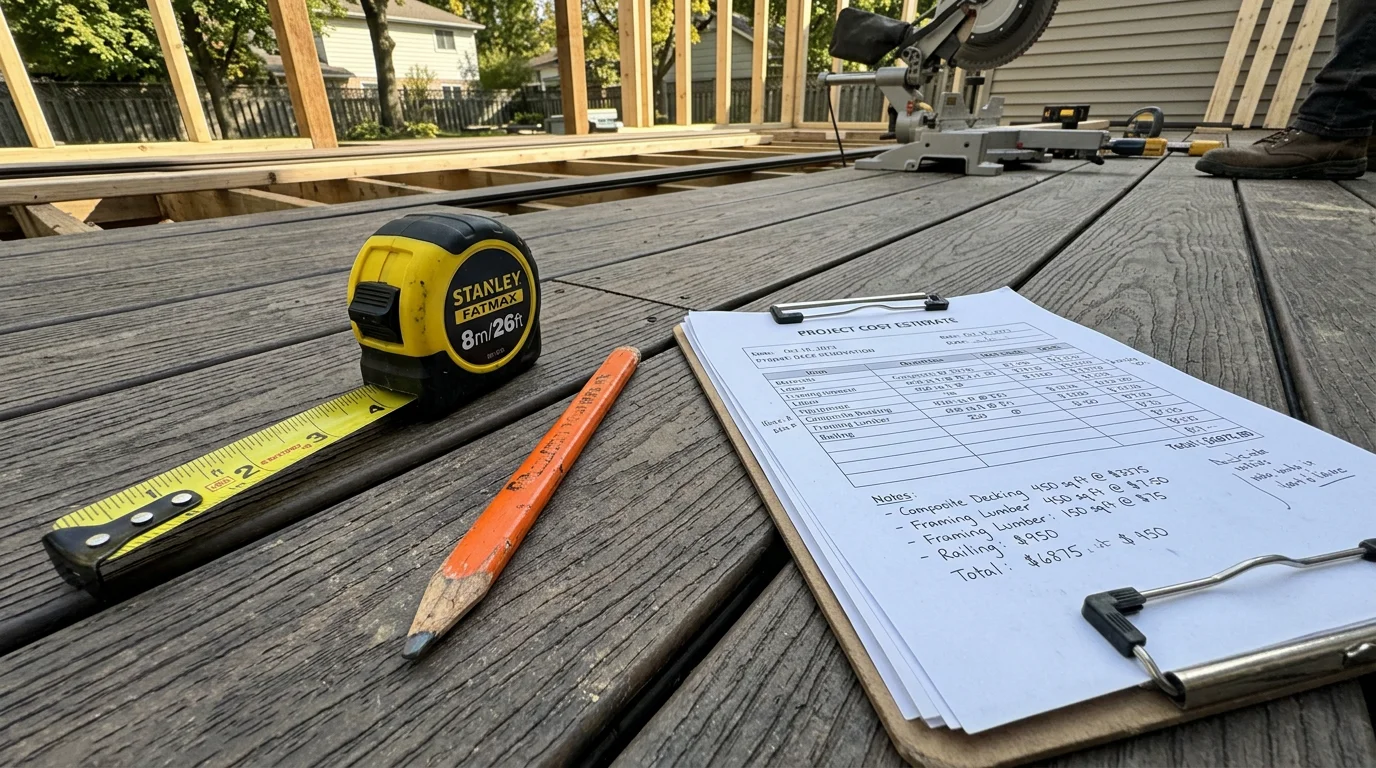
You've settled on composite for your new deck, locked in a design, and now you're staring at product pages wondering how many boards to order. Get it wrong and you're either making emergency trips to the supplier mid-build or sitting on $800 worth of leftover material.
Here's how to calculate exactly what you need—decking boards, hidden fasteners, starter clips, screws, and the right waste factor for your project.
Basic Deck Area Calculation
Start with your deck's footprint. Multiply length by width to get square footage.
🏗️ Planning a deck project?
Get a free manual project review, or visualize your dream deck with AI before requesting quotes.
Example calculations:
- 12 ft × 16 ft deck = 192 square feet
- 10 ft × 20 ft deck = 200 square feet
- 14 ft × 18 ft deck = 252 square feet
For L-shaped or multi-level decks, break the design into rectangles, calculate each section separately, then add them together. A 12×16 main deck with an 8×8 bump-out equals 192 + 64 = 256 square feet total.
Don't subtract for stairs or built-in planters yet. You'll account for those in the waste factor.
Composite Board Coverage Per Piece
Most composite decking in Canada comes in 12-foot, 16-foot, and 20-foot lengths. Standard board widths are either 5.5 inches (actual coverage) or 6 inches nominal.
Coverage per board (5.5-inch width with 1/8" gap):
- 12-foot board = 5.5 sq ft of coverage
- 16-foot board = 7.3 sq ft of coverage
- 20-foot board = 9.2 sq ft of coverage
Most manufacturers list coverage per piece on spec sheets. Trex, TimberTech, and Fiberon all use similar dimensions, but verify with your specific product line—grooved boards for hidden fasteners sometimes have slightly different coverage than square-edge boards.
How to Calculate Board Quantity
Take your total square footage and divide by the coverage per board, then add waste factor.
Formula:
(Total Square Footage ÷ Coverage Per Board) × Waste Factor = Boards Needed
Waste factors for Ontario deck guides builds:
- Straightforward rectangle, no angles: 1.10 (10% waste)
- Deck with stairs or small cutouts: 1.15 (15% waste)
- Deck with 45° picture frame border: 1.20 (20% waste)
- Complex angles, curves, or herringbone pattern: 1.25-1.30 (25-30% waste)
Ontario's freeze-thaw cycles make it smart to keep 2-3 extra boards on hand for future board replacement if damage occurs. Composite doesn't rot, but it can scratch, stain, or get damaged by patio furniture, BBQs, or snow removal tools.
Example Calculation: 12×16 Deck
You're building a 192 sq ft deck in Waterloo using 12-foot composite boards:
192 sq ft ÷ 5.5 sq ft per board = 34.9 boards (base)
34.9 × 1.10 (10% waste) = 38.4 boards
Order 39 boards.
Add 2 extra for future repairs if you want to avoid color-matching headaches in 5 years when the same board might have a slightly different shade.
Hidden Fastener Quantities
If you're using hidden fastening systems (grooved-edge boards with clips), you'll need starter clips for the first row and standard hidden fasteners for the rest.
Typical spacing:
- Hidden fasteners are placed every 16 inches along each board edge
- Each board edge needs fasteners on both sides (left groove, right groove)
Formula for hidden fasteners:
(Total Linear Feet of Decking ÷ 1.33 ft spacing) = Number of Fasteners
For a 12×16 deck running boards across the 16-foot span:
- 12 feet of deck width ÷ 0.46 ft board width = 26 boards across
- 26 boards × 16 feet long = 416 linear feet of decking
- 416 ÷ 1.33 = 313 hidden fasteners
Starter clips (first row): You need one clip per joist for the first board. If you have joists every 16 inches across a 12-foot span, that's 10 joists = 10 starter clips.
Most hidden fastener systems come in bulk packs of 90, 350, or 500 pieces. For a 192 sq ft deck, a 350-piece bucket covers the job with spares.
Fascia Board Coverage
Fascia (perimeter trim) runs along the exposed edges of your deck frame. Measure the total perimeter, subtract any side attached to the house, and add 10% waste for cuts and miters.
Example perimeter calculation (12×16 deck):
- Three exposed sides: 16 ft + 12 ft + 16 ft = 44 linear feet
- Add 10% waste: 44 × 1.10 = 48.4 linear feet
If fascia boards are 12 feet long:
48.4 ÷ 12 = 4.03 boards → order 5 boards
Most composite fascia is 1 inch thick × 11.25 inches tall (actual dimensions). Some builders use the same decking boards vertically as fascia to maintain color consistency—this uses more material but eliminates the need to order a separate fascia product.
Railing Material Calculations
Railing gets complicated fast because systems vary. Here's what you need for a typical 36-inch composite railing system:
Per 6-foot railing section:
- 1 top rail (6 ft)
- 1 bottom rail (6 ft)
- 2 posts (42 inches tall, allowing for mounting)
- Infill: Either composite balusters (every 4 inches per OBC) or cable/glass inserts
For a 12×16 deck with three open sides:
- 44 linear feet ÷ 6 ft per section = 7.3 sections → 8 sections
Most railing kits are sold as complete 6-foot or 8-foot sections including posts, rails, and balusters. Budget $40-120 per linear foot installed depending on material (composite vs. aluminum vs. glass).
For more on railing costs and code requirements, see Deck Railing Cost Ontario and Deck Railing Height Ontario Code.
Stair Material Calculations
Calculating stairs is its own beast. You need to know total rise (height from ground to deck surface) and tread depth (how deep each step is).
Ontario Building Code stair requirements:
- Maximum riser height: 7.75 inches (196 mm)
- Minimum tread depth: 10 inches (254 mm)
- Consistent riser height (within 3/8 inch across all steps)
Example: 36-inch total rise:
36 inches ÷ 7.5 inches per riser = 4.8 risers → 5 risers (4 treads + landing)
Each tread is typically 11 inches deep and runs the full width of the stairs (usually 36-48 inches wide for residential decks).
Material for 4-step stairs (36 inches wide):
- Stringers: 2×12 pressure-treated (3 stringers for 36" width)
- Treads: 4 treads × 3 feet wide = 12 linear feet of composite decking
- Riser boards (optional): 5 risers × 3 feet = 15 linear feet
For a detailed breakdown of stair math, see How Many Stairs Do I Need for My Deck?.
Material Cost Breakdown (2026 KWC Pricing)
Here's what a 12×16 composite deck (192 sq ft) costs in materials for a DIY build in Kitchener-Waterloo:
| Material | Quantity | Unit Price | Total |
|----------|----------|------------|-------|
| Composite decking (39 boards × 12 ft) | 468 linear ft | $4.50-7/ft | $2,100-3,276 |
| Hidden fasteners + starter clips | 350-pack | $120-180 | $120-180 |
| Fascia boards (5 × 12 ft) | 60 linear ft | $4-6/ft | $240-360 |
| Pressure-treated framing (joists, beams, posts) | ~600 bf | $1.80-2.50/bf | $1,080-1,500 |
| Concrete footings (8 sono-tubes) | 8 | $35-60 each | $280-480 |
| Ledger board + flashing + fasteners | 16 linear ft | $80-150 total | $80-150 |
| Joist tape/membrane (optional) | 200 linear ft | $0.50-1/ft | $100-200 |
| Railing system (44 linear ft) | 44 ft | $25-50/ft materials | $1,100-2,200 |
Total materials: $5,100-8,346 for a 192 sq ft composite deck with railing.
Add $25-45 per square foot in labour if hiring a builder: 192 sq ft × $35/sq ft avg = $6,720 for professional installation. Expect total installed cost of $65-95 per square foot for composite in the KWC area. See Composite Deck Cost Waterloo Ontario for detailed cost breakdowns.
Adjusting for Diagonal or Angled Decking
Running boards at 45° angles (diagonal decking or picture frame borders) increases waste and changes your joist spacing.
Key adjustments:
- Joist spacing must be 12 inches on-center (instead of 16") for diagonal composite
- Waste factor jumps to 20-25% due to angled end cuts
- Double-check manufacturer specs—some composite brands void warranties if installed diagonally without proper support
Example: 12×16 deck with 45° boards:
- Base coverage: 192 sq ft ÷ 5.5 sq ft per board = 34.9 boards
- With 25% waste: 34.9 × 1.25 = 43.6 boards → order 44 boards
Picture frame borders (perimeter boards running perpendicular to field boards) add another 8-12 boards depending on deck size. That same 12×16 deck needs roughly 10 extra 12-foot boards for a full picture frame.
Online Composite Decking Calculators
Most major brands offer free online calculators:
Trex Deck Calculator (trex.com): Enter dimensions, board direction, railing style—generates a full material list with SKU numbers and estimated cost.
TimberTech Deck Designer (timbertech.com): Similar tool with 3D visualization. Useful for multi-level decks.
Fiberon Deck Calculator (fiberondecking.com): Basic square footage calculator with waste factor adjustment.
These tools are accurate for simple rectangular decks, but they don't account for Ontario-specific factors like joist tape, flashing details, or local permit requirements. Use them as a starting point, then adjust based on your builder's framing plan.
For regional pricing and installation details, see Best Composite Decking Canada.
Common Mistakes When Ordering Materials
Ordering exact square footage with no waste. You'll run short. Always add 10% minimum, more if your design has angles or complex cuts.
Forgetting fascia and starter/end boards. These aren't included in standard decking coverage calculations. Measure and order separately.
Mixing board lengths inefficiently. If your deck is 14 feet wide, using 16-foot boards leaves 2-foot scraps that are tough to reuse. Sometimes two 12-foot boards with a seam mid-span is cleaner.
Ignoring color lot matching. Composite boards can vary slightly between production runs. Order all your material at once from the same lot to avoid shade mismatches. Keep the lot number in case you need future replacements.
Underestimating fasteners. Hidden fastener systems need more clips than you think. A 350-piece bucket covers about 150-200 sq ft of decking depending on joist spacing.
Not accounting for board end-seaming. If you're butting two boards end-to-end over a joist, you need blocking or a specialized seam clip. Factor this into your fastener count.
Should You Order Extra?
Yes—always order 2-3 extra boards beyond your calculated need.
Here's why:
- Damaged boards in shipping: Composite ships wrapped, but occasionally a board arrives with a gouge or crack.
- Mis-cuts during installation: Even experienced builders occasionally cut a board 2 inches short.
- Future repairs: If a board gets damaged 5 years from now, you'll want an exact color match. Composite fades slightly over time, and new boards won't match aged ones perfectly.
Store spare boards flat and covered in a garage or shed. They'll last decades and save you from impossible color-matching situations down the road.
🎨 Not sure which material to pick?
Upload a photo of your backyard and see exactly how Trex, TimberTech, or cedar would look — free and instant.
Common Questions
How many square feet does a 12-foot composite board cover?
A standard 12-foot composite board with 5.5-inch actual width covers approximately 5.5 square feet when installed with proper 1/8-inch gaps. A 16-foot board covers 7.3 sq ft, and a 20-foot board covers 9.2 sq ft. Always verify coverage with your specific product's spec sheet—grooved boards for hidden fasteners may differ slightly from square-edge boards.
Do I need more material for diagonal composite decking?
Yes. Diagonal (45° angle) decking requires 20-25% waste factor instead of the standard 10%. You'll also need closer joist spacing—12 inches on-center instead of 16 inches—which increases framing costs. Check your composite manufacturer's installation guide, as some brands have specific requirements or warranty restrictions for diagonal installations.
How much does composite decking material cost in Ontario?
Composite decking materials range from $4.50-7.00 per linear foot ($2.75-4.25 per square foot) in the KWC area as of 2026. Mid-range brands like Trex Enhance and TimberTech Edge run $5-6/linear foot. Premium capped composite (Trex Transcend, Fiberon Paramount) costs $6.50-8/linear foot. Budget $2,100-3,300 in decking materials alone for a typical 200 sq ft deck. See Composite Decking Cost Per Square Foot Canada for detailed pricing.
Can I return unused composite decking?
Most suppliers accept returns of unopened, undamaged boards within 30-90 days, but expect a 15-25% restocking fee. Once you open a bundle or cut a board, it's typically not returnable. This is why accurate material calculation matters—you don't want to over-order and eat restocking fees, but you also don't want to under-order and make emergency trips mid-build.
How do I calculate composite decking for an L-shaped deck?
Break the L-shape into two rectangles, calculate square footage for each section separately, then add them together. Example: An L-shaped deck with a 12×16 main section (192 sq ft) and a 10×10 bump-out (100 sq ft) totals 292 square feet. Divide by coverage per board, add 15% waste for the transition and extra cuts, and round up. For a 292 sq ft deck using 12-foot boards: (292 ÷ 5.5) × 1.15 = 61 boards.
Related: Composite Decking Warranty Comparison: Trex vs TimberTech vs Fiberon.
Upload a backyard photo and preview real decking materials with AI — free, instant, no sign-up.
Permits, costs, material comparisons, and questions to ask before requesting quotes — delivered to your inbox.