
Hidden Fasteners for Composite Decking in Canada: Options and Cost
Hidden fasteners for composite decking in Canada cost $1.50-$4 per sqft installed. Compare clip systems, costs, and compatibility for Ontario builds.
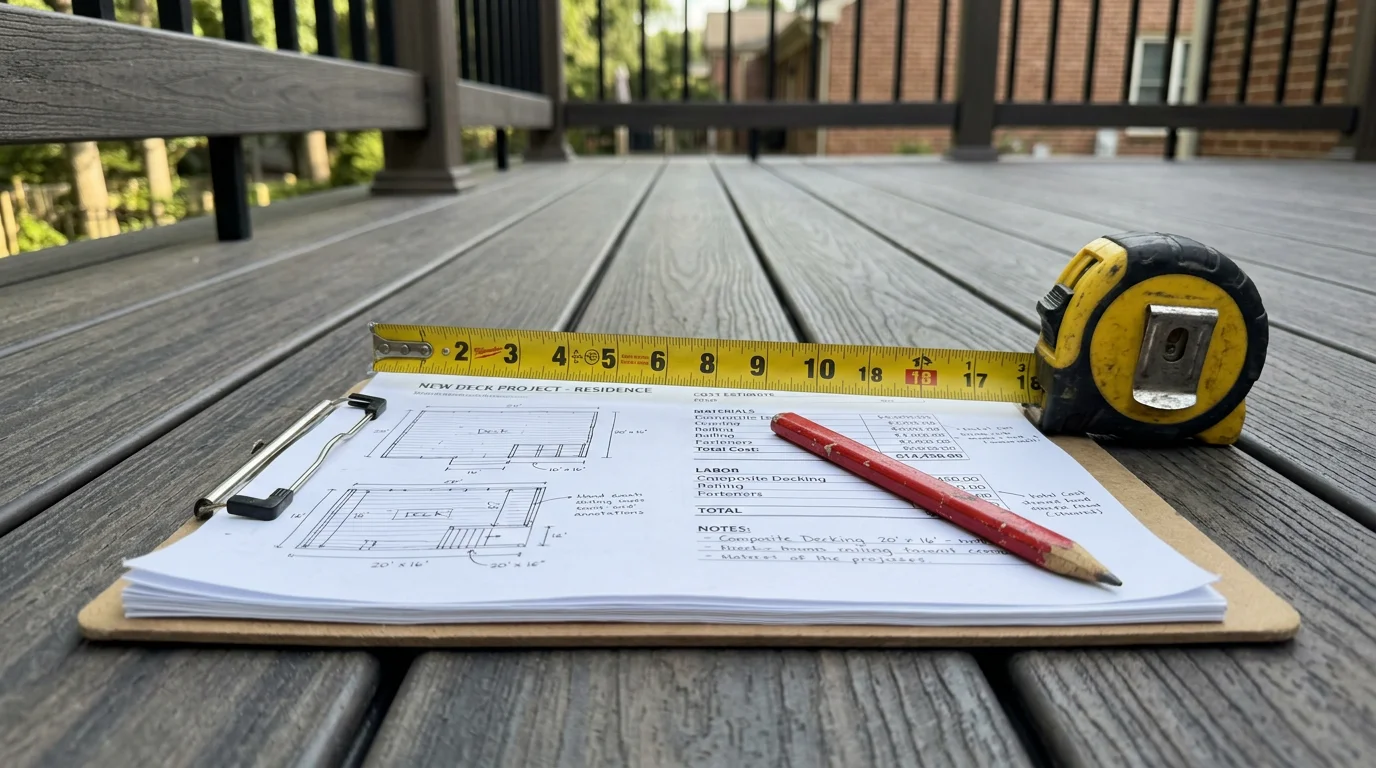
Hidden fasteners give composite decks a clean, screw-free surface while allowing boards to expand and contract through Ontario's freeze-thaw cycles. You'll pay $1.50-$4.00 per square foot more for materials and installation compared to face-screwing, but you get better aesthetics and fewer water penetration points.
Most composite deck manufacturers design their boards to work with specific hidden fastener systems. Some clip into grooves along the board edges. Others use t-clips or biscuit-style connectors. Here's what works in the Canadian market and what you'll actually pay.
Why Hidden Fasteners Work Better for Composite
Composite decking expands and contracts more than wood — typically 3-5mm per 4.8-meter (16-foot) board in summer-to-winter temperature swings. Face screws create fixed points that restrict movement, which can cause:
🏗️ Planning a deck project?
Get a free manual project review, or visualize your dream deck with AI before requesting quotes.
- Board warping along screw lines
- Mushrooming around screw heads
- Cracking at fastener points during extreme cold
Hidden fastener clips allow lateral movement while securing boards to joists. The board floats slightly, absorbing expansion without buckling.
Water intrusion matters more than you think. Every face screw is a potential entry point for moisture. In Ontario's wet spring and freeze-thaw cycles, water can wick into the composite core through screw holes, leading to mold growth and accelerated breakdown of the wood fiber component. Hidden fasteners eliminate 90% of these penetration points.
The other advantage: you never see fastener heads. No rusting, no discoloration, no tripping hazard from proud screws. Your deck surface is completely smooth.
Main Hidden Fastener Systems in Canada
Grooved-Edge Clip Systems
How they work: The composite board has a factory-milled groove along each edge. A plastic or metal clip slides into the groove, fastens to the joist, and locks the next board in place when you slide its groove over the exposed clip tab.
Compatible brands:
- Trex (groove boards work with Trex Hideaway clips)
- TimberTech (CAMO Edge clips or proprietary TimberTech CONCEALoc)
- Fiberon (grooved boards use Cortex or Fiberon Hidden Fasteners)
- Most Canadian-made composite brands with grooved profiles
Cost: $1.50-$2.50 per square foot for clips plus installation labor
Pros: Fast installation once you're practiced, very secure hold, allows proper gapping
Cons: Requires grooved boards (not all composite lines offer them), clips can be finicky in cold weather during installation
Top-Down Clip Systems (CAMO, Deckwise, Tiger Claw)
How they work: You drive a screw at an angle through a guide clip that sits on top of the joist. The screw pulls the board tight while the clip grabs the board edge. The next board covers the clip.
Compatible with: Any solid-edge composite board — you're not reliant on factory grooves
Cost: $2.00-$3.50 per square foot including clips and screws
Popular models:
- CAMO Edge Deck Fasteners: Widely available at Home Depot and Canadian Tire, $40-60 per 90-square-foot bucket
- Deckwise WiseCLIP: Stainless steel option for high-moisture areas, $70-90 per 100 sqft
- Tiger Claw TC-G: Metal clip with built-in gap spacer, $50-75 per 100 sqft
Pros: Works with virtually any composite board, easier to correct mistakes, no special board profiles needed
Cons: Slightly slower installation than groove systems, requires a specialized driver tool ($30-80), screw still penetrates board edge (though not the surface)
Biscuit/T-Clip Systems
How they work: A small plastic or composite "biscuit" slots between board edges. You screw down through the biscuit into the joist. Each biscuit holds two adjacent boards.
Compatible brands: Mostly proprietary — Azek, Zuri, some Fiberon lines
Cost: $2.50-$4.00 per square foot installed
Pros: Very clean look, excellent expansion/contraction tolerance, strong lateral hold
Cons: More expensive, slower installation, requires precision spacing, harder to find in Canada outside specialty suppliers
Installation Cost Breakdown
If you're hiring a deck builder in Kitchener-Waterloo, expect to pay $8-15 per square foot more for hidden fastener installation versus face-screwing.
Material costs (2026 Ontario pricing):
- Grooved-edge clips: $140-220 per 100 sqft of deck surface
- Top-down clips (CAMO, Tiger Claw): $170-280 per 100 sqft
- Biscuit systems: $250-400 per 100 sqft
Labor premium: Hidden fasteners add 1.5-2.5 hours per 100 square feet of installation time. At $80-120/hour for skilled carpentry in KWC, that's $120-300 extra labor per 100 sqft.
Example: 300-square-foot composite deck
| Item | Face Screws | Hidden Fasteners |
|------|-------------|------------------|
| Composite boards (300 sqft) | $2,100 | $2,100 |
| Fasteners | $40 | $600 |
| Labor (decking only) | $900 | $1,350 |
| Total (decking & fastening) | $3,040 | $4,050 |
You're paying roughly $1,000 more for hidden fasteners on a typical 300-square-foot deck. For most homeowners upgrading to composite (which already costs 15-30% more than pressure-treated), the hidden fastener premium is worth it for the finished look.
Compatibility: Match Fasteners to Your Board
Not all hidden fastener systems work with all composite boards. Here's what matters:
Board Profile
- Grooved boards require compatible clips designed for that groove depth and width
- Square-edge boards work with top-down clips but not groove systems
- Tongue-and-groove boards (rare in composite) use specialized hidden fasteners
Check your composite manufacturer's installation guide. Trex, for example, voids warranty if you use non-approved fasteners with their grooved boards.
Board Thickness
Most hidden fastener systems are designed for standard 25mm (1-inch) composite boards. If you're using thicker 38mm (1.5-inch) boards or capped polymer boards, verify clip compatibility. Some systems don't grab properly on thicker profiles.
Joist Spacing
Hidden fasteners work best with 12-inch (305mm) or 16-inch (406mm) on-center joist spacing. If your framing uses 24-inch spacing (rare for composite), you may need additional blocking or face screws at unsupported edges.
The Ontario Building Code requires adequate support regardless of fastener type — hidden clips don't change structural requirements.
Installation Tips for Ontario Climate
Install when it's warm. Hidden fasteners are fussier in cold weather. Composite boards are stiffer below 10°C, grooves can crack during clip insertion, and plastic fasteners can snap. Aim for deck installation between May and September in the KWC region.
Gap properly for expansion. Most hidden fastener systems have built-in gap spacing (typically 5-6mm). Don't force boards tight against each other. Ontario's temperature swings demand room for movement. Check your composite deck manufacturer's gapping requirements.
Use stainless steel screws. Even though the screw head is hidden, it's still in contact with the composite board and joist. Galvanized screws can corrode in Ontario's wet climate and cause brown staining. Spend the extra $20 per box for stainless.
Starter and end boards need special treatment. The first and last board of your deck can't use hidden fasteners on both edges. Most builders face-screw the outside edge using color-matched composite screws (like Cortex), then use hidden fasteners on the interior edge.
Stairs are tricky. Stair treads see more foot traffic and stress than deck boards. Some builders skip hidden fasteners on stairs entirely and use color-matched face screws for better hold. Others use a hybrid approach — hidden fasteners on the back of each tread, one face screw at the front.
Do Hidden Fasteners Affect Permits?
No. The City of Kitchener, Waterloo, and Cambridge permit applications don't distinguish between face screws and hidden fasteners. Your inspector cares about:
- Proper joist spacing and span
- Ledger board attachment and flashing
- Footing depth (48 inches / 1.2m minimum in Ontario)
- Railing height and guard requirements
Fastener choice is a finish detail, not a structural concern — as long as you're using an approved system and following manufacturer specs.
That said, hidden fasteners must still secure boards properly. If an inspector sees loose boards or inadequate fastening during a framing inspection, you'll need to fix it regardless of system type.
Maintenance and Long-Term Performance
Hidden fasteners hold up better than face screws over time. In Ontario's freeze-thaw environment, face screws can work loose as the composite expands and contracts. You'll see proud screws that need re-driving every 2-3 years. Hidden clips don't have this problem — the board moves around the fastener, not against it.
Replacement boards are trickier. If you need to replace a damaged board mid-deck, you'll need to remove adjacent boards to access the hidden clips. With face screws, you just back out the screws and swap the board. This rarely matters (composite boards seldom need replacement), but it's worth knowing.
No visible corrosion. Face screws rust, stain, and discolor over time, especially if you use anything less than stainless steel. Hidden fasteners eliminate this entirely. Your deck looks identical in year 10 as it did on installation day.
For composite deck maintenance in Ontario, hidden fasteners make cleaning easier — no screw heads to catch debris, and smoother surface means less dirt accumulation.
Should You Upgrade to Hidden Fasteners?
Yes, if:
- You're already paying for composite decking and want the cleanest finish
- Your budget allows for the $3-5/sqft premium
- You're building a larger deck (200+ sqft) where aesthetics matter
- You want minimal maintenance and maximum longevity
Skip it if:
- You're on a tight budget and every dollar counts
- Your deck is small (under 100 sqft) where the cost difference is minimal anyway
- You're using lower-tier composite where hidden fasteners may not be compatible
- You're DIYing and want the simplest installation method
For most homeowners building a composite deck in Kitchener-Waterloo, hidden fasteners are worth the upgrade. You're already spending $65-95 per square foot installed for composite — adding another $3-5/sqft for a vastly better appearance is a smart investment.
If you're getting quotes, ask builders to price both options. Some include hidden fasteners as standard with premium composite brands like Trex or TimberTech. Others charge it as an add-on.
🎨 Not sure which material to pick?
Upload a photo of your backyard and see exactly how Trex, TimberTech, or cedar would look — free and instant.
Common Questions
Can you use hidden fasteners on existing deck framing?
Yes, as long as your joists are in good condition and spaced 16 inches or less on-center. Hidden fasteners don't change structural requirements — they're just a different way to attach boards. If you're replacing an old wood deck with composite, you can reuse the framing and upgrade to hidden fasteners at the same time. Just ensure your joists meet current code for the composite board span you're installing.
Do hidden fasteners void composite deck warranties?
Only if you use incompatible systems. Most composite manufacturers require approved hidden fasteners to maintain warranty coverage on grooved boards. Using random clips or face screws on boards designed for hidden fastening can void your warranty. Check the installation manual for your specific composite brand — it will list approved fastener systems. Trex Hideaway, CAMO Edge, and CONCEALoc are widely approved across multiple brands.
Can you mix hidden fasteners and face screws on the same deck?
Yes, and most decks do. Starter boards, end boards, and perimeter edges typically need face screws because there's no adjacent board to cover the fastener. Builders use color-matched composite screws (Cortex, HeadCote, etc.) for these spots — they're less visible than metal screws. The rest of the field uses hidden fasteners. Stair treads often get face screws for extra hold. This hybrid approach is standard practice and doesn't affect appearance or performance.
How much extra time does hidden fastener installation add?
Expect 1.5-2.5 hours per 100 square feet compared to face screwing. Grooved-edge clip systems are fastest once you're practiced — experienced installers can match face-screw speed. Top-down clips (CAMO, Tiger Claw) are slower because each board requires precise alignment and angled driving. Biscuit systems are slowest. For DIY installation, add 50% more time to account for the learning curve. A 300-square-foot deck that would take 6 hours with face screws might take 9-10 hours with hidden fasteners.
Are hidden fasteners strong enough for high-traffic decks?
Absolutely. Hidden fastener systems are engineered to meet or exceed the pull-out and shear strength of face screws. Grooved-edge clips actually distribute load better than face screws because they engage the entire board edge rather than a single penetration point. Commercial decks, boardwalks, and public spaces in Canada use hidden fasteners without issue. The key is proper installation — clips must be fully seated and screws driven to spec. Under-driven fasteners (hidden or face) will cause problems regardless of system type.
Related: Composite Decking Calculator: How Much Material Do I Need?.
You may also find Composite Decking Fading: UV Performance by Brand in Canada helpful.
Upload a backyard photo and preview real decking materials with AI — free, instant, no sign-up.
Permits, costs, material comparisons, and questions to ask before requesting quotes — delivered to your inbox.