
Deck Builder Insurance in Ontario: What to Verify
Verify your Ontario deck builder has proper insurance coverage. Learn what policies protect you, how to check certificates, and red flags to avoid.
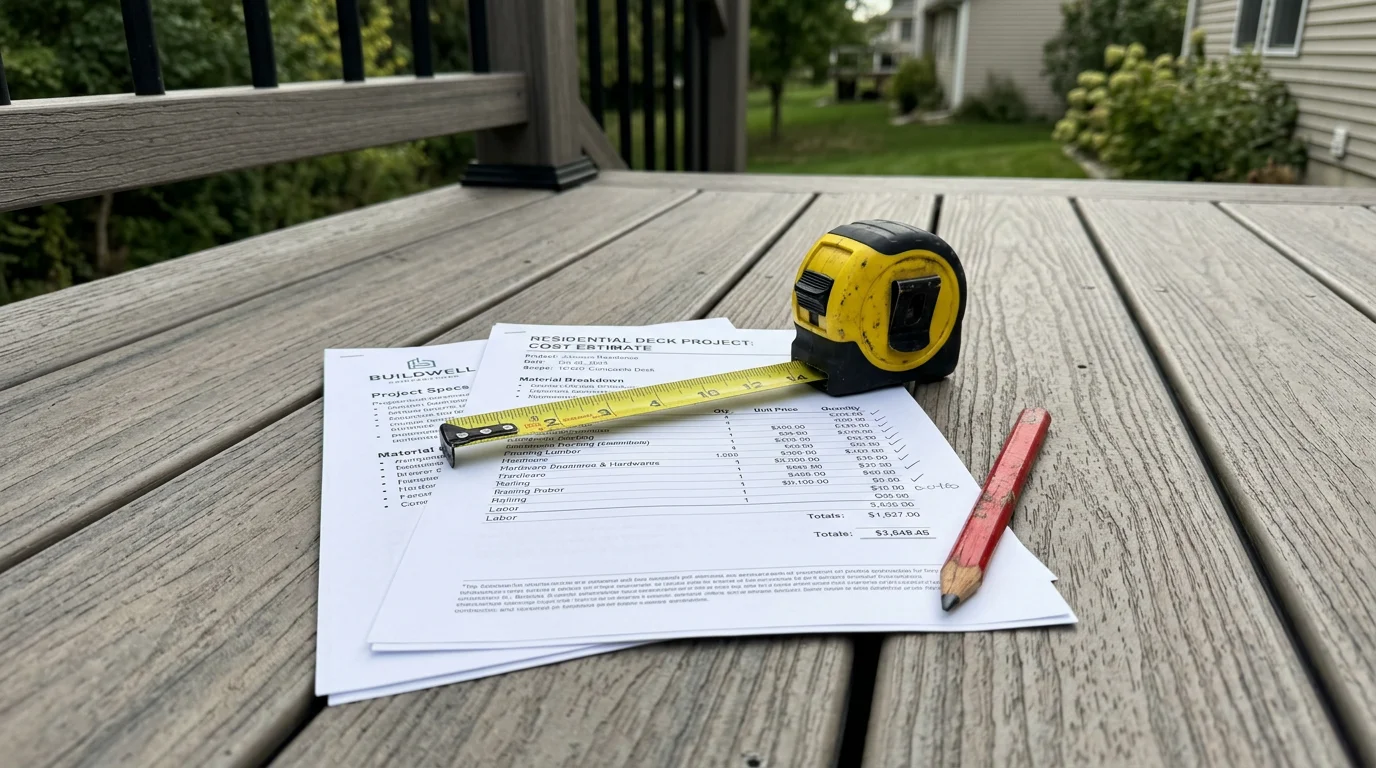
Your deck builder just quoted you $18,000 for a 12x16 composite deck. Before you sign anything, you need to verify they carry the right insurance. If someone gets hurt on your property during construction—or the deck collapses two years later—inadequate coverage could leave you holding a six-figure liability.
Here's exactly what insurance your Ontario deck guides builder must carry, how to verify it, and what happens when they don't have proper coverage.
Why Deck Builder Insurance Matters in Ontario
Ontario operates under premises liability law. If a worker falls off your deck during construction and the builder lacks proper insurance, you as the property owner become the backup defendant. Your homeowner's insurance may refuse to cover commercial construction claims, leaving your personal assets exposed.
🏗️ Planning a deck project?
Get a free manual project review, or visualize your dream deck with AI before requesting quotes.
Beyond injuries, professional liability covers design defects and code violations. A deck that fails inspection, pulls away from your house, or collapses under snow load can trigger lawsuits that outlast the builder's business by years.
Required Insurance Policies for Ontario Deck Builders
Legitimate deck contractors in the KWC region carry three core policies:
Commercial General Liability (CGL)
Minimum coverage: $2,000,000 per occurrence
This covers third-party bodily injury and property damage. If your neighbor's kid wanders onto the worksite and gets hurt, or the builder's crew damages your siding during ledger board installation, CGL pays out.
Most reputable builders carry $2-5 million in coverage. Anything under $2 million is inadequate for residential construction in Ontario.
Workplace Safety and Insurance Board (WSIB) Coverage
Required for all employees and subcontractors
WSIB is Ontario's mandatory workers' compensation system. If the builder's employee falls through your joists and breaks their back, WSIB covers medical costs and lost wages—not your homeowner's insurance.
Sole proprietors can exempt themselves from WSIB, but they must carry Commercial General Liability with employee injury coverage instead. If they hire anyone—even a day laborer—they must register for WSIB within 10 days.
Professional Liability Insurance (Errors & Omissions)
Typical coverage: $1,000,000 per claim
This covers design errors, faulty workmanship, and code violations that surface after project completion. If your builder miscalculates joist spans and your deck starts sagging in year three, professional liability pays for repairs and legal defense.
Not all deck builders carry this coverage—it's expensive—but it separates professionals from handymen operating on thin margins.
How to Verify Insurance Coverage
Don't take verbal assurances. Get proof before work starts.
Request a Certificate of Insurance (COI)
Ask for a current Certificate of Insurance naming your property address. The certificate must show:
- Policy numbers for CGL and professional liability
- Coverage amounts ($2M minimum for CGL)
- Effective dates (must cover your entire project timeline)
- Named insured (should match the business name on your contract)
A legitimate contractor will provide this within 24 hours. If they hesitate, they're either uninsured or underinsured.
Verify WSIB Coverage Directly
Ask for the builder's WSIB clearance certificate. This proves they're registered and current on premiums.
You can verify WSIB status yourself:
1. Call WSIB at 1-800-387-0750
2. Provide the business name and registration number
3. Request confirmation of active coverage
If the builder claims WSIB exemption as a sole proprietor, verify they have no employees. Check their quote—does it include "labor and materials" or just the builder's time? If they're bringing a crew, they need WSIB.
Contact the Insurance Provider
The COI lists the insurance company's contact number. Call and confirm:
- The policy is active (not expired or cancelled)
- Coverage amounts match the certificate
- Your project falls within the policy's scope
Forged certificates are rare but not unheard of. A two-minute phone call eliminates that risk.
Red Flags That Signal Insurance Problems
Watch for these warning signs during the hiring process:
"We're covered under the homeowner's policy." False. Your homeowner's insurance does not cover commercial contractors or their employees.
"Insurance is included in the price." That's not how insurance works. The builder carries their own policies. This phrase usually means they're uninsured and gambling you won't ask questions.
"We only need insurance for big jobs." Wrong. A 10x10 deck has the same liability exposure as a 20x20 deck. All projects require full coverage.
"My buddy's a contractor, he'll give us a deal." Unlicensed and uninsured contractors are common in Ontario. Your "deal" becomes expensive when someone gets hurt or the deck fails inspection.
Refuses to provide a COI or WSIB clearance. Walk away immediately. This is the biggest red flag in residential construction.
What Happens When Your Builder Isn't Properly Insured
During Construction
If an uninsured worker gets injured on your property:
1. They can sue you directly under Ontario premises liability law
2. Your homeowner's insurance may deny the claim (commercial exclusion)
3. You pay legal defense costs and any settlement out of pocket
A broken ankle costs $40,000-80,000 in medical bills and lost wages. A spinal injury can reach $500,000-1,000,000.
After Completion
If the deck fails and causes property damage or injury:
1. Without professional liability insurance, the builder may declare bankruptcy to avoid the lawsuit
2. You inherit liability as the property owner
3. Your only recourse is suing the builder personally (good luck collecting)
This scenario plays out frequently with cheap contractors who disappear after payment. Your deck builder contract should include insurance verification clauses to prevent this.
Insurance Coverage and Permits
Ontario building permits don't require proof of insurance—but they should. Municipalities verify design compliance, not contractor credentials.
Some homeowners bypass permits entirely when hiring uninsured builders. This compounds your liability:
- You're on the hook for unpermitted construction
- Your insurance may void coverage for unpermitted structures
- Future buyers will discover the unpermitted deck during home inspection
If you're considering the permit route, read our guides on Kitchener deck permit applications, Waterloo permit requirements, and Cambridge permit processes.
How Much Does Contractor Insurance Cost?
Deck builders pay $2,000-5,000 annually for CGL coverage, depending on revenue and claims history. WSIB premiums run $2-6 per $100 of payroll for construction trades. Professional liability adds another $1,500-3,000 per year.
For a mid-sized deck builder running three crews, total insurance costs hit $8,000-12,000 annually. That's roughly 3-5% of revenue for a $250,000/year operation.
This cost is baked into your quote. A builder offering prices 20-30% below market is either uninsured, inexperienced, or cutting corners elsewhere. When comparing deck quotes in the KWC region, factor in insurance verification—it's worth paying an extra $2-3 per square foot for proper coverage. Our complete guide to deck costs in Ontario shows how insurance overhead fits into the total price.
Insurance vs. Bonding: What's the Difference?
Insurance protects you from injuries and defects. Bonding guarantees project completion if the contractor abandons the job or goes bankrupt.
Deck builders rarely carry bonds unless they're working on municipal contracts. For residential work, focus on insurance verification first.
If you're hiring for a large project ($40,000+), consider requiring a performance bond. This costs the builder 1-3% of the contract value but ensures you don't lose your deposit if they walk away mid-project.
What to Include in Your Contract
Your deck builder contract should include:
- Copies of current COI and WSIB clearance as attachments
- Requirement to maintain coverage throughout the project
- Obligation to provide updated certificates if policies renew mid-project
- Right to verify coverage directly with insurance providers
- Cancellation clause if insurance lapses during construction
Add this clause: *"Contractor warrants they carry Commercial General Liability insurance with minimum coverage of $2,000,000 and active WSIB registration (or equivalent coverage). Contractor must provide updated certificates within 48 hours if requested. Failure to maintain coverage constitutes breach of contract and grounds for immediate termination."*
How to Handle a Builder Who Won't Provide Proof
If your chosen contractor refuses to provide insurance documentation:
1. Ask why. Some older contractors don't understand why homeowners need this. Explain your liability exposure.
2. Offer to wait. If they're between policies or updating coverage, give them a week to sort it out.
3. Walk away if they deflect. "Trust me" and "I've been doing this 20 years" are not substitutes for insurance certificates.
4. Report to your municipality. Many cities maintain contractor complaint systems. Uninsured builders operating without permits are a code enforcement issue.
5. Find another contractor. The KWC region has dozens of insured deck builders. Don't gamble on the uninsured option to save $1,500.
Check our deck quote checklist for Kitchener-Waterloo projects for more vetting questions to ask during the hiring process.
Insurance and Subcontractors
Your deck builder may hire subcontractors for specialized work—excavation, electrical, railing fabrication. Each sub should carry their own insurance.
Ask your builder: "Will you use subcontractors, and are they insured?"
If yes, request certificates for each sub. Your builder's CGL may not cover subcontractor errors or injuries.
Alternatively, verify the builder carries subcontractor default insurance, which covers gaps in sub coverage. This is common for larger contractors managing multiple trades.
Insurance Verification for DIY Decks
Planning to build your own deck? Your homeowner's insurance typically covers DIY projects as long as you pull permits and follow code.
If you hire day laborers or unlicensed help:
- They're not covered by WSIB
- Your homeowner's policy may exclude hired workers
- You could face lawsuit liability if they're injured
Stick to fully insured contractors or go completely solo. The middle ground exposes you to maximum risk.
For DIY guidance, check our Ontario Building Code deck requirements and deck framing inspection checklist.
🎨 Not sure which material to pick?
Upload a photo of your backyard and see exactly how Trex, TimberTech, or cedar would look — free and instant.
Common Questions
What if my builder's insurance expires during construction?
Your contract should require immediate notification if coverage lapses. Stop work until they provide an updated certificate. Continuing construction with expired insurance voids your liability protection.
Can I add my deck builder to my homeowner's insurance?
No. Homeowner's policies don't cover commercial contractors. Your builder must carry their own coverage. Some policies allow you to list them as "additional insured" for specific projects, but this doesn't replace their CGL policy.
Does WSIB cover the contractor owner?
Sole proprietors can opt out of WSIB if they have no employees. However, the moment they hire anyone—including cash laborers—they must register within 10 days. Operating partners in a corporation are automatically covered.
How long should I keep insurance certificates after the project?
Keep all insurance documentation for 10 years after project completion. Ontario's statute of limitations for construction defects runs up to 10 years. If someone sues over a deck collapse in year seven, you'll need proof the builder was insured during construction.
What happens if my uninsured contractor gets hurt on my property?
They can sue you under premises liability law. Even if they were negligent, Ontario courts may find you partially liable for allowing an uninsured contractor on-site. This is why verification matters—it's not just protecting the contractor, it's protecting you.
Upload a backyard photo and preview real decking materials with AI — free, instant, no sign-up.
Permits, costs, material comparisons, and questions to ask before requesting quotes — delivered to your inbox.