
Covered Deck Snow Load in Ontario: Engineer + Permit Checklist (KWC)
Adding a roof over a deck changes everything. Here’s how snow load, beam sizing, connections, and permits work in Ontario — plus a practical checklist for Kitchener–Waterloo–Cambridge.
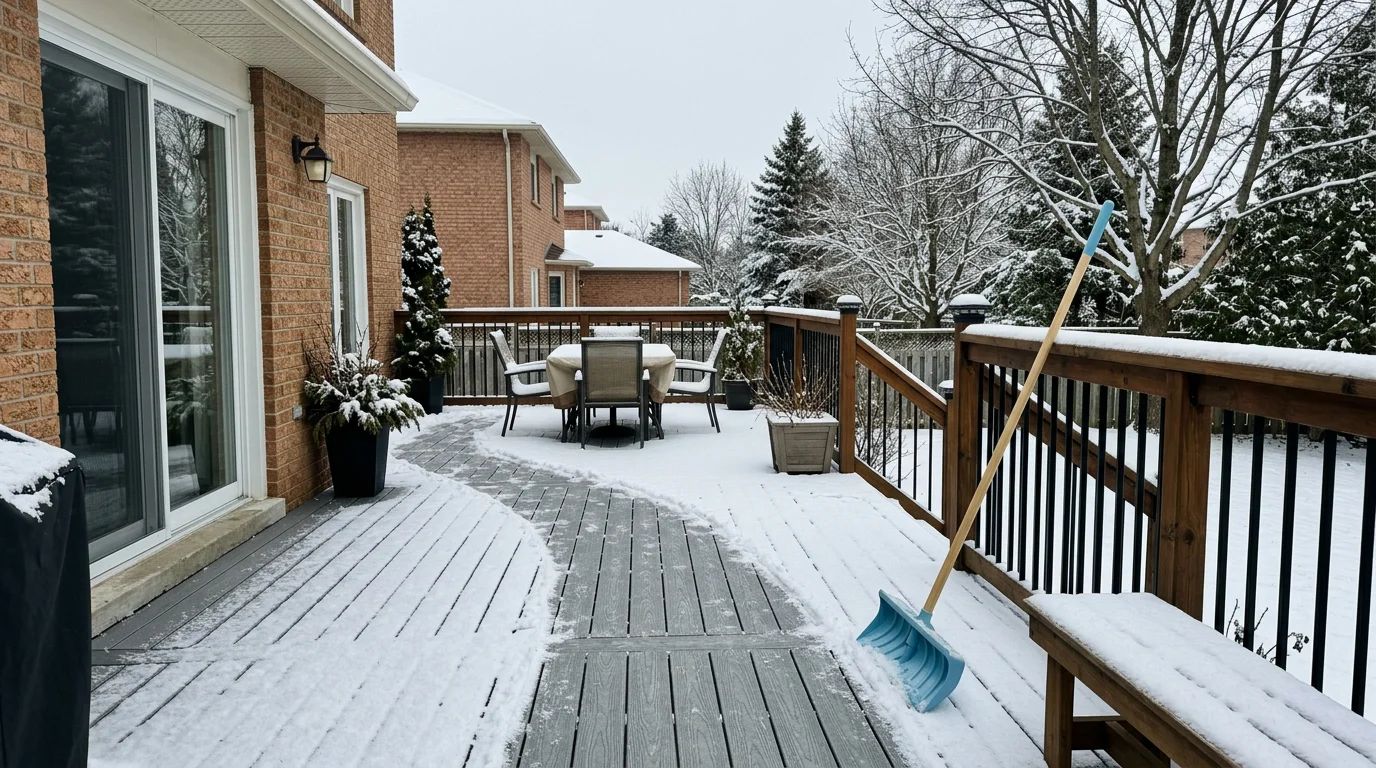
A covered deck (a roof over a deck, pergola with a solid roof, screened porch, or “deck with a canopy”) feels like a simple upgrade — until you hit the part nobody warns you about:
A roof turns your deck into a structural snow-load project.
In Ontario, snow load is one of the biggest reasons covered decks:
- require a building permit (even if the deck itself might have been permit-exempt)
- trigger engineering
- get delayed at plan review or fail inspection
This guide is a practical, builder-friendly checklist for Kitchener–Waterloo–Cambridge (KWC) homeowners planning a roofed deck.
If you want a fast sanity check on feasibility and budget, start here: /#quote-form.
What “snow load” actually means for a roof over a deck
Snow load isn’t just “how much snow is on the roof.” For building departments, it’s about ensuring your roof system can safely handle:
🏗️ Planning a deck project?
Get a free manual project review, or visualize your dream deck with AI before requesting quotes.
- accumulated snow from storms
- drifting (snow piling up near higher walls / roof transitions)
- rain-on-snow events (heavy, dense snow)
- load transfer paths from roof → posts → beams → footings → soil
A covered deck concentrates load into a few posts and footings, which is why a deck that felt “fine” as a platform becomes a different engineering problem once it carries a roof.
Why covered decks get flagged in permits (even when low decks don’t)
Many homeowners learn the “24-inch rule” for elevated decks (permit triggers when the walking surface is more than ~600mm above grade). In Kitchener, see: Deck permits in Kitchener: the 24-inch rule.
But a roof changes the permit conversation:
- A roof is a new structure with wind + snow loads.
- The roof often ties into the house (ledger/flashing/building envelope).
- The supporting posts/footings often need to be deeper/larger than a basic deck.
If you’re in “do I even need a permit?” mode, start with: Do I need a permit to build a deck in KWC? (2026 Guide).
Common covered-deck designs (and how they affect snow-load complexity)
1) “Roof over deck” tied into the house
This is the most common (and most scrutinized) option.
Typical risk points:
- ledger connection and flashing
- how the roof ties into existing framing
- concentrated loads into a few posts close to the foundation
If your design touches the building envelope, plan on permit scrutiny.
2) Free-standing roof structure over a deck
Free-standing can reduce building-envelope complexity, but it does not eliminate snow-load requirements.
It can actually increase footing complexity because all loads are carried to the ground by your posts (instead of being shared with house framing).
3) Pergola vs “solid roof”
A pergola with open slats is usually not treated the same as a solid roof.
The moment you add:
- a solid sheathing + roofing system
- polycarbonate panels
- a “waterproof pergola” system
…it starts behaving like a roof for load + permit purposes.
If you’re specifically doing a pergola/covered hybrid in KWC, also read: Pergola / covered deck permit rules (Kitchener/Waterloo).
When you should expect engineering (practical rule of thumb)
Building departments can approve simple structures from prescriptive code paths, but covered decks often fall into “needs a pro” territory.
Expect engineering when any of the following are true:
- the roof spans are large (wide projection or long beam lines)
- you have a tall roof (wind exposure)
- you’re using helical piles and need pile capacity/installation details for the permit
- the roof connects into the house in a way that needs verified load paths
- you’re building near a property line / with tight zoning setbacks
For helical piles in KWC (common under covered decks), see:
- Helical piles for decks in KWC: permits and engineering
- Helical piles vs concrete footings in KWC: permit expectations
Covered deck permit checklist (Kitchener–Waterloo–Cambridge)
This is the “submit package” view — what reduces plan-review back-and-forth.
A) A clear scope summary (what are you actually building?)
Include a one-paragraph description:
- deck size (approx. L×W)
- roof footprint (same as deck? smaller? cantilever?)
- attachment method (tied to house vs free-standing)
- roofing type (shingles, metal, polycarbonate, etc.)
B) Site plan (setbacks + lot constraints)
Your site plan should show:
- property lines
- setbacks (and how you measured)
- deck + roof footprint
- stairs/landings (these often push you closer to lines)
If you need a fast workflow for checking setbacks in KWC, see: Deck zoning + setbacks in KWC.
C) Framing plan + elevations (posts, beams, roof pitch)
Covered decks need the “load path” information:
- post locations and sizes
- beam sizes and spans
- joist directions and any doubled/tripled members
- roof pitch and rafter direction
If you’re unsure what drawings are expected, use:
D) Connection details (the part that fails inspections)
Most covered-deck failures aren’t “snow on roof.” They’re about connections:
- ledger attachment / flashing details (if attached)
- post-to-beam connectors
- beam-to-joist / hanger choices
- lateral resistance / bracing (especially for tall covers)
For water-management at the house connection, see: Deck ledger flashing (Ontario).
E) Footings / piles (depth, size, soil)
Covered structures often push you toward:
- deeper footings (Ontario frost concerns)
- more substantial concrete pads/piers
- engineered pile solutions
Start here:
F) Inspection planning (don’t get trapped mid-build)
Covered decks can add inspection steps or extra scrutiny.
A practical move is to plan your schedule around inspection availability and the required “hold points.”
Quote checklist: questions to ask any builder quoting a covered deck
Covered decks look similar in photos but price wildly because the structure underneath changes. Reviewing typical deck costs in Ontario will help you understand where the premium for a roofed deck starts.
Ask these questions before you compare quotes:
1) Is the roof engineered? If not, what prescriptive code path are they using?
2) How are you handling the house connection + flashing? (If attached)
3) What’s the footing plan? (depth/type, frost considerations, soil assumptions)
4) What is included in the permit package? (drawings, engineering stamp, resubmits)
5) What’s the inspection plan? (timing, who meets inspector, what happens if a detail changes)
6) What’s excluded? (eavestrough, electrical, lighting, soffit, screening, stairs, skirting, landscaping)
If you want a simple apples-to-apples method, use:
The two biggest “snow load” mistakes we see
Mistake #1: Treating a covered deck like a normal deck with taller posts
A roof isn’t just vertical weight.
Without proper bracing and connection design, covered decks can rack under wind and drift loads, even if the deck surface feels solid.
Mistake #2: Getting deep into a build before confirming the permit path
Covered decks are where people lose weeks:
- missing a drawing detail
- adding a solid roof after submitting as a pergola
- changing post locations after the engineer stamped the plan
If you want to avoid permit churn, start with the by-city rules and build your drawing package from there:
Quick “should I do this?” decision tree
A covered deck is usually a good idea if:
- you’ll actually use the space in shoulder seasons
- you’re okay with permit lead time
- you want a higher-end finished product (and budget)
It’s usually a bad idea (or needs a redesign) if:
- you need the project done fast and can’t risk resubmits
- you’re right on a setback boundary
- you’re trying to keep the project “simple and cheap”
Related guides (KWC + Ontario)
If you’re planning a roofed deck, these guides help you avoid the usual permit + engineering surprises:
- Kitchener vs. Waterloo vs. Cambridge deck bylaws
- Deck permit drawings checklist (KWC)
- Helical piles for decks in KWC: permits and engineering
- Ledger board attachment (Ontario deck safety)
- Deck quote line items (Ontario)
- Pergola or covered deck permit in Kitchener-Waterloo
🎨 Not sure which material to pick?
Upload a photo of your backyard and see exactly how Trex, TimberTech, or cedar would look — free and instant.
Need a covered deck quote in KWC?
If you’re building in Kitchener, Waterloo, or Cambridge and want a fast feasibility + budget sanity check, submit your details here:
Get a quote: /#quote-form
Or browse the main hub for city pages and planning guides: /decks.
Upload a backyard photo and preview real decking materials with AI — free, instant, no sign-up.
Permits, costs, material comparisons, and questions to ask before requesting quotes — delivered to your inbox.