
Deck Cost in Savannah (2026)
What does a deck cost in Savannah in 2026? Get real pricing per square foot for composite, wood, and Trex decks plus tips to save in Georgia's coastal climate.
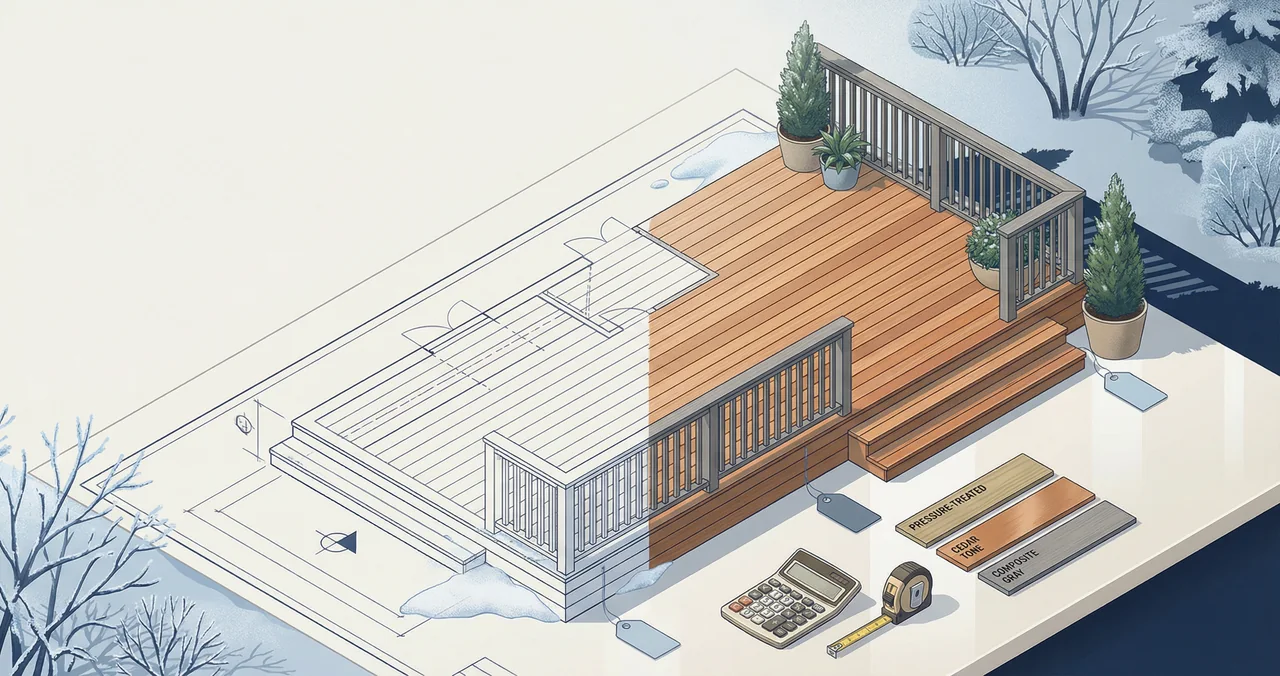
Average Deck Cost in Savannah by Material
A new deck in Savannah typically runs between $8,000 and $28,000 for a standard 300-square-foot build, depending on the material you choose and the complexity of the design. That's a wide range — and the material decision is the single biggest factor driving it.
🏗️ Planning a deck project?
Get a free manual project review, or visualize your dream deck with AI before requesting quotes.
🧮 Tool Alert: Deck Cost Calculator
Estimate your project costs in seconds based on local pricing bands for your area.
Calculate My Cost →Looking for more regional information? Check out our Georgia State Decking Hub.
Here's what Savannah homeowners are paying in 2026 for fully installed decks:
| Material | Installed Cost Per Sq Ft | 300 Sq Ft Deck Total |
|---|---|---|
| Pressure-treated wood | $25–$45 | $7,500–$13,500 |
| Cedar | $35–$55 | $10,500–$16,500 |
| Composite | $45–$75 | $13,500–$22,500 |
| Trex (brand-name composite) | $50–$80 | $15,000–$24,000 |
| Ipe (hardwood) | $60–$100 | $18,000–$30,000 |
Those numbers include materials, labor, standard railings, and basic stairs. They don't include permits, site prep for uneven lots (common in areas like Ardsley Park or the Victorian District), or upgrades like built-in lighting or custom benches.
Pressure-treated pine remains the go-to budget option, but Savannah's heat and humidity punish it. You'll spend less upfront and more on maintenance. Composite costs more on day one but holds up far better against the moisture, UV exposure, and mold pressure this city throws at outdoor surfaces.
<!-- slot:after-intro -->
For a broader look at deck pricing across different materials and regions, see our complete deck cost guide for Georgia. Timing your build right can also save thousands — check our guide on the best time to build a deck.
Cost Per Square Foot Breakdown
Per-square-foot pricing is the most reliable way to compare bids from Savannah contractors. But keep in mind: the sticker price on materials is only part of the equation. Installation difficulty, deck height, and structural requirements all shift the final number.
Material costs vs. installed costs
The gap between raw material price and installed price tells you a lot about what labor adds:
| Material | Material Only (Per Sq Ft) | Installed (Per Sq Ft) | Labor Portion |
|---|---|---|---|
| Pressure-treated | $8–$15 | $25–$45 | ~60% |
| Cedar | $12–$22 | $35–$55 | ~55% |
| Composite | $18–$32 | $45–$75 | ~55% |
| Trex | $22–$38 | $50–$80 | ~55% |
| Ipe | $28–$45 | $60–$100 | ~50% |
Labor consistently accounts for 50–60% of the total project cost in Savannah. That's slightly lower than the national average, thanks to a relatively strong supply of deck builders in the coastal Georgia market.
Size matters — but not linearly
Larger decks cost more in total but less per square foot. A 200-square-foot deck might run $50/sqft installed in composite, while a 400-square-foot deck in the same material could come in closer to $42/sqft. Contractors spread fixed costs — mobilization, permit fees, dumpster rental — across more square footage.
Labor Costs in Savannah
Savannah's labor market for deck construction is shaped by a few local realities. The city's year-round building season means contractors don't face the same compressed scheduling pressure you see in northern markets. That works in your favor.
Typical labor rates in the Savannah area:
- General deck labor: $15–$28 per square foot
- Complex builds (multi-level, curved, rooftop): $25–$40 per square foot
- Demolition and removal of old deck: $3–$8 per square foot
- Staining/sealing (for wood decks): $2–$5 per square foot
What drives labor costs up
- Deck height over 4 feet — requires additional bracing, longer posts, and often a more involved permitting process
- Angled or curved designs — more cuts, more waste, more time
- Second-story decks — common on Savannah's raised homes in historic neighborhoods, these require engineered connections to the house frame
- Access challenges — narrow lots in downtown Savannah or on the Islands can limit how materials get delivered and staged
Timing your project
Savannah builders stay busy, but there are pockets of lower demand. Late fall through early spring (October–April) is actually the best window to build here — the weather cooperates more than the brutal June-through-September heat, and some contractors offer off-peak discounts during winter months. If you're flexible on timing, ask about scheduling during these months. You may save 5–10% on labor alone.
<!-- slot:mid-content -->
What Affects Your Total Price
Material and size get the most attention, but several other factors can push your Savannah deck cost up — sometimes by thousands.
Deck height and foundation
Savannah's frost line is shallow at 6–12 inches, which keeps footing costs reasonable compared to northern states. But if your yard slopes or your home sits on a raised foundation (very common in Savannah's historic core), the posts and framing get more expensive. A ground-level deck might need minimal footings, while a raised deck on a Midtown home could require concrete piers sunk 24–36 inches for stability.
Permits and inspections
In Savannah, deck permits are typically required for structures over 200 square feet or more than 30 inches above grade. Contact the city's Building/Development Services department before breaking ground. Permit fees generally run $150–$500 depending on project scope. Skipping the permit is a gamble that can cost you at resale — home inspectors catch unpermitted work, and buyers use it as leverage. If you're unsure about permit requirements for your deck project, handle this step first.
Coastal and hurricane considerations
If you're building in Tybee Island, Whitemarsh, or other coastal areas near Savannah, expect additional requirements:
- Hurricane-rated fasteners and connectors — Simpson Strong-Tie or equivalent, adding $300–$800 to a typical project
- Wind uplift resistance — the deck ledger connection and railing posts may need to meet higher wind-load standards
- Elevated construction — flood zone properties may require the deck to be built above the base flood elevation
These aren't optional add-ons. They're code requirements, and any reputable Savannah contractor will build to these standards automatically.
Railings, stairs, and extras
The deck surface gets the headlines, but the peripherals add up fast:
- Railings: $20–$60 per linear foot (aluminum and cable rail run higher)
- Stairs: $50–$120 per step, depending on width and material
- Built-in benches: $500–$1,500
- Deck lighting: $500–$2,500 for integrated LED systems
- Skirting/fascia: $5–$15 per linear foot
For a look at railing system options and costs, the range is wider than most homeowners expect.
Composite vs Wood: Cost Comparison
This is the decision most Savannah homeowners wrestle with. Here's the honest breakdown.
Upfront cost
Pressure-treated wood wins, hands down. A 300-square-foot pressure-treated deck installed runs $7,500–$13,500. The same deck in mid-range composite: $13,500–$22,500. That's a significant gap.
Maintenance cost over 10 years
Here's where the math changes. In Savannah's climate:
- Pressure-treated wood needs staining or sealing every 1–2 years (the humidity and UV exposure are relentless). Each treatment costs $600–$1,500 for a 300-sqft deck. Over 10 years, you're looking at $3,000–$10,000 in maintenance alone. And boards may need replacement from rot, warping, or termite damage.
- Composite needs occasional cleaning. That's essentially it. A garden hose and a deck brush once or twice a year. 10-year maintenance cost: under $500.
Total cost of ownership (10 years)
| | Pressure-Treated | Composite |
|---|---|---|
| Install cost (300 sqft) | $10,500 avg | $18,000 avg |
| 10-year maintenance | $5,000–$10,000 | $200–$500 |
| Board replacements | $500–$2,000 | $0–$300 |
| 10-year total | $16,000–$22,500 | $18,200–$18,800 |
Over a decade, the gap narrows dramatically — and composite often comes out ahead. In Savannah's climate specifically, composite's resistance to moisture, mold, and insects makes the long-term value proposition strong.
The Savannah factor
Termites are aggressive in coastal Georgia. Formosan subterranean termites are particularly destructive in the Savannah area, and they love pressure-treated lumber that hasn't been maintained. Composite decking is completely termite-proof. That alone tips the scale for many homeowners.
Use PaperPlan to visualize different decking materials on your own home before committing — seeing how a warm teak composite or a classic gray tone looks against your specific siding color saves you from expensive second-guessing. Try it at paperplan.app.
If you're comparing specific composite brands, look at warranty length and fade resistance. In Savannah's intense UV environment, a 25-year fade warranty matters more than it does in Portland.
How to Save Money on Your Savannah Deck
Smart planning can shave 15–25% off your total project cost without sacrificing quality.
1. Build during the off-season
Schedule your build for November through March. Savannah contractors have more availability, and some actively discount labor during slower months. The weather during this window is actually ideal for construction — cooler temperatures and lower humidity.
2. Choose a simple rectangle
Every angle, curve, and level change adds cost. A straightforward rectangular deck with a single set of stairs is the most cost-effective design. You can always add visual interest with furniture, planters, and deck lighting rather than paying for complex framing.
3. Optimize your size
Before committing to a size, lay out your furniture on the ground where the deck will go. Many homeowners over-build. A 12x16 deck (192 sqft) fits a dining table for six and a grill station comfortably. You might not need the 400-square-foot footprint you're imagining.
4. Use composite strategically
You don't have to go all-in on premium materials. Some builders recommend composite decking boards with a pressure-treated substructure. The framing sits below the surface where it's protected from UV and foot traffic, while the visible boards get the durability of composite. This hybrid approach can save 10–15% compared to an all-composite system.
5. Get three to five bids
Savannah's contractor market is competitive enough that pricing varies meaningfully between companies. Get at least three detailed, written bids. Compare them line by line — not just the bottom number. The lowest bid isn't always the best value. Check for included items like permits, cleanup, and warranty coverage.
6. Handle demo yourself
If you're replacing an old deck, doing the demolition yourself can save $1,000–$3,000. It's labor-intensive but straightforward. Rent a dumpster, grab a pry bar, and set aside a weekend.
7. Skip the premium railings (for now)
Standard pressure-treated wood railings cost a fraction of cable rail or aluminum systems. You can always upgrade railings later — it's one of the easiest deck components to swap out. Starting with budget-friendly railing options saves cash without limiting your future choices.
<!-- slot:before-faq -->
🎨 Not sure which material to pick?
Upload a photo of your backyard and see exactly how Trex, TimberTech, or cedar would look — free and instant.
Frequently Asked Questions
How much does a 12x16 deck cost in Savannah?
A 12x16 deck (192 square feet) in Savannah costs approximately $4,800–$8,640 in pressure-treated wood or $8,640–$14,400 in composite, fully installed. Add $1,500–$3,500 for railings on three sides and a set of stairs. For a detailed size-based breakdown, check out how 12x16 deck costs compare across materials and regions.
Do I need a permit to build a deck in Savannah?
Most likely, yes. Savannah requires permits for decks over 200 square feet or more than 30 inches above grade. Even smaller decks may need permits depending on your zoning district, especially in the Savannah Historic District where the Historic Preservation Office reviews exterior changes. Contact the city's Building/Development Services department at (912) 525-3100 or visit their office to confirm requirements for your specific property.
What's the best decking material for Savannah's climate?
Composite decking is the strongest performer in Savannah's hot, humid environment. It resists moisture absorption, won't rot or warp from humidity cycles, is impervious to termites (including Formosan subterranean termites common in coastal Georgia), and modern formulas handle UV exposure well. Pressure-treated pine works fine on a budget, but plan to seal it every 1–2 years and inspect annually for termite activity. If you want the lowest-maintenance option available, composite is hard to beat.
How long does it take to build a deck in Savannah?
A standard 300-square-foot deck takes most Savannah contractors 3–7 days of active construction, assuming the permit is already in hand. Permitting itself can take 1–3 weeks. Multi-level decks, complex designs, or projects requiring engineered plans may extend the timeline to 2–3 weeks of build time. The permitting clock is usually the bottleneck, not the labor.
Is it cheaper to build a deck or a patio in Savannah?
A basic concrete patio runs $8–$16 per square foot in the Savannah area, making it cheaper than any deck option. But patios have limitations — they don't work well on sloped lots, they can't be elevated to match a raised entry door, and they offer less design flexibility. Many Savannah homes, especially those with raised foundations in Midtown, Thomas Square, or the historic neighborhoods, genuinely need a deck rather than a patio to create functional outdoor space. For ground-level situations on flat lots, a patio can save you 40–60% compared to a deck.
<!-- slot:end -->
📋 Planning a deck project?
Get a free manual project review from our team — no obligation, no spam.
Get Free Project Review →Upload a backyard photo and preview real decking materials with AI — free, instant, no sign-up.
Permits, costs, material comparisons, and questions to ask before requesting quotes — delivered to your inbox.