
Do You Need a Permit to Build a Deck in Cambridge, Ontario?
When Cambridge deck permits are usually required, what "counts" as a deck, and how to avoid delays with the right drawings and details.
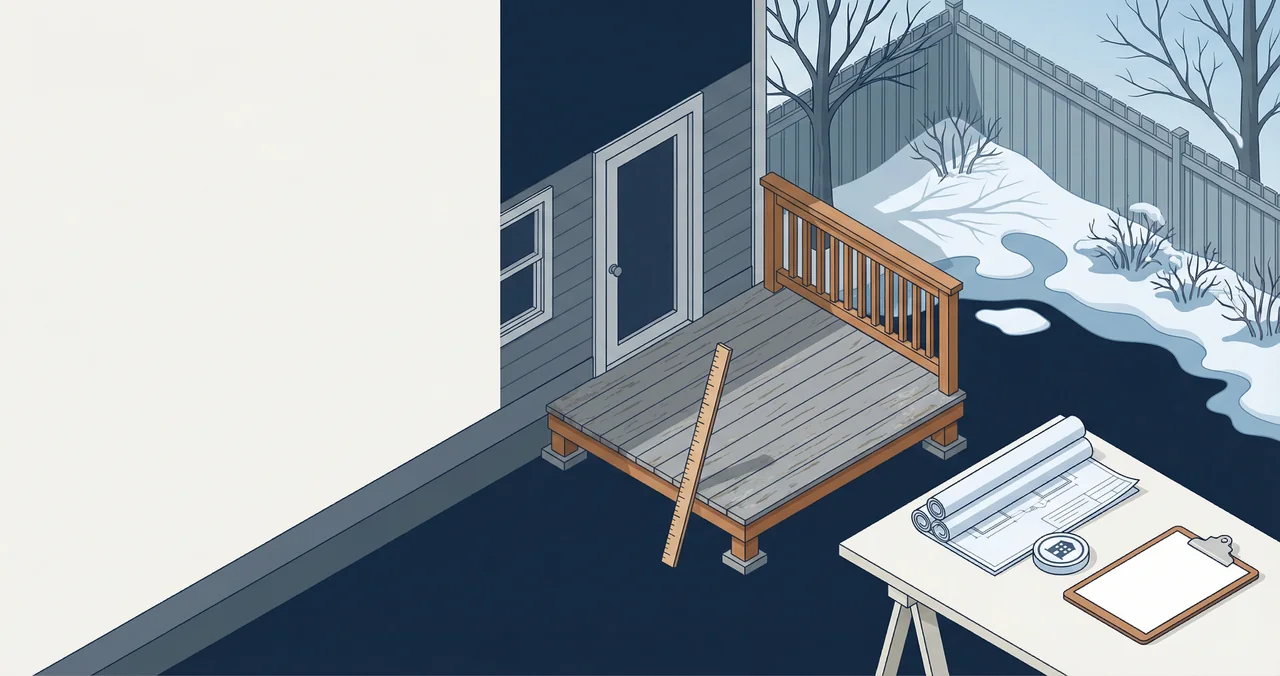
Cambridge is made up of three distinct communities — Galt, Preston, and Hespeler — and each has its own mix of lot sizes, neighbourhood character, and zoning designations. That makes deck permits in Cambridge more variable than in some neighbouring cities. A walkout-basement deck in an older Galt neighbourhood has different considerations than a ground-level platform in a new Hespeler subdivision.
This guide covers when a permit is typically required, what the building department expects, and how to avoid the common mistakes that delay approvals.
For the neighbouring cities, see:
Cambridge building department: where to go
The City of Cambridge handles building permits through its Building Division.
🏗️ Planning a deck project?
Get a free manual project review, or visualize your dream deck with AI before requesting quotes.
- In-person: 50 Dickson Street, Cambridge (Municipal Office, Main Floor)
- Online: Cambridge offers an online building permit portal. Search "Cambridge building permit application" on the city website for the current submission page.
- Phone: 519-621-0740 ext. 4250 (building division)
- Pre-submission consultation: Cambridge allows pre-application meetings. Especially useful for decks on sloped lots, near waterways (parts of Galt and Preston sit close to the Grand River and Speed River floodplains), or in heritage districts.
A quick phone call to confirm what applies to your specific lot is the best starting point.
When does Cambridge require a deck permit?
Cambridge follows the Ontario Building Code (OBC). In practice, the main triggers are:
Height above grade
- A permit is typically required when the deck surface is more than 24 inches (600 mm) above finished grade at any point
- Measured from the ground to the top of the walking surface, not the railing
- On sloped lots (common in older Galt and Preston neighbourhoods), the grade difference can change dramatically across the deck. The highest point is what counts.
Attachment to the house
- A deck connected through a ledger board typically requires a permit regardless of height
- Ledger connections are a leading cause of deck failure in Ontario, which is why building departments focus on them. See our ledger board guide.
Covered or enclosed structures
- A roof, pergola, or solid overhead cover almost always triggers a permit
- Privacy screens that are tall, solid, or structurally attached can also push into permit territory. See our privacy screen guide.
Other triggers
- Hot tubs on raised decks require structural consideration
- Stairs and landings from a raised deck to grade are part of the permit scope
- Significant lot grading changes may require separate site grading review
When you probably do NOT need a permit
- A ground-level platform (24 inches or less above grade everywhere) that is freestanding and does not support a roof, hot tub, or heavy concentrated loads
- Zoning setbacks still apply even without a building permit
Cambridge permit fees and processing time
- Permit fee: Generally $150-$400, based on declared construction value. Cambridge uses a fee schedule tied to project value — check the current fee bylaw for exact rates.
- Plan review time: Approximately 2-4 weeks for a complete application. During peak season (April through July), timelines push toward the longer end.
- Incomplete applications: Each round of revisions adds 1-3 weeks. Two rounds of back-and-forth can turn a 3-week process into 7 weeks.
For all permit-related costs beyond the city fee (drawings, engineering, survey), see our deck permit cost guide. If you want to understand what to expect for deck costs in Ontario beyond permits alone, our complete pricing guide breaks it down.
What drawings and documents does Cambridge require?
1. Site plan
- Property boundaries with dimensions
- House footprint and proposed deck location
- Setback measurements from the deck to all property lines
- Location of easements, rights-of-way, or regulated areas (especially relevant near the Grand River or Speed River)
2. Plan view (top-down layout)
- Overall deck dimensions
- Joist direction and spacing (16" o.c. is standard residential)
- Beam locations and sizes
- Post and footing positions
- Location of stairs, guards, and any screen/pergola attachments
3. Cross-section and elevation
- Deck height above grade at the highest point
- Guard height (36 inches minimum for decks under 1.8 m above grade; 42 inches for higher)
- Stair details: rise, run, and handrail height
- Footing depth: Minimum 4 feet (1.2 metres) to get below frost line
4. Structural connection details
- Footing diameter and depth
- Post-to-beam connection method
- Ledger board attachment if house-attached — flashing type, fastener size, and spacing
- Reference to span tables or engineering for beam/joist sizing
For a full drawing checklist, see our deck permit drawings guide.
Zoning considerations in Cambridge
Zoning in Cambridge is more varied than in Kitchener or Waterloo because of the three legacy communities.
Setbacks
- Rear yard: Uncovered decks can typically project into the required rear yard setback (often 1.5-2 metres), but the base setback varies by zone
- Side yard: Interior side yard minimums are often 1.2 metres, depending on zoning designation
- Corner lots: The exterior side yard (street-facing) usually has a larger setback, often 4.5 metres or more
- River-adjacent lots: Properties near the Grand River or Speed River may fall within the Grand River Conservation Authority (GRCA) regulated area. GRCA review adds time and potentially conditions.
Heritage districts
Parts of downtown Galt are designated under the Ontario Heritage Act. If your property is in a heritage district, exterior changes (including visible deck structures) may require heritage review on top of the building permit.
Neighbourhood-specific notes
- Galt (older core): Smaller lots, sloped terrain near the river, walkout basements. Elevated decks are common but setback and drainage issues come up frequently.
- Preston: Mix of older residential and newer infill. Lots near the Speed River may have GRCA involvement.
- Hespeler: More newer subdivisions with standard lot layouts. Decks here are simpler from a permit perspective, but lot coverage and setbacks still apply.
For more on setbacks across the region, see our KWC setback guide.
Common Cambridge deck permit mistakes
1. No site plan or missing setback dimensions. Without property-line setbacks on the drawing, the application stalls immediately.
2. Footing depth too shallow. Frost line in Cambridge is 1.2 metres. Drawings showing 3-foot footings will get a correction notice.
3. Ledger details absent. "Attach to house" is not a detail — the department needs fastener type, spacing, and flashing method.
4. Ignoring GRCA regulated areas. If your lot is near a watercourse and you did not check GRCA requirements, the city may hold your permit until you get clearance.
5. Not accounting for grade changes. On sloped Galt lots, deck height can vary 2-3 feet from one side to the other. Show the height at the highest point.
6. Scope changes after approval. Adding stairs, a screen, or a hot tub after the permit is issued usually requires a revision.
The inspection process in Cambridge
Cambridge typically requires three inspections:
Footing inspection
- When: Before pouring concrete or backfilling around piles
- What they check: Diameter, depth below frost line (1.2 m minimum), location matching approved plan
- Common issue: Footings poured before calling for inspection — you may have to excavate and expose the base
Framing inspection
- When: After posts, beams, joists, and ledger are installed, but before decking goes on
- What they check: Joist size/spacing, beam-to-post connections, ledger fasteners and flashing, guard post attachment
- Common issue: Decking installed before inspection — boards may need to come off temporarily
For a detailed look at what framing inspectors focus on, see our framing inspection guide.
You may also want to read Deck Painting in Cambridge, Ontario: Cost and How-To.
See our comparison in DIY Fence vs Professional Installation in Ontario for more details.
Final inspection
- When: Deck fully complete (decking, guards, stairs, handrails, accessories)
- What they check: Guard height and baluster spacing, stair rise/run consistency, handrail graspability, overall compliance
- Common issue: Guard openings exceeding the 4-inch maximum (the "sphere test")
Inspection tips
- Book early in the week during peak season — Friday requests often get pushed to the following week
- Have approved plans on site for the inspector to compare against
- Keep the building permit posted visibly until the final inspection passes
Quick decision checklist
You likely need a Cambridge deck permit if any of these apply:
- [ ] Deck surface is more than 24 inches above grade at any point
- [ ] Deck is attached to the house (ledger board connection)
- [ ] Deck includes a roof, pergola, or covered structure
- [ ] Deck will support a hot tub or heavy concentrated load
- [ ] Deck includes stairs from a raised surface to grade
- [ ] Property is in a GRCA regulated area (near Grand River or Speed River)
If none apply, you may be able to build without a permit — but confirm with Cambridge's building division first, and make sure zoning setbacks are met.
---
🎨 Not sure which material to pick?
Upload a photo of your backyard and see exactly how Trex, TimberTech, or cedar would look — free and instant.
Want a fast deck quote in Kitchener-Waterloo?
If you're planning a deck and want a ballpark price + a builder-ready scope quickly, submit your details here:
- Get a deck quote: Get a deck quote
The more info you include (approx size, height, material preference, stairs/rail, photos), the more accurate the estimate.
Upload a backyard photo and preview real decking materials with AI — free, instant, no sign-up.
Permits, costs, material comparisons, and questions to ask before requesting quotes — delivered to your inbox.