
Privacy Screens for Decks in Ontario: What to Know (Wind Load + Permits)
A homeowner guide to deck privacy walls/screens: where they work, what can go wrong (wind), and when they can trigger permit review.
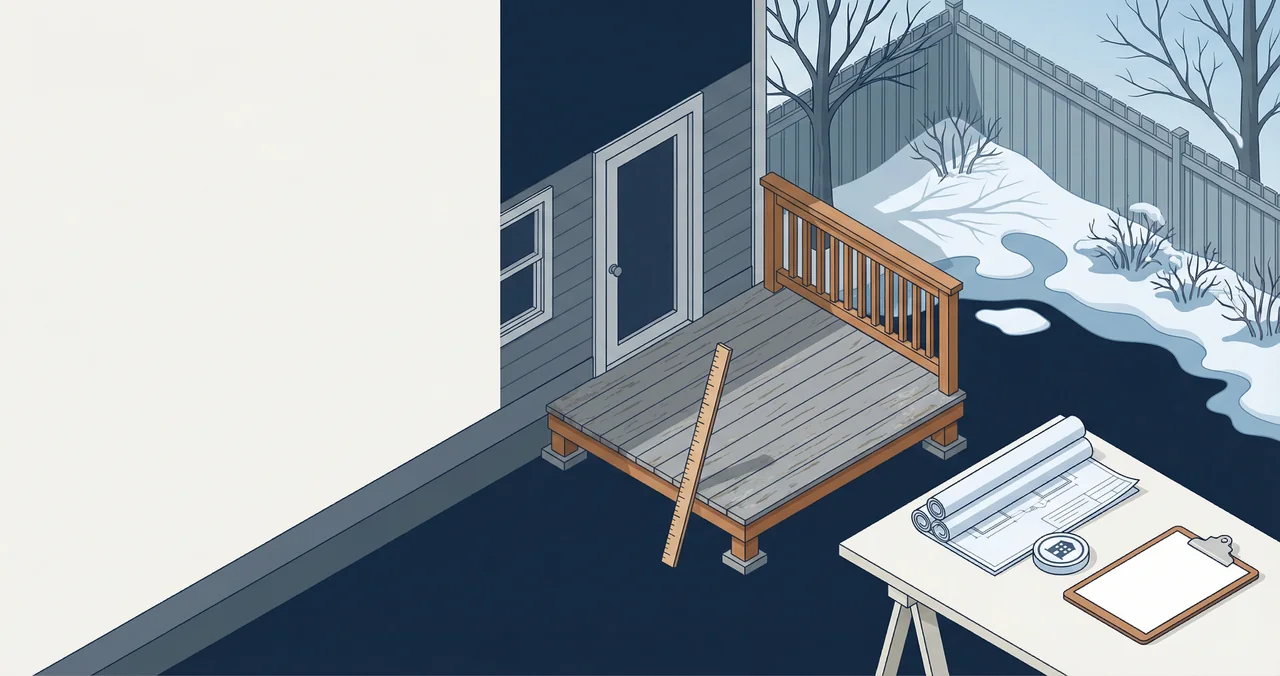
If your backyard deck feels like a fishbowl, you're not alone. Lot widths in Kitchener-Waterloo-Cambridge subdivisions are shrinking, and many newer homes sit 3 to 5 metres from the property line. That means your neighbour's second-floor windows often look directly down onto your deck.
A well-designed privacy screen solves that — but in Ontario, screens come with real structural and permit considerations that homeowners often overlook.
Why privacy screens are popular in KWC
The region has seen aggressive infill and subdivision development over the past decade:
🏗️ Planning a deck project?
Get a free manual project review, or visualize your dream deck with AI before requesting quotes.
- Narrower lots with rear yards backing onto other rear yards
- Multi-storey neighbours with direct sightlines onto your deck
- Semi-detached and townhome layouts where side-by-side decks share a fence line
- Corner lots where foot traffic passes within metres of your outdoor space
A screen gives you usable outdoor space without feeling exposed. It also blocks wind, reduces noise, and defines zones on a larger deck.
Types of privacy screens
Not every screen blocks the same amount of light, wind, or visual access. Here is a breakdown ranked roughly from most to least privacy.
Solid panels (full privacy)
- What they are: Tongue-and-groove boards, solid composite panels, or frosted glass/acrylic sheets
- Trade-off: Maximum wind load and reduced airflow — these act as a sail in a storm
- Best for: Decks facing directly into a neighbour's window at close range
Louvered or angled slats
- What they are: Horizontal or vertical slats angled to block direct sightlines while allowing airflow
- Trade-off: More expensive than lattice; angle and spacing matter
- Best for: Balancing privacy with ventilation and a modern look
Lattice panels
- What they are: Classic diagonal or square-pattern lattice in pressure-treated wood or PVC
- Trade-off: Cheapest option but can look dated; wood lattice needs maintenance
- Best for: Partial screening where full privacy is not the goal
Frosted glass or acrylic panels
- What they are: Tempered glass or acrylic sheets in aluminum or steel frames
- Trade-off: Expensive, requires solid structural framing, shows dirt
- Best for: Modern builds or situations where preserving light matters
Living walls and planter screens
- What they are: Tall planters with climbing plants, trellises with vines, or tiered cedar planter boxes
- Trade-off: Takes a growing season or two to fill in; seasonal maintenance required
- Best for: A softer, natural look for homeowners who are patient with timing
Fabric shade sails and curtains
- What they are: Outdoor fabric panels hung between posts or attached to a pergola
- Trade-off: Not permanent, wears over time, must be removed or secured in winter
- Best for: Seasonal privacy that does not require structural changes
Wind load: the hidden problem with deck screens
This is the section most homeowners skip — and the one that matters most in Ontario.
A solid privacy screen on a deck is essentially a wall without a foundation. When wind hits it, the force transfers directly into the posts and deck frame. Ontario gets regular gusts of 80-100 km/h during spring and fall storms.
Why this matters practically:
- A 4-foot by 6-foot solid screen in a 90 km/h gust generates hundreds of pounds of lateral force at the base
- Standard 4x4 railing posts bolted to a rim joist are not designed for this — they can lever out of the frame
- Even partial screens (louvered, lattice) catch more wind than expected
- If a screen fails, it can take the railing and part of the deck frame with it
What proper wind bracing looks like
- Larger posts: 6x6 minimum for screens over 5 feet tall, through-bolted to the substructure
- Diagonal bracing: Knee braces or angled supports to transfer lateral loads into the deck frame
- Deep post embedment: Posts extending past the deck frame and tying into footings or blocking
- Engineering for tall screens: Anything over 6 feet tall and solid should get a structural review
Permit rules: when does a screen trigger review?
Privacy screens live in a grey area for permits. Here is how it typically works in Ontario municipalities, including Kitchener, Waterloo, and Cambridge.
When you likely do NOT need a permit
- Freestanding screen under 2 metres (6.5 ft) tall measured from grade, not attached to the deck
- Lightweight lattice or planter screens that do not change the structural load
- Fabric or temporary screens that can be removed without tools
When a permit is more likely required
- Screen height exceeds 2 metres from grade — often triggers review as an accessory structure
- Screen is structurally attached to the deck and changes the load path
- Screen is part of a covered or roofed structure — see our pergola permit guide
- Screen encloses more than one side — an "open deck" starts looking like a "room" to an inspector
The practical rule
If your screen is under 6 feet from the deck surface, uses lightweight materials, and does not require structural modification, you are usually fine. But if you are going taller, using solid panels, or modifying the deck frame, call your local building department first.
For more on how deck permits work in this region:
Material options and installed pricing
Pricing below is per square foot of screen area, installed, in the KWC market. Actual cost depends on height, wind exposure, and structural reinforcement needed.
| Material | Installed cost (per sq ft) | Maintenance | Lifespan |
|---|---|---|---|
| Pressure-treated wood | $15 -- $30 | Stain/seal every 2-3 years | 10-15 years |
| Composite / PVC | $25 -- $50 | Low (wash annually) | 20-25+ years |
| Aluminum | $30 -- $60 | Minimal | 25+ years |
| Tempered glass / acrylic | $50 -- $100 | Clean regularly | 20+ years |
Wood is cheapest upfront but needs regular maintenance — in Ontario's freeze-thaw cycles, untreated wood screens warp and split within a few seasons. Composite and aluminum hold up better long-term. For more on this trade-off, see our composite vs. wood decking guide, and for a full breakdown of deck investment costs in Ontario including add-ons like privacy screens.
Design ideas by privacy level
Full block (neighbours very close):
- Frosted glass panels on one or two sides, louvered slats on the third
- Solid tongue-and-groove cedar screen with a decorative cap rail
Partial screening (some openness desired):
- Horizontal slats with 1-inch gaps — blocks direct views but allows airflow
- Lower solid panel (3 ft) topped with open lattice (2-3 ft)
Filtered light and ambience:
- Pergola overhead with shade sails or retractable fabric
- Planter boxes with tall ornamental grasses and climbing trellis
The best approach often combines two or three types: a solid panel where privacy matters most, open lattice where you want light, and nothing where the view is already good.
How to add a screen to an existing deck
If your deck is already built, retrofitting a screen is possible — but the attachment method matters.
- Check your existing posts. Standard 4x4 railing posts are not adequate for solid screens taller than 3-4 feet. You may need to sister new 6x6 posts alongside or replace them.
- Through-bolt, do not lag-screw. Lag screws into end grain pull out under lateral load. Use through-bolts with backing plates.
- Add blocking below. Blocking between joists at post locations prevents the rim joist from rotating under wind load.
- Consider freestanding. If the deck frame cannot handle the load, a freestanding screen anchored to its own footings avoids modifying the structure entirely.
For context on how deck framing handles lateral loads, see our framing inspection guide.
Key takeaways
- Wind load is the real risk — solid screens catch enormous force in Ontario storms, and standard railing posts are not built for it
- Permit triggers are usually about height (above 6 ft from grade), structural attachment, and whether the screen creates an enclosed space
- Material choice affects both cost and longevity — wood is cheapest but needs the most upkeep in Ontario's climate
- Retrofitting to an existing deck almost always requires post reinforcement or freestanding footings
---
🎨 Not sure which material to pick?
Upload a photo of your backyard and see exactly how Trex, TimberTech, or cedar would look — free and instant.
Want a fast deck quote in Kitchener-Waterloo?
If you're planning a deck and want a ballpark price + a builder-ready scope quickly, submit your details here:
- Get a deck quote: Get a deck quote
The more info you include (approx size, height, material preference, stairs/rail, photos), the more accurate the estimate.
Upload a backyard photo and preview real decking materials with AI — free, instant, no sign-up.
Permits, costs, material comparisons, and questions to ask before requesting quotes — delivered to your inbox.