
Deck Design Trends in Kitchener-Waterloo (2026)
What's trending in deck design Kitchener homeowners are choosing in 2026? Low-maintenance composite, cable railings, and covered outdoor rooms.
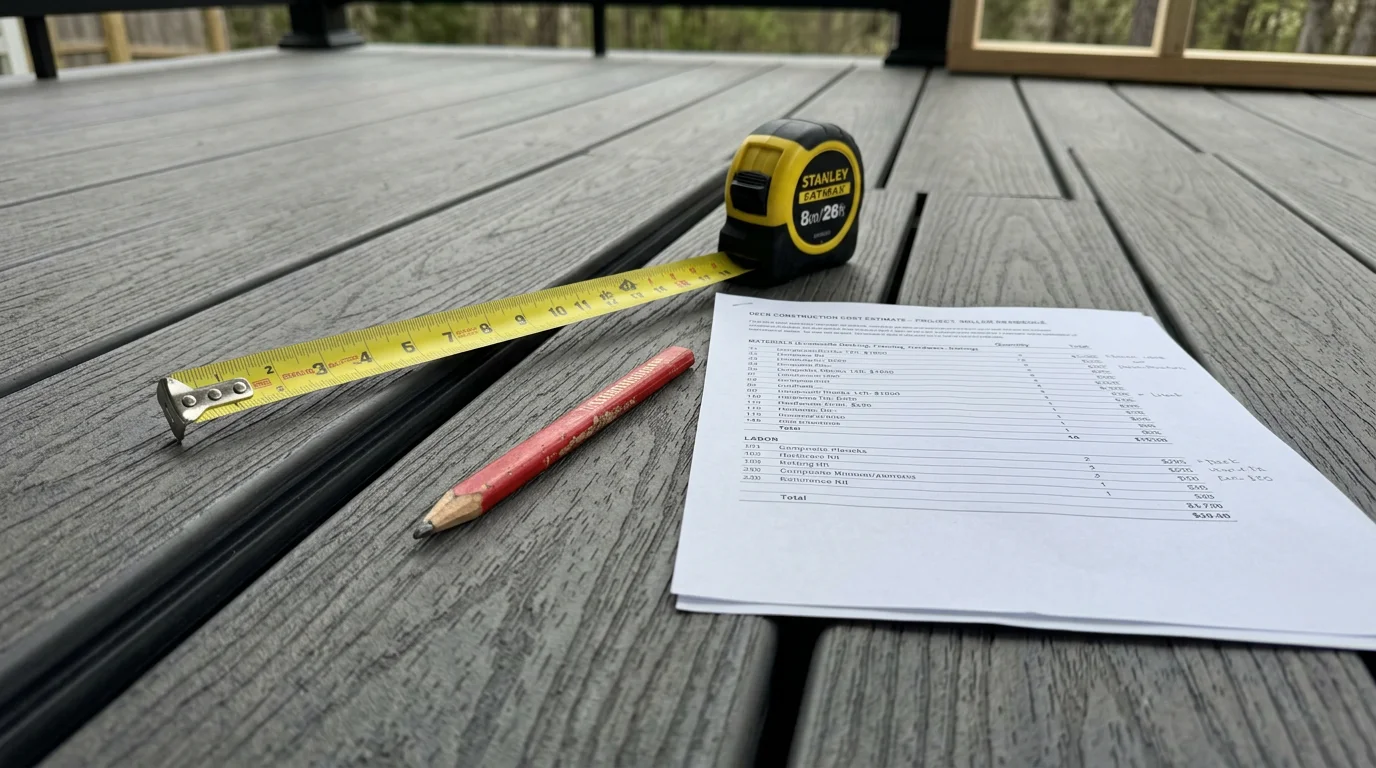
Homeowners in Kitchener-Waterloo are building decks that look sharper, last longer, and require less upkeep than ever before. If you're planning a deck project this year, here's what's actually gaining traction in KWC neighbourhoods — from material choices to layout decisions that make sense for our freeze-thaw climate.
Composite Decking Is Now the Default Choice
Walk through Vista Hills or Laurelwood on a Saturday afternoon and you'll see composite boards going in on nearly every second deck project. Composite decking now accounts for roughly 60-65% of new deck installations in Kitchener-Waterloo, up from about 40% just three years ago.
🏗️ Planning a deck project?
Get a free manual project review, or visualize your dream deck with AI before requesting quotes.
The math is simple: composite costs $65-95/sqft installed compared to $45-65/sqft for pressure-treated lumber, but you skip staining, sealing, and board replacement for 25+ years. For a typical 300 sqft deck, that's a $6,000-9,000 upfront premium that pays back in saved maintenance hours and material costs.
Ontario winters hammer wood decks. Freeze-thaw cycles crack finishes, snow shoveling gouges boards, and road salt tracked from your boots accelerates rot. Composite handles all of it without seasonal maintenance beyond soap-and-water cleaning.
Popular composite brands in KWC right now:
- Trex Enhance and Transcend: Most common, wide colour selection, readily available through local suppliers
- TimberTech AZEK: Premium capped polymer, stays cooler in summer sun
- Fiberon Horizon: Mid-tier pricing with good stain resistance
- Made-in-Canada options: Deckorators and select product lines for homeowners prioritizing domestic manufacturing
Check out composite vs wood decking comparison for detailed cost-benefit analysis and warranty differences.
Two-Tone Colour Schemes
The days of single-colour decks are fading fast. Homeowners are pairing rich brown or grey field boards with contrasting fascia and border trim in charcoal, black, or lighter tones.
This isn't purely aesthetic. Picture-framing your deck with a darker border visually defines the space and hides cut ends where deck boards terminate. You're working with the same material — just ordering two colour SKUs and planning the layout before installation.
Cost impact is negligible since you're buying the same square footage. Installation adds 2-4 hours for the border detail work, which translates to about $150-300 extra on a typical deck build.
Trending colour combinations in 2026:
- Warm grey field boards + black fascia
- Driftwood tan decking + charcoal border
- Medium brown boards + lighter beige trim (reverse contrast)
Herringbone and Diagonal Patterns
If you want your deck to stand out, diagonal or herringbone board layouts deliver serious visual interest without exotic materials.
Diagonal patterns (typically 45-degree angles) add about 10-15% material waste due to angled cuts, so budget an extra $800-1,200 in materials for a 300 sqft deck. Installation labour increases too — expect to pay an additional $5-8/sqft because every board needs precise angle cuts and the framing requires closer joist spacing for structural support.
Herringbone patterns are more complex still. They create stunning geometric designs but demand expert installation and generate higher waste. Most builders charge $12-20/sqft premium over standard perpendicular decking patterns.
These patterns work best on larger decks (400+ sqft) where the design has room to breathe. On a small 150 sqft deck, intricate patterns can look busy rather than intentional.
Cable Railing Systems Dominate
Cable railings now appear on 40%+ of new elevated decks in Kitchener-Waterloo, especially in neighbourhoods like Beechwood and Westmount where homeowners want to preserve sightlines to ravine views or mature backyards.
Standard wood or composite railings block 60-70% of your view with vertical pickets or horizontal boards. Cable railings use 1/8" or 3/16" stainless steel cables spaced 3" apart vertically, giving you nearly unobstructed views while meeting Ontario railing code requirements.
Pricing varies significantly based on post material and hardware quality:
- Aluminum posts + stainless cable: $80-100/linear foot installed
- Composite posts + stainless cable: $70-90/linear foot
- Wood posts + cable infill: $60-80/linear foot
A typical deck needs 40-60 linear feet of railing. Budget $3,200-6,000 for a complete cable railing system on a standard elevated deck.
Installation matters here. Cables must be tensioned precisely — too loose and they sag or vibrate; too tight and posts lean inward over time. Use a builder experienced with cable systems, not someone trying it for the first time on your deck.
Glass Panel Railings for Wind Protection
Glass railings cost significantly more than cable — typically $120-180/linear foot installed — but they block wind while maintaining views. If your deck faces prevailing west winds or you want a quieter outdoor space for conversation, tempered glass panels deliver better comfort than cables.
Glass works particularly well for rooftop decks or elevated second-story decks where wind exposure makes the space unusable 4-5 months of the year. The panels create a microclimate that extends your deck season into late fall and early spring.
Maintenance is simple: occasional window cleaner and a squeegee. Snow and ice slide off easily compared to cable systems where ice can build up between lines.
Covered Deck Sections and Pergolas
Homeowners want outdoor living space that functions in light rain, morning sun, and evening shade. Partially covered decks — where 30-50% of the deck sits under a roof structure or pergola — are now standard requests rather than luxury add-ons.
Three popular approaches:
1. Solid roof extension from house
Your builder extends your existing roof structure to cover a portion of the deck, creating a true outdoor room with ceiling, lighting, and full rain protection. This requires engineering, structural support posts or beams, and careful integration with existing roof lines.
Cost: $30-50/sqft for the covered section, including roofing, structure, and integration with house exterior.
Permit requirements: Yes, this is a significant structural addition. Your municipality will want engineered drawings and a building permit. Read more in covered deck permits Kitchener-Waterloo.
2. Aluminum louvered roof systems
Adjustable louvers let you control sun and shade throughout the day, rotating from fully closed (rain protection) to fully open (sun and breeze). Brands like StruXure and Azenco offer motorized systems with integrated LED lighting and optional retractable screens.
Cost: $60-90/sqft installed for premium louvered systems with motor and lighting.
Permits: Usually required as a permanent structure. Some municipalities allow them as accessory structures without full foundation requirements.
3. Wood or vinyl pergolas
Classic open-top pergolas provide partial shade, visual definition, and structure for climbing plants or retractable shade cloth. They don't offer rain protection but they transform a flat deck into distinct zones.
Cost: $15-35/sqft depending on materials (pressure-treated vs cedar vs vinyl) and design complexity.
Permits: Often required if attached to the house or if posts require footings below frost line. Check Kitchener permit requirements or Waterloo deck permits.
Multi-Level Deck Layouts
Instead of one large elevated platform, multi-level decks with 8-12 inch step-downs create distinct zones for dining, lounging, and grilling without walls or railings dividing the space.
This design approach works especially well on sloped lots common in Stanley Park, Forest Heights, and Preston areas. Rather than building massive retaining structures or hauling in yards of fill, you follow the natural grade with stepped deck levels.
Structural benefits:
- Lower deck sections may avoid railing requirements if they're under 24 inches above grade (confirm with local setback and height rules)
- Shorter support posts mean less lumber cost and easier construction
- Natural drainage flows between levels rather than pooling on a single flat surface
Multi-level decks cost $3-8/sqft more than single-level designs due to additional framing, multiple beam levels, and custom stair builds between platforms. For a 400 sqft multi-level deck, expect to add $1,200-3,200 to your total project cost.
Built-In Seating and Planters
Standalone patio furniture looks generic and shifts around in wind. Built-in benches with backs, corner L-shaped seating, and integrated planters are becoming standard design elements rather than afterthoughts.
A built-in bench costs roughly $45-75/linear foot to construct during deck installation — far less than adding it later when your builder has already demobilized. A typical 10-foot bench runs $450-750 including materials and labour.
Design considerations:
- Bench depth: 18-20 inches for comfortable seating (24 inches if you want people to lounge)
- Seat height: 16-18 inches above deck surface
- Back support: Add a backrest at 14-16 inches above seat for comfort
- Planter integration: Combine seating with 16x16" or 20x20" planters at corners or as dividers between zones
Built-ins reduce your furniture budget while maximizing usable deck space. An 8-foot sofa eats up floor area; a built-in bench along the railing adds seating without sacrificing circulation space.
Planters need proper drainage. Your builder should incorporate weep holes and use composite or rot-resistant lumber for planter boxes since soil retains moisture constantly.
LED Lighting Is Standard
Low-voltage LED deck lighting is no longer a premium upgrade — it's expected on any quality deck build. Homeowners want to use their outdoor space after sunset, and lighting transforms a deck from daytime-only to evening entertainment space.
Common lighting locations:
- Post cap lights: On railing posts, typically 40-60 lumens per fixture
- Recessed stair lights: On riser faces or stringer sides for safety
- Under-rail strip lighting: Along the underside of top rails for ambient glow
- In-deck floor lights: Flush-mounted between deck boards for pathway lighting
A complete LED lighting package for a 300 sqft deck with 12-16 fixtures costs $800-1,500 including transformer, wiring, and installation. Most systems run on 12V or 24V DC through a weatherproof transformer mounted near your electrical panel.
Dimmable systems with remote or smartphone control add $200-400 but let you adjust brightness for dinner parties versus late-night conversations.
Lighting requires electrical work. If your deck is more than 25 feet from your panel, you may need a dedicated circuit or upgraded service, especially if you're also adding outdoor outlets for music systems or heaters. Factor this into your overall deck cost planning.
Outdoor Kitchens and Built-In Grills
The trend isn't a full outdoor kitchen with sink, fridge, and pizza oven — that's still a 5-figure luxury addition. What's popular now: dedicated grill stations with small countertops and storage underneath, integrated into the deck design during construction.
A built-in grill surround costs $1,200-3,000 depending on materials:
- Pressure-treated or composite framing with tile countertop: $1,200-1,800
- Stone veneer or manufactured stone facade: $2,000-2,800
- Stainless steel outdoor cabinets: $2,500-4,000+
Benefits over a standalone grill:
- Secure gas line connection (no propane tank swaps)
- Prep counter on both sides of the grill
- Storage for tools, seasonings, and plates
- Integrated into deck aesthetics rather than a metal box sitting in the corner
You'll need a natural gas line run from your house meter to the grill location. Budget $400-800 for gas line installation depending on distance and whether lines run under the deck or through the house.
Many homeowners are also adding beverage coolers or outdoor fridges in 24" undercounter units ($600-1,200) rather than full-size refrigerators. These are perfect for drinks and basic food storage without the cost and utility load of running a full fridge year-round.
Darker Deck Board Colours
Light tan and cedar tones dominated for years, but charcoal, dark brown, and black-grey composite colours are surging in 2026. These darker tones create modern contrast against brick or siding and hide dirt, pollen, and leaf stains better than light boards.
Heat absorption is the trade-off. Dark composite boards can reach 140-150°F surface temperature on a 85°F summer day in direct sun. That's too hot for bare feet.
Solutions:
- Choose capped composite or PVC decking with "cool technology" pigments that reflect infrared heat (TimberTech AZEK, Trex Transcend)
- Design partial shade coverage over main traffic areas
- Use lighter colours for high-traffic zones and darker tones for lower seating areas
- Add outdoor rugs in main circulation paths
If you're set on dark boards, schedule an early-season installation (May-June) so you can test heat levels during peak summer before committing to furniture and layout. Some homeowners end up regretting dark boards after a July afternoon barefoot experience.
Privacy Screens Without Feeling Closed-In
Neighbours are closer in Kitchener-Waterloo's newer subdivisions. Vertical slatted privacy screens — mounted on one or two sides of a deck — block sightlines while maintaining airflow and an open feeling.
Popular materials:
- Composite slats: Match your deck boards, low maintenance, $50-80/linear foot installed
- Cedar slats: Natural look, requires staining every 2-3 years, $45-70/linear foot
- Aluminum slats: Powder-coated in various colours, very durable, $70-100/linear foot
- Vinyl lattice panels: Budget option at $30-50/linear foot but less modern aesthetics
Spacing matters. Slats spaced 2-3 inches apart block direct views while allowing breeze and dappled light. Solid panels or tighter spacing create a wall-like feeling that defeats the openness of outdoor space.
A 12-foot section of privacy screen costs $600-1,200 installed. That's typically enough to block views from one neighbouring property without enclosing your entire deck.
Check local bylaws before installation. Some municipalities have height restrictions on deck privacy screens or classify them as fences that must meet setback requirements. Read more in privacy screen permit requirements.
Structural Upgrades: Helical Piles Are Mainstream
Helical piles (screw piles) are now used on 25-30% of new deck builds in Kitchener-Waterloo, up from under 10% five years ago. They're faster, cleaner, and often cheaper than traditional concrete footings once you factor in labour and equipment costs.
Ontario requires deck footings below 48 inches depth (frost line). Digging and pouring concrete for 12-16 footings on a typical deck takes 6-10 hours of labour, costs $200-400 per footing all-in, and requires multiple days for concrete curing before you can frame.
Helical piles install in 15-20 minutes each with a hydraulic driver, reach below frost line in a single step, and allow immediate deck framing. Cost: $150-300 per pile installed, competitive with concrete once you account for labour savings and no cure time.
Advantages in KWC's clay soil conditions:
- No excavation spoils to haul away
- Install in tight access yards where concrete trucks can't reach
- Won't crack or heave in freeze-thaw cycles
- Engineer-certified load ratings (required by many municipalities for permit approval)
Read helical piles vs concrete footings for detailed permit and engineering requirements.
Hot Tub Integration
Dropping a hot tub on top of an existing deck is a recipe for structural failure. Tubs weigh 3,000-5,000 lbs when filled with water and people. Smart homeowners are designing hot tub support into new deck builds from the start.
Structural requirements:
- Posts directly under tub corners or perimeter (no cantilevered support)
- Upgraded beam sizing (typically double 2x10 or 2x12 instead of standard deck framing)
- Footings specifically sized for concentrated loads
- Access panel for plumbing and electrical service
Structural upgrades for hot tub support add $1,500-3,000 to deck costs depending on tub size and deck height. That's far less than repairing a collapsed deck or rebuilding from scratch.
Many builders now include a dedicated hot tub pad — a reinforced section designed for future tub placement even if you're not installing one immediately. This costs $800-1,200 extra but preserves the option without major reconstruction later.
Check hot tub structural requirements for Ontario code requirements and engineering considerations.
Sustainable and Local Material Choices
Made-in-Canada composite decking is gaining traction among homeowners who prioritize domestic manufacturing and reduced shipping impacts. Brands like Deckorators (Royal products manufactured in Canada) offer quality comparable to US imports.
Pricing is competitive: $60-85/sqft installed for Canadian-made composite, right in line with Trex and TimberTech. Lead times are often shorter since product ships from Ontario or Quebec facilities rather than cross-border.
Reclaimed or sustainably-harvested wood is a niche option. Expect to pay $70-100/sqft for reclaimed barn board decking or FSC-certified ipe, cumaru, or garapa hardwoods. These materials deliver unique character but require specialized installation skills and ongoing maintenance.
Local lumber yards in KWC now stock Ontario-sourced cedar and hemlock for buyers who want regionally-harvested softwoods. Cost is similar to standard cedar ($55-80/sqft installed) but with lower transportation impact.
See composite decking made in Canada for brand comparisons and availability.
Smart Home Integration
WiFi-enabled lighting systems, motorized pergola roofs, and outdoor audio are increasingly common on premium deck builds. These systems integrate with Alexa, Google Home, or Apple HomeKit for voice control and automation.
Popular integrations:
- Deck lighting that auto-dims at sunset and turns off at midnight
- Motorized louvered roofs that close when rain sensors detect precipitation
- Outdoor speakers wired during construction (much cleaner than retrofit)
- Outlet boxes with USB charging ports built into railing posts or benches
Smart features add $500-2,000 depending on complexity. Basic WiFi lighting control is around $500; full smart home integration with sensors, motorization, and audio runs $1,500-2,000+.
This is optional but appreciated. Once you've used voice control to adjust deck lighting from your kitchen while prepping dinner, standard switches feel like a step backwards.
What's Declining: Trends to Avoid
Not everything is trending upward. These design choices are fading in KWC:
Horizontal cable railings: Codes in many jurisdictions now prohibit them because children can climb horizontal cables easily. Vertical cable is code-compliant and safer.
All-white or all-grey decks: Monochrome is fading in favour of two-tone contrast and warmer colour palettes that complement Ontario's natural surroundings.
Ultra-wide board spacing: Some homeowners tried 1/4" or 3/8" gaps between composite boards to maximize drainage and minimize expansion issues. It looks industrial and creates tripping hazards. Standard 1/8" gaps are back in style.
Cheap vinyl railings: The lowest-tier vinyl railing systems yellow, crack in cold, and look dated within 5 years. Homeowners are investing in quality composite or aluminum railings that last 20+ years instead of replacing vinyl every decade.
What to Expect for Deck Design in 2027
Looking forward, these trends are emerging in early-2026 custom builds and will likely become mainstream by next year:
- Heated decking systems: Embedded radiant heating to melt snow and extend usable months (currently $30-50/sqft premium)
- Fully retractable pergola covers: Motorized louvered roofs that retract completely into sleek housing (now $80-120/sqft, likely to drop)
- Composite fascia with integrated lighting channels: Built-in LED strips in fascia boards rather than surface-mounted fixtures
- Deck-level planters with irrigation: Built-in watering systems connected to outdoor taps for low-maintenance greenery
🎨 Not sure which material to pick?
Upload a photo of your backyard and see exactly how Trex, TimberTech, or cedar would look — free and instant.
Common Questions
What's the most popular deck colour in Kitchener-Waterloo right now?
Warm greys and charcoal browns dominate 2026 deck installations, often paired with black or darker borders for contrast. Trex "Island Mist" and TimberTech "Coastline" are the most-requested colours in KWC. Lighter tans and cedar tones are declining in popularity as homeowners prefer modern aesthetics and better stain-hiding properties of darker boards.
Do cable railings meet Ontario Building Code?
Yes, cable railings fully comply with Ontario Building Code when installed correctly. Cables must be spaced no more than 4 inches apart (most installers use 3" spacing for safety margin), and the system must withstand 200 lb concentrated load and 50 lb/linear foot uniform load. Use vertical cable orientation only — horizontal cables are prohibited in many jurisdictions because they present climbing hazards for children.
How much does a trendy deck design cost compared to a basic deck?
A basic pressure-treated deck with wood railings costs $45-65/sqft installed. Adding popular 2026 features increases costs:
- Composite decking: +$20-30/sqft
- Cable railings: +$30-50/linear foot vs wood railings
- LED lighting package: +$800-1,500 flat cost
- Partial roof/pergola: +$15-50/sqft for covered section
- Built-in benches: +$45-75/linear foot
A 300 sqft "trendy" composite deck with cable rails, lighting, and built-in seating typically runs $22,000-30,000 compared to $14,000-20,000 for a basic wood deck. See detailed breakdowns in Kitchener deck cost guide.
Are dark composite deck boards too hot in summer?
Dark boards can reach 140-150°F surface temperature in direct summer sun, hot enough to be uncomfortable for bare feet. Quality capped composite with heat-reflective technology (Trex Transcend, TimberTech AZEK, Fiberon Paramount) stays 15-20°F cooler than basic composite in the same colour. If you choose dark boards, plan for partial shade coverage, outdoor rugs in main traffic areas, or accept that you'll wear sandals during peak afternoon sun.
Do I need a permit for a pergola or covered deck section?
In Kitchener, Waterloo, and Cambridge, yes — covered structures attached to your house require building permits because they're considered permanent additions to your dwelling. Freestanding pergolas may be exempt if under 10 square metres (108 sqft) and not attached to the house, but rules vary by municipality. Always check before building. Read covered deck permit requirements for detailed municipal rules and application processes.
Upload a backyard photo and preview real decking materials with AI — free, instant, no sign-up.
Permits, costs, material comparisons, and questions to ask before requesting quotes — delivered to your inbox.