
Deck Cost in Saskatoon (2026)
What does a deck cost in Saskatoon in 2026? Get real CAD pricing per square foot for composite, wood, and Trex decks — plus tips to save on your build.
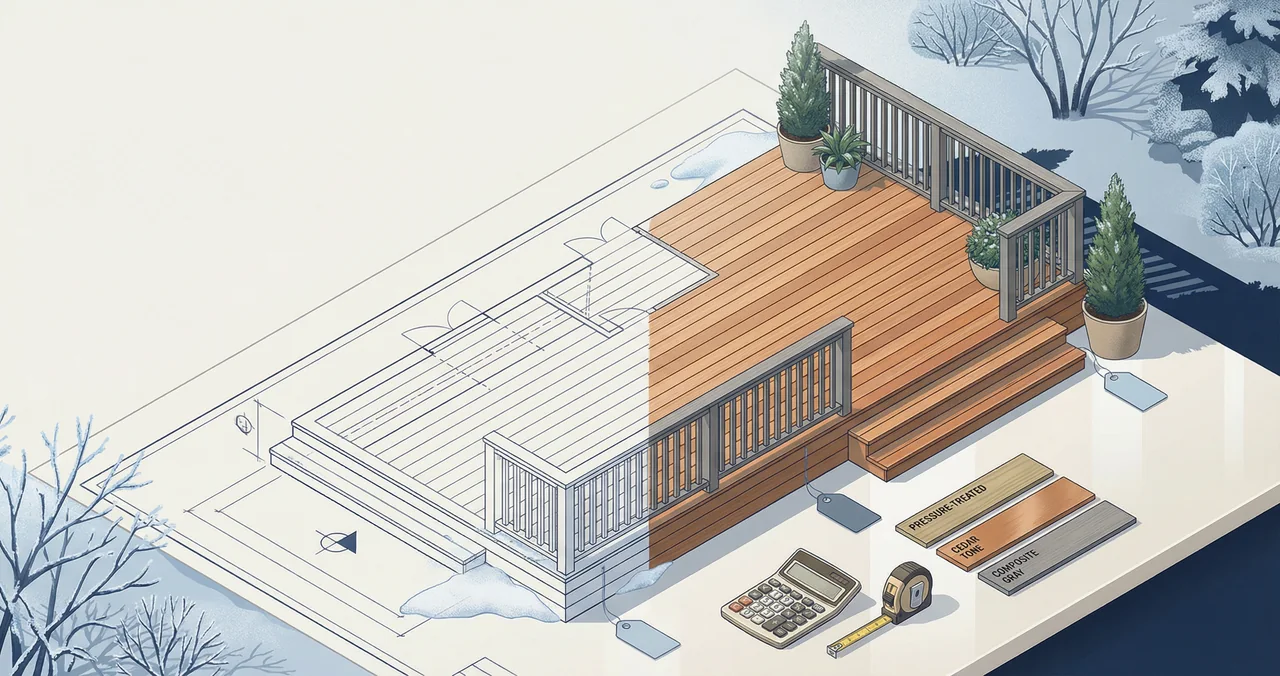
How Much Does a Deck Cost in Saskatoon?
You're getting quotes, and the numbers are all over the place. One contractor says $12,000, another says $28,000 for what sounds like the same deck. That's not unusual in Saskatoon — pricing depends heavily on what material you choose, how deep your footings need to go, and whether you're building in peak season or managed to lock in an early booking.
🏗️ Planning a deck project?
Get a free manual project review, or visualize your dream deck with AI before requesting quotes.
Here's the short answer: a standard 12x16 pressure-treated deck in Saskatoon runs $5,760 to $10,560 installed in 2026. A composite deck the same size? $9,600 to $16,320. Those are real numbers based on current local rates, and this guide breaks down exactly where that money goes.
🧮 Tool Alert: Deck Cost Calculator
Estimate your project costs in seconds based on local pricing bands for your area.
Calculate My Cost →Average Deck Cost in Saskatoon by Material
Material choice is the single biggest factor in your final price. Here's what Saskatoon homeowners are paying per square foot in 2026, fully installed:
| Material | Cost Per Sq Ft (CAD, Installed) | 12x16 Deck (192 sq ft) | 16x20 Deck (320 sq ft) |
|---|---|---|---|
| Pressure-Treated Wood | $30–$55 | $5,760–$10,560 | $9,600–$17,600 |
| Cedar | $40–$65 | $7,680–$12,480 | $12,800–$20,800 |
| Composite | $50–$85 | $9,600–$16,320 | $16,000–$27,200 |
| Trex (brand-name composite) | $55–$90 | $10,560–$17,280 | $17,600–$28,800 |
| Ipe (tropical hardwood) | $70–$120 | $13,440–$23,040 | $22,400–$38,400 |
A few notes on these ranges. The low end assumes a simple rectangular deck, ground level, with basic railing. The high end reflects second-storey builds, complex layouts, built-in benches, or premium railing systems like glass or cable.
Pressure-treated is still the most popular choice in Saskatoon — it's affordable upfront and readily available. But factor in annual sealing and staining, and the lifetime cost narrows against composite faster than most people expect.
Cost Per Square Foot Breakdown
That $30–$90/sqft range covers everything, but it helps to see where your money actually goes:
Materials Only (No Labor)
- Pressure-treated lumber: $8–$18/sqft
- Cedar decking: $14–$28/sqft
- Composite boards: $22–$40/sqft
- Trex Select/Enhance: $25–$42/sqft
- Ipe hardwood: $35–$55/sqft
These are board costs only. You'll also need joists, beams, posts, concrete for footings, hardware, fasteners, and railing — which typically adds $8–$15/sqft depending on your substructure requirements.
Why Saskatoon's Substructure Costs Are Higher
This is something homeowners from milder climates don't always anticipate. Saskatoon's frost line sits at 48 to 60 inches deep. Every footing on your deck needs to extend below that line, or freeze-thaw cycles will heave your posts and warp the entire structure.
That means more concrete, deeper holes, and more labor just to get to the point where decking boards go down. Budget an extra $1,500–$4,000 for deep footings compared to what you'd pay in a city with a 24-inch frost line.
Labor Costs in Saskatoon
Labor typically accounts for 40–60% of your total deck cost. In Saskatoon, expect to pay:
- General deck labor: $20–$35/sqft
- Experienced deck-specific contractors: $25–$40/sqft
- Complex builds (multi-level, curved, rooftop): $35–$50/sqft
Saskatoon's building season runs May through October, and those months fill up fast. Most reputable contractors start booking in February and March. If you call in June hoping to build in July, you'll either wait until fall or pay a premium for availability.
Should You DIY to Save on Labor?
A DIY pressure-treated deck can cut your total cost by 35–50%. The materials for a 12x16 deck might run $3,000–$5,500, saving you thousands on labor.
But be honest about what's involved. You still need:
- A building permit (for decks over 24 inches above grade or over 100 sq ft in Saskatoon — contact the City's Building Standards Division for your specific requirements)
- Footings dug to 48–60 inches below grade
- Proper joist spacing and beam sizing per code
- Inspections at the footing and framing stages
DIY makes the most sense for ground-level, rectangular builds. Once you add stairs, railings over 36 inches, or a second level, the complexity — and the risk of costly mistakes — jumps significantly. If you're considering a larger project, check out our guide to 16x20 deck costs in Ontario for a sense of how size impacts budgeting on bigger builds.
What Affects Your Total Price
Beyond material and labor, these factors move the needle on your Saskatoon deck quote:
Deck Height and Access
A ground-level deck on a flat lot is the cheapest scenario. Once your deck rises above 4 feet, you need longer posts, engineered beams, lateral bracing, and code-compliant stairs with railings. Every foot of height can add $5–$12/sqft to the project.
Railing Type
Railing is often the surprise line item. Basic pressure-treated wood railing costs $15–$30 per linear foot. Aluminum? $40–$70/lf. Glass panels? $80–$150/lf. On a 12x16 deck, you might have 40+ linear feet of railing — that's the difference between $600 and $6,000.
Deck Shape and Features
A square or rectangular deck is the most cost-efficient shape. Add angles, curves, or octagonal bump-outs, and you'll see 15–25% more in material waste and labor time. Built-in benches, planters, and pergolas all add cost but also add real value if you use the space.
Snow Load and Structural Requirements
Saskatoon gets an average of 100+ cm of snowfall each winter. If your deck is covered or partially roofed, the structure needs to handle that snow load — which means heavier beams, closer joist spacing, and sometimes engineered lumber. A covered deck build will cost more upfront but protects your decking from the worst of Saskatchewan's winters.
Permit and Inspection Fees
Deck permits in Saskatoon typically run $100–$400 depending on the scope. The permit process includes plan review, footing inspection, and final inspection. Budget for this and build it into your timeline — inspections can add a week or two to the schedule.
Composite vs Wood: Cost Comparison
This is the most common decision Saskatoon homeowners wrestle with. Here's a realistic 20-year cost comparison for a 320 sq ft (16x20) deck:
| Pressure-Treated | Composite | |
|---|---|---|
| Installed cost | $9,600–$17,600 | $16,000–$27,200 |
| Annual maintenance | $200–$500 (stain/seal) | $0–$50 (cleaning) |
| Maintenance over 20 yrs | $4,000–$10,000 | $0–$1,000 |
| Board replacement | $500–$2,000 (warped/cracked boards) | Rare |
| 20-year total | $14,100–$29,600 | $16,000–$28,200 |
The numbers converge — and in Saskatoon's climate, they often favor composite. Here's why.
Saskatoon's freeze-thaw cycles are brutal on wood. Water seeps into grain, freezes, expands, and splits the fibers. Pressure-treated wood needs annual sealing to resist this, and most homeowners don't seal consistently enough. After 8–10 years, many pressure-treated decks in Saskatchewan look rough — cupped boards, popped screws, grey and splintered surfaces.
Composite doesn't absorb water the same way. Modern composite boards (Trex, TimberTech, Fiberon) have capped shells that resist moisture penetration. They won't split from freeze-thaw, won't need staining, and carry 25-year fade and stain warranties. The upfront premium buys you genuine long-term savings and far less hassle.
That said, wood still makes sense if:
- Your budget is firm and upfront cost is the priority
- You genuinely enjoy the annual maintenance ritual
- You're building a smaller deck where the total savings are meaningful
For a deeper comparison between Trex and other materials, our Trex deck builders in Saskatoon page covers what local installers recommend.
Use PaperPlan to visualize different decking materials on your own home before committing — seeing composite versus cedar on your actual house makes the decision much easier than staring at samples in a showroom.
How to Save Money on Your Saskatoon Deck
Smart savings come from planning, not from cutting corners on structure. Here are strategies that actually work:
1. Book Early — By March at the Latest
Saskatoon contractors are slammed from May through September. Booking in February or March gives you first pick of scheduling and sometimes early-bird pricing — 5–10% off isn't unusual for projects booked before the season starts.
2. Keep the Design Simple
A rectangular deck with standard dimensions (12x16, 14x16, 16x20) uses lumber efficiently with minimal waste. Every angle cut means more material in the bin and more labor time.
3. Use Pressure-Treated for the Substructure
Even if you want composite decking on top, there's no reason to use premium lumber below the surface. Pressure-treated joists and beams are code-approved, strong, and far cheaper than composite or cedar framing — which nobody does anyway.
4. Compare at Least Three Quotes
Pricing varies 20–40% between Saskatoon deck builders for the same project. Get three written quotes with itemized breakdowns. If a quote is just a single lump sum with no detail, that's a red flag. For tips on finding reliable builders at competitive prices, see our affordable deck builders in Calgary and Edmonton guides — many of the vetting strategies apply across the prairies.
5. Phase the Project
Can't afford the full vision right now? Build the deck platform this year and add the pergola, built-in seating, or deck-with-financing options next year. A good contractor will design the substructure to support future additions.
6. Consider Timing Your Build for Late Season
September and October builds sometimes come with discounts as contractors try to fill remaining slots before winter. The risk? Weather delays. But the savings can be 10–15% if the weather cooperates.
🎨 Not sure which material to pick?
Upload a photo of your backyard and see exactly how Trex, TimberTech, or cedar would look — free and instant.
Frequently Asked Questions
How much does a 12x16 deck cost in Saskatoon?
A 12x16 (192 sq ft) pressure-treated deck in Saskatoon costs $5,760–$10,560 installed in 2026. The same size in composite runs $9,600–$16,320. These ranges include footings, framing, decking, basic railing, and labor. Stairs, premium railings, or complex designs push costs toward the higher end.
Do I need a permit to build a deck in Saskatoon?
Yes, in most cases. Saskatoon requires a building permit for decks that are over 24 inches above grade or larger than 100 sq ft. The permit ensures your footings meet frost-line requirements, your structure handles Saskatchewan snow loads, and your railing meets safety code. Contact Saskatoon's Building Standards Division directly for your specific situation — requirements can vary depending on lot location and zoning.
What is the best decking material for Saskatoon's climate?
Composite and PVC decking hold up best in Saskatoon's harsh winters. The freeze-thaw cycles that run from October through April are especially tough on wood — moisture gets into the grain, freezes, and causes splitting and warping over time. Composite's capped surface resists moisture penetration, won't splinter, and requires virtually no maintenance. If you prefer real wood, cedar is more rot-resistant than pressure-treated, but it still needs annual sealing to perform well through Saskatchewan winters.
When is the best time to build a deck in Saskatoon?
May through October is the practical building window. Ground conditions need to be thawed enough to dig footings — that usually means late April at the earliest. The sweet spot for scheduling is booking by March for a May or June start. This gives you the full summer to enjoy the deck and avoids the mid-season price premiums that come with last-minute bookings.
How deep do deck footings need to be in Saskatoon?
Deck footings in Saskatoon must extend below the frost line, which is 48 to 60 inches deep depending on your specific location and soil conditions. This is significantly deeper than many other Canadian cities and adds real cost to the project — typically $1,500–$4,000 more than you'd pay somewhere with a shallower frost line. Skipping this requirement isn't an option. Shallow footings will heave, and your deck will shift, slope, and eventually become unsafe.
📋 Planning a deck project?
Get a free manual project review from our team — no obligation, no spam.
Get Free Project Review →Upload a backyard photo and preview real decking materials with AI — free, instant, no sign-up.
Permits, costs, material comparisons, and questions to ask before requesting quotes — delivered to your inbox.