
Deck Permits in Edmonton (2026)
Need a deck permit in Edmonton? Learn when permits are required, current fees, building code setbacks, frost depth rules, and how to apply step by step in 2026.
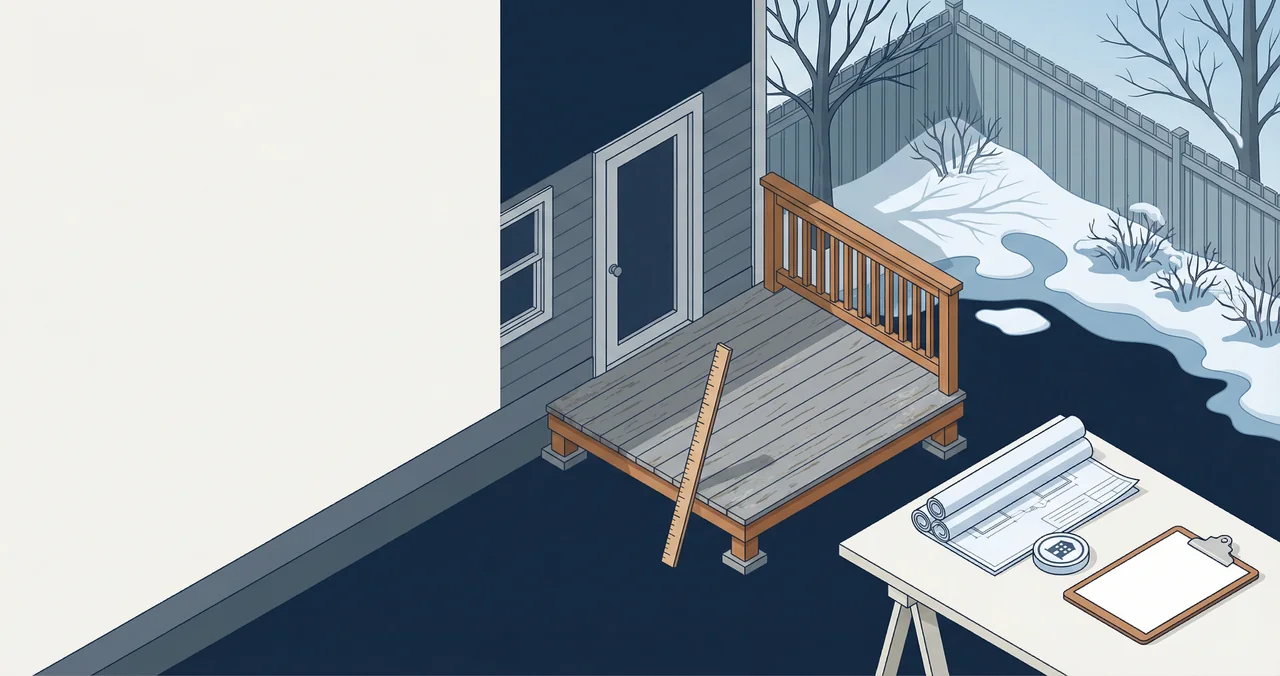
Planning a new deck in Edmonton? Before you pick out boards or call a contractor, you need to know whether the City of Edmonton requires a building permit for your project — and what happens if you skip it.
The short answer: most decks in Edmonton do require a permit. The specifics depend on height, size, and whether the deck attaches to your house. Here's everything you need to know to stay on the right side of Edmonton's building codes in 2026.
📋 Tool Alert: Permit Checker
Do you really need a permit? Check the exact rules for your city or township.
Check Permits →Do You Need a Deck Permit in Edmonton?
Edmonton's Safety Codes Officers enforce the Alberta Building Code, and the rules are straightforward:
🏗️ Planning a deck project?
Get a free manual project review, or visualize your dream deck with AI before requesting quotes.
- Decks higher than 24 inches (0.6 m) above grade require a building permit
- Decks over 100 square feet (9.3 m²) typically require a permit regardless of height
- Attached decks — any deck structurally connected to your home — require a permit because they affect the building envelope
A small, ground-level platform under 24 inches with no roof and no attachment to the house? You're likely fine without a permit. Anything beyond that, assume you need one.
Important: Even if your deck falls below the permit threshold, it still must comply with the Alberta Building Code. "No permit required" does not mean "no rules apply."
What About Freestanding Decks?
Freestanding decks (not bolted to the house) still need a permit if they exceed the height or size thresholds. The difference is in how the footings and ledger board requirements work — not whether you need paperwork. If you're weighing attached versus freestanding options, the permit implications for attached vs. freestanding decks apply in a similar way across Canadian jurisdictions.
When a Permit Is Required
Here's a quick breakdown of common Edmonton deck projects and whether they trigger a permit:
| Project Type | Permit Required? |
|---|---|
| Ground-level deck under 24" high, under 100 sq ft, freestanding | No |
| Deck over 24" above grade | Yes |
| Deck over 100 sq ft | Yes |
| Deck attached to the house | Yes |
| Deck with a roof or pergola | Yes |
| Adding stairs to an existing deck | Yes (if deck is over 24") |
| Replacing decking boards on existing frame | No (repair, not new construction) |
| Adding a hot tub to a deck | Yes (structural load changes) |
If your project involves any structural changes — new footings, altered load paths, or connections to your home — get the permit. Edmonton's Development & Zoning Services doesn't look kindly on homeowners who try to argue their way out of it after the fact.
Permit Fees & Processing Time
Current Fees (2026)
Edmonton's building permit fees are calculated based on the construction value of your project. For residential deck permits, expect:
- Base permit fee: Approximately $113 CAD minimum
- Fee calculation: Roughly $11.50 per $1,000 of construction value
- Safety Codes Council levy: An additional small surcharge applies
For a typical 300 sq ft pressure-treated deck with an estimated construction value of $12,000–$16,500 CAD, your permit fee would land around $150–$200 CAD. A larger composite deck project valued at $15,000–$25,500 CAD pushes the permit fee to $200–$300 CAD.
For reference, here's what installed deck costs look like in Edmonton right now:
| Material | Installed Cost (CAD/sq ft) |
|---|---|
| Pressure-treated wood | $30–$55 |
| Cedar | $40–$65 |
| Composite | $50–$85 |
| Trex (premium composite) | $55–$90 |
| Ipe (hardwood) | $70–$120 |
These prices affect your permit fee since it's tied to project value. For a deeper look at how material choice impacts your budget, check out the best composite decking brands in Canada — several perform exceptionally well in Alberta's freeze-thaw climate.
Processing Time
Edmonton's current processing times for residential deck permits:
- Simple deck permits: 10–15 business days for review
- Complex projects (multi-level decks, roofed structures, proximity to property lines): 3–6 weeks
- Revisions required: Add another 5–10 business days per resubmission
Pro tip: Submit your permit application in January or February. Edmonton's building season runs roughly May through October, and contractors book solid by March. Getting your permit sorted early means your builder can start as soon as the ground thaws. Waiting until April puts you at the back of the line — both at the permit office and on contractor schedules.
Building Codes & Setback Rules
Edmonton follows the Alberta Building Code (ABC), which aligns closely with the National Building Code of Canada. Here are the key requirements that affect deck construction:
Frost Depth and Footings
This is where Edmonton's climate makes things serious. Frost depth in the Edmonton region ranges from 48 to 60 inches (1.2–1.5 m).
Your deck footings must extend below the frost line — no exceptions. Shallow footings will heave during freeze-thaw cycles, and in Edmonton you'll see dozens of those cycles every winter. A deck that shifts even slightly can pull away from the house, crack concrete pads, and create structural hazards.
Acceptable footing options include:
- Sono tubes (concrete piers) — most common, poured to a minimum 60-inch depth in Edmonton
- Helical screw piles — increasingly popular in Alberta; installed mechanically and effective in clay-heavy Edmonton soils
- Concrete pad footings — must still reach frost depth; surface pads alone won't pass inspection
If you're building your own deck, footing depth is the single most critical detail. Get this wrong and nothing else matters.
Setback Requirements
Edmonton's Zoning Bylaw dictates how close your deck can be to property lines:
- Rear setback: Typically 1.2 m (about 4 feet) from the rear property line for most residential zones
- Side setback: 0.9–1.2 m from side property lines, depending on your zone
- Front setback: Decks are rarely permitted in front yards
- Easements and rights-of-way: Your deck cannot encroach on utility easements. If you're unsure where yours are, building near an easement explains why this matters
Check your property's specific zoning designation through Edmonton's zoning map — setbacks vary between RF1 (Single Detached), RF3 (Small Scale Infill), and other residential zones. Mature neighbourhoods like Strathcona, Glenora, and Bonnie Doon sometimes have additional overlay regulations.
Railing and Guard Requirements
- Decks 24 inches or more above grade require guards (railings) at least 42 inches (1,070 mm) high
- Baluster spacing: No gap greater than 4 inches (100 mm) — a 4-inch sphere must not pass through
- Stair railings: Required on both sides for stairs with more than 3 risers
- Graspable handrails: Must be between 34 and 38 inches high on stairs
For railing options that meet code and handle Edmonton winters, see the best deck railing systems in Canada.
Snow Load and Structural Requirements
Edmonton's ground snow load is approximately 1.6 kPa (about 33 lbs per sq ft). Your deck must be engineered to handle this, plus any additional live loads. If you're adding a roof or pergola, snow load requirements increase significantly — a covered deck essentially becomes a roof structure under the building code.
Beam spans, joist spacing, and post sizing must all comply with the span tables in the Alberta Building Code. Your permit drawings need to show these calculations.
How to Apply for a Deck Permit in Edmonton
Step 1: Check Your Zoning
Before anything else, confirm your property's zoning designation and any overlays. You can do this through Edmonton's online zoning map or by contacting Development & Zoning Services at 780-442-5311.
Step 2: Prepare Your Drawings
Edmonton requires the following for a residential deck permit application:
- Site plan showing your property boundaries, the house footprint, and the proposed deck location with dimensions to all property lines
- Deck plan (top view) with overall dimensions, joist layout, beam locations, and post spacing
- Cross-section drawing showing footing depth, post height, beam and joist sizes, decking material, and railing height
- Elevation drawing showing the deck from the side, including grade level and height above grade
Drawings don't need to be professionally drafted, but they must be to scale, legible, and dimensioned. Many Edmonton contractors include permit drawings as part of their service — ask before you sign.
Use PaperPlan to visualize different decking materials on your own home before committing. It helps to see what composite versus cedar actually looks like against your siding before you finalize plans.
Step 3: Submit Your Application
You have two options:
- Online: Through Edmonton's POSSE online portal — search for "building permit" on edmonton.ca
- In person: At the Edmonton Tower, 10111 - 104 Avenue NW, 2nd Floor
Online submissions are faster and let you track your application status.
Step 4: Pay the Fee
Fees are calculated at submission based on your declared construction value. Payment is required before review begins.
Step 5: Wait for Review and Address Deficiencies
A Plans Examiner reviews your submission. If anything is missing or doesn't meet code, you'll receive a deficiency notice. Respond promptly — each round of revisions adds 5–10 business days.
Step 6: Receive Your Permit and Schedule Inspections
Once approved, you'll receive your building permit. Post it visibly at the job site. Edmonton typically requires two inspections:
- Footing inspection — before pouring concrete, the inspector verifies depth and diameter
- Final inspection — after the deck is complete, confirming structure, railings, and overall code compliance
Do not backfill footings or install decking before the footing inspection. Inspectors need to see the holes.
What Happens If You Build Without a Permit
Skip the permit and you're gambling with real consequences:
- Stop work order: A Safety Codes Officer can shut down construction immediately
- Fines: Edmonton can levy fines of up to $10,000 for building without a permit
- Forced removal: In worst cases, you may be ordered to demolish the deck entirely
- Insurance problems: Your homeowner's insurance may deny claims related to an unpermitted structure — if someone is injured on your deck, this gets expensive fast
- Sale complications: When you sell your home, the buyer's home inspector and lawyer will flag unpermitted structures. You'll likely need to obtain a retroactive permit (more expensive) or remove the deck
The risks of building a deck without a permit aren't hypothetical. Edmonton's Safety Codes Officers actively respond to complaints, and neighbours do report unpermitted construction — especially when a new deck affects sightlines or property values.
A retroactive permit costs more and requires opening up finished work for inspection. You may need to remove decking boards so an inspector can examine the framing and footings. Getting the permit first is always cheaper.
Can a Neighbour Complain About My Deck?
Yes. If your deck is unpermitted, too close to the property line, or creates a privacy issue, your neighbour can file a complaint with the City. Edmonton investigates these complaints, and if your deck doesn't comply, you're the one who pays to fix it.
🎨 Not sure which material to pick?
Upload a photo of your backyard and see exactly how Trex, TimberTech, or cedar would look — free and instant.
Frequently Asked Questions
How much does a deck permit cost in Edmonton?
Most residential deck permits in Edmonton cost between $150 and $300 CAD, depending on the total construction value of your project. The fee is calculated at approximately $11.50 per $1,000 of construction value, with a minimum fee of around $113. Larger or more complex projects with higher construction values will have proportionally higher permit fees.
How long does it take to get a deck permit in Edmonton?
Plan for 10–15 business days for a straightforward deck permit. More complex projects or applications with deficiencies can take 3–6 weeks. Submit early in the year — the permit office gets significantly busier from March through May as everyone prepares for Edmonton's short building season.
Do I need a permit for a ground-level deck in Edmonton?
If your deck is under 24 inches above grade, under 100 square feet, and freestanding (not attached to your house), you likely don't need a permit. However, it still must comply with the Alberta Building Code. If it exceeds any of those thresholds — height, size, or attachment — a permit is required.
How deep do deck footings need to be in Edmonton?
Deck footings in Edmonton must extend below the frost line, which is typically 48 to 60 inches (1.2–1.5 m) deep in this region. Shallow footings will heave during freeze-thaw cycles, causing structural damage. Helical screw piles are a popular alternative to traditional sono tubes in Edmonton's clay-heavy soil.
What materials work best for decks in Edmonton's climate?
Composite and PVC decking handle Edmonton's harsh winters best — they resist moisture, won't crack from freeze-thaw cycles, and never need sealing. Pressure-treated wood is the most affordable option at $30–$55/sq ft installed, but requires annual sealing to protect against moisture and road salt. Cedar ($40–$65/sq ft) looks great but demands regular maintenance. For the best decking materials for freeze-thaw climates, composite consistently comes out on top for long-term value.
📋 Planning a deck project?
Get a free manual project review from our team — no obligation, no spam.
Get Free Project Review →Upload a backyard photo and preview real decking materials with AI — free, instant, no sign-up.
Permits, costs, material comparisons, and questions to ask before requesting quotes — delivered to your inbox.