
Deck Permits in Nanaimo (2026)
Everything you need to know about getting a deck permit in Nanaimo — requirements, fees, setback rules, and how to apply. Updated for 2026.
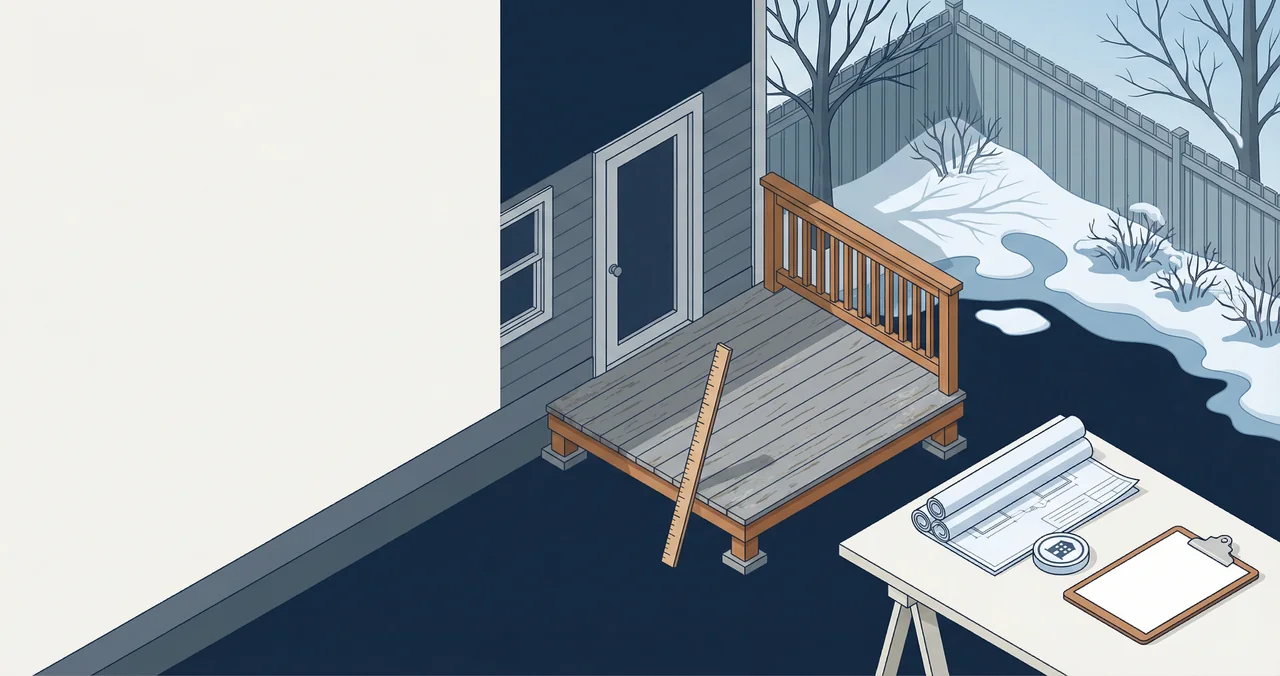
Planning a new deck in Nanaimo? Before you pick materials or hire a contractor, you need to answer one question first: do you need a building permit? Skip this step and you could face fines, forced removal, or complications when you sell your home.
Here's exactly what Nanaimo homeowners need to know about deck permits in 2026 — the rules, the costs, and the step-by-step application process.
📋 Tool Alert: Permit Checker
Do you really need a permit? Check the exact rules for your city or township.
Check Permits →Do You Need a Deck Permit in Nanaimo?
Yes, in most cases. The City of Nanaimo requires a building permit for decks that meet any of these criteria:
🏗️ Planning a deck project?
Get a free manual project review, or visualize your dream deck with AI before requesting quotes.
- The deck surface is more than 24 inches (600 mm) above finished grade
- The deck is over 100 square feet (9.3 m²) in area
- The deck is attached to your house (structural connection to the building)
- The deck includes a roof, pergola, or overhead cover
A small, ground-level platform under 100 square feet that sits independently from your home? You're likely in the clear. But anything beyond that — and that covers the vast majority of backyard decks Nanaimo homeowners actually build — needs a permit.
When in doubt, call the City of Nanaimo's Building Inspection Division at 250-755-4472 before starting work. A five-minute phone call can save you thousands in headaches.
When a Permit Is Required
Let's break this down with real examples Nanaimo homeowners commonly run into:
You DO Need a Permit For:
- A 12×16 deck off your back door (192 sq ft — well over the 100 sq ft threshold)
- Any raised deck with stairs — if it's over 24 inches high, it needs a permit regardless of size
- A second-story deck or balcony — always requires a permit plus engineered drawings
- Decks with hot tubs — the added load requires structural review
- Covered decks or those with privacy walls — these change wind and snow load calculations
- Decks attached to your home — the ledger board connection affects your home's structural envelope
You Likely DON'T Need a Permit For:
- A floating deck under 100 sq ft that sits less than 24 inches above grade
- A freestanding ground-level platform with no roof or walls
- Replacing deck boards only — if you're not altering the structure, framing, or footings
Even for permit-exempt projects, your deck still needs to comply with the BC Building Code and Nanaimo's zoning bylaws. No permit doesn't mean no rules.
Permit Fees & Processing Time
How Much Does a Deck Permit Cost in Nanaimo?
Nanaimo's building permit fees are calculated based on the estimated construction value of your project. For 2026, expect:
| Project Value | Approximate Permit Fee |
|---|---|
| Under $5,000 | $100–$150 |
| $5,000–$15,000 | $150–$350 |
| $15,000–$50,000 | $350–$750 |
| Over $50,000 | $750+ (based on sliding scale) |
Most standard residential decks in Nanaimo fall in the $150–$500 range for permit fees. That's a fraction of your total build cost — a typical pressure-treated deck runs $30–55 per square foot installed, while composite decking comes in at $50–85 per square foot.
Additional Fees to Budget For:
- Plan review fee — often included in the permit fee, but complex projects may incur extra
- Re-inspection fee — if your deck fails an inspection and requires a callback, expect $75–$150
- Variance or development permit — if your project doesn't meet standard zoning, fees start around $500+
How Long Does It Take?
Standard deck permits in Nanaimo typically take 2–4 weeks for processing. During peak season (spring and early summer), expect closer to 4 weeks or longer as contractors across the city submit applications for summer builds.
Pro tip: Submit your permit application in January or February for a summer build. Nanaimo's dry season runs June through September, and those months book up fast. Winter applications mean your permit is approved and ready before the building rush starts.
Building Codes & Setback Rules in Nanaimo
Your deck needs to comply with both the British Columbia Building Code (BCBC) and Nanaimo's local zoning bylaws. Here are the key requirements:
Structural Requirements
- Footings must extend below the frost line — in Nanaimo, that's 12–24 inches deep depending on your specific location and soil conditions
- Deck joists — typically 2×8 or 2×10 pressure-treated lumber, spaced 12–16 inches on center depending on span
- Beam sizing — determined by span tables in the BCBC; your plans must show calculations
- Ledger board connections — must use approved fasteners (typically ½-inch lag bolts or through-bolts) with proper flashing to prevent moisture infiltration. This is critical in Nanaimo's wet climate — a poorly flashed ledger is the number-one cause of deck failures in the Pacific Northwest
Guardrail & Stair Requirements
- Guardrails are required on any deck surface 24 inches or more above grade — minimum height of 42 inches (1070 mm)
- Baluster spacing — maximum 4 inches (100 mm) between balusters (the sphere rule: a 4-inch sphere shouldn't pass through)
- Stair rise and run — maximum 7¾-inch rise, minimum 10-inch run
- Handrails required on stairs with 3 or more risers — graspable profile between 1¼" and 2" diameter
Setback Rules
Nanaimo's zoning bylaws dictate how close your deck can be to property lines. These vary by zone, but typical residential requirements include:
- Rear yard setback: minimum 6–7.5 metres from rear property line (varies by zone)
- Side yard setback: minimum 1.5–3 metres from side property lines
- Front yard setback: typically 6–7.5 metres
Important: These setbacks apply to the deck structure, including stairs and landings — not just the main platform. A set of stairs extending into your setback can trigger a variance requirement.
If your property is in areas like Departure Bay, Hammond Bay, or the Old City, you may have additional heritage or environmental restrictions. Properties near Departure Bay, Long Lake, or Westwood Lake may also fall under Riparian Area Regulation (RAR), which restricts building near waterways. Check your property's zoning designation on the City of Nanaimo's online mapping tool before designing your deck.
Climate-Specific Code Considerations
Nanaimo gets roughly 1,100 mm of rain annually. That constant moisture affects every aspect of deck construction:
- Snow load requirements — Nanaimo's design snow load is lower than interior BC, but covered decks still need to account for it
- Drainage — the BCBC requires that decks attached to buildings allow water to drain away from the foundation. Board spacing of ⅛ inch minimum is standard
- Flashing and waterproofing — expect inspectors to closely examine ledger board flashing, joist tape, and any connection points between your deck and house
If you're weighing different materials for Nanaimo's climate, composite and PVC options resist moisture, mold, and algae far better than wood. Cedar and pressure-treated lumber can work, but budget for annual cleaning and resealing every 1–2 years to prevent rot. Use PaperPlan to visualize different decking materials on your own home before committing — it's helpful for comparing how composite versus wood will actually look on your property.
How to Apply for a Deck Permit in Nanaimo
Step 1: Check Your Zoning
Before drawing a single line, confirm your property's zoning designation through the City of Nanaimo's online map or by calling the Planning Department at 250-755-4472. You need to know:
- Your zone designation (R1, R4, R6, etc.)
- Setback requirements for your zone
- Whether any restrictive covenants or easements affect your property
- Whether you're within a Development Permit Area (DPA)
Step 2: Prepare Your Plans
Your permit application needs to include:
- Site plan — showing your property boundaries, the house footprint, the proposed deck location, and distances to all property lines
- Construction drawings — plan view, cross-sections, and elevation views of the deck showing:
- Footing locations and depths
- Beam and joist sizes, spacing, and spans
- Ledger attachment details (if attached to house)
- Guardrail details and heights
- Stair layout
- Material specifications — what you're building with and relevant grade stamps
- Engineered drawings — required for complex decks, multi-level structures, or decks supporting heavy loads like hot tubs
Most local deck builders in Nanaimo handle the permit application as part of their service. If you're going the DIY route, consider hiring a designer or technologist to prepare code-compliant drawings — $300–$800 is typical for a standard deck plan.
Step 3: Submit Your Application
You can submit your application:
- Online through the City of Nanaimo's building permit portal
- In person at the Building Inspection Division, 411 Dunsmuir Street, Nanaimo
Include your completed application form, two sets of plans, proof of property ownership, and the permit fee.
Step 4: Wait for Approval
The city reviews your plans for code compliance. They may request revisions — this is normal. Respond quickly to keep things moving. Once approved, you'll receive your permit and a posted permit card for the job site.
Step 5: Schedule Inspections
Nanaimo typically requires two inspections for deck projects:
- Footing inspection — before you pour concrete or backfill. The inspector checks footing depth, diameter, and placement
- Final inspection — after the deck is complete. The inspector checks guardrails, stairs, structural connections, and overall code compliance
Don't skip the final inspection. An open permit (one that was never finaled) creates problems when you sell your home. Buyers' home inspectors flag them, and lenders sometimes won't approve mortgages until open permits are resolved.
What Happens If You Build Without a Permit
Building a deck without a required permit in Nanaimo carries real consequences:
- Stop-work orders — the city can halt your project immediately
- Fines — Nanaimo can levy fines of up to $2,000 per day for building code violations under the Community Charter
- Forced removal — in serious cases, the city can require you to tear down the unpermitted structure at your own expense
- Insurance issues — your homeowner's insurance may deny claims for injuries or damage involving an unpermitted deck
- Sale complications — unpermitted structures must be disclosed. Buyers will demand a discount, or their lender may require removal or retroactive permitting before closing
Can You Get a Retroactive Permit?
Sometimes. The City of Nanaimo may allow you to apply for a permit after the fact, but expect:
- Higher fees — typically double the standard permit fee
- Destructive investigation — an inspector may require you to open up finished areas to verify hidden structural elements (footings, connections, joist hangers)
- Required modifications — if your deck doesn't meet code, you'll need to bring it into compliance, which can mean partial or full rebuilding
It's always cheaper and simpler to get the permit first. On a project where deck costs already range from $30–90+ per square foot depending on materials, the permit fee is a minor line item.
Nanaimo Deck Building: Timing & Planning Tips
A few practical notes specific to building in Nanaimo:
- Book your contractor in winter for a summer build. The June–September dry window is prime building season, and experienced deck builders in Nanaimo fill their schedules months in advance
- Budget for rain delays. Even in summer, Nanaimo sees occasional rain. A good contractor builds this into the timeline
- Consider moisture-resistant materials. Nanaimo's damp climate accelerates wood decay. Composite decking costs more upfront but eliminates the annual sealing and staining cycle — a real advantage when you're dealing with moss and algae six months of the year
- Footing depth matters. While Nanaimo's frost line is shallower than interior BC (12–24 inches), your soil type affects requirements. Properties in areas with clay-heavy soil — common in parts of Harewood and the South End — may need deeper footings or engineered solutions
🎨 Not sure which material to pick?
Upload a photo of your backyard and see exactly how Trex, TimberTech, or cedar would look — free and instant.
Frequently Asked Questions
How much does a deck permit cost in Nanaimo?
Most residential deck permits in Nanaimo cost between $150 and $500, depending on the project's estimated construction value. A standard 200–300 square foot deck typically falls in the $200–$400 range. Budget an additional $75–$150 for re-inspection fees if needed.
Do I need a permit for a ground-level deck in Nanaimo?
Not always. If your deck is freestanding (not attached to your house), under 100 square feet, and less than 24 inches above grade, you likely don't need a permit. However, it still must comply with the BC Building Code and Nanaimo's zoning bylaws — including setback requirements. When in doubt, call the Building Inspection Division.
How long does it take to get a deck permit in Nanaimo?
Expect 2–4 weeks for standard residential deck permits. During peak season (March through June), processing times may stretch longer. Submit your application well before your planned build date — ideally 6–8 weeks ahead to account for any plan revision requests.
Can my contractor pull the permit for me?
Yes. Most licensed deck contractors in Nanaimo will handle the entire permit process as part of their service — from preparing drawings to scheduling inspections. Make sure the permit is pulled in your name as the property owner, not just the contractor's. This protects you if the contractor disappears mid-project. Ask to see the approved permit before work starts.
What's the penalty for building a deck without a permit in Nanaimo?
Penalties can include fines up to $2,000 per day, stop-work orders, and potentially being forced to remove the deck entirely. Beyond fines, an unpermitted deck creates problems with insurance coverage and home resale. Retroactive permits are possible but cost roughly double the original fee, and may require opening up the deck for inspection — a costly process if modifications are needed.
📋 Planning a deck project?
Get a free manual project review from our team — no obligation, no spam.
Get Free Project Review →Upload a backyard photo and preview real decking materials with AI — free, instant, no sign-up.
Permits, costs, material comparisons, and questions to ask before requesting quotes — delivered to your inbox.