
Deck Permits in Newark (2026)
Need a deck permit in Newark, NJ? Learn permit requirements, fees, building codes, setback rules, and how to apply for your Newark deck permit in 2026.
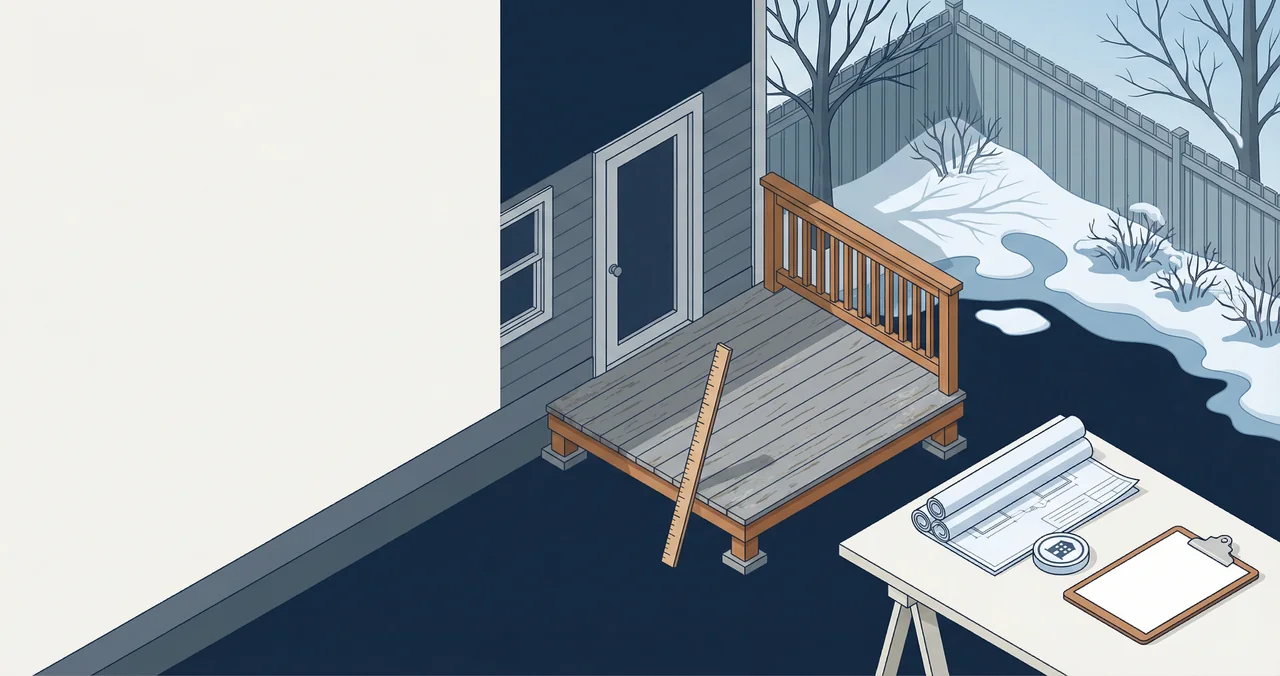
Deck Permits in Newark: Requirements, Costs & How to Apply in 2026
Planning a new deck in Newark? Before you pick out materials or hire a contractor, there's one step you can't skip: figuring out whether you need a deck permit. Newark's Building/Development Services department enforces specific rules about what you can build, where you can build it, and how it needs to be constructed. Getting this wrong can mean fines, forced demolition, or serious headaches when you try to sell your home.
🏗️ Planning a deck project?
Get a free manual project review, or visualize your dream deck with AI before requesting quotes.
📋 Tool Alert: Permit Checker
Do you really need a permit? Check the exact rules for your city or township.
Check Permits →Here's everything you need to know about deck permits in Newark, New Jersey — the actual requirements, what it costs, and how to get through the process without delays.
<!-- slot:after-intro -->
Do You Need a Permit in Newark?
Short answer: almost certainly yes.
In Newark, a building permit is typically required for any deck that meets one or both of these thresholds:
- Over 200 square feet in total area
- More than 30 inches above grade at any point
That 30-inch rule catches most homeowners off guard. Even if your yard slopes gently, one corner of your deck might push past that height — and now you need a permit. Ground-level patios and very small platforms sometimes qualify as exempt, but don't assume. Newark's code enforcement is active, and a neighbor complaint is all it takes to trigger an inspection.
If your deck attaches to the house, you'll need a permit regardless of size in most cases. Attached structures affect the building envelope and must meet the New Jersey Uniform Construction Code (NJUCC) for structural connections, ledger board fastening, and flashing.
When You Might Not Need a Permit
A few narrow exceptions exist:
- Freestanding platforms under 200 sq ft that sit less than 30 inches above grade
- Ground-level floating decks with no permanent footings (though zoning setbacks still apply)
- Minor repairs — replacing a few boards or refinishing the surface doesn't require a permit
Even for "exempt" projects, zoning regulations still apply. You can't build in a setback zone, block an easement, or violate lot coverage limits just because the structure is small. When in doubt, call Newark's Building Department at (973) 733-3860 before you start.
When a Permit Is Required
Beyond the size and height triggers, Newark requires permits for decks in these situations:
- Any deck attached to the house (ledger board connection to the structure)
- Decks with roofing, pergolas, or overhead structures
- Decks with built-in electrical (lighting, outlets, hot tub wiring)
- Elevated decks requiring stairs and railings
- Any deck that changes the footprint of an existing structure
Newark follows the 2021 International Residential Code (IRC) as adopted under the NJUCC, with local amendments. This means your deck design needs to comply with both state-level building codes and Newark's municipal zoning ordinances — including lot coverage maximums, which in many Newark neighborhoods cap impervious coverage at 70-80% of the lot.
Newark's Climate Makes Permits Even More Important
This isn't just bureaucratic box-checking. Newark's harsh winters — with freeze-thaw cycles, heavy snow loads, and ice — put serious stress on deck structures. The permit process ensures your footings go deep enough, your framing can handle the weight, and your connections won't fail when ice forms between the ledger board and the house.
The frost line in northern New Jersey ranges from 36 to 42 inches deep. Your footings must extend below this line, or frost heave will push your deck out of level within a few seasons. This is one of the specific things inspectors check during the footing inspection.
Permit Fees & Processing Time
Newark's permit fees for residential deck construction are based on the estimated project cost. Here's what to expect in 2026:
| Project Cost | Estimated Permit Fee |
|---|---|
| Under $5,000 | $75–$125 |
| $5,000–$15,000 | $150–$300 |
| $15,000–$50,000 | $300–$600 |
| Over $50,000 | $600+ (percentage-based) |
Additional fees you might encounter:
- Plan review fee: $50–$150 (sometimes included in the permit fee)
- Zoning review fee: $50–$100
- Certificate of Occupancy: $25–$75 (required when the deck is complete)
- Re-inspection fee: $50–$100 if you fail an inspection and need a return visit
How Long Does It Take?
Plan on 2 to 6 weeks from application to permit approval for a standard residential deck. Factors that affect timing:
- Simple decks (ground-level, straightforward design): 2–3 weeks
- Elevated or complex decks (multi-level, structural attachments): 3–6 weeks
- Zoning variances needed: 8–12+ weeks (requires a hearing)
Newark's Building Department can get backed up, especially in spring when everyone's applying at once. Submit your application in February or March to have your permit in hand by the time building season starts in May. If you wait until April, you might not break ground until June — and with Newark's short building season running through October, that compresses your timeline significantly.
Building Codes & Setback Rules
Newark enforces the New Jersey Uniform Construction Code, which incorporates the IRC with state amendments. Here are the key code requirements for residential decks:
Structural Requirements
- Footings: Must extend below the frost line (minimum 36 inches deep in Newark's zone). Concrete footings, typically 12–16 inches in diameter for standard decks.
- Joist sizing: Typically 2x8 or 2x10 pressure-treated lumber, spaced 12" or 16" on center depending on span and decking material.
- Ledger board: Must be lag-bolted or through-bolted to the rim joist with proper flashing. This is the #1 point of failure in deck collapses — inspectors scrutinize this closely.
- Beam sizing: Determined by span tables in the IRC. Double 2x10 or 2x12 beams are common for standard residential decks.
- Post-to-beam connections: Must use approved hardware (post caps, through-bolts). Notched posts or toenailing alone won't pass inspection.
Railing & Stair Codes
- Railing required when the deck surface is 30 inches or more above grade
- Minimum railing height: 36 inches for residential (42 inches if local amendment applies — verify with your inspector)
- Baluster spacing: Maximum 4 inches between balusters (the "4-inch sphere" rule)
- Stair width: Minimum 36 inches
- Riser height: Maximum 7¾ inches, uniform throughout
- Tread depth: Minimum 10 inches
- Handrail: Required on at least one side for stairs with 4+ risers, graspable profile between 1¼" and 2" in diameter
Setback Rules
Newark's zoning ordinances dictate where on your lot you can build. Typical setbacks for residential zones:
- Rear yard setback: 10–15 feet from the rear property line (varies by zone)
- Side yard setback: 3–5 feet minimum from each side property line
- Front yard: Decks are generally not permitted in front yard setback areas
These vary depending on your specific zoning district (R-1, R-2, R-3, etc.). You can look up your property's zoning designation on Newark's zoning map or by calling the Zoning Office. If your desired deck location encroaches on a setback, you'll need a zoning variance — which means a hearing before the Board of Adjustment, additional fees, and significantly more time.
Lot coverage is another common issue in Newark, where lots tend to be smaller than in suburban areas. If your home, garage, driveway, and existing hardscape already push you near the coverage limit, adding a deck might require a variance.
How to Apply for a Deck Permit
Here's the step-by-step process for getting a deck permit in Newark:
Step 1: Gather Your Documents
Before you visit the Building Department, prepare:
- Property survey showing lot lines, existing structures, and easements
- Deck plans — a scaled drawing (typically ¼" = 1') showing:
- Overall dimensions and layout
- Footing locations and depths
- Framing plan (joists, beams, posts)
- Ledger board attachment detail
- Railing and stair details
- Height above grade at all corners
- Site plan showing where the deck sits relative to property lines and existing structures
- Materials list with specifications
- Proof of property ownership (deed or tax bill)
- Contractor information (NJ contractor license number, insurance)
Most contractors who work in Newark regularly will prepare the permit drawings as part of their scope. If you're DIY-ing, you may need to hire a draftsperson or engineer — especially for elevated decks.
Use PaperPlan to visualize different decking materials on your own home before committing. It helps narrow down your material choice before you finalize plans.
Step 2: Submit Your Application
File your application at:
Newark Department of Economic & Housing Development
Division of Code Enforcement
City Hall, 920 Broad Street, Newark, NJ 07102
Some applications can be initiated online through Newark's permitting portal, but plan reviews and approvals still typically require in-person visits or document submissions. Call ahead to confirm current procedures — (973) 733-3860.
Step 3: Plan Review
The Building Department reviews your plans for code compliance. You may receive:
- Approval — you can start building
- Conditional approval — minor changes needed
- Rejection — significant code issues that require redesign
If changes are required, address them promptly. Each round of revisions adds another 1–2 weeks.
Step 4: Schedule Inspections
Once your permit is approved and posted at the job site, you'll need inspections at key milestones:
1. Footing inspection — before pouring concrete (inspector verifies depth below frost line)
2. Framing inspection — after framing is complete but before decking is installed
3. Final inspection — completed deck, including railings, stairs, and any electrical
Don't skip inspections. If you pour footings before the footing inspection, the inspector may require you to dig them up to verify depth. That's an expensive mistake.
Step 5: Get Your Certificate of Occupancy
After passing the final inspection, you'll receive a Certificate of Occupancy (or Certificate of Approval). Keep this document — you'll need it when you sell your home.
<!-- slot:mid-content -->
What Happens If You Build Without a Permit
Building a deck without the required permit in Newark carries real consequences:
- Stop-work order: The city can halt construction immediately
- Fines: Newark can impose fines of $100–$2,000 per day for unpermitted construction
- Forced removal: In worst cases, you may be ordered to demolish the deck entirely
- Retroactive permits: You might be able to obtain an after-the-fact permit, but expect double fees and the hassle of proving code compliance on an already-built structure
- Insurance issues: Your homeowner's insurance may deny claims for injuries or damage involving an unpermitted structure
- Sale complications: Title searches reveal unpermitted work. Buyers walk away, or you're forced to remediate before closing
This isn't hypothetical. Newark actively enforces building codes, and the Ironbound, North Ward, and Vailsburg neighborhoods in particular have seen increased code enforcement activity in recent years. Neighbors report unpermitted construction, and city inspectors follow up.
The permit process exists partly because of Newark's climate. Decks built without proper frost-line footings in New Jersey will fail — it's not a matter of if, but when. Frost heave can lift posts several inches over a single winter, cracking framing connections and creating dangerous structural conditions.
If you're comparing costs, consider that a deck permit typically runs $150–$600 for most residential projects. That's a tiny fraction of your total deck investment, which commonly ranges from $10,000 to $30,000+ depending on size and materials. For a detailed cost breakdown, check out our guides on composite deck builders in Newark and pool deck options.
What About Freestanding Decks?
There's a common myth that freestanding decks don't need permits. In Newark, a freestanding deck still needs a permit if it exceeds 200 sq ft or 30 inches in height. The only advantage of a freestanding deck is that it avoids the ledger board attachment requirements — which simplifies the structural review but doesn't eliminate the permit requirement. For a deeper look at how this works, see our article on attached vs. freestanding deck permits.
Choosing the Right Materials for Newark's Climate
Since you're already thinking about your deck project, here's a quick look at what materials make sense for Newark's freeze-thaw climate:
| Material | Installed Cost (per sq ft) | Lifespan | Maintenance |
|---|---|---|---|
| Pressure-treated wood | $25–$45 | 15–20 years | Annual sealing required |
| Cedar | $35–$55 | 20–25 years | Annual sealing/staining |
| Composite (Trex, TimberTech) | $45–$75 | 25–30+ years | Minimal — occasional washing |
| Trex (specifically) | $50–$80 | 25–30+ years | Minimal |
| PVC | $50–$80 | 25–30+ years | Very low |
| Ipe (hardwood) | $60–$100 | 40+ years | Annual oiling recommended |
For Newark specifically, composite and PVC decking perform best against the freeze-thaw cycles, road salt exposure, and moisture that defines northern New Jersey winters. Pressure-treated wood is the budget-friendly option, but you'll need to seal it every year — skip that, and it'll crack, warp, and gray out fast. Newark homeowners who choose wood and don't maintain it end up replacing boards within 8–10 years.
For more on choosing materials that handle freeze-thaw conditions or low-maintenance decking options, we've got detailed breakdowns.
Timing Your Newark Deck Project
Newark's building season runs roughly May through October. Here's the ideal timeline:
- January–February: Research materials, get design ideas, request contractor quotes
- February–March: Submit your permit application. Book your contractor by March — schedules fill up fast with the shorter northern building season
- March–April: Permit review and approval period
- May–June: Construction begins (ideal start)
- September–October: Latest comfortable window for construction
Starting late means rushing the build into fall, when rain and dropping temperatures slow everything down. And if your project spills into November, you're dealing with frozen ground that makes footing work nearly impossible.
If you're in the early planning stages and wondering about costs for specific deck sizes, our deck cost guides break down pricing for Newark.
<!-- slot:before-faq -->
🎨 Not sure which material to pick?
Upload a photo of your backyard and see exactly how Trex, TimberTech, or cedar would look — free and instant.
Frequently Asked Questions
How much does a deck permit cost in Newark, NJ?
Most residential deck permits in Newark cost between $150 and $600, depending on your total project value. Simple decks under $5,000 in value may cost as little as $75–$125 for the permit. Budget an additional $50–$150 for plan review and $25–$75 for the Certificate of Occupancy. These fees are a small fraction of your total project cost and well worth the legal protection and resale value they provide.
How long does it take to get a deck permit in Newark?
Expect 2 to 6 weeks from application submission to permit approval. Simple, straightforward deck designs get approved faster. Complex or elevated decks, or anything requiring a zoning variance, can take 8–12+ weeks. To stay on schedule for a May build start, submit your application no later than early March.
Can I build a deck myself in Newark without a contractor?
Yes — New Jersey allows homeowners to pull permits and build on their own property. However, you're still responsible for meeting all code requirements and passing inspections. For elevated decks or anything involving electrical work, most inspectors recommend (and some require) plans prepared or reviewed by a licensed professional. You'll also need to demonstrate that the structural elements meet IRC span tables and load requirements. If you're considering the DIY route, our guide on building your own deck covers what's involved.
What's the penalty for building a deck without a permit in Newark?
Newark can fine you $100 to $2,000 per day for unpermitted construction. Beyond fines, you risk a stop-work order, forced demolition, insurance claim denials, and problems selling your home. Retroactive permits are sometimes possible but cost roughly double the original permit fee — and you may need to open up finished work so inspectors can verify structural elements like footings and framing connections. The risks of building without a permit far outweigh the cost of doing it right.
Do I need a permit for a ground-level deck in Newark?
It depends on size. A ground-level deck under 200 square feet and less than 30 inches above grade at all points may be exempt from the building permit requirement. But zoning rules still apply — you must respect setback distances, lot coverage limits, and easement restrictions regardless of whether a building permit is required. If you're close to any threshold, call Newark's Building Department to confirm before you start.
<!-- slot:end -->
📋 Planning a deck project?
Get a free manual project review from our team — no obligation, no spam.
Get Free Project Review →Upload a backyard photo and preview real decking materials with AI — free, instant, no sign-up.
Permits, costs, material comparisons, and questions to ask before requesting quotes — delivered to your inbox.