
Deck Cost in Ann Arbor (2026)
What does a deck cost in Ann Arbor? Get 2026 pricing by material, labor rates, cost per square foot, and tips to save on your build in Michigan's climate.
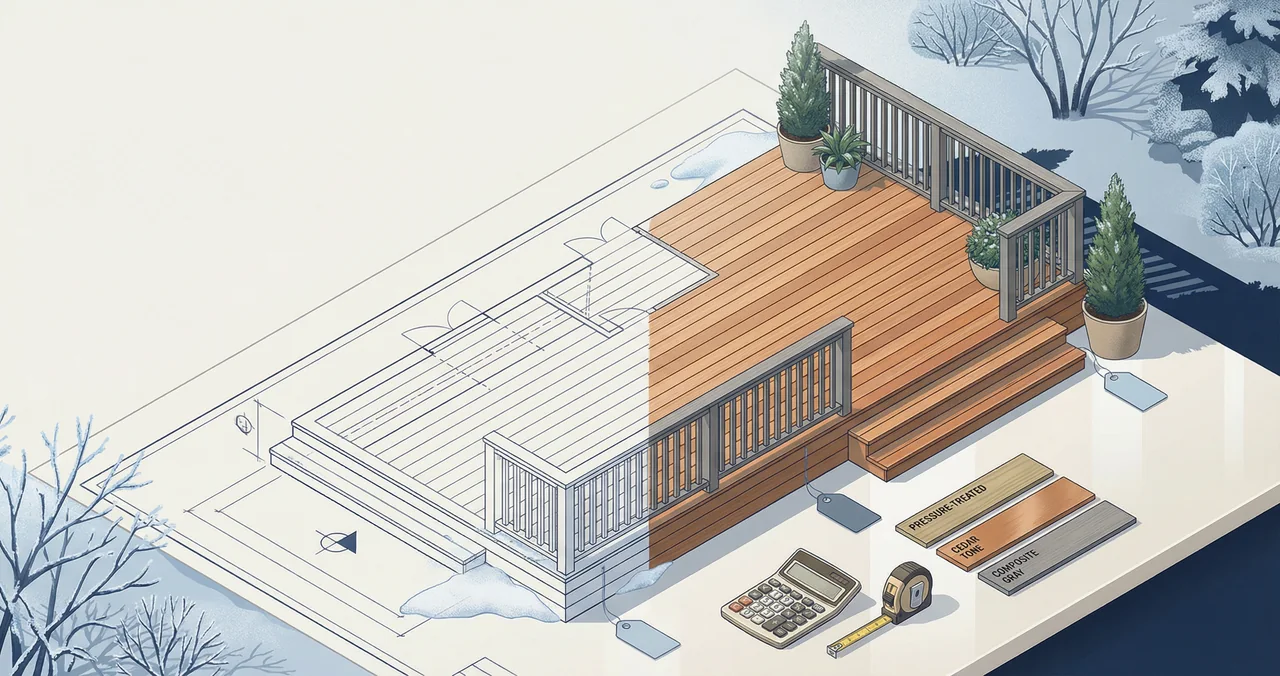
How Much Does a Deck Cost in Ann Arbor?
If you're a homeowner in Ann Arbor pricing out a new deck, you're probably seeing a wide range of numbers online — and wondering which ones actually apply here. Michigan pricing doesn't match national averages, and Ann Arbor's shorter building season and harsh freeze-thaw cycles push costs in specific directions.
🏗️ Planning a deck project?
Get a free manual project review, or visualize your dream deck with AI before requesting quotes.
🧮 Tool Alert: Deck Cost Calculator
Estimate your project costs in seconds based on local pricing bands for your area.
Calculate My Cost →Here's the short answer: most Ann Arbor homeowners pay $8,000 to $32,000 for a new deck, depending on size, material, and complexity. A standard 320 sq ft pressure-treated deck runs $8,000–$14,400 installed, while the same footprint in composite lands at $14,400–$24,000.
Those are starting points. Below is everything that moves the needle on your final price.
<!-- slot:after-intro -->
For a broader look at deck pricing across different materials and regions, see our deck cost guide.
Average Deck Cost in Ann Arbor by Material
Material choice is the single biggest driver of your total deck cost. Here's what Ann Arbor contractors are charging in 2026, fully installed:
| Material | Installed Cost per Sq Ft | 320 Sq Ft Deck | 500 Sq Ft Deck |
|---|---|---|---|
| Pressure-Treated Wood | $25–$45 | $8,000–$14,400 | $12,500–$22,500 |
| Cedar | $35–$55 | $11,200–$17,600 | $17,500–$27,500 |
| Composite | $45–$75 | $14,400–$24,000 | $22,500–$37,500 |
| Trex (mid-high tier) | $50–$80 | $16,000–$25,600 | $25,000–$40,000 |
| Ipe (Hardwood) | $60–$100 | $19,200–$32,000 | $30,000–$50,000 |
Pressure-treated lumber is still the most popular choice in neighborhoods like Burns Park and Water Hill where older homes have modest-sized decks. But composite is gaining ground fast — and for good reason in this climate.
Cedar looks great the first year, but Ann Arbor's snow, ice melt, and spring moisture can turn an untreated cedar deck gray and splintery within two seasons. If you go cedar, budget an extra $300–$600 per year for staining and sealing. That adds up.
Cost Per Square Foot Breakdown
Your per-square-foot cost includes materials, labor, and basic structural work. But it shifts depending on what you're building:
Ground-Level Deck (under 30 inches)
- $25–$50/sq ft for wood
- $45–$70/sq ft for composite
- Simpler footings, no railing required by code (though recommended)
Raised Deck (30+ inches above grade)
- $40–$65/sq ft for wood
- $55–$85/sq ft for composite
- Requires railings (Michigan code), deeper footings past the frost line, and often stairs
Second-Story Deck
- $50–$90/sq ft depending on material
- Structural engineering, ledger board connections, and beefier posts add cost fast
- Permits are mandatory at this height — no exceptions in Ann Arbor
The frost line in southeastern Michigan sits at 36 to 42 inches below grade. Every footing on your deck needs to reach below that depth or you risk frost heave — where frozen soil pushes your posts up and your deck starts to shift. This is non-negotiable in Ann Arbor and one of the reasons local labor costs run higher than warmer-climate cities.
Labor Costs in Ann Arbor
Labor typically accounts for 50–65% of your total deck project, and Ann Arbor sits at the higher end of Michigan's labor market. Here's why:
- Compressed building season: Most Ann Arbor deck contractors work May through October. That's six months of bookable time for a full year's worth of demand.
- Skilled trades shortage: Washtenaw County has strong demand for residential construction, and experienced deck builders stay booked.
- University-area demand: Rental property upgrades and the steady housing market near the University of Michigan keep contractors busy.
Expect to pay $15–$35 per square foot for labor alone, depending on deck complexity. Simple rectangular ground-level decks come in at the low end. Multi-level builds with custom railings, benches, or pergola integrations push toward the top.
Pro tip: Book your contractor by March if you want a summer build. By April, the best crews in Ann Arbor are scheduled through August.
<!-- slot:mid-content -->
What Affects Your Total Price
Beyond material and labor, these factors move your Ann Arbor deck cost up or down:
Deck Size and Shape
Straightforward. A 12×16 rectangle costs less per square foot than an L-shaped or wraparound design. Angles and curves add cutting waste and labor time. If you're curious about pricing for specific dimensions, our breakdown of 12×16 deck costs covers the math in detail.
Height and Access
A deck built at grade on flat ground is the cheapest scenario. Sloped lots — common in neighborhoods like Barton Hills and along the Huron River — require taller posts, more concrete, and potentially retaining work. Each foot of elevation adds roughly $3–$8 per square foot to your project.
Railing and Stairs
Michigan building code requires railings on any deck surface 30 inches or more above grade. Basic wood railings run $20–$35 per linear foot. Composite or aluminum railing systems jump to $40–$80 per linear foot. Cable railing — popular with the modern aesthetic common in Ann Arbor's newer developments — costs $50–$100+ per linear foot installed.
Stairs add $1,000–$3,000 depending on the run and material.
Permits and Inspections
In Ann Arbor, deck permits are required for structures over 200 sq ft or 30 inches above grade. Contact the city's Building/Development Services department before construction. Permit fees typically run $150–$500 depending on project scope. Your contractor should handle the application, but confirm this upfront — not all do.
Building without a permit in Ann Arbor creates real problems. It can complicate your home sale, void your insurance coverage, and trigger mandatory teardown orders. Not worth the risk. If you're wondering about the broader implications, see our piece on building a deck without a permit and the risks involved.
Footings and Foundation
Ann Arbor's freeze-thaw cycles are brutal on deck foundations. Footings need to extend below the frost line — 36 inches minimum in this region, though some contractors go to 42 inches for extra safety. Helical piles are an alternative gaining popularity locally, running $150–$300 per pile but eliminating the concrete cure time.
Built-In Features
Benches, planters, pergolas, and lighting all add cost:
- Built-in bench seating: $500–$2,000
- Pergola addition: $3,000–$10,000
- Deck lighting package: $500–$2,500
- Under-deck drainage system: $1,500–$4,000
Composite vs Wood: Cost Comparison
This is the decision most Ann Arbor homeowners wrestle with. Here's a realistic 10-year comparison for a 320 sq ft deck:
| Factor | Pressure-Treated Wood | Composite |
|---|---|---|
| Upfront cost (installed) | $8,000–$14,400 | $14,400–$24,000 |
| Annual maintenance | $300–$600 (stain/seal) | $0–$50 (occasional cleaning) |
| 10-year maintenance total | $3,000–$6,000 | $0–$500 |
| 10-year total cost | $11,000–$20,400 | $14,400–$24,500 |
| Expected lifespan | 10–15 years | 25–30+ years |
| Warranty | None typical | 25–50 years (manufacturer) |
In Ann Arbor specifically, composite and PVC decking outperform wood over time. The combination of heavy snow load, road salt tracked onto deck surfaces, freeze-thaw stress, and spring moisture makes wood maintenance a constant battle. Pressure-treated boards that might last 15 years in a milder climate often show significant deterioration by year 8–10 here without diligent annual care.
Composite doesn't rot, warp, or splinter — and it handles snow shoveling without damage. For most homeowners, the upfront premium pays for itself within 5–7 years through eliminated maintenance costs.
That said, if budget is the hard constraint and you're comfortable with the upkeep, pressure-treated wood is a solid functional choice. Just go in knowing what you're committing to every spring.
Use PaperPlan to visualize different decking materials on your own home before committing — seeing composite versus wood on your actual house makes the decision much more concrete.
For a deeper look at how the best composite decking brands compare on price and performance, we've tested and reviewed the top options.
How to Save Money on Your Ann Arbor Deck
Build in the Off-Season
September and October are your sweet spot. Contractors are wrapping up their summer backlog, and some offer 10–15% discounts to fill their schedule before winter. Early spring (April) can work too, though Michigan weather makes this less reliable.
Keep the Design Simple
A rectangular deck with standard railings costs significantly less per square foot than multi-level designs with custom features. Going from a rectangle to an L-shape can add 15–25% to your total.
Choose Your Material Strategically
If you want composite on a budget, look at entry-level composite lines like Trex Enhance Basics or Fiberon Good Life. These run $45–$55/sq ft installed — well below premium composite lines — and still outperform wood in durability. Our guide to low-maintenance decking options covers the full range.
Do Some Prep Work Yourself
Clearing the build area, removing an old deck, or handling post-build landscaping can save $500–$2,000 in labor charges. Leave the structural work to the pros, but there's no reason to pay contractor rates for demolition hauling.
Get Three Detailed Quotes
Not three ballpark numbers — three itemized written quotes that break out materials, labor, permits, and contingencies. Ann Arbor has enough reputable deck builders to make competitive bidding work in your favor. Look for contractors who pull their own permits and carry proper insurance.
Skip Features You Can Add Later
Lighting, built-in seating, and privacy screens can all be added after the initial build. Get the structure right first, then upgrade over time. You'd be surprised how much this phased approach saves upfront.
Material Guide for Ann Arbor's Climate
Ann Arbor gets roughly 50 inches of snow annually and experiences 100+ freeze-thaw cycles per season. That's not trivial when choosing deck materials.
Best Performers
- Composite (Trex, TimberTech, Fiberon): Handles freeze-thaw without cracking. No moisture absorption means no warping. Best all-around choice for Michigan.
- PVC decking (Azek, TimberTech Advanced PVC): Even more moisture-resistant than standard composite. Premium price but virtually indestructible in this climate.
- Ipe hardwood: Naturally resistant to everything — rot, insects, moisture. But it's expensive, heavy, and requires specialized installation.
Needs Extra Care
- Cedar and redwood: Beautiful but high-maintenance in Ann Arbor. Require annual sealing against moisture and salt. Performance degrades quickly without it.
- Pressure-treated pine: Functional and affordable. Needs staining and sealing every 1–2 years. Prone to checking and splitting after a few harsh winters. Knowing the best deck stains and sealers makes a big difference if you go this route.
Avoid
- Untreated softwoods: Will not survive an Ann Arbor winter. Period.
Understanding which decking materials handle freeze-thaw cycles best is critical when you're building in a cold climate.
<!-- slot:before-faq -->
🎨 Not sure which material to pick?
Upload a photo of your backyard and see exactly how Trex, TimberTech, or cedar would look — free and instant.
Frequently Asked Questions
How much does a 12×16 deck cost in Ann Arbor?
A 12×16 (192 sq ft) deck in Ann Arbor costs $4,800–$8,640 in pressure-treated wood or $8,640–$14,400 in composite, fully installed. Since this is under 200 sq ft, you may not need a permit — but verify with Ann Arbor's Building Services if the deck will be 30 inches or more above grade, as height triggers the permit requirement regardless of size.
What is the best decking material for Michigan winters?
Composite decking is the top recommendation for Michigan's climate. It resists moisture absorption, won't crack from freeze-thaw cycling, and handles snow removal without splintering. PVC decking performs even better for moisture resistance. Wood can work but demands consistent annual maintenance — miss a year of sealing and you'll see the damage by spring. Check out our comparison of the best low-maintenance decking options for specifics.
Do I need a permit to build a deck in Ann Arbor?
Yes, in most cases. Ann Arbor requires a building permit for decks over 200 sq ft or higher than 30 inches above grade. The permit ensures your deck meets structural requirements, including proper frost-depth footings and railing heights. Apply through Ann Arbor's Building/Development Services department. Your contractor should handle this, but always confirm before signing a contract.
When is the best time to build a deck in Ann Arbor?
May through October is the realistic building window. The best strategy: start getting quotes in January–February, sign a contract by March, and target a May or June start date. Contractor schedules fill fast because of the short season. If you wait until May to start looking, you're likely building in late summer or fall. For more on timing your build right, see our guide on best time to build a deck.
Can I build my own deck in Ann Arbor to save money?
You can, and it will save roughly 40–50% on labor costs. But be realistic about what that means in Ann Arbor: you still need a permit for most builds, your footings still need to go 36+ inches deep below the frost line, and the work needs to pass inspection. A poorly built deck in Michigan's climate fails faster and costs more to fix than it saved. If you have solid carpentry skills, a ground-level deck is a reasonable DIY project. Anything elevated or attached to the house is better left to professionals.
<!-- slot:end -->
📋 Planning a deck project?
Get a free manual project review from our team — no obligation, no spam.
Get Free Project Review →Upload a backyard photo and preview real decking materials with AI — free, instant, no sign-up.
Permits, costs, material comparisons, and questions to ask before requesting quotes — delivered to your inbox.