
Deck Cost in Chattanooga (2026)
What does a new deck cost in Chattanooga? Get 2026 pricing by material, labor rates, cost-per-square-foot breakdowns, and tips to save on your project.
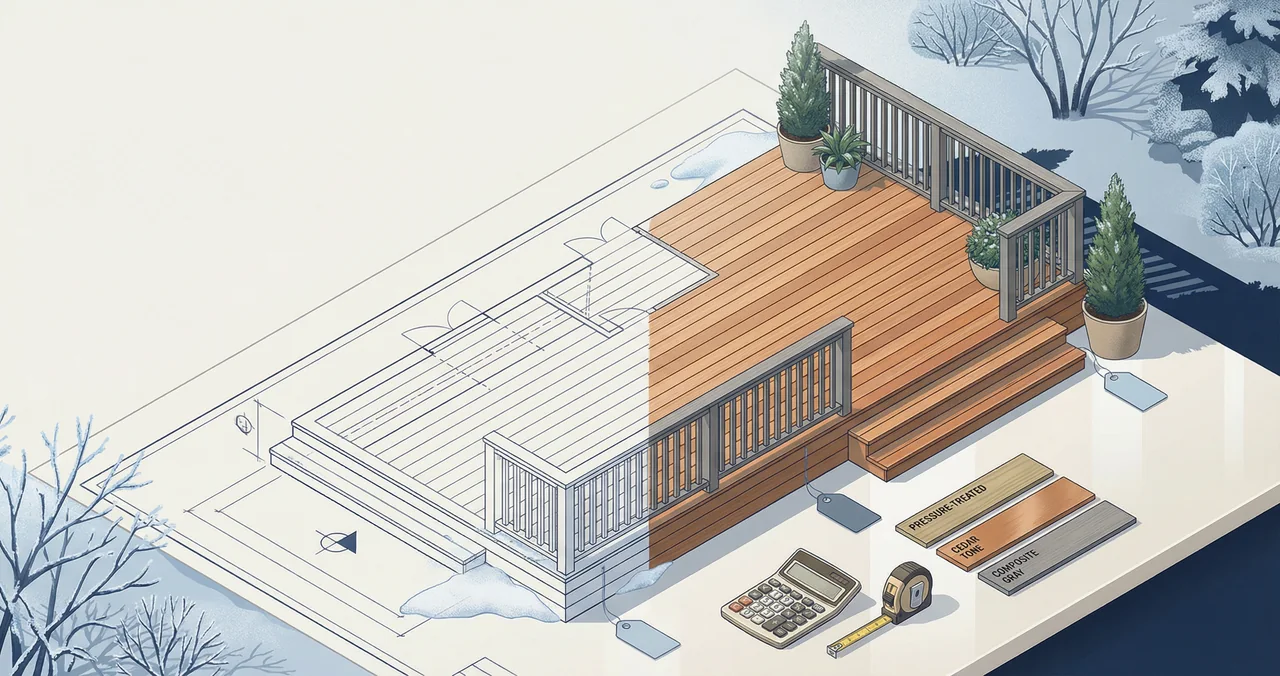
How Much Does a Deck Cost in Chattanooga?
A new deck in Chattanooga typically runs between $8,000 and $30,000 for a standard 300–400 square foot build, depending on the material you choose and the complexity of your design. That's a wide range — and the difference comes down to a few key decisions you'll make early on.
🏗️ Planning a deck project?
Get a free manual project review, or visualize your dream deck with AI before requesting quotes.
🧮 Tool Alert: Deck Cost Calculator
Estimate your project costs in seconds based on local pricing bands for your area.
Calculate My Cost →Looking for more regional information? Check out our Tennessee State Decking Hub.
Chattanooga's long building season (March through November) means you have more scheduling flexibility than homeowners in colder climates. But that also means spring books up fast. If you're planning ahead, you can use the off-peak months to your advantage.
Here's what Chattanooga homeowners are actually paying in 2026, broken down by material, labor, and the factors that move your total up or down.
<!-- slot:after-intro -->
For a broader look at deck pricing across different materials and regions, see our complete deck cost guide for Tennessee. Timing your build right can also save thousands — check our guide on the best time to build a deck.
Average Deck Cost in Chattanooga by Material
Material is the single biggest factor in your deck's total cost. Here's a realistic look at what you'll pay per square foot, fully installed, from Chattanooga-area contractors in 2026:
| Material | Installed Cost (per sq ft) | 300 sq ft Deck | 400 sq ft Deck |
|---|---|---|---|
| Pressure-Treated Pine | $25–$45 | $7,500–$13,500 | $10,000–$18,000 |
| Cedar | $35–$55 | $10,500–$16,500 | $14,000–$22,000 |
| Composite | $45–$75 | $13,500–$22,500 | $18,000–$30,000 |
| Trex (brand-specific) | $50–$80 | $15,000–$24,000 | $20,000–$32,000 |
| Ipe (hardwood) | $60–$100 | $18,000–$30,000 | $24,000–$40,000 |
Pressure-treated pine remains the most popular choice across Hamilton County and the surrounding suburbs — neighborhoods like Hixson, Red Bank, and East Brainerd see it on the majority of new builds. It handles Chattanooga's moderate humidity well and keeps costs down.
Composite and Trex are gaining ground quickly, especially in newer developments around Ooltewah and Signal Mountain where homeowners want something they can install and largely forget about. The upfront premium pays off when you skip years of staining and sealing.
Cedar splits the difference. It's a natural wood that holds up reasonably well in Chattanooga's climate, though it will need periodic maintenance — typically staining every two to three years.
Ipe is the luxury tier. It's extraordinarily durable and beautiful, but the material cost alone puts it out of reach for most budgets. You'll see it more on high-end properties in Lookout Mountain and downtown Chattanooga's Northshore district.
Cost Per Square Foot Breakdown
Understanding what you're paying *for* helps you negotiate and prioritize. Here's a typical breakdown of where your money goes on a Chattanooga deck project:
Materials (40–50% of total cost)
- Decking boards: The surface you walk on. This is where material choice has the biggest impact.
- Framing lumber: Joists, beams, and posts — almost always pressure-treated regardless of your decking surface. Expect $8–$12 per square foot for framing.
- Hardware: Joist hangers, screws, bolts, post brackets. Budget $1–$3 per square foot.
- Footings and concrete: Chattanooga's frost line sits at 18–36 inches, so your footings need to go deep enough to avoid heaving. Sonotubes and concrete typically add $2–$5 per square foot.
Labor (40–55% of total cost)
Labor is the other half of the equation, and it varies based on complexity. A simple rectangular deck costs less to build per square foot than a multi-level design with angles and built-in benches.
Extras (5–15% of total cost)
Railings, stairs, lighting, permits, and finishing details. These add up faster than most homeowners expect — more on that below.
Labor Costs in Chattanooga
Chattanooga deck builders typically charge between $15 and $35 per square foot for labor, depending on the scope of work. Some contractors quote labor as a flat project rate; others break it out by the hour at $45–$75 per hour per crew member.
What drives labor cost up:
- Multi-level decks — Each level change adds framing complexity and time
- Elevated decks — Anything more than 4–5 feet off the ground requires more substantial structural support and often additional safety measures
- Wraparound designs — More corners, more cuts, more time
- Site conditions — Sloped yards are common in Chattanooga, especially in areas near Missionary Ridge, Stringer's Ridge, and the hillside neighborhoods off Signal Mountain Road. Grading and additional foundation work can add $1,000–$3,000 to your project
A straightforward ground-level or low-profile deck on flat terrain? That's the most affordable to build. The further you move from that baseline, the more labor hours go into the project.
Get at least three quotes. Chattanooga has a solid pool of experienced deck builders, and pricing varies. Make sure each quote breaks out materials and labor separately so you can compare apples to apples.
<!-- slot:mid-content -->
What Affects Your Total Price
Beyond material and labor, several factors can push your Chattanooga deck cost higher — or keep it in check.
Deck Size and Shape
This one's obvious, but worth stating: a 12×12 deck (144 sq ft) is a different project than a 16×20 deck (320 sq ft). The per-square-foot cost often *decreases* slightly on larger decks because setup and mobilization costs get spread across more area. If you're curious how size impacts pricing, check out this breakdown of 16×20 deck costs for reference.
Elevation and Foundation
Chattanooga's terrain is hilly. If your lot slopes, your builder may need deeper footings, taller posts, or even helical piers. Elevated decks over 30 inches also trigger permit requirements (more on that in a moment). Budget an extra 10–20% for elevated builds compared to ground-level.
Railings
Railings are required on any deck surface more than 30 inches above grade under Tennessee building codes. Options range widely:
- Pressure-treated wood railings: $15–$30 per linear foot
- Composite railings: $25–$50 per linear foot
- Aluminum or metal railings: $30–$60 per linear foot
- Cable railings: $50–$80+ per linear foot
A 300 sq ft deck with 50 linear feet of railing could add $750–$4,000 to your project depending on the style you choose. Cable railing systems look stunning but come at a premium — learn more about cable railing code requirements before committing.
Stairs
Each set of stairs adds $500–$2,000 depending on the number of steps, material, and whether you want a landing. Most Chattanooga decks need at least one set to reach yard level.
Permits and Inspections
In Chattanooga, deck permits are typically required for structures over 200 sq ft or 30 inches above grade. Contact Chattanooga's Building/Development Services department before you start — your contractor should handle this, but verify. Permit fees typically run $75–$300 depending on project scope.
Building without a permit is risky. It can create problems when you sell your home and may violate your homeowner's insurance terms. The cost of a permit is negligible compared to the headaches of skipping it. If you want to understand what's at stake, read about the risks of building without a permit.
Lighting, Built-Ins, and Finishing Touches
- Deck lighting: $200–$1,500 depending on complexity. Post cap lights and stair risers are popular. Explore the best deck lighting kits for ideas.
- Built-in benches or planters: $500–$2,000
- Skirting: $300–$1,000 to close in the underside of an elevated deck
- Post-build staining/sealing (wood decks): $300–$800 for a standard deck
Composite vs Wood: Cost Comparison
This is the decision most Chattanooga homeowners wrestle with. Here's an honest comparison:
| Factor | Pressure-Treated Wood | Composite |
|---|---|---|
| Installed cost (per sq ft) | $25–$45 | $45–$75 |
| Lifespan | 15–25 years (with maintenance) | 25–50 years |
| Annual maintenance | Stain/seal every 1–3 years ($300–$800) | Occasional cleaning |
| 10-year maintenance cost | $1,500–$4,000 | $200–$500 |
| Fade/warp resistance | Moderate (depends on upkeep) | High |
| Splinter risk | Yes, over time | No |
| Appearance | Natural wood grain | Mimics wood, many color options |
The Real Math
A 300 sq ft pressure-treated deck costs roughly $7,500–$13,500 installed. Over 10 years, add $1,500–$4,000 in maintenance. Total: $9,000–$17,500.
A 300 sq ft composite deck costs $13,500–$22,500 installed. Maintenance over 10 years: maybe $300 for cleaning supplies. Total: $13,800–$22,800.
The gap narrows significantly over time. If you plan to stay in your Chattanooga home for 10+ years, composite often makes financial sense. If you're building on a tight budget or plan to sell within five years, pressure-treated is hard to beat on value.
Chattanooga's climate is moderate enough that both materials perform well. You won't deal with the extreme freeze-thaw cycles that punish wood in northern states, but summer humidity means mildew can be an issue on neglected wood decks. Composite shrugs that off. For more on how materials hold up in different climates, check out this guide on the best decking materials for varying weather.
Use PaperPlan to visualize different decking materials on your own home before committing — it's a practical way to see how wood tones or composite colors actually look against your siding and trim.
How to Save Money on Your Chattanooga Deck
You don't have to sacrifice quality to bring your deck cost down. These strategies work:
1. Build in Fall
Chattanooga's building season runs through November, but most homeowners call contractors in March and April. Scheduling your build for September or October often means better availability, potentially lower labor rates, and faster turnaround. The weather is still cooperative — you just need to beat the first hard frost.
2. Simplify Your Design
Every angle, level change, and custom feature adds labor hours. A rectangular deck at a single elevation is the most cost-effective shape. You can always add features later — built-in benches, a pergola, lighting — as your budget allows.
3. Choose Pressure-Treated for the Frame
Even if you want composite decking on top, your substructure will almost certainly be pressure-treated lumber. This is standard practice and keeps costs down without sacrificing structural integrity. If you're considering an aluminum frame, understand the cost differences with aluminum deck framing before deciding.
4. Get Multiple Bids
Three quotes minimum. In Chattanooga, pricing can vary by 15–25% between contractors for the same project. Look for itemized quotes that separate materials, labor, and permits.
5. Do Selective DIY
You probably shouldn't frame and build your own deck unless you have real construction experience. But you *can* handle:
- Demolition of an old deck (saves $500–$1,500)
- Staining and sealing after the build ($300–$800 saved)
- Landscaping around the new deck
- Installing post-cap lights or simple lighting
6. Consider Smaller and Expand Later
A 12×16 deck (192 sq ft) gives you a functional outdoor living space for $4,800–$14,400 depending on material. You can always expand in a future phase. Design your footings and framing with expansion in mind — a good builder will accommodate this.
7. Watch Material Sales
Lumber and composite prices fluctuate. Pressure-treated pine tends to dip in late fall and winter when demand drops. If you can purchase materials in the off-season and store them (or have your contractor do so), you may save 5–10% on material costs.
<!-- slot:before-faq -->
🎨 Not sure which material to pick?
Upload a photo of your backyard and see exactly how Trex, TimberTech, or cedar would look — free and instant.
Frequently Asked Questions
How much does a 12×16 deck cost in Chattanooga?
A 12×16 deck (192 sq ft) in Chattanooga costs approximately $4,800–$8,640 in pressure-treated wood or $8,640–$14,400 in composite, fully installed. Add $750–$3,000 for railings if your deck is elevated. These estimates assume a straightforward build on relatively flat ground — sloped lots or elevated designs will run higher.
Do I need a permit to build a deck in Chattanooga?
Most likely, yes. Chattanooga requires permits for decks over 200 sq ft or more than 30 inches above grade. Contact the Chattanooga Building/Development Services department to confirm requirements for your specific project. Your contractor should pull the permit, but make sure it's included in your contract. Permit fees are typically $75–$300.
What is the best decking material for Chattanooga's climate?
All standard decking materials work well in Chattanooga's moderate climate. Pressure-treated pine is the most affordable and handles the humidity and mild winters without major issues — just stay on top of staining. Composite is the best low-maintenance choice and resists the mildew that moderate humidity can cause on neglected wood. Cedar is a solid middle ground if you prefer natural wood and don't mind periodic upkeep.
When is the cheapest time to build a deck in Chattanooga?
Late fall (October–November) and late winter (February) tend to offer the best pricing. Spring is peak season — contractors are busiest, and you may wait weeks for a start date. Building in September through November gives you good weather, better contractor availability, and potentially lower quotes. Some builders offer off-season discounts of 5–15% to keep crews working through slower months.
How long does it take to build a deck in Chattanooga?
A standard 300–400 sq ft deck takes 3–7 days of active construction for an experienced crew. The full timeline from contract signing to completion is longer — factor in 2–6 weeks for permit processing, material ordering, and scheduling. Complex builds with multiple levels, custom railings, or difficult site conditions can extend the build to 2–3 weeks of on-site work.
<!-- slot:end -->
📋 Planning a deck project?
Get a free manual project review from our team — no obligation, no spam.
Get Free Project Review →Upload a backyard photo and preview real decking materials with AI — free, instant, no sign-up.
Permits, costs, material comparisons, and questions to ask before requesting quotes — delivered to your inbox.