
Deck Cost in Halifax (2026)
What does a deck cost in Halifax in 2026? Get real CAD pricing per square foot for composite, wood, and Trex decks — plus tips to save on your build.
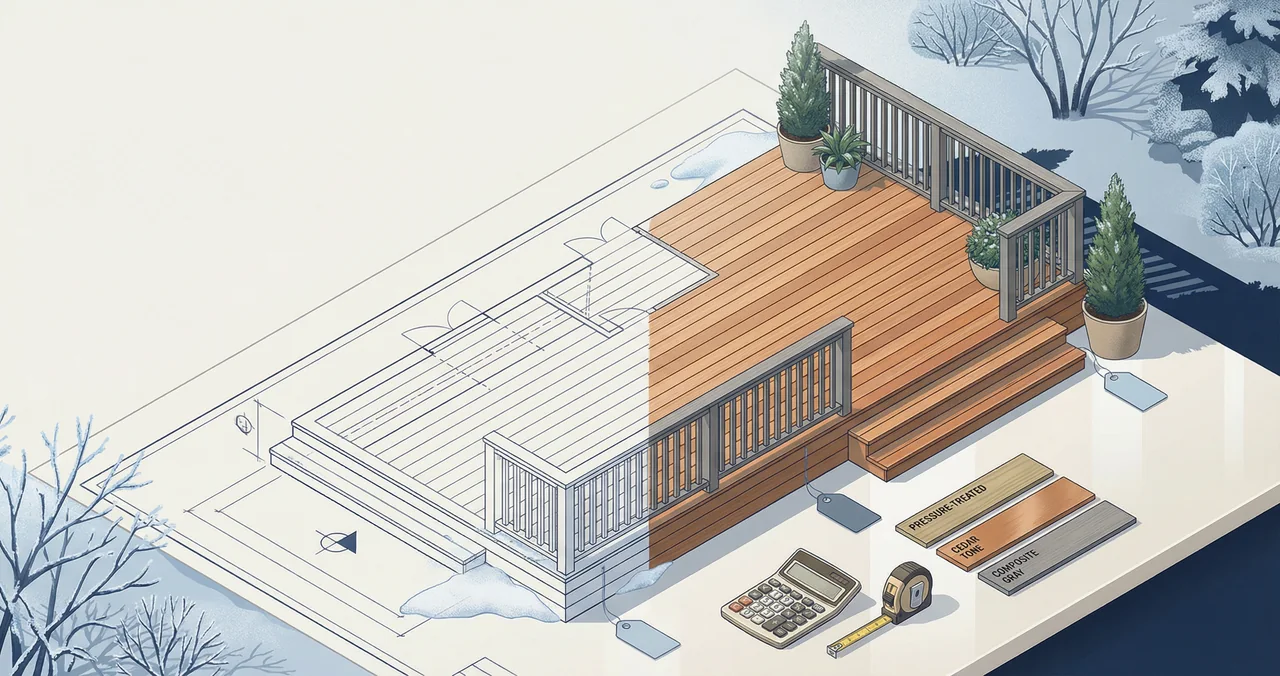
You're trying to figure out what a deck actually costs in Halifax — not a national average, not a vague range, but what contractors in HRM are charging right now. Fair enough. Between material prices, Halifax's short building season, and the reality of building on Nova Scotia's rocky terrain, the numbers here don't always match what you'll find on generic cost calculators.
Here's what Halifax homeowners are actually paying in 2026, broken down by material, size, and scope.
🧮 Tool Alert: Deck Cost Calculator
Estimate your project costs in seconds based on local pricing bands for your area.
Calculate My Cost →Average Deck Cost in Halifax by Material
The biggest factor in your total cost is the decking material you choose. These are installed prices — materials plus labor — based on what Halifax-area contractors are quoting in 2026.
🏗️ Planning a deck project?
Get a free manual project review, or visualize your dream deck with AI before requesting quotes.
| Material | Installed Cost (CAD/sq ft) | 12x16 Deck (192 sq ft) | 16x20 Deck (320 sq ft) |
|---|---|---|---|
| Pressure-Treated Wood | $30–$55 | $5,760–$10,560 | $9,600–$17,600 |
| Cedar | $40–$65 | $7,680–$12,480 | $12,800–$20,800 |
| Composite | $50–$85 | $9,600–$16,320 | $16,000–$27,200 |
| Trex (brand-name composite) | $55–$90 | $10,560–$17,280 | $17,600–$28,800 |
| Ipe (tropical hardwood) | $70–$120 | $13,440–$23,040 | $22,400–$38,400 |
A few things to note. The low end of each range typically assumes a straightforward, ground-level deck with basic railing. The high end reflects elevated builds, complex layouts, premium railing systems, or builds in areas with difficult access — think sloped backyards in Purcell's Cove or tight lots in the North End.
Most Halifax homeowners building a mid-sized deck (roughly 300 sq ft) land somewhere between $15,000 and $28,000 CAD depending on material choice and complexity.
Cost Per Square Foot Breakdown
When contractors quote you a per-square-foot price, that number usually bundles materials and labor together. But it helps to understand what's actually inside that number.
Materials Only (CAD/sq ft)
- Pressure-treated lumber: $8–$18
- Cedar decking: $14–$25
- Composite boards: $20–$38
- Trex decking: $24–$42
- Ipe: $35–$55
Labor Only (CAD/sq ft)
- Basic ground-level deck: $18–$30
- Elevated deck (4+ feet): $25–$40
- Multi-level or custom design: $30–$50+
The rest of your per-square-foot cost comes from substructure (joists, beams, posts, footings), fasteners, railing, and finishing details like stairs, skirting, or built-in benches.
For a real-world comparison of how deck size affects your total budget, check out our 12x16 deck cost breakdown or the 16x20 deck cost guide — the material ratios are similar even though those focus on Ontario pricing.
Labor Costs in Halifax
Labor is where Halifax pricing starts to diverge from national averages. Here's why:
The building season is compressed. Realistically, most deck construction happens between May and October. That's six months — and the prime window is even shorter. Contractors are booking solid from May through September, which means demand outpaces supply during peak season.
Expect to pay $18–$50 per square foot for labor alone, depending on:
- Deck height: Ground-level is cheapest. Once you're more than 4 feet off the ground, structural requirements increase and so does the labor bill.
- Site access: If materials can't be delivered close to the build site — common in older Halifax neighborhoods like the South End or along the harbour — expect a premium.
- Footing complexity: Halifax's frost line sits between 36 and 60 inches depending on your specific location. Digging footings to that depth, especially through rocky ground (which is half of HRM), takes time and sometimes specialized equipment.
- Permits and inspections: More on this below, but the inspection process can add scheduling delays that affect labor timelines.
Pro tip: If you want the best pricing and the contractor of your choice, book by March. By April, most reputable Halifax deck builders have their summer schedules locked.
What Affects Your Total Price
Material and labor are the big two, but several other factors can push your Halifax deck cost up (or occasionally down).
Deck Size and Layout
Straightforward math — more square footage costs more. But shape matters too. A simple rectangle is the most cost-effective layout. Add angles, curves, multiple levels, or wraparound designs and you're adding 15–30% to both materials and labor.
If you're considering a larger build, our 20x20 deck cost guide breaks down how costs scale with size.
Height and Structural Requirements
A deck attached to a walkout basement at ground level is a very different project than a second-storey deck overlooking Bedford Basin. Elevated decks need:
- Larger posts and beams
- Deeper, more robust footings
- Code-compliant guardrails (minimum 42 inches in Nova Scotia)
- Potentially engineered drawings
This can add $3,000–$10,000+ to your project compared to a ground-level build of the same footprint.
Railing and Stairs
Railing is one of those line items that surprises people. Basic pressure-treated wood railing might run $30–$60 per linear foot installed. Upgrade to aluminum, glass, or cable railing and you're looking at $80–$200+ per linear foot.
Stairs add $75–$200 per step depending on material and width.
Permits in Halifax
In Halifax, deck permits are typically required for structures over 24 inches above grade or over 100 square feet — though specifics can vary by municipality within HRM. Contact Halifax's Building Department before you start. Permit fees generally run $100–$400 depending on scope, and the process adds 2–4 weeks to your timeline.
Skipping permits to save money is a bad idea. It can cause problems when you sell your home, void your insurance coverage, and result in fines if the municipality catches it.
Foundation and Soil Conditions
Halifax is famously rocky. If your yard sits on bedrock or heavy clay, footing installation gets more expensive. Some contractors use helical piles instead of traditional concrete footings — these screw into the ground and work well in difficult soil. They cost more upfront ($150–$300 per pile) but save on excavation time.
Composite vs Wood: Cost Comparison
This is the decision most Halifax homeowners wrestle with. Here's an honest breakdown.
Upfront Cost
Wood wins on day one. A 300 sq ft pressure-treated deck runs roughly $9,000–$16,500 installed, while the same deck in composite costs $15,000–$25,500. That's a significant gap.
Cedar splits the difference at $12,000–$19,500 for the same size.
Maintenance Cost Over 10 Years
Here's where the math shifts. Pressure-treated wood in Halifax needs:
- Annual power washing: $150–$300 (DIY) or $300–$500 (professional)
- Staining/sealing every 1–2 years: $400–$800 per application
- Board replacement (expect some warping, cracking, and rot): $200–$600 over a decade
That's roughly $4,000–$8,000 in maintenance over 10 years. Halifax's freeze-thaw cycles, ocean moisture, and salt air are particularly hard on untreated and under-maintained wood.
Composite decking? Occasional cleaning with soap and water. That's it. Virtually zero maintenance cost.
Total Cost of Ownership (10 Years, 300 sq ft deck)
| Pressure-Treated | Cedar | Composite | |
|---|---|---|---|
| Install cost | $9,000–$16,500 | $12,000–$19,500 | $15,000–$25,500 |
| 10-year maintenance | $4,000–$8,000 | $3,000–$6,000 | $0–$500 |
| Total | $13,000–$24,500 | $15,000–$25,500 | $15,000–$26,000 |
Over a decade, composite and pressure-treated end up costing roughly the same — but composite looks better at year 10 and requires almost none of your time or effort.
For Halifax specifically, composite and PVC decking hold up best against the climate. Wood can absolutely work, but only if you commit to annual sealing and stay on top of moisture damage. The salt air near the harbour and Dartmouth waterfront accelerates wood deterioration noticeably.
Use PaperPlan to visualize different decking materials on your own home before committing — it's a helpful way to see how composite vs wood actually looks against your siding and landscaping.
How to Save Money on Your Halifax Deck
You don't have to blow your budget. Here are practical ways Halifax homeowners reduce costs without compromising quality.
1. Build in the Off-Season
Some contractors offer 10–15% discounts for fall builds (late September through November) when their schedules open up. The trade-off is weather risk and a tighter completion window — but if your project is straightforward, it's worth asking about.
2. Choose Pressure-Treated for Low-Visibility Areas
Use composite or cedar for the deck surface and railings — the parts you see and touch — and pressure-treated lumber for the substructure (joists, beams, posts). This is standard practice and saves money without sacrificing durability where it counts.
3. Keep the Design Simple
A rectangular deck with a single level and standard railing is the most cost-efficient design. Every angle, bump-out, and custom feature adds cost. If budget is tight, go bigger and simpler rather than smaller and complex. You'll get more usable space for your dollar.
4. Get Multiple Quotes — But Compare Apples to Apples
Get at least three quotes from Halifax-area contractors. But make sure each quote covers the same scope: same materials, same size, same railing, same footing type. The cheapest quote isn't always the best value — check reviews, ask for references, and confirm they're licensed and insured.
If you're looking at affordable deck builders in Halifax, we've put together a guide to help you find reputable contractors without overpaying.
5. Do Some Prep Work Yourself
Clearing the build site, removing an old deck, or handling landscaping around the deck area can save you $500–$1,500 in labor. Just don't touch anything structural — that's where mistakes get expensive.
6. Consider a Smaller Footprint with Better Materials
A 200 sq ft composite deck often costs the same as a 300 sq ft pressure-treated deck — and you'll spend far less on maintenance over the years. Sometimes less space in a better material is the smarter investment, especially if you're planning to stay in the home long-term.
For homeowners in nearby cities dealing with similar climate challenges, our guides on deck costs in Vancouver and deck costs in Surrey offer useful comparison points for composite vs wood pricing.
🎨 Not sure which material to pick?
Upload a photo of your backyard and see exactly how Trex, TimberTech, or cedar would look — free and instant.
Frequently Asked Questions
How much does a 12x12 deck cost in Halifax?
A basic 12x12 (144 sq ft) pressure-treated deck in Halifax typically costs $4,300–$7,900 installed. In composite, expect $7,200–$12,200. These ranges assume a ground-level build with standard railing. Add stairs, elevation, or premium railing and the price goes up accordingly.
Do I need a permit to build a deck in Halifax?
Most likely, yes. In Halifax, permits are generally required for decks over 24 inches above grade or exceeding 100 square feet. Requirements vary slightly across HRM municipalities, so contact Halifax's Building Department before starting your project. Budget $100–$400 for permit fees and 2–4 weeks for processing.
What is the best decking material for Halifax's climate?
Composite and PVC decking perform best in Halifax's harsh winters. The freeze-thaw cycles, snow load, and salt-laden ocean air are tough on wood. Pressure-treated lumber can work well if you commit to annual sealing and staining, but composite requires virtually no maintenance and won't rot, warp, or splinter. For most Halifax homeowners, the slightly higher upfront cost of composite pays off within 5–7 years through maintenance savings alone.
When is the best time to build a deck in Halifax?
The ideal building window runs from May through October, with June through September being peak season. For the best contractor availability and pricing, start getting quotes in January or February and book your project by March. Waiting until spring often means you're competing with everyone else for limited contractor slots — and you may not get your deck built until late summer or fall.
How deep do deck footings need to be in Halifax?
Halifax's frost line ranges from 36 to 60 inches depending on your specific location within HRM. Your footings must extend below the frost line to prevent frost heave — a real and common problem in Nova Scotia where freezing ground can literally push your deck posts upward, causing structural shifting and damage. Your contractor and building inspector will determine the exact depth required for your property. Helical piles are an increasingly popular alternative to traditional poured footings, especially on Halifax's rocky terrain.
📋 Planning a deck project?
Get a free manual project review from our team — no obligation, no spam.
Get Free Project Review →Upload a backyard photo and preview real decking materials with AI — free, instant, no sign-up.
Permits, costs, material comparisons, and questions to ask before requesting quotes — delivered to your inbox.