
Deck Cost in Winnipeg (2026)
What does a deck cost in Winnipeg in 2026? Get real CAD pricing per square foot for composite, wood, and Trex decks — plus tips to save on your build.
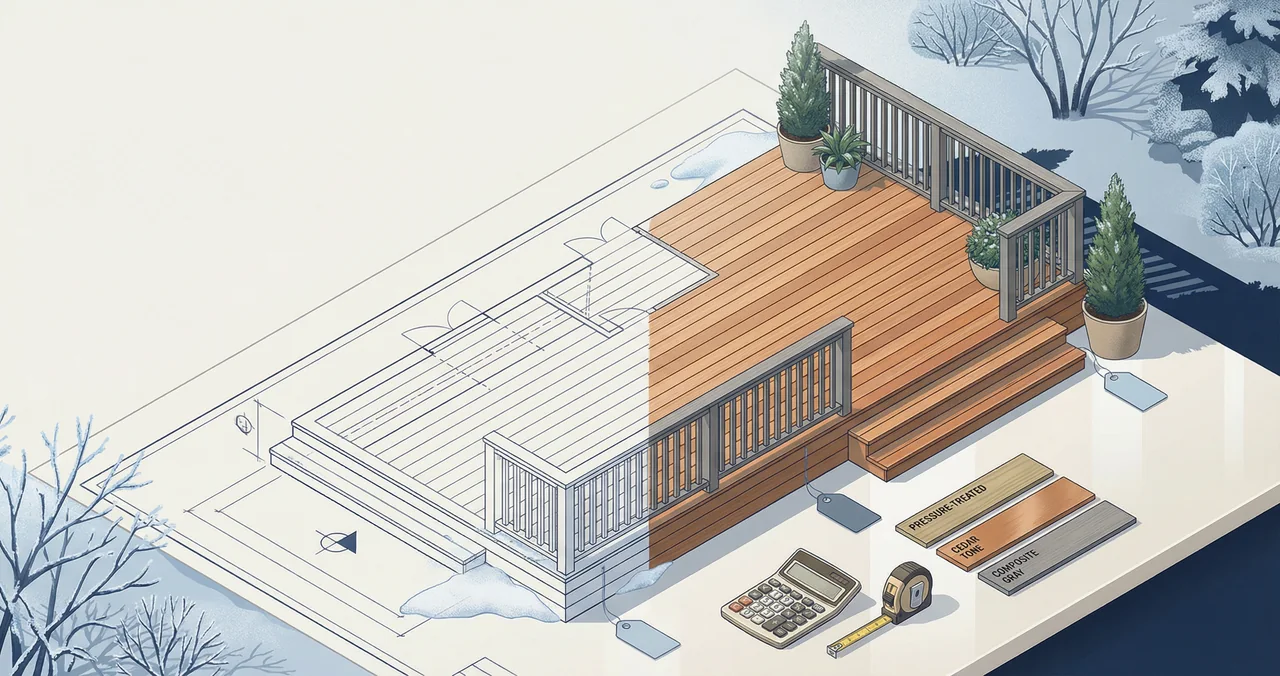
A new deck in Winnipeg runs anywhere from $9,000 to $35,000+ depending on size, material, and complexity. That's a wide range, and it's not particularly helpful on its own. What you really need to know is how those numbers break down — what you're paying for materials versus labour, which decking holds up to Manitoba winters, and where you can trim costs without cutting corners.
Here's what Winnipeg homeowners are actually paying in 2026.
🧮 Tool Alert: Deck Cost Calculator
Estimate your project costs in seconds based on local pricing bands for your area.
Calculate My Cost →For a broader look at deck pricing across different materials and regions, see our complete deck cost guide. Timing your build right can also save thousands — check our guide on the best time to build a deck.
Average Deck Cost in Winnipeg by Material
Material choice is the single biggest factor in your final price. Below are installed costs — meaning materials, labour, footings, and basic railing — for a standard deck in Winnipeg as of early 2026.
🏗️ Planning a deck project?
Get a free manual project review, or visualize your dream deck with AI before requesting quotes.
| Material | Installed Cost (CAD/sq ft) | 300 sq ft Deck Total |
|---|---|---|
| Pressure-treated wood | $30–$55 | $9,000–$16,500 |
| Cedar | $40–$65 | $12,000–$19,500 |
| Composite (mid-range) | $50–$85 | $15,000–$25,500 |
| Trex (premium composite) | $55–$90 | $16,500–$27,000 |
| Ipe (hardwood) | $70–$120 | $21,000–$36,000 |
These ranges reflect Winnipeg's market specifically. Prices here tend to run slightly higher than national averages because of the shorter building season (May through October) and the additional foundation work Manitoba's frost line demands.
A few things worth noting:
- Pressure-treated lumber is the most affordable upfront, but factor in annual staining and sealing — Winnipeg's freeze-thaw cycles punish untreated wood
- Composite and Trex cost more initially but require almost zero maintenance, which matters when your deck sits under snow for five months
- Ipe is stunning and nearly indestructible, but the price reflects it — most Winnipeg homeowners find composite delivers better value for the climate
If you're comparing brands, our guide to the best composite decking in Canada covers the top options available through Manitoba suppliers.
Cost Per Square Foot Breakdown
Understanding where your money goes helps you make smarter trade-offs. Here's how a typical composite deck at $65/sq ft breaks down in Winnipeg:
| Cost Component | Approximate % | Per Sq Ft (CAD) |
|---|---|---|
| Decking boards | 30–35% | $19–$23 |
| Substructure (joists, beams, hardware) | 15–18% | $10–$12 |
| Footings & foundation | 12–15% | $8–$10 |
| Railings & stairs | 10–15% | $7–$10 |
| Labour | 25–30% | $16–$20 |
Footings are a bigger line item in Winnipeg than in milder climates. Manitoba's frost line sits between 36 and 60 inches deep depending on your specific area. That means deeper holes, more concrete, and more labour to get your deck's foundation below the freeze line. Skimping here is how you end up with a deck that heaves and shifts after a few winters.
For larger projects, check our breakdowns for 12x16 decks and 16x20 decks to see how size affects per-square-foot pricing — the math scales similarly for Manitoba builds.
Labour Costs in Winnipeg
Labour accounts for roughly $15–$25 per square foot in Winnipeg, or about 25–35% of your total project cost. That's for a qualified crew — not a handyman with a circular saw.
Here's what drives labour pricing in this market:
- Seasonal demand. Winnipeg contractors have roughly five solid building months. By April, the good crews are booked into July. If you wait until June to call, you'll either pay a premium or wait until fall.
- Foundation complexity. Drilling or digging footings to 48–60 inches takes real equipment and time. Crews working in River Heights or Wolseley often deal with mature tree roots and older lot grading that adds hours to footing work.
- Permit and inspection coordination. Licensed builders handle the permit process (more on that below), but inspection scheduling adds to the timeline and overhead.
The single best way to keep labour costs reasonable: book your contractor by March. Get quotes in January or February while crews are still planning their season. You'll have more negotiating room and better scheduling options.
A straightforward 300 sq ft deck typically takes 3–5 days for an experienced crew. Multi-level decks, complex angles, or built-in features like benches and planters push that to 7–10 days.
What Affects Your Total Price
Beyond material and labour, several factors can push your Winnipeg deck cost up — or keep it in check.
Deck Size and Layout
Simple rectangle? Most affordable. L-shaped, multi-level, or wraparound? Each angle and elevation change adds framing complexity and labour time. A two-tier deck typically costs 15–25% more than a single-level deck of the same total square footage.
Height Off the Ground
A ground-level deck on a slab or shallow footings is the cheapest to build. Once your deck is more than 24 inches above grade, you need railings (code requirement), deeper footings, and potentially stairs — each adding $1,500–$5,000 to the project.
Railings and Stairs
Basic pressure-treated wood railings run $15–$30 per linear foot. Aluminum or glass railings jump to $40–$80+ per linear foot. Stairs cost $75–$200 per step depending on width and material. For a breakdown of what's available, see our guide to the best deck railing systems in Canada.
Permits in Winnipeg
In Winnipeg, deck permits are typically required for structures over 24 inches above grade or exceeding 100 square feet. Permit fees generally run $150–$400 depending on project scope. Contact the City of Winnipeg's Building Department for your specific requirements — rules can vary, and building without a permit creates real problems at resale. Our post on the risks of building without a permit covers why this matters.
Site Conditions
Sloped yards in areas like Charleswood or South Pointe need additional grading or retaining work. Mature trees in Crescentwood or Old St. Vital may require root-sensitive footing placement. Difficult access — think narrow side yards or rear lots backing onto lanes — can add $500–$2,000 for material delivery and equipment logistics.
Snow Load and Structural Requirements
Manitoba building code accounts for significant snow loads. Your deck's substructure needs to handle the weight of heavy, wet spring snow — which in Winnipeg can mean 40–60 pounds per square foot of load on horizontal surfaces. This often means closer joist spacing and heavier beams compared to decks in milder provinces.
Composite vs Wood: Cost Comparison
This is the decision most Winnipeg homeowners wrestle with. Here's how the two options stack up over time.
| Factor | Pressure-Treated Wood | Composite |
|---|---|---|
| Installed cost (per sq ft) | $30–$55 | $50–$85 |
| Annual maintenance | $1.50–$3.00/sq ft (stain + seal) | Near zero |
| Lifespan | 15–20 years | 25–30+ years |
| 10-year total cost (300 sq ft) | $13,500–$25,500 | $15,000–$25,500 |
| Warranty | None typical | 25–50 years |
| Freeze-thaw resistance | Moderate (requires sealing) | Excellent |
The numbers tell a clear story. Over 10 years, composite and pressure-treated wood end up costing about the same — but composite gets there without you spending weekends sanding and staining.
In Winnipeg specifically, this calculation tips even further toward composite. Here's why:
- Freeze-thaw cycles are brutal on wood. Water seeps into grain, freezes, expands, and splits the fibres. This happens dozens of times per season in Manitoba.
- Road salt and calcium chloride tracked onto your deck accelerate wood deterioration. Composite resists this.
- Snow sitting on the surface for months means extended moisture contact — exactly what destroys untreated or poorly sealed wood.
If you do choose wood, cedar outperforms pressure-treated in this climate thanks to its natural resistance to moisture and insects. But it still needs annual attention. Our roundup of the best deck sealers applies to Manitoba homeowners too — the products work the same way in cold climates.
For homeowners who want the wood look without the maintenance, today's composite boards are remarkably realistic. Use PaperPlan to visualize different decking materials on your own home before committing — it's easier to justify the composite price tag when you can see exactly how it'll look.
How to Save Money on Your Winnipeg Deck
You don't have to build the cheapest deck possible to get good value. Smart choices save thousands without sacrificing quality.
Choose a Simple Layout
A basic rectangle maximizes usable space per dollar. Every angle, curve, and level change costs extra in framing, cutting, and labour. A 14x20 rectangle gives you 280 sq ft of usable space for significantly less than an L-shaped deck of the same area.
Build During Shoulder Season
Late September and October are your best bet for savings. Crews are looking to fill their schedules before winter, and you may find 5–15% lower quotes compared to peak summer pricing. The weather is usually still workable in Winnipeg through mid-October.
Get Multiple Quotes — But Get Them Early
Three quotes minimum. Five is better. But start this process in January or February. By the time snow melts, the best contractors are booked. Early planning also gives you time to compare without pressure.
Consider a Hybrid Approach
Use composite for the deck surface (where you'll see and feel it daily) and pressure-treated wood for the substructure (where it's hidden and protected). This is standard practice and saves 10–15% versus an all-composite build.
Skip the Extras — For Now
Built-in benches, pergolas, and outdoor kitchens are nice but expensive. Build your deck with a solid foundation and clean design first. You can always add features in year two or three when budget allows. Just make sure your substructure is engineered to support future additions.
Do Your Own Demolition
If you're replacing an old deck, tearing it out yourself saves $500–$2,000 in labour. It's hard work but doesn't require specialized skills. Rent a dumpster, grab a pry bar, and set aside a weekend.
For more ideas on managing your backyard budget, our guide on backyard landscaping costs covers the bigger picture of outdoor renovation spending.
🎨 Not sure which material to pick?
Upload a photo of your backyard and see exactly how Trex, TimberTech, or cedar would look — free and instant.
Frequently Asked Questions
How much does a 12x12 deck cost in Winnipeg?
A 12x12 deck (144 sq ft) in Winnipeg costs between $4,300 and $7,900 for pressure-treated wood or $7,200 and $12,200 for composite, fully installed. These figures include footings, basic railings, and labour. Smaller decks have a higher per-square-foot cost because the fixed costs (permits, mobilization, footings) are spread over fewer square feet.
What is the best decking material for Winnipeg winters?
Composite and PVC decking handle Winnipeg's climate best. They resist freeze-thaw damage, don't absorb moisture, and won't split or crack from ice expansion. If you prefer real wood, cedar is your best option — but plan on sealing it every spring. Pressure-treated wood works on a budget but demands the most maintenance in cold climates. Our guide to the best materials for freeze-thaw climates goes deeper on this topic.
Do I need a permit to build a deck in Winnipeg?
Most likely, yes. Winnipeg requires building permits for decks over 24 inches above grade or larger than 100 square feet. Even if your deck falls below these thresholds, it's worth confirming with the City of Winnipeg's Building Department. Permit fees are minor compared to the cost of removing or modifying an unpermitted structure during a home sale.
When is the best time to build a deck in Winnipeg?
The building season runs May through October, but the best time to start planning is winter. Get quotes in January or February, book your contractor by March, and aim for a May or early June start date. This gives you the full summer to enjoy your new deck. Fall builds (September–October) can save money but risk weather delays.
How long does a deck last in Winnipeg?
With proper construction and maintenance: pressure-treated wood lasts 15–20 years, cedar lasts 15–25 years, and composite lasts 25–30+ years. The key variable in Manitoba is maintenance. A wood deck that's stained and sealed annually will far outlast one that's neglected. Composite eliminates this variable entirely — it holds up through decades of Winnipeg winters with nothing more than occasional cleaning. Check out our low-maintenance decking guide for the top options available in Canada.
📋 Planning a deck project?
Get a free manual project review from our team — no obligation, no spam.
Get Free Project Review →Upload a backyard photo and preview real decking materials with AI — free, instant, no sign-up.
Permits, costs, material comparisons, and questions to ask before requesting quotes — delivered to your inbox.