
Deck Permits in Winnipeg (2026)
Need a deck permit in Winnipeg? Learn when permits are required, current fees, building codes, setback rules, and how to apply for your 2026 deck project.
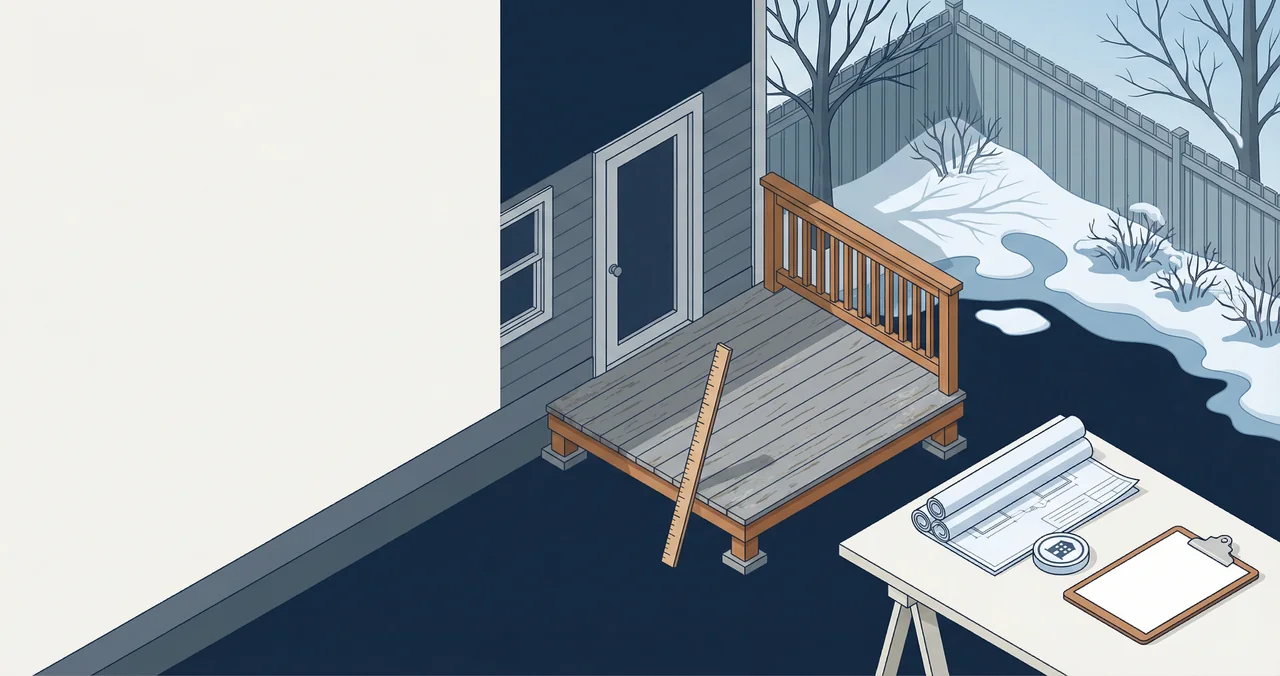
Planning a new deck in Winnipeg? Before you pick materials or call a contractor, there's one question you need to answer first: do you need a building permit?
The short answer for most Winnipeg homeowners — yes, you probably do. The City of Winnipeg requires permits for the majority of residential deck projects, and skipping this step can cost you far more than the permit itself. Here's everything you need to know to get your permit sorted and your project started right.
📋 Tool Alert: Permit Checker
Do you really need a permit? Check the exact rules for your city or township.
Check Permits →Do You Need a Deck Permit in Winnipeg?
In Winnipeg, you need a building permit for any deck that is:
🏗️ Planning a deck project?
Get a free manual project review, or visualize your dream deck with AI before requesting quotes.
- More than 24 inches (600 mm) above adjacent grade, or
- Over 100 square feet (9.3 m²) in area, or
- Attached to your house
If your deck meets any of these thresholds, a permit is required. Since most functional backyard decks exceed 100 square feet and many are attached to the home, the vast majority of Winnipeg deck projects need a permit.
When You Might Not Need a Permit
A small number of deck projects are exempt. You may be able to skip the permit if your deck is:
- Freestanding (not attached to the house)
- Under 24 inches above grade at all points
- Under 100 square feet in total area
Even then, your deck still has to comply with all applicable building codes and zoning bylaws — including setback requirements. "No permit needed" doesn't mean "no rules apply."
If you're on the fence, call the City of Winnipeg's Plan Examination Branch at (204) 986-5140. A quick phone call can save you from a costly mistake.
When a Permit Is Required
Beyond the basic thresholds above, here are specific scenarios where Winnipeg homeowners commonly need a deck permit:
- Raised decks for walkout basements or sloped lots (common in areas like Charleswood, Linden Woods, and River Heights)
- Multi-level or tiered decks — even if one level is under 24 inches, the overall structure usually triggers permit requirements
- Decks with roofed structures like pergolas or gazebos attached to them
- Hot tub decks — the added structural load means engineering and permitting requirements
- Decks that encroach on setback zones — these may need a variance in addition to a permit
Attached vs. Freestanding Decks
Attached decks connect to your home's structure through a ledger board, which creates a direct structural relationship with your house. This is why Winnipeg treats them more strictly from a permitting standpoint.
Freestanding decks sit on their own post-and-footing system. They're simpler to permit — and in some cases exempt — but they still need to meet code for footings, railings, and setbacks. If you're weighing the two approaches, our guide on attached vs. freestanding deck permits covers the key differences.
Permit Fees & Processing Time
Current Winnipeg Deck Permit Fees (2026)
Winnipeg's building permit fees are based on the estimated construction value of your project. The current fee structure:
| Project Value | Permit Fee |
|---|---|
| Up to $5,000 | ~$80–$120 |
| $5,000–$15,000 | ~$120–$250 |
| $15,000–$30,000 | ~$250–$400 |
| Over $30,000 | Calculated as a percentage of project value |
For a typical 12x16 pressure-treated deck (192 sq ft) valued around $6,000–$10,500 CAD in materials and labour, expect to pay roughly $120–$200 for your permit. A composite deck of the same size at $9,600–$16,300 CAD will land in the $150–$300 range.
These fees change periodically, so confirm the current rates with the City of Winnipeg's Planning, Property and Development department.
How Long Does It Take?
- Standard residential deck permits: 10–20 business days for review
- Simple projects with complete applications: Sometimes faster, especially outside peak season
- Complex projects (variances, engineered designs, proximity to lot lines): 4–8 weeks or longer
Pro tip: Submit your application in February or March. Winnipeg's building season is short — realistically May through October — and contractor schedules fill up fast. Getting your permit early means you're ready to build when the frost finally breaks.
Building Codes & Setback Rules
Winnipeg follows the Manitoba Building Code, which is based on the National Building Code of Canada. Here are the key requirements for residential decks:
Structural Requirements
- Footings must extend below the frost line — in Winnipeg, that means at least 48 inches (4 feet) deep, though some areas require up to 60 inches depending on soil conditions. This is non-negotiable. Winnipeg's freeze-thaw cycles will heave shallow footings right out of the ground.
- Post sizes: Minimum 4x4 for low decks, 6x6 recommended for any deck over 4 feet above grade
- Beam and joist sizing must meet span tables in the building code based on species, grade, and spacing
- Ledger board connections (for attached decks) require lag bolts or through-bolts with proper flashing to prevent water infiltration
Railing Requirements
- Railings are mandatory on any deck surface more than 24 inches (600 mm) above grade
- Minimum railing height: 36 inches for residential (42 inches if the deck is more than 6 feet above grade)
- Baluster spacing: Maximum 4 inches (100 mm) between balusters — a 4-inch sphere cannot pass through
- Railings must resist a specified lateral load (typically 0.5 kN/m minimum)
For railing options that meet Canadian code, check out our guide on the best deck railing systems in Canada.
Setback Rules
Winnipeg's zoning bylaws dictate how close your deck can sit to your property lines:
- Rear yard setback: Typically 25% of lot depth or a minimum specified distance (varies by zoning district — R1, R2, etc.)
- Side yard setback: Usually 1.2 metres (about 4 feet) minimum, but depends on your zoning classification
- Decks may project into required rear yards by a limited amount (often up to 2 metres) — but this varies by district
Your specific setbacks depend on your lot's zoning designation. Check your property's zoning at the City of Winnipeg's online property assessment tool or call Planning, Property and Development.
Snow Load and Climate Considerations
Winnipeg's climate puts unique demands on deck structures:
- Ground snow load in Winnipeg is approximately 1.8 kPa — your deck's structural design must account for this
- Freeze-thaw cycles (Winnipeg averages 30+ per winter) punish shallow footings and trapped moisture
- Ice dam potential where decks meet the house wall — proper flashing and drainage are critical
- All lumber in contact with the ground or within 150 mm of grade must be pressure-treated to UC4A or higher
Material choice matters here. Composite and PVC decking hold up best against Winnipeg winters — wood decks need annual sealing to survive the moisture and road salt tracked onto surfaces. If you're leaning toward composite, our review of the best composite decking brands in Canada breaks down what performs best in cold climates.
How to Apply for a Deck Permit in Winnipeg
Step 1: Gather Your Documents
Before applying, you'll need:
- Site plan showing your property boundaries, the house footprint, and the proposed deck location with dimensions and distances to all property lines
- Construction drawings including a plan view, elevation/cross-section, and footing details
- Structural details — beam sizes, joist spacing, post sizes, footing dimensions and depth
- Material specifications — decking type, lumber species and grade, fastener types
- Property legal description (lot, block, plan numbers — found on your tax assessment)
Your drawings don't need to be architect-produced, but they must be clear, to scale, and include all required dimensions. Many Winnipeg contractors will prepare permit drawings as part of their quote.
Step 2: Submit Your Application
You can apply through:
- Online: The City of Winnipeg offers electronic permit applications through their eDevelopment portal
- In person: Planning, Property and Development offices at 65 Garry Street, Winnipeg
- By mail: Less common but accepted
The application form requires your personal information, property details, project description, estimated construction value, and contractor information (if applicable).
Step 3: Pay Fees and Wait for Review
Fees are paid at the time of application. The plan examiner will review your submission for code compliance. You may receive:
- Approval as submitted — you're good to build
- Conditional approval — minor corrections needed
- Revision required — significant changes needed before approval
Step 4: Schedule Inspections
Once approved, your permit will specify required inspections. Typical inspection points for a deck:
- Footing inspection — before pouring concrete (inspector verifies depth and diameter)
- Framing inspection — after framing is complete but before decking is installed
- Final inspection — completed deck, including railings and stairs
Don't skip inspections. Each one must be passed before moving to the next stage. Call (204) 986-5140 to schedule inspections at least 48 hours in advance.
Step 5: Get Your Final Approval
After passing the final inspection, you'll receive a completion certificate. Keep this document — you'll need it if you ever sell your home or refinance.
Use PaperPlan to visualize different decking materials on your own home before committing — it's especially helpful when you're deciding between pressure-treated wood, composite, or cedar and want to see how each looks against your siding and yard.
What Happens If You Build Without a Permit
Building a deck without a required permit in Winnipeg isn't just risky — it's expensive when it catches up with you. And it almost always catches up.
Immediate Consequences
- Stop-work orders: The City can halt your project mid-build
- Fines: Winnipeg can impose penalties for unpermitted construction — these can run into the thousands of dollars
- Retroactive permit fees: You'll pay the regular permit fee plus additional penalties (often double the original fee)
Long-Term Problems
- Insurance issues: Your homeowner's insurance may deny claims for injuries or damage related to an unpermitted structure
- Sale complications: Home inspectors and buyers' lawyers flag unpermitted work. You may be forced to obtain a retroactive permit, pay for a professional engineer's assessment, or even demolish the deck before closing
- Property tax reassessment: Unpermitted structures discovered during assessment can trigger back-taxes
Winnipeg's building without a permit risks are similar across Canadian cities, but enforcement in Winnipeg has become more proactive in recent years. Neighbours report unpermitted work, and bylaw officers follow up.
The Bottom Line
A permit for a typical deck costs $120–$300. Tearing down and rebuilding an unpermitted deck costs $5,000–$15,000+. The math is simple.
What Does a Deck Actually Cost in Winnipeg?
Since you're already planning your permit, here's what Winnipeg homeowners are paying for deck installation in 2026:
| Material | Installed Cost (CAD/sq ft) | 200 sq ft Deck Total |
|---|---|---|
| Pressure-treated wood | $30–$55 | $6,000–$11,000 |
| Cedar | $40–$65 | $8,000–$13,000 |
| Composite | $50–$85 | $10,000–$17,000 |
| Trex (composite) | $55–$90 | $11,000–$18,000 |
| Ipe (hardwood) | $70–$120 | $14,000–$24,000 |
These prices include materials, labour, footings, framing, and basic railing. Complex designs, multi-level layouts, or built-in features like benches and planters add to the total. For a deeper cost breakdown, see our guide on what a 12x16 deck costs.
Winnipeg's shorter building season (roughly May to October) means demand is compressed. Book your contractor by March to lock in your preferred start date and avoid premium pricing during peak summer months.
🎨 Not sure which material to pick?
Upload a photo of your backyard and see exactly how Trex, TimberTech, or cedar would look — free and instant.
Frequently Asked Questions
How much does a deck permit cost in Winnipeg?
Most residential deck permits in Winnipeg cost between $80 and $400 CAD, depending on your project's estimated construction value. A standard backyard deck in the $8,000–$15,000 range will typically require a permit fee of $150–$300. Fees are paid at the time of application and are non-refundable.
Can I build a small deck without a permit in Winnipeg?
Possibly. If your deck is freestanding (not attached to your house), under 24 inches above grade, and under 100 square feet, you may not need a permit. However, you still must comply with all zoning setbacks and building code requirements. Confirm with the City before building — a quick call to (204) 986-5140 takes five minutes and could save you thousands.
How deep do deck footings need to be in Winnipeg?
Deck footings in Winnipeg must extend below the frost line, which is a minimum of 48 inches (4 feet) deep. Some areas with particular soil conditions may require footings up to 60 inches deep. This depth prevents frost heave from shifting your deck during Winnipeg's harsh freeze-thaw cycles. Cutting corners on footing depth is the single most common cause of deck failure in Manitoba.
How long does it take to get a deck permit approved in Winnipeg?
Plan for 10–20 business days for a standard residential deck permit. Complete, well-prepared applications move through faster. Complex projects involving variances or engineered designs can take 4–8 weeks. Submit your application in late winter to have your permit in hand when building season starts in May.
Do I need a permit to replace an existing deck in Winnipeg?
Generally, yes. If you're replacing the decking boards on an existing permitted structure without changing the footprint or structural elements, you may not need a new permit. But if you're replacing the entire deck — footings, framing, and all — that's new construction and requires a full permit. Changing the size, height, or location of an existing deck also triggers a permit requirement. When in doubt, check with the City's Plan Examination Branch.
📋 Planning a deck project?
Get a free manual project review from our team — no obligation, no spam.
Get Free Project Review →Upload a backyard photo and preview real decking materials with AI — free, instant, no sign-up.
Permits, costs, material comparisons, and questions to ask before requesting quotes — delivered to your inbox.