
Deck Permits in Aurora (2026)
Need a deck permit in Aurora, CO? Learn requirements, fees, setback rules, and how to apply. Avoid fines and delays — everything Aurora homeowners need to know.
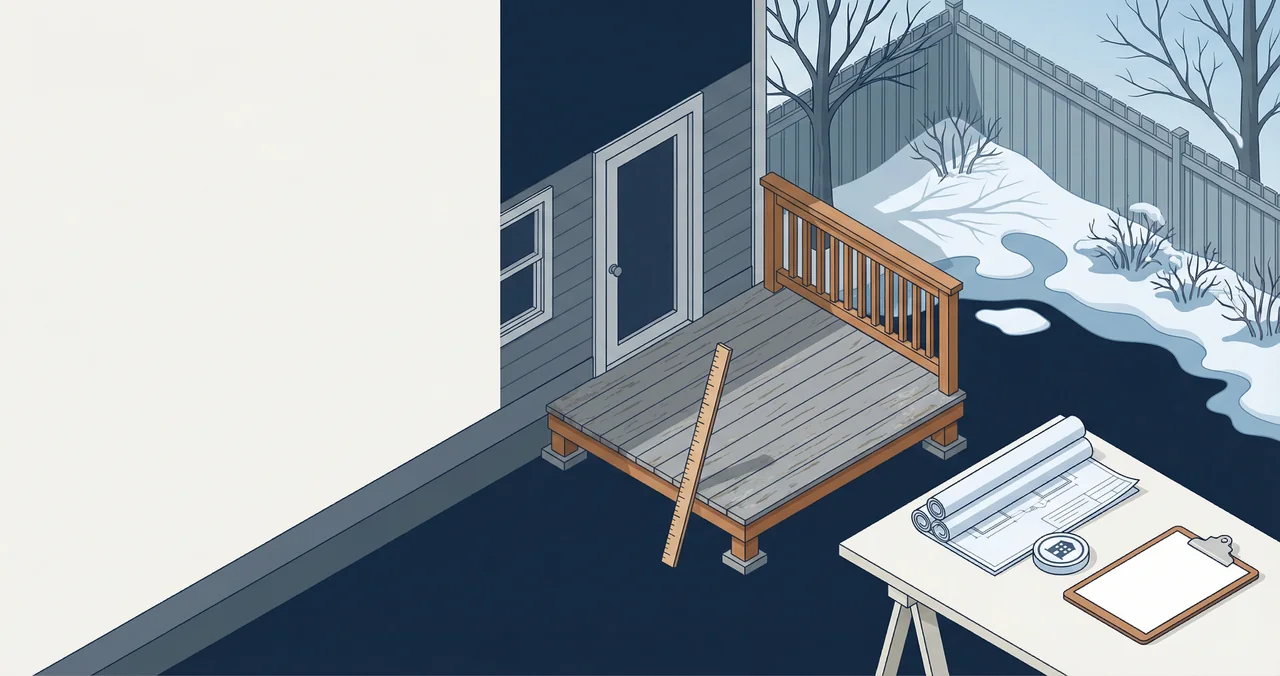
If you're planning a deck project in Aurora, Colorado, the permit question is probably one of the first things on your mind. Skip it, and you risk fines, forced removal, or a nightmare when you try to sell your home. Get it right, and the process is straightforward — just a bit of paperwork and patience.
📋 Tool Alert: Permit Checker
Do you really need a permit? Check the exact rules for your city or township.
Check Permits →Here's exactly what Aurora requires, what it costs, and how to navigate the process without headaches.
Looking for more regional information? Check out our Colorado State Decking Hub.
Do You Need a Deck Permit in Aurora?
Yes, in most cases. Aurora's Building & Development Services department requires a building permit for any deck that meets either of these thresholds:
🏗️ Planning a deck project?
Get a free manual project review, or visualize your dream deck with AI before requesting quotes.
- More than 200 square feet in total area
- More than 30 inches above grade at any point
That second rule catches a lot of homeowners off guard. Even a modest deck on a sloped yard can easily exceed 30 inches on the downhill side. Measure from the lowest point of the ground beneath your deck to the top of the deck surface — if it's over 30 inches anywhere, you need a permit.
When You Might Be Exempt
A few scenarios where you *may* not need a permit:
- Ground-level patios and platforms under 200 sq ft that sit less than 30 inches above grade
- Simple replacement of deck boards on an existing permitted structure (no structural changes)
- Minor repairs that don't alter the footprint, height, or structural members
Even if your project seems exempt, it's worth a quick call to Aurora's Building Division at (303) 739-7420 to confirm. A five-minute phone call beats a code enforcement visit.
<!-- slot:after-intro -->
When a Permit Is Required
Beyond the size and height triggers, Aurora requires permits for decks that involve:
- Attachment to the house — ledger boards connecting to your home's structure need inspection to prevent water intrusion and structural failure
- Electrical work — built-in lighting, outlets, or hot tub wiring require separate electrical permits
- Multi-level or elevated designs — any deck with stairs, multiple tiers, or significant elevation changes
- Roofed or covered portions — adding a pergola or roof structure over your deck triggers additional requirements
- Hot tub or spa support — the added weight (a filled hot tub can exceed 4,000 pounds) demands engineered footings
Aurora follows the 2021 International Residential Code (IRC) as adopted by the City, with local amendments. Your contractor should know these inside and out — if they wave off the permit conversation, that's a red flag.
Permit Fees & Processing Time
What You'll Pay
Aurora's deck permit fees are based on the valuation of the project — essentially, what the work costs. Here's what to budget:
| Project Value | Approximate Permit Fee |
|---|---|
| Under $5,000 | $75 – $150 |
| $5,000 – $15,000 | $150 – $350 |
| $15,000 – $30,000 | $350 – $550 |
| Over $30,000 | $550 – $800+ |
Additional fees may apply for:
- Plan review: Typically $50 – $150 on top of the base permit
- Re-inspection fees: $75 – $100 per visit if your work fails inspection
- Electrical permit: $50 – $120 if you're adding wiring
For a typical 300–400 sq ft composite deck, you're looking at a total project cost of $13,500–$30,000 installed. The permit fee is a tiny fraction of that investment — usually under 3%. Not worth skipping.
How Long It Takes
- Over-the-counter permits (simple projects): Same day to 3 business days
- Plan review (most deck projects): 5 – 15 business days
- Complex or large projects: 2 – 4 weeks
Aurora's building department gets slammed in spring when everyone's trying to start construction before summer. Submit your application in February or March to avoid the backlog. This also aligns with booking contractors early — Aurora's shorter building season (May through October) means best time to build a deck.
<!-- slot:mid-content -->
Building Codes & Setback Rules in Aurora
Aurora enforces specific structural and placement requirements for residential decks. Ignore these and your permit will be denied — or worse, you'll build something that fails inspection.
Structural Requirements
- Footings must extend below the frost line. In Aurora, that means a minimum of 36 inches deep, though some areas require up to 42 inches depending on soil conditions. Colorado's freeze-thaw cycles are brutal — shallow footings will heave and shift, cracking your deck's structure within a few winters.
- Post sizes: Minimum 4x4 for decks under 8 feet high; 6x6 posts recommended and often required for elevated decks
- Beam and joist sizing: Must comply with IRC span tables. Your plans need to show lumber species, grade, and dimensions for every structural member.
- Ledger board attachment: Must use ½-inch lag screws or through-bolts with proper flashing. This is the number-one failure point inspectors flag in Aurora — poor ledger connections cause decks to collapse.
- Railing height: Minimum 36 inches for residential decks. Baluster spacing cannot exceed 4 inches (the "4-inch sphere rule").
- Snow load rating: Aurora decks must be designed for a ground snow load of 30 PSF (pounds per square foot) minimum. Your engineer or contractor should account for this in joist spacing and beam sizing.
Setback Requirements
Aurora's zoning code dictates how close your deck can sit to property lines:
- Rear setback: Typically 10 – 15 feet from the rear property line (varies by zoning district)
- Side setback: Usually 5 feet minimum from side property lines
- Easements: Your deck cannot encroach on any utility or drainage easements — check your property plat before designing
Important: Setbacks are measured from the outermost edge of the deck, including stairs and landings — not from the posts. A staircase that extends 4 feet past your deck edge eats into your setback.
If your property backs onto open space or an HOA common area, you may face additional restrictions. Many Aurora neighborhoods — Saddle Rock, Southshore, Tallyn's Reach — have HOA design review boards that impose their own rules on top of city requirements. Get HOA approval *before* you apply for the city permit.
Climate-Specific Code Considerations
Aurora's climate demands extra attention to a few areas:
- Frost heave protection: Footings poured above the frost line will shift. Tube-form footings (Sonotubes) extending 36+ inches deep are standard practice.
- Drainage: Grade the area beneath your deck to slope away from your foundation at ¼ inch per foot minimum. Standing water under a deck accelerates rot and attracts insects.
- Material selection: Composite and PVC decking handles Aurora's freeze-thaw cycles far better than wood. Pressure-treated lumber works but needs annual sealing to resist moisture damage from snow, ice, and salt. Cedar is a middle ground at $35–$55/sq ft installed but still requires regular maintenance.
Use PaperPlan to visualize different decking materials on your own home before committing — it helps to see how composite vs. wood actually looks against your siding and landscape.
How to Apply for a Deck Permit in Aurora
Step 1: Prepare Your Plans
Aurora requires a site plan and construction drawings with your application. At minimum, include:
- Site plan showing your property boundaries, the house footprint, and the proposed deck location with dimensions and distances to property lines
- Construction drawings showing framing layout, footing details, post sizes, beam spans, joist spacing, ledger connection details, and railing design
- Elevation views showing deck height above grade, railing height, and stair layout
- Material specifications — species and grade of lumber, or manufacturer specs for composite/PVC products
You don't necessarily need a professional architect. Many Aurora contractors prepare permit-ready drawings as part of their scope. If you're DIYing, Aurora's building department offers handout guides with typical deck construction details that meet code.
Step 2: Submit Your Application
Aurora offers two submission options:
1. Online: Through the City of Aurora's Accela Citizen Access (ACA) portal. Create an account, upload your plans as PDFs, and pay fees electronically.
2. In person: Visit the Aurora Municipal Center, 15151 E. Alameda Parkway, Building Division on the first floor. Bring two sets of printed plans.
Online submission is faster and lets you track your application status in real time.
Step 3: Plan Review
A plans examiner reviews your submittal for code compliance. You'll receive one of three responses:
- Approved — proceed to construction
- Approved with conditions — minor changes required, but you can usually start work
- Corrections required — you'll get a detailed list of what needs fixing. Resubmit the corrected plans.
Most straightforward deck projects get approved within 5–10 business days. Corrections add another review cycle.
Step 4: Schedule Inspections
Once approved, you'll need to pass inspections at key milestones:
1. Footing inspection — before pouring concrete, the inspector verifies hole depth and diameter
2. Framing inspection — after the structure is built but before decking is installed
3. Final inspection — completed deck including railings, stairs, and any electrical work
Schedule inspections at least 24 hours in advance through the ACA portal or by calling (303) 739-7420. Inspectors need access to see structural connections, so don't cover anything up before the framing inspection.
Step 5: Get Your Certificate of Completion
After passing final inspection, Aurora issues documentation that your deck was built to code. Keep this paperwork. You'll need it when you sell your home — title companies and buyers' agents routinely ask for permit records on deck additions.
What Happens If You Build Without a Permit
This is where things get expensive fast. Aurora takes unpermitted construction seriously.
Potential Consequences
- Stop-work order: If a code enforcement officer spots unpermitted construction, work halts immediately
- Double permit fees: Aurora charges double the standard permit fee for work done without authorization — that's a penalty, not a shortcut
- Retroactive inspection: You may need to expose structural connections that are already covered — meaning tearing up finished decking to show framing and footings
- Forced removal: If the deck doesn't meet code and can't be brought into compliance, Aurora can order you to demolish it at your expense
- Impact on home sale: Unpermitted structures show up in title searches. Buyers can demand you either get retroactive permits or reduce the sale price — often by more than the deck cost to build
- Insurance issues: If someone is injured on an unpermitted deck, your homeowner's insurance may deny the claim
The risks of building without a permit far outweigh the cost and effort of doing it right. A $300 permit fee versus potentially tens of thousands in fines, demolition costs, or liability — the math is clear.
Can You Get a Retroactive Permit?
Sometimes. Aurora allows homeowners to apply for after-the-fact permits, but the process is more involved:
- You'll pay the doubled permit fee
- An inspector must verify all structural elements meet code — which may require opening up finished surfaces
- If the work doesn't meet code, you're responsible for corrections before the permit is issued
It's always cheaper and easier to permit the work upfront.
<!-- slot:before-faq -->
Related Deck Resources
🎨 Not sure which material to pick?
Upload a photo of your backyard and see exactly how Trex, TimberTech, or cedar would look — free and instant.
Frequently Asked Questions
How much does a deck permit cost in Aurora, Colorado?
Most residential deck permits in Aurora cost between $75 and $550, depending on the total project value. A typical mid-range deck project ($10,000–$25,000) runs about $200–$450 for the permit and plan review combined. Budget an additional $50–$120 if you need a separate electrical permit for lighting or outlets.
Do I need a permit for a small deck or platform in Aurora?
If your deck is under 200 square feet and less than 30 inches above grade at all points, you generally don't need a permit. However, if it attaches to your house via a ledger board, Aurora may still require a permit to ensure proper flashing and structural connection. Call (303) 739-7420 to confirm your specific situation.
How long does it take to get a deck permit approved in Aurora?
Simple projects can receive same-day or next-day approval. Most standard deck permits go through plan review, which takes 5–15 business days. During peak season (March through May), expect the longer end of that range. Submit early — ideally in February — to stay ahead of the rush and have your contractor lined up for spring construction.
What inspections are required for a deck permit in Aurora?
Aurora typically requires three inspections: a footing inspection (before concrete is poured), a framing inspection (structure complete but decking not yet installed), and a final inspection (everything finished, including railings and stairs). Electrical work requires its own separate inspection. Schedule each inspection at least 24 hours ahead through Aurora's online portal.
Can my contractor pull the deck permit for me in Aurora?
Yes, and most reputable contractors do. Licensed contractors in Aurora can pull permits on behalf of homeowners as part of their project scope. Make sure the permit is pulled in the contractor's name with their license number — this ensures they're accountable for code-compliant work. Ask to see a copy of the approved permit before construction begins. If you're comparing contractors, checking their approach to permits and building codes tells you a lot about their professionalism.
<!-- slot:end -->
📋 Planning a deck project?
Get a free manual project review from our team — no obligation, no spam.
Get Free Project Review →Upload a backyard photo and preview real decking materials with AI — free, instant, no sign-up.
Permits, costs, material comparisons, and questions to ask before requesting quotes — delivered to your inbox.