
Deck Permits in Rochester (2026)
Need a deck permit in Rochester, NY? Learn permit requirements, fees, building codes, setback rules, and how to apply for your 2026 deck project.
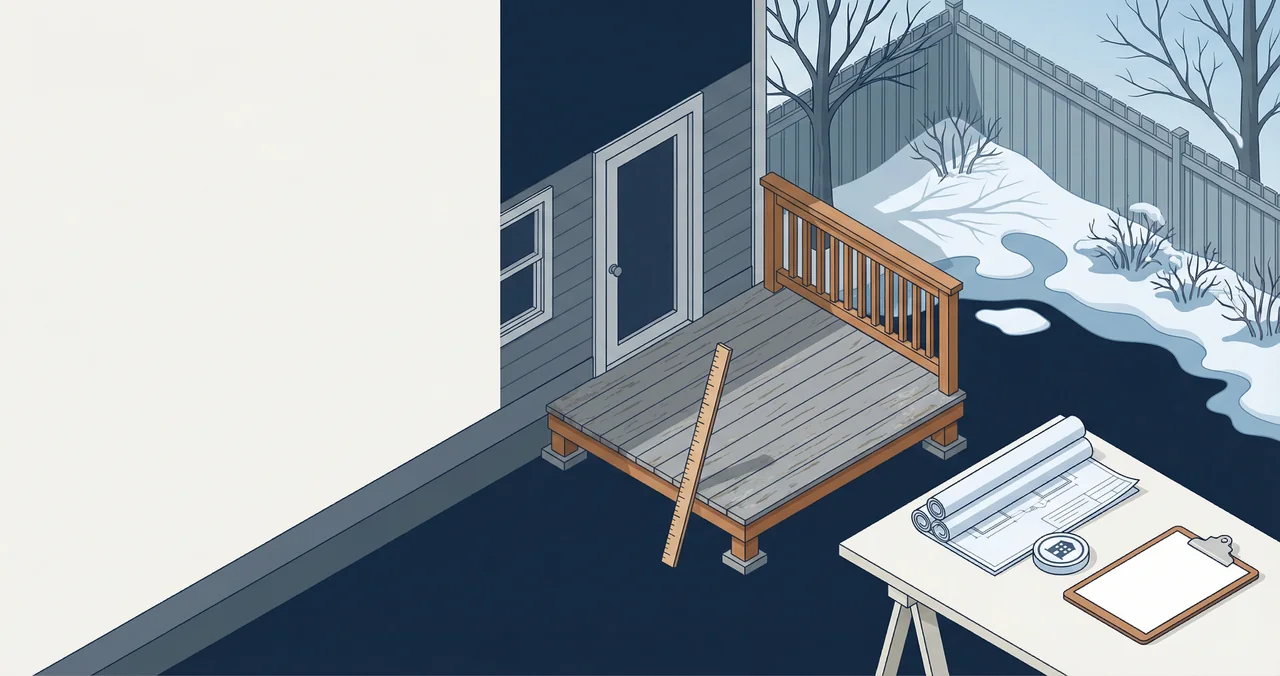
Deck Permits in Rochester: Requirements, Costs & How to Apply in 2026
Building a deck in Rochester without pulling the right permits can cost you thousands — in fines, forced teardowns, and headaches when you try to sell your home. Rochester's Building and Development Services department enforces permit requirements strictly, and with the city's harsh winters putting extra structural demands on outdoor builds, those codes exist for good reason.
🏗️ Planning a deck project?
Get a free manual project review, or visualize your dream deck with AI before requesting quotes.
📋 Tool Alert: Permit Checker
Do you really need a permit? Check the exact rules for your city or township.
Check Permits →Here's exactly what you need to know before breaking ground.
<!-- slot:after-intro -->
Do You Need a Permit in Rochester?
Yes, most deck projects in Rochester require a building permit. The City of Rochester requires permits for decks that meet either of these thresholds:
- Over 200 square feet in total area
- More than 30 inches above grade at any point
If your deck is both under 200 square feet *and* 30 inches or less above grade, you may be exempt from a full building permit. But "exempt" doesn't mean "no rules." You still need to comply with zoning setbacks, lot coverage limits, and the New York State Residential Code.
A quick reality check: most useful backyard decks exceed one or both of those thresholds. A standard 12×16 deck is already 192 square feet — add a single extra foot in either direction and you're over the limit. And if your yard has any slope at all, hitting 30 inches above grade is easy.
When in doubt, call Rochester's Building and Development Services at (585) 428-6520. A five-minute phone call beats a stop-work order.
When a Permit Is Required
Beyond the basic thresholds, you'll need a permit for these specific scenarios:
- Attached decks — any deck structurally connected to your house requires a permit regardless of size, because the ledger board attachment affects your home's structural integrity
- Elevated decks — anything over 30 inches above grade, which includes most second-story decks and walkout basement-level builds common in Rochester's hilly neighborhoods like Park Avenue, South Wedge, and the East End
- Covered or roofed decks — adding a pergola or roof structure triggers additional structural requirements
- Decks with electrical — running wiring for lighting, outlets, or hot tub connections requires an electrical permit in addition to the building permit
- Hot tub installations — the added weight load (a filled hot tub can weigh 4,000+ pounds) demands engineering review
Projects That Typically Don't Need a Permit
- Ground-level patios and pavers (no structure involved)
- Freestanding decks under 200 square feet and under 30 inches above grade
- Basic deck repairs — replacing boards, refinishing, resealing
- Replacing railing with code-compliant railing of similar design
Even for exempt projects, setback rules still apply. Building right up to your property line will get flagged regardless of permit status.
Permit Fees & Processing Time
Rochester's deck permit fees are based on the estimated project cost. Here's what to expect in 2026:
| Project Value | Estimated Permit Fee |
|---|---|
| Under $5,000 | $75–$150 |
| $5,000–$15,000 | $150–$350 |
| $15,000–$50,000 | $350–$600 |
| Over $50,000 | $600+ (scaled to value) |
Additional fees may apply for:
- Plan review: $50–$150 depending on complexity
- Electrical permit: $50–$100 (separate from the building permit)
- Zoning variance: $200–$500+ if your project needs a setback exception
- Inspections: Typically included in the permit fee, but re-inspections after failed checks may carry a $50–$75 fee
How Long Does It Take?
For a straightforward residential deck, expect 2 to 4 weeks from application to permit approval. More complex projects — multi-level decks, structures requiring engineering, or anything needing a zoning variance — can take 6 to 8 weeks or longer.
Rochester's building department sees a surge of applications every spring. If you're planning a summer build, submit your permit application by March to avoid delays. Contractors in Rochester operate on a compressed schedule thanks to the short building season (May through October), and permit delays can push your project into fall or even the following year.
Building Codes & Setback Rules
Rochester follows the New York State Residential Code, which aligns closely with the International Residential Code (IRC). Key requirements for decks include:
Structural Requirements
- Footing depth: Footings must extend below the frost line, which in Rochester is 42 to 48 inches deep. This is non-negotiable — shallow footings will heave during freeze-thaw cycles and compromise your entire deck structure
- Post sizing: Minimum 6×6 posts for decks over 6 feet above grade; 4×4 posts allowed for lower structures depending on span
- Beam and joist sizing: Determined by span tables in the NYS Residential Code — your plans must show these calculations
- Ledger board attachment: Must use ½-inch lag screws or through-bolts with proper flashing to prevent water infiltration. Ledger board failures are the number-one cause of deck collapses nationally
- Lateral bracing: Required for elevated decks to resist wind and lateral loads
Railing & Safety Codes
- Railing required on any deck surface 30 inches or more above grade
- Minimum railing height: 36 inches (42 inches recommended for decks over 6 feet high)
- Baluster spacing: No more than 4 inches between balusters (the "4-inch sphere rule" — if a 4-inch ball can pass through, it fails)
- Stairs: Required if the deck is more than 8 inches above grade; must be at least 36 inches wide with proper handrails and uniform riser height
Setback Rules
Rochester's zoning code varies by district, but typical residential setbacks are:
- Front yard: 25–30 feet from the property line (decks generally can't extend into the front setback)
- Side yard: 5–10 feet minimum, depending on your zoning district
- Rear yard: 15–25 feet minimum
- Lot coverage: Your deck, house, garage, and other structures combined generally can't exceed 40–50% of your lot area
Rochester's older neighborhoods — like the 19th Ward, Corn Hill, and Maplewood — often have smaller lots where setbacks become a real constraint. If your lot is tight, you may need a zoning variance, which adds time and cost to the process.
For homes in historic districts like the East Avenue Preservation District, additional design review may apply. Contact the Rochester Preservation Board before submitting plans.
<!-- slot:mid-content -->
How to Apply for a Deck Permit in Rochester
Step 1: Prepare Your Plans
Rochester requires detailed plans with your application. At minimum, you'll need:
- Site plan showing your property boundaries, existing structures, and the proposed deck location with dimensions and setback distances
- Construction drawings including framing plan, footing details, post and beam sizes, ledger attachment details, and railing specifications
- Elevation drawings showing the deck height above grade from at least two sides
- Materials list specifying lumber species/grade or composite product specifications
For straightforward projects, many Rochester contractors prepare these drawings as part of their service. For complex builds, you may need a licensed architect or engineer.
Use PaperPlan to visualize different decking materials on your own home before committing — it helps you finalize design decisions before drafting formal plans.
Step 2: Submit Your Application
You can apply through:
- In person: Rochester City Hall, Bureau of Buildings, 30 Church Street, Room 100B
- Online: Through the City of Rochester's online permit portal (check for current availability — the city has been expanding digital services)
Submit your completed application, plans, and payment. Make sure your property address and tax ID are correct — mismatches delay processing.
Step 3: Plan Review
A plans examiner reviews your submission for code compliance. They'll check:
- Structural adequacy (footing depth, beam spans, joist spacing)
- Setback and zoning compliance
- Ledger board connection details
- Railing and stair code compliance
- Drainage impact
If corrections are needed, you'll receive a written notice. Respond promptly — every back-and-forth adds a week or more.
Step 4: Receive Your Permit and Begin Construction
Once approved, your permit must be posted visibly at the job site before any work begins. In Rochester, permits are typically valid for 6 to 12 months — if your project stalls, you may need to renew.
Step 5: Schedule Inspections
Rochester typically requires two inspections for deck construction:
1. Footing inspection — before pouring concrete, the inspector verifies hole depth and diameter. Given Rochester's frost line requirements, this is critical
2. Final inspection — after construction is complete, covering structural connections, railing, stairs, and overall code compliance
Some complex projects require a mid-build framing inspection as well. Your permit will specify which inspections are required. Don't cover up footings or framing before they've been inspected — you may be required to tear out work for the inspector to verify.
What Happens If You Build Without a Permit
Skipping the permit might seem tempting when you just want to enjoy your new deck. Don't do it. Here's what's actually at stake in Rochester:
Immediate Consequences
- Stop-work order: The city can shut down your project immediately if a neighbor complains or an inspector notices unpermitted work
- Fines: Rochester can levy $250–$1,000+ per day for unpermitted construction. That adds up fast
- Forced removal: In worst cases, the city can require you to tear down the deck entirely at your own expense
Long-Term Problems
- Home sale complications: When you sell, the buyer's home inspector and title company will flag unpermitted structures. You'll either need to retroactively permit the work (including bringing it up to current code) or offer a price reduction. Common headache in Rochester's active real estate market
- Insurance issues: If someone is injured on an unpermitted deck, your homeowner's insurance may deny the claim. Liability falls entirely on you
- Property tax reassessment: Unpermitted work can trigger a reassessment if discovered — you'll owe back taxes on the added value
Can You Get a Retroactive Permit?
Sometimes. Rochester may allow you to apply for a permit after the fact, but you'll likely face:
- Double or triple permit fees as penalties
- Required inspections that may mean opening up finished work (cutting into concrete, removing deck boards to expose framing)
- Mandatory upgrades to meet current code — even if the original build met code at the time
The permit fee for a typical deck is a few hundred dollars. The cost of fixing an unpermitted build can run into the thousands. It's not worth the risk.
For a deeper look at the consequences, see our guide on building a deck without a permit and the risks involved.
Rochester-Specific Considerations for Your Deck Build
Climate and Materials
Rochester's winters are brutal on outdoor structures. Average annual snowfall tops 100 inches, and the constant freeze-thaw cycling between November and April puts enormous stress on deck materials and connections.
Material choices matter here more than in most cities:
| Material | Installed Cost (USD/sqft) | Winter Performance | Maintenance |
|---|---|---|---|
| Pressure-treated wood | $25–$45 | Good with annual sealing | High — seal every year |
| Cedar | $35–$55 | Good with maintenance | Moderate — stain every 2–3 years |
| Composite (Trex, TimberTech) | $45–$75 | Excellent | Very low |
| Trex (premium lines) | $50–$80 | Excellent | Very low |
| Ipe (hardwood) | $60–$100 | Excellent | Low to moderate |
Composite and PVC decking hold up best in Rochester's climate. Wood decks need annual sealing against moisture and road salt tracked onto the surface — skip a year, and you'll see cracking and splintering by the next spring. For a full breakdown of materials that handle freeze-thaw well, check out our guide on the best decking materials for freeze-thaw climates.
Footing Depth Is Critical
Rochester's frost line means your footings need to reach 42 to 48 inches deep — and some areas closer to the lake may require even deeper footings. This is more excavation than in warmer climates, which adds to your project cost. But skimping on footing depth leads to frost heave, which will rack your entire deck frame within a few seasons.
If you're comparing costs across different deck sizes, our guides on 12×16 deck costs and 20×20 deck costs break down what to budget.
Timing Your Build
The realistic building season in Rochester runs May through October. Contractors' schedules fill up fast — book by March to secure a summer start date. If you wait until May to start calling contractors, you may not get on the schedule until August or later.
Permits add another layer of timing. Submit your application in early spring so you have approval in hand when the weather breaks. There's nothing worse than having a contractor ready to go while you're still waiting on permit approval.
For more on seasonal timing, see our post on the best time to build a deck.
Attached vs. Freestanding: Permit Implications
In Rochester, attached decks always require a permit because of the ledger board connection to your home. Freestanding decks under 200 square feet and 30 inches above grade may be exempt — but the footings still need to meet frost depth requirements regardless.
Wondering which approach fits your project? Our comparison of attached vs. freestanding deck permits covers the trade-offs.
<!-- slot:before-faq -->
🎨 Not sure which material to pick?
Upload a photo of your backyard and see exactly how Trex, TimberTech, or cedar would look — free and instant.
Frequently Asked Questions
How much does a deck permit cost in Rochester, NY?
Most residential deck permits in Rochester cost between $75 and $600, depending on your project's estimated value. A standard 12×16 pressure-treated deck typically falls in the $150–$350 range for the permit fee alone. Budget an additional $50–$150 for plan review. These fees are a small fraction of your total project cost — a composite deck of that size runs $8,600–$14,400 installed.
How long does it take to get a deck permit in Rochester?
Plan for 2 to 4 weeks for a standard residential deck. Complex or multi-level builds may take 6 to 8 weeks, especially if plan revisions are required. Spring is the busiest time for applications, so submitting in February or March gives you the best chance of having your permit in hand for a May start.
Can I build a small deck without a permit in Rochester?
A freestanding deck that is both under 200 square feet and 30 inches or less above grade may not require a building permit. However, you still must comply with zoning setbacks and lot coverage limits. If the deck is attached to your house, a permit is required regardless of size. Always verify with Rochester's Building and Development Services — rules can change, and your specific lot may have additional restrictions.
What inspections are required for a deck in Rochester?
Rochester typically requires a footing inspection (before pouring concrete) and a final inspection (after construction is complete). The footing inspection is especially important in Rochester because of the deep frost line — inspectors verify your holes reach the required 42–48 inches. Larger or more complex projects may also require a framing inspection before decking is installed.
Do I need a permit to replace an existing deck in Rochester?
If you're doing a full tear-down and rebuild, yes — you need a new permit. The new structure must meet current building codes, which may differ from when your original deck was built. If you're simply replacing deck boards, railings, or doing cosmetic repairs without altering the structure, a permit is generally not required. Structural changes — like replacing posts, beams, or footings — trigger permit requirements. If you're planning a rebuild, it's a smart time to consider upgrading to low-maintenance decking materials that can handle Rochester winters with less upkeep.
<!-- slot:end -->
📋 Planning a deck project?
Get a free manual project review from our team — no obligation, no spam.
Get Free Project Review →Upload a backyard photo and preview real decking materials with AI — free, instant, no sign-up.
Permits, costs, material comparisons, and questions to ask before requesting quotes — delivered to your inbox.