
Deck Permits in Springfield (2026)
Need a deck permit in Springfield, MO? Learn requirements, fees, building codes, setback rules, and how to apply for your 2026 deck project.
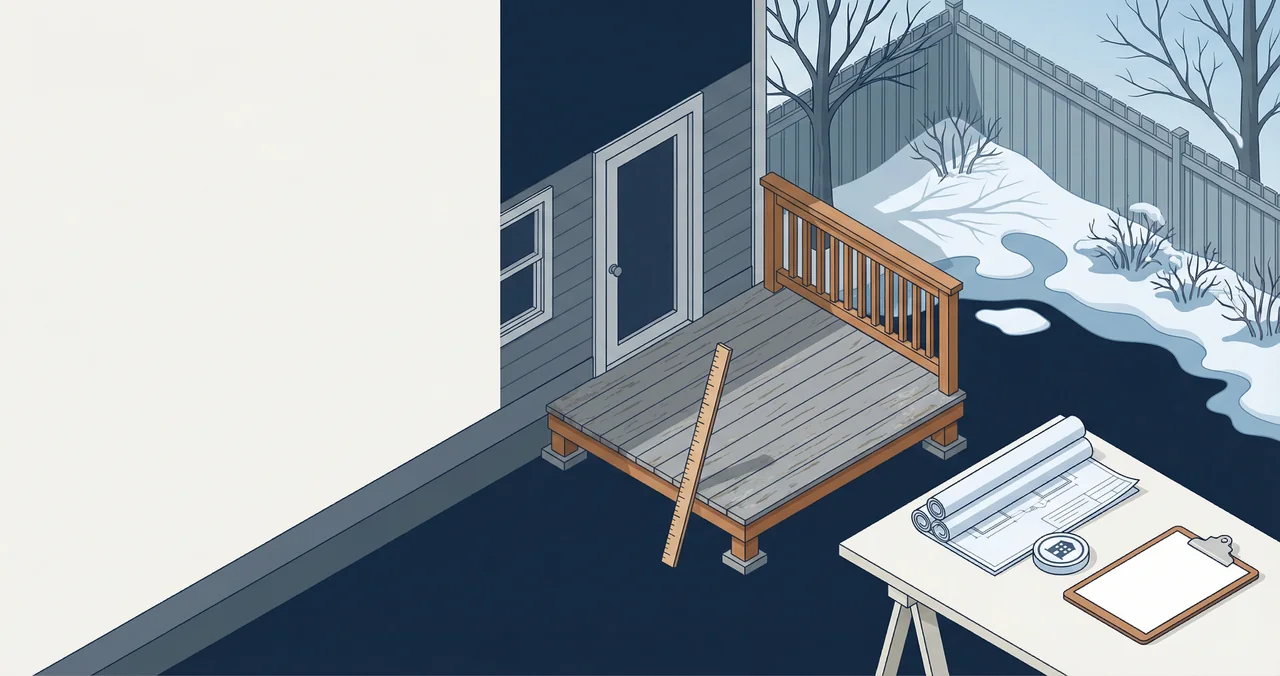
Deck Permits in Springfield: Requirements, Costs & How to Apply in 2026
If you're planning to build a deck in Springfield, Missouri, the permit question is probably one of your first concerns. Do you actually need one? How much will it cost? And what happens if you skip it?
🏗️ Planning a deck project?
Get a free manual project review, or visualize your dream deck with AI before requesting quotes.
📋 Tool Alert: Permit Checker
Do you really need a permit? Check the exact rules for your city or township.
Check Permits →Here's the short answer: most deck projects in Springfield require a building permit. The city's Building Development Services department enforces this, and the consequences of ignoring it range from fines to forced demolition. But the process isn't as complicated as you might think — and this guide walks you through every step.
<!-- slot:after-intro -->
Do You Need a Deck Permit in Springfield?
In most cases, yes. Springfield follows the International Residential Code (IRC) with local amendments, and the city requires permits for the majority of residential deck construction.
The general rule from Springfield's Building Development Services:
- Decks over 200 square feet require a permit
- Decks more than 30 inches above grade require a permit
- Any deck attached to the house typically requires a permit, regardless of size
A small, ground-level platform deck under 200 square feet that's freestanding *may* be exempt — but don't assume. Call Springfield's Building Development Services at (417) 864-1060 or visit their office at 840 Boonville Avenue to confirm before you start buying lumber.
Even if your project falls below the threshold, getting a permit is often worth it. It protects you during resale, ensures structural safety, and keeps you on the right side of code enforcement.
When a Permit Is Required
Let's break this down more specifically. You need a deck permit in Springfield when:
- Your deck exceeds 200 square feet in total area
- Any part of the deck surface is more than 30 inches above the adjacent grade
- The deck attaches to your home's structure (ledger board connection)
- You're adding stairs with more than three risers
- The project includes electrical work (outlets, lighting) — this requires a separate electrical permit
- You're building a roofed or screened structure over the deck
Projects That May Not Need a Permit
- A freestanding, ground-level deck under 200 square feet with no electrical
- Minor repairs or like-for-like board replacement on an existing permitted deck
- Cosmetic changes like staining or painting
Even for exempt projects, your deck still has to comply with Springfield's zoning and setback requirements. A permit exemption doesn't mean a code exemption.
Permit Fees & Processing Time
Springfield's permit fees are based on the estimated project value, which includes labor and materials. Here's what to expect for typical residential deck projects in 2026:
Estimated Permit Costs
| Project Value | Approximate Permit Fee |
|---|---|
| Under $5,000 | $50–$75 |
| $5,000–$15,000 | $75–$150 |
| $15,000–$30,000 | $150–$250 |
| Over $30,000 | $250–$400+ |
These are estimates based on Springfield's fee schedule. The exact amount depends on the project scope. Plan review fees may be additional, typically running $25–$75 for residential deck projects.
To put this in context, here's what common deck projects cost installed in Springfield:
| Deck Material | Installed Cost Per Sq Ft |
|---|---|
| Pressure-treated wood | $25–$45 |
| Cedar | $35–$55 |
| Composite | $45–$75 |
| Trex (premium composite) | $50–$80 |
| Ipe (hardwood) | $60–$100 |
A typical 16×20 pressure-treated deck (320 sq ft) runs $8,000–$14,400 installed, putting your permit fee in the $75–$150 range. That's a small fraction of the total project cost — and a fraction of what you'd pay in fines without one.
For a deeper look at how deck costs break down by size and material, check out our guide on composite deck builders in Springfield.
Processing Time
- Standard review: 5–10 business days for residential deck permits
- Expedited review: Available for some projects — ask at the counter
- Inspections: Typically scheduled within 1–3 business days of your request
Spring is the busiest season for Springfield contractors and the permit office alike. If you're planning a March–May build, submit your application in January or February to avoid delays. Fall projects (September–November) often move faster through the system and can mean better contractor pricing too.
<!-- slot:mid-content -->
Building Codes & Setback Rules
Springfield enforces building codes that directly affect how and where you can build your deck. Understanding these before you design saves headaches — and redesign fees.
Key Structural Requirements
- Frost line depth: Footings must extend at least 36 inches below grade in Springfield. Missouri's frost line varies, but Springfield's climate — with regular winter frost and occasional hard freezes — demands deep footings to prevent heaving.
- Beam and joist sizing: Must comply with IRC span tables. Most Springfield inspectors expect a minimum of 2×8 joists for standard residential decks at typical spacing.
- Ledger board attachment: When attaching to the house, flashing and proper lag bolt spacing are mandatory. This is one of the most common inspection failures.
- Post-to-beam connections: Must use approved hardware (post caps, through-bolts). Toenailing alone won't pass inspection.
- Guardrails: Required on any deck surface 30 inches or more above grade. Minimum height is 36 inches for residential decks.
- Baluster spacing: No gap greater than 4 inches — the classic "4-inch sphere" test.
- Stair requirements: Maximum 7¾-inch riser height, minimum 10-inch tread depth, and graspable handrails on stairs with four or more risers.
If you're considering cable or glass railing systems, those have additional code requirements — see our article on cable railing for decks and code compliance for details on what inspectors look for.
Setback Rules in Springfield
Zoning setbacks determine how close your deck can be to property lines. In Springfield, these vary by zoning district, but for most R-1 (single-family residential) lots:
- Front yard setback: 25 feet from the front property line (decks rarely go here, but it applies)
- Side yard setback: 5–8 feet minimum, depending on lot size and zoning
- Rear yard setback: 25 feet for primary structures; 3–5 feet for accessory structures
A deck attached to the house is generally considered part of the primary structure and follows primary setback rules. A freestanding deck may qualify as an accessory structure with smaller setbacks — but this varies.
Easements add another layer. If your property has a utility or drainage easement along the back or side, your buildable area shrinks. Check your property survey or plat before designing your deck. Many Springfield homes — especially in neighborhoods like Galloway Village, Phelps Grove, and the newer developments south of Battlefield — have easements that catch homeowners off guard. Our guide on building near easements covers what you need to know.
Springfield Climate Considerations
Springfield's moderate four-season climate affects your deck build in specific ways:
- Frost heave: Those 36-inch footings aren't optional. Shallow footings will shift during freeze-thaw cycles, and inspectors know it.
- Humidity and moisture: Springfield averages around 50–60% humidity in summer. Pressure-treated wood holds up well, but proper ventilation under the deck prevents moisture-related issues.
- Temperature swings: Composite decking expands and contracts with temperature. Springfield can swing from the teens to the 60s within a week in winter. Follow manufacturer gapping recommendations precisely — usually 3/16 to 1/4 inch between board ends.
- Storm exposure: Springfield is in tornado-prone territory. While a deck won't withstand a direct hit, proper anchoring and hardware connections improve overall structural resilience.
Use PaperPlan to visualize different decking materials on your own home before committing — it's especially helpful for comparing how composite vs. wood options look against your siding and trim.
How to Apply for a Deck Permit in Springfield
The application process is straightforward if you come prepared. Here's exactly what to do:
Step 1: Gather Your Documents
You'll need:
- Site plan/plot plan showing your property boundaries, the house footprint, and the proposed deck location with dimensions and setback measurements
- Deck construction plans including framing layout, footing locations, beam/joist sizing, railing details, and ledger attachment method
- Elevation drawings showing the deck height above grade, stair layout, and railing height
- Material specifications — what type of wood or composite, fastener types, and hardware
Plans don't need to be architect-drawn for a standard residential deck. Many Springfield homeowners submit contractor-prepared plans or detailed hand-drawn plans with dimensions. The key is completeness and accuracy.
Step 2: Submit Your Application
You have two options:
1. In person at Springfield's Building Development Services, 840 Boonville Avenue, Springfield, MO 65802
2. Online through the city's electronic permitting system (check the City of Springfield website for current portal access)
Fill out the residential building permit application, attach your plans, and pay the fee. You'll receive a permit number for tracking.
Step 3: Wait for Plan Review
Standard review takes 5–10 business days. The plan reviewer may approve as-is or send back comments requesting changes or clarification. Common revision requests:
- Missing footing depth specifications
- Inadequate ledger board flashing detail
- Setback dimensions not shown
- Railing height or baluster spacing not noted
Step 4: Schedule Inspections
Once approved, your project typically requires two inspections:
1. Footing inspection — before pouring concrete. The inspector verifies hole depth (minimum 36 inches), diameter, and location.
2. Final inspection — after the deck is complete. The inspector checks framing, connections, railings, stairs, and overall code compliance.
Some projects may require a framing inspection between these two, especially for complex multi-level designs.
Step 5: Get Your Certificate of Completion
After passing final inspection, you'll receive documentation that the deck was built to code. Keep this paperwork. You'll need it if you ever sell your home, refinance, or make insurance claims.
If you're weighing whether to tackle this yourself or hire a pro, our guide on building your own deck breaks down the practical realities.
What Happens If You Build Without a Permit
This is where some Springfield homeowners get into trouble. The temptation to skip the permit — especially for a "simple" deck — is real. But the risks are significant:
Financial Consequences
- Stop-work orders: Code enforcement can shut down your project mid-build
- Double or triple permit fees: Springfield can charge penalty fees for unpermitted work, often 2–3 times the original permit cost
- Fines: Ongoing daily fines until the situation is resolved
- Forced removal: In worst cases, the city can require you to tear down the deck entirely
Long-Term Problems
- Home sale complications: Buyers' inspectors and appraisers flag unpermitted structures. This can kill a deal or require price reductions of thousands of dollars — far more than the permit would have cost.
- Insurance issues: If someone is injured on an unpermitted deck, your homeowner's insurance may deny the claim.
- Neighbor complaints: It only takes one call to code enforcement. Springfield actively investigates complaints.
- Property tax reassessment complications: An unpermitted structure creates a documentation mess.
For a deeper look at the real-world consequences, read our article on building a deck without a permit and the risks involved.
Bottom line: The permit costs a fraction of what you'll spend on the deck itself. It's not worth skipping.
What If You Already Built Without One?
If you have an existing unpermitted deck, you can often apply for a retroactive permit. You'll pay the standard fee (possibly with penalties), submit plans, and the city will inspect the structure. If it meets code, you're in the clear. If it doesn't, you'll need to bring it up to code — which can mean expensive modifications.
It's better to come forward voluntarily than to wait for an enforcement action or discover the problem during a home sale.
<!-- slot:before-faq -->
🎨 Not sure which material to pick?
Upload a photo of your backyard and see exactly how Trex, TimberTech, or cedar would look — free and instant.
Frequently Asked Questions
How much does a deck permit cost in Springfield, MO?
Most residential deck permits in Springfield cost between $50 and $250, depending on your project's estimated value. A standard 300–400 square foot deck typically falls in the $75–$150 range for the permit fee alone. Plan review fees may add another $25–$75. Contact Springfield Building Development Services at (417) 864-1060 for an exact quote based on your project.
How long does it take to get a deck permit in Springfield?
Plan on 5–10 business days for standard residential plan review. If revisions are needed, add another week. During peak season (March–May), processing can take longer. Submit early — ideally 2–3 weeks before your planned build start date. Once approved, inspections can usually be scheduled within 1–3 business days.
Can I build a small deck without a permit in Springfield?
Possibly. Springfield generally exempts freestanding decks under 200 square feet that are less than 30 inches above grade and don't include electrical work. However, the deck still must comply with zoning setbacks and other code requirements. Always confirm with Building Development Services before starting — the rules have nuances, and a quick phone call can save you from a code violation.
What is the frost line depth for deck footings in Springfield, Missouri?
Deck footings in Springfield must extend to a minimum of 36 inches below grade to get below the frost line. This prevents frost heave from shifting your deck's foundation during Missouri's freeze-thaw cycles. The inspector will verify footing depth during the footing inspection, so cutting corners here will get caught immediately.
Do I need a permit to replace deck boards in Springfield?
Generally, no — like-for-like repairs and board replacement on an existing permitted deck don't require a new permit. But if you're changing the structural framing, expanding the deck's footprint, adding height, or altering the load path, that crosses into permit territory. When in doubt, a quick call to the city clarifies whether your specific repair needs a permit. If you're planning a full renovation, check out our guide on best time to build a deck — timing your project right in Springfield can save on both contractor rates and material costs.
<!-- slot:end -->
📋 Planning a deck project?
Get a free manual project review from our team — no obligation, no spam.
Get Free Project Review →Upload a backyard photo and preview real decking materials with AI — free, instant, no sign-up.
Permits, costs, material comparisons, and questions to ask before requesting quotes — delivered to your inbox.