
Deck Permits in Ann Arbor (2026)
Need a deck permit in Ann Arbor? Learn permit requirements, fees, building codes, setback rules, and how to apply through Ann Arbor's Building Services in 2026.
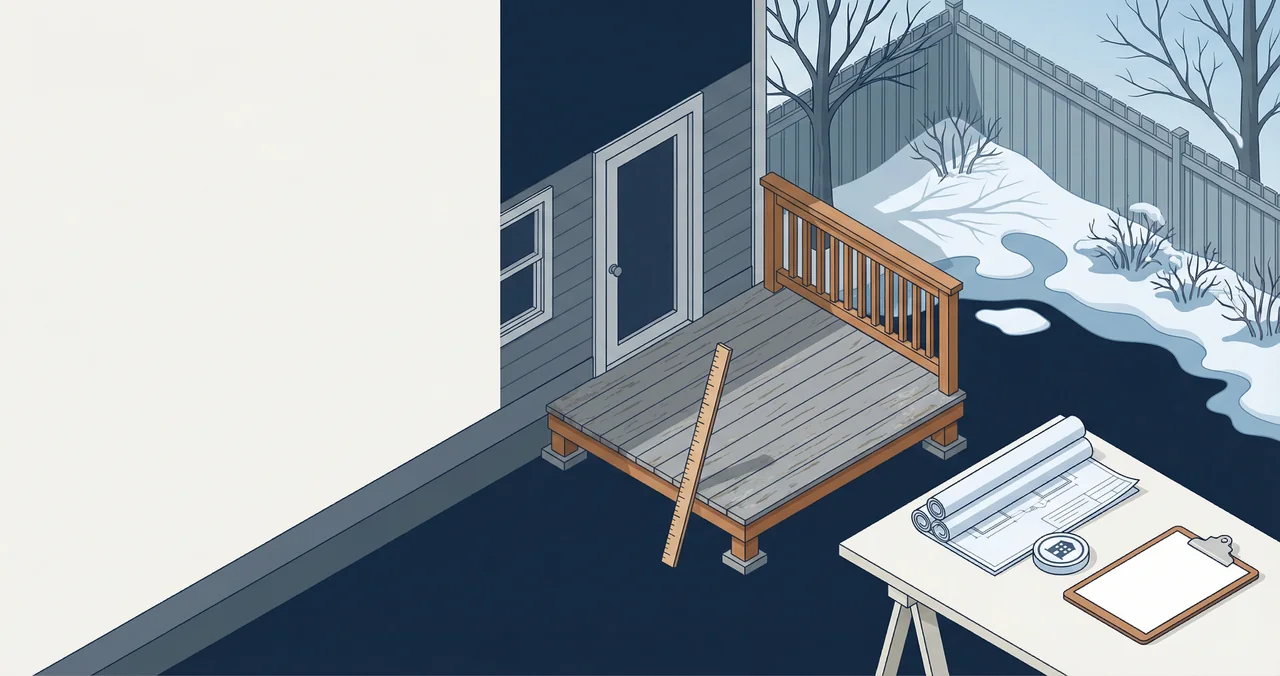
Deck Permits in Ann Arbor: Requirements, Costs & How to Apply in 2026
You're ready to build a deck. Maybe you've already picked out composite boards and sketched a rough layout on graph paper. But before any footings go in the ground, you need to answer one question: do you need a permit in Ann Arbor?
🏗️ Planning a deck project?
Get a free manual project review, or visualize your dream deck with AI before requesting quotes.
📋 Tool Alert: Permit Checker
Do you really need a permit? Check the exact rules for your city or township.
Check Permits →The short answer — probably yes. Here's exactly what Ann Arbor requires, what it costs, and how to get through the process without delays.
<!-- slot:after-intro -->
Do You Need a Deck Permit in Ann Arbor?
In Ann Arbor, a building permit is required for any deck that is over 200 square feet or more than 30 inches above grade. That threshold catches the majority of backyard deck projects. A small ground-level platform under 200 square feet might be exempt, but anything attached to your house, elevated, or of significant size will need a permit from Ann Arbor's Building/Development Services department.
Even if your project falls below the thresholds, you should still confirm with the city. Zoning overlays in neighborhoods like Burns Park, Old West Side, and the Angell area can introduce historic district requirements that apply regardless of deck size. A five-minute call to Building Services at (734) 794-6267 can save you weeks of headaches later.
Bottom line: If you're building anything more than a small, ground-level platform, plan on pulling a permit.
When a Permit Is Required
Here's a clear breakdown of what triggers a permit and what doesn't:
You Need a Permit If:
- Your deck will be larger than 200 square feet
- The deck surface is more than 30 inches above grade at any point
- The deck is attached to your house (ledger board connection)
- You're adding a roof, pergola, or screened enclosure over the deck
- The project involves electrical work (outlets, lighting circuits)
- You're building stairs with more than three risers
You Might Not Need a Permit If:
- The deck is under 200 square feet AND under 30 inches above grade
- It's a freestanding platform at ground level with no roof structure
- You're doing a surface-level repair (replacing boards, not structural members)
A word of caution: "freestanding" doesn't automatically mean permit-free. Size and height still matter. And if you're in a flood zone or near a wetland — parts of Ann Arbor along the Huron River fall into this category — additional permits from the Michigan Department of Environment may apply.
For a deeper look at the risks of skipping this step, see our guide on building a deck without a permit and the risks involved.
Permit Fees & Processing Time
How Much Does a Deck Permit Cost in Ann Arbor?
Permit fees in Ann Arbor are based on the estimated project value. For most residential deck builds, expect the following:
| Project Value | Approximate Permit Fee |
|---|---|
| Under $5,000 | $75–$125 |
| $5,000–$15,000 | $125–$250 |
| $15,000–$30,000 | $250–$400 |
| Over $30,000 | $400–$600+ |
Additional fees may include:
- Plan review fee: Typically included in the permit fee, but complex projects may incur a separate charge of $50–$100
- Zoning compliance review: $25–$75 if your lot requires a variance or special review
- Re-inspection fee: $50–$75 per visit if you fail an inspection and need a callback
How Long Does It Take?
- Standard residential permits: 5–15 business days for review and approval
- Simple projects (straightforward deck, no variances): Can sometimes be processed in under a week
- Complex projects (historic districts, variances, large builds): 3–6 weeks
Pro tip: Submit your application in January or February. Ann Arbor's building season is short — roughly May through October — and contractor schedules fill fast. If you wait until April to start the permit process, you might not break ground until June. Book your contractor by March and have permits in hand before the snow melts.
Building Codes & Setback Rules
Ann Arbor follows the Michigan Residential Code, which aligns closely with the International Residential Code (IRC). Here are the key requirements for deck construction:
Structural Requirements
- Frost line depth: Footings must extend 42 inches below grade in Ann Arbor (Washtenaw County). This is non-negotiable — Michigan's freeze-thaw cycles will heave shallow footings right out of the ground.
- Post sizing: Minimum 4x4 posts for decks under 8 feet high; 6x6 posts recommended for anything taller or for heavy snow load areas
- Beam and joist spans: Must comply with IRC span tables. Your plans need to show lumber species, grade, size, and spacing.
- Ledger board attachment: Must use ½-inch lag screws or through-bolts at specific intervals with proper flashing to prevent water intrusion
- Snow load rating: Design for a minimum 40 psf ground snow load — standard for Washtenaw County
Setback Rules
Ann Arbor's zoning ordinance dictates how close your deck can be to property lines:
- Front yard setback: Decks generally cannot encroach into the front yard setback (typically 25 feet from the front property line in R1 zones)
- Side yard setback: Minimum 5 feet from the side property line in most residential zones
- Rear yard setback: Minimum 5 feet from the rear property line (varies by zoning district — R1 vs. R2 vs. R4 can differ)
- Lot coverage: Your deck counts toward the maximum lot coverage percentage, usually 30–35% in residential zones. If your house, garage, and driveway already use most of that allowance, a large deck could push you over.
Railing Requirements
- Guardrails required on any deck surface 30 inches or more above grade
- Minimum railing height: 36 inches (residential)
- Baluster spacing: No gap larger than 4 inches (the "4-inch sphere rule")
- For more on railing options that meet code, check out our guide to deck railing systems
Climate-Specific Code Considerations
Ann Arbor's climate punishes shortcuts. A few code-adjacent details worth getting right:
- Flashing: The ledger board connection is the #1 failure point in Michigan decks. Proper flashing isn't optional — it's what keeps water from rotting your rim joist and band board.
- Joist tape: Protective tape on joist tops prevents moisture from wicking into end grain. It adds maybe $50–$100 to a project and years to the framing life.
- Drainage slope: Deck boards should have a slight pitch away from the house. Standing water plus freeze-thaw equals cracked boards and popped fasteners.
For material choices that handle Michigan winters, see our breakdown of the best decking materials for freeze-thaw climates.
<!-- slot:mid-content -->
How to Apply for a Deck Permit in Ann Arbor
Step 1: Prepare Your Plans
You'll need a site plan and construction drawings. At minimum, Ann Arbor requires:
- Site plan (plot plan) showing your property boundaries, existing structures, the proposed deck location, and distances to all property lines
- Construction drawings including framing plan, footing details, post/beam/joist sizes and spacing, railing details, and stair layout
- Elevation views showing the deck height above grade and connection to the house
- Material specifications — lumber species/grade or composite product details
You don't necessarily need an architect. Many contractors prepare permit-ready drawings, and for simpler decks, a detailed hand-drawn plan with accurate measurements can work. Use PaperPlan to visualize different decking materials on your own home before committing — it helps both with your design decisions and with showing your contractor exactly what you want.
Step 2: Submit Your Application
Ann Arbor accepts permit applications through their online portal or in person at:
Ann Arbor Building Department
301 E. Huron Street, Ann Arbor, MI 48104
To submit:
1. Complete the Residential Building Permit Application
2. Attach your site plan and construction drawings
3. Pay the permit fee
4. Receive your application number for tracking
Step 3: Plan Review
The Building Department reviews your plans for compliance with:
- Michigan Residential Code
- Ann Arbor Zoning Ordinance
- Any applicable overlay district rules
If revisions are needed, the department will contact you with specific corrections. Respond promptly — each round of revisions adds days to the timeline.
Step 4: Receive Your Permit & Schedule Inspections
Once approved, you'll receive your building permit. Post it visibly at the job site. You'll need inspections at these stages:
1. Footing inspection — before pouring concrete (inspector checks depth, diameter, and soil conditions)
2. Framing inspection — after framing is complete but before decking goes on (verifies structural connections, hardware, ledger attachment)
3. Final inspection — completed deck with railings, stairs, and all finishes
Don't cover up work before it's inspected. Pouring concrete before the footing inspection means you'll be digging it out.
Step 5: Final Approval
After passing the final inspection, you receive a Certificate of Completion. Keep this document — you'll need it when you sell your home.
What Happens If You Build Without a Permit
Skipping the permit might seem tempting. It's not worth it. Here's what you're risking in Ann Arbor:
Immediate Consequences
- Stop work order: If a building inspector spots unpermitted construction, they'll shut the project down immediately
- Fines: Ann Arbor can impose fines starting at $100–$500 per violation, with daily penalties for non-compliance
- Retroactive permit fees: You'll still need to pull the permit — often at double the original fee
Long-Term Problems
- Required to expose hidden work: You may need to remove decking boards so inspectors can verify the framing underneath. That means labor costs to tear apart and rebuild what's already done.
- Home sale complications: Title companies and buyers' inspectors flag unpermitted structures. This can delay or kill a sale, reduce your home's appraised value, or force you to obtain a retroactive permit under pressure.
- Insurance issues: If someone is injured on an unpermitted deck, your homeowner's insurance may deny the claim. If the deck causes structural damage to your home, same outcome.
- Neighbor complaints: Ann Arbor has an active code enforcement process. It only takes one complaint to trigger an investigation.
The Real Cost of Skipping a Permit
A permit for a typical Ann Arbor deck costs $125–$400. The cost of dealing with an unpermitted deck — retroactive fees, tear-out, rebuild, potential fines, sale delays — can easily run $2,000–$10,000+. It's the worst ROI in home improvement.
For related context on what happens when you skip permits, our article on the risks of building without a permit covers the full picture.
How Much Does a Deck Actually Cost in Ann Arbor?
Since you're already thinking about permits, here's what the full project typically runs in the Ann Arbor area in 2026:
| Material | Installed Cost (per sq ft) |
|---|---|
| Pressure-treated wood | $25–$45 |
| Cedar | $35–$55 |
| Composite | $45–$75 |
| Trex (brand-name composite) | $50–$80 |
| Ipe (hardwood) | $60–$100 |
For a typical 12x16 deck (192 sq ft), that translates to:
| Material | Total Installed Cost |
|---|---|
| Pressure-treated | $4,800–$8,640 |
| Cedar | $6,720–$10,560 |
| Composite | $8,640–$14,400 |
| Trex | $9,600–$15,360 |
| Ipe | $11,520–$19,200 |
Material advice for Ann Arbor: Composite and PVC decking hold up best against Michigan's brutal winters. Pressure-treated wood is the budget option, but it needs annual sealing to survive the moisture, road salt tracking, and freeze-thaw cycles. Cedar falls in between — beautiful but high-maintenance in this climate. For the lowest long-term cost of ownership, composite wins in Ann Arbor.
Want to compare options in more detail? Check out our guide to low-maintenance decking for a full material comparison.
Working With Ann Arbor Contractors
Most experienced Ann Arbor deck builders handle the permit process for you — it's standard practice. When vetting contractors, ask:
- "Do you pull the permit, or do I?" — A reputable contractor handles this. If they suggest you skip the permit, walk away.
- "Are your footings dug to 42 inches?" — Any contractor working in Washtenaw County should know the frost line depth without hesitation.
- "Can I see your builder's license?" — Michigan requires a Residential Builder License for projects over $600.
The short building season in Ann Arbor — realistically May through October — means the best contractors book up early. Start getting quotes in January or February and lock in your contractor by March for a spring/early summer build.
If you're considering the DIY route, our guide on whether you can build your own deck covers what's realistic and where most homeowners run into trouble.
<!-- slot:before-faq -->
🎨 Not sure which material to pick?
Upload a photo of your backyard and see exactly how Trex, TimberTech, or cedar would look — free and instant.
Frequently Asked Questions
How much does a deck permit cost in Ann Arbor?
Most residential deck permits in Ann Arbor cost between $75 and $400, depending on the estimated project value. A typical backyard deck in the $10,000–$20,000 range will run $125–$300 for the permit. Plan review is usually included, though complex projects or zoning variances can add $25–$100 in additional fees.
Do I need a permit for a small ground-level deck in Ann Arbor?
If your deck is under 200 square feet and less than 30 inches above grade, you may be exempt from a building permit. However, you should still verify with Ann Arbor's Building Department — zoning setbacks and lot coverage limits still apply even to exempt structures, and historic overlay districts may have additional requirements.
How deep do deck footings need to be in Ann Arbor?
Deck footings in Ann Arbor must extend at least 42 inches below grade to get below the frost line. This is a strict requirement in Washtenaw County. Footings that are too shallow will shift during Michigan's freeze-thaw cycles, causing the deck to heave, crack, and eventually become structurally unsafe.
How long does it take to get a deck permit approved in Ann Arbor?
Standard residential deck permits take 5–15 business days for review and approval. Simple, straightforward projects can sometimes clear in under a week. If your property is in a historic district, requires a zoning variance, or involves a complex design, expect 3–6 weeks. Submit early — especially if you're targeting a May build start.
Can my contractor pull the deck permit for me in Ann Arbor?
Yes, and most reputable contractors will. In Michigan, licensed residential builders can pull permits on behalf of homeowners. This is standard practice and actually preferred — the contractor takes responsibility for the work meeting code. Make sure whoever pulls the permit is a licensed Michigan Residential Builder and that the permit is posted on-site during construction.
<!-- slot:end -->
📋 Planning a deck project?
Get a free manual project review from our team — no obligation, no spam.
Get Free Project Review →Upload a backyard photo and preview real decking materials with AI — free, instant, no sign-up.
Permits, costs, material comparisons, and questions to ask before requesting quotes — delivered to your inbox.