
Deck Permits in Omaha (2026)
Need a deck permit in Omaha? Learn requirements, fees, building codes, setback rules, and how to apply through Omaha's Building Services department in 2026.
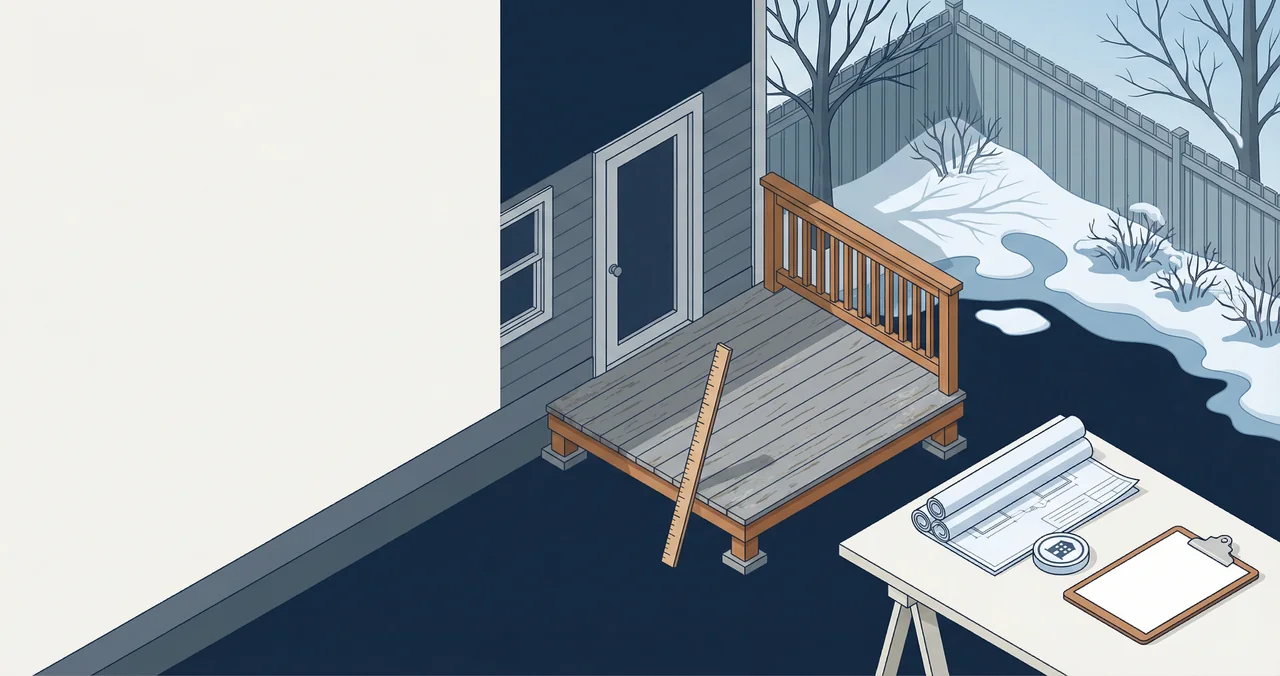
Deck Permits in Omaha: Requirements, Costs & How to Apply in 2026
You're ready to build a deck. Maybe you've already picked out materials and sketched a rough layout. But before you break ground in Omaha, there's one question that trips up almost every homeowner: do you actually need a permit?
🏗️ Planning a deck project?
Get a free manual project review, or visualize your dream deck with AI before requesting quotes.
📋 Tool Alert: Permit Checker
Do you really need a permit? Check the exact rules for your city or township.
Check Permits →The short answer — probably yes. And skipping it can cost you far more than the permit itself. Here's everything you need to know about Omaha's deck permit process, from requirements and fees to building codes specific to Nebraska's climate.
<!-- slot:after-intro -->
Do You Need a Deck Permit in Omaha?
In most cases, yes. Omaha's Building and Development Services department requires a building permit for deck construction that meets certain thresholds. The city follows the International Residential Code (IRC) with local amendments, and the rules are straightforward:
- Decks over 200 square feet require a permit
- Decks more than 30 inches above grade require a permit
- Any deck attached to the house typically requires a permit, regardless of size
Even a modest 12×16 deck (192 sq ft) might need a permit if it's attached to your home or sits higher than 30 inches off the ground. A ground-level patio deck under 200 square feet that's freestanding? You're likely in the clear — but confirm with the city before assuming.
Important: If your deck includes electrical work (for lighting or outlets), plumbing, or a gas line for a built-in grill, you'll need separate trade permits on top of the building permit.
When a Permit Is Required
Here's a quick breakdown of common Omaha deck scenarios:
| Scenario | Permit Required? |
|----------|-----------------|
| Freestanding deck under 200 sq ft, under 30" high | Usually no |
| Freestanding deck over 200 sq ft | Yes |
| Any deck over 30" above grade | Yes |
| Deck attached to the house | Yes |
| Replacing decking boards only (same footprint) | Usually no |
| Adding stairs or railings to an existing deck | Yes |
| Covered deck or screened porch addition | Yes |
| Deck with electrical, plumbing, or gas | Yes (plus trade permits) |
The distinction between attached and freestanding decks matters more than most homeowners realize. An attached deck transfers structural loads to your house, which means the city wants to verify the ledger board connection won't compromise your home's structure. That's a legitimate safety concern — ledger board failures are one of the leading causes of deck collapses nationwide.
Replacing or Repairing an Existing Deck
If you're doing a board-for-board replacement — same size, same height, same footprint — you generally won't need a permit. But if you're changing the structure, expanding the footprint, or altering the height, treat it like new construction and pull a permit.
Permit Fees & Processing Time
Omaha's deck permit fees are based on the estimated project cost. Here's what to expect in 2026:
- Residential building permit: Typically $50–$200 for most deck projects, calculated as a percentage of construction value
- Plan review fee: Included in many residential permits, but complex projects may incur an additional $50–$100
- Electrical permit (if applicable): $40–$75
- Re-inspection fee (if you fail an inspection): $50–$75
For a standard 300–400 sq ft composite deck — one of the most popular builds in Omaha — you're looking at roughly $100–$175 in total permit fees. That's a tiny fraction of the overall project cost when composite decking runs $45–$75 per square foot installed.
How Long Does It Take?
Plan review typically takes 5–10 business days for residential deck permits in Omaha. Simple, straightforward deck plans on the faster end. Anything with unusual engineering — a multi-level deck on a steep lot in the Dundee hills, for example — could take longer.
During peak building season (May through August), expect processing times closer to the longer end. Omaha's building season is compressed compared to southern states, so everyone's submitting permits around the same time.
Pro tip: Submit your permit application in February or March. You'll beat the rush and have your permit in hand before the ground thaws. Contractor schedules fill up fast in Omaha's short building season — booking by March is the move.
<!-- slot:mid-content -->
Building Codes & Setback Rules
Omaha follows the IRC with local amendments. Here are the key code requirements that affect deck construction:
Structural Requirements
- Footings must extend below the frost line — in Omaha, that's 36 inches minimum. Some areas of the metro, especially farther from the river, may require depths closer to 42 inches. This is non-negotiable. Nebraska's freeze-thaw cycles will heave shallow footings right out of the ground.
- Minimum footing diameter: 12 inches for most residential decks
- Post size: Minimum 4×4 for decks under 8 feet tall; 6×6 posts are required (and recommended regardless) for taller structures
- Beam and joist sizing must meet span tables in the IRC — your plans need to show specific lumber grades and dimensions
- Ledger board attachment requires lag screws or through-bolts into the rim joist, with proper flashing to prevent water infiltration
Railing Requirements
- Railings are required on any deck surface 30 inches or more above grade
- Minimum railing height: 36 inches
- Baluster spacing: No more than 4 inches between balusters (the classic "4-inch sphere" test — a 4-inch ball shouldn't pass through)
- Stairs need a graspable handrail between 34 and 38 inches high
For more on railing options that meet code, check out our guide on the best deck railing systems.
Setback Rules
Omaha's zoning code dictates how close your deck can sit to property lines:
- Rear setback: Typically 20 feet from the rear property line in most residential zones (R1–R4), though this varies by zoning district
- Side setback: Usually 5–7 feet from the side property line
- Front setback: Decks rarely go in front yards, but front setbacks are typically 25 feet from the property line
Check your specific zoning district. Omaha has dozens of residential zones, and setbacks vary. Properties in older neighborhoods like Benson, Dundee, or Midtown may have different requirements than newer subdivisions in Elkhorn or Millard. You can look up your property's zoning through the city's online GIS portal or call the Planning Department at (402) 444-5150.
If your property has easements — common along older Omaha streets — those further restrict where you can build. A survey or easement check before you design saves headaches later.
Snow Load & Climate Considerations
This is where Omaha decks differ from builds in milder climates. Your deck must handle:
- Snow loads of 20–30 psf (pounds per square foot) — the IRC minimum for ground snow load in the Omaha area
- Freeze-thaw cycling that stresses connections and materials from November through March
- Ice dam potential where a covered deck meets the house roofline
These aren't abstract concerns. Omaha gets an average of 30 inches of snow per year, and winter temperatures regularly drop below zero. The repeated freeze-thaw cycles are brutal on materials and fasteners alike.
Material choice matters here. Composite and PVC decking hold up best against Omaha winters — they won't crack, split, or rot from moisture cycling. Pressure-treated wood works but needs annual sealing to resist moisture and deicing salt. Cedar looks beautiful but demands even more maintenance in this climate. For a deeper look at what holds up in freeze-thaw conditions, read our material comparison guide.
Use PaperPlan to visualize different decking materials on your own home before committing — it's particularly helpful for seeing how lighter composite shades look against Omaha's brick and siding styles.
Cost Context for Omaha Decks
Knowing permit requirements is one thing, but budgeting for the full project is another. Here's what Omaha homeowners are paying in 2026:
| Material | Installed Cost (per sq ft) |
|----------|---------------------------|
| Pressure-treated wood | $25–$45 |
| Cedar | $35–$55 |
| Composite | $45–$75 |
| Trex (premium composite) | $50–$80 |
| Ipe (hardwood) | $60–$100 |
For a typical 320 sq ft deck (roughly 16×20), that translates to:
- Pressure-treated: $8,000–$14,400
- Composite: $14,400–$24,000
- Trex: $16,000–$25,600
These prices include materials, labor, footings, railings, and stairs. The permit fee is a rounding error in comparison. For a breakdown of what drives deck costs, including long-term maintenance savings, it's worth comparing low-maintenance options before deciding.
How to Apply for a Deck Permit in Omaha
Here's the step-by-step process:
Step 1: Prepare Your Plans
You'll need to submit:
- Site plan showing your property boundaries, the house footprint, and the proposed deck location with dimensions and setback distances
- Construction drawings including a framing plan, cross-section details, footing locations, and beam/joist sizes
- Elevation drawings showing the deck height, railing height, and stair layout
- Material specifications — lumber grades, fastener types, concrete specs for footings
Most contractors will prepare these for you as part of their bid. If you're building the deck yourself, you'll need to draft plans that meet the city's standards. They don't need to be architectural-grade, but they must be clear, to-scale, and include all required details.
Step 2: Submit Your Application
You can apply through:
- Online: Omaha has moved many permits online through their permitting portal. Check the City of Omaha Public Works / Building and Development Services page.
- In person: Visit the Omaha-Douglas Civic Center, 1819 Farnam Street, Omaha, NE 68183. The Permits & Inspections counter handles residential applications.
- By appointment: During peak season, scheduling ahead saves wait time.
Bring your completed application, two sets of plans, proof of property ownership, and your fee payment.
Step 3: Plan Review
The city reviews your plans for code compliance. This takes 5–10 business days for standard residential decks. If revisions are needed, you'll be contacted — this adds time, so get the details right on the first submission.
Step 4: Receive Your Permit & Schedule Inspections
Once approved, you'll receive your building permit. Post it visibly at the job site — inspectors need to see it.
You'll typically need two inspections:
1. Footing inspection — before pouring concrete, the inspector verifies hole depth (at least 36 inches), diameter, and soil conditions
2. Final inspection — after the deck is complete, the inspector checks structural connections, railing height, baluster spacing, stair dimensions, and overall code compliance
Some projects require an intermediate framing inspection as well. Your permit will specify which inspections are required.
Step 5: Get Your Certificate of Completion
After passing final inspection, you receive documentation that the deck was built to code. Keep this. You'll need it when you sell your home, and it protects you if insurance questions come up.
What Happens If You Build Without a Permit
It's tempting to skip the paperwork. Don't.
The risks are real and expensive:
- Stop-work orders. If a neighbor reports unpermitted construction or an inspector spots it, the city can shut down your project immediately.
- Fines. Omaha can impose fines for unpermitted work. Building without a permit when one is required typically results in double the original permit fee as a penalty, minimum.
- Forced removal. In worst-case scenarios, the city can require you to tear down the deck entirely. That $20,000 composite deck becomes a total loss.
- Insurance problems. If someone is injured on an unpermitted deck, your homeowner's insurance may deny the claim. That's a liability nightmare.
- Selling complications. Home inspectors flag unpermitted structures. Buyers' lenders may require the deck be permitted retroactively — or removed — before closing. This kills deals or costs thousands in last-minute fixes.
For a deeper look at the consequences, our article on building without a permit covers the full range of what can go wrong.
Can you get a retroactive permit? Sometimes. Omaha may allow you to apply for an after-the-fact permit, but you'll pay penalty fees, and the deck must pass inspection as-is. If it doesn't meet code, you're on the hook for modifications — which often means tearing apart finished work to expose structural elements for inspection.
<!-- slot:before-faq -->
🎨 Not sure which material to pick?
Upload a photo of your backyard and see exactly how Trex, TimberTech, or cedar would look — free and instant.
Frequently Asked Questions
How much does a deck permit cost in Omaha?
Most residential deck permits in Omaha cost between $50 and $200, depending on the estimated construction value. Electrical permits, if needed, add $40–$75. The exact fee is calculated as a percentage of your project's total value. For a typical backyard deck, the permit is one of the smallest line items in your budget.
How long does it take to get a deck permit approved in Omaha?
Plan review typically takes 5–10 business days. Submit complete, accurate plans to avoid revision cycles that add days or weeks. During peak season (March through May), processing times may stretch to the longer end as the department handles higher volume.
Do I need a permit to replace my deck boards in Omaha?
If you're doing a like-for-like replacement — same footprint, same height, no structural changes — you generally don't need a permit. But if you're changing the deck's structure, expanding it, raising it, or altering the support system, a permit is required. When in doubt, call Omaha's Building and Development Services at (402) 444-5370 and describe your project. A quick phone call can save you from a costly mistake.
Can I build my own deck in Omaha, or do I need a licensed contractor?
Omaha homeowners can pull their own permits and build their own decks as owner-builders. You don't need a contractor's license to work on your own property. However, the deck still must meet all code requirements and pass inspections. If you're not confident in structural framing, footing depth calculations, or ledger board connections, hiring a professional is worth the investment — especially given Omaha's frost line requirements and snow load standards. A footing that's 6 inches too shallow will fail inspection and could fail structurally.
What is the frost line depth for deck footings in Omaha?
Omaha's frost line is a minimum of 36 inches, though some areas of the metro may require footings down to 42 inches or deeper depending on soil conditions and specific location. Your footings must extend below the frost line to prevent frost heave — when frozen ground pushes footings upward, it can crack concrete, shift posts, and compromise the entire deck structure. This is one of the most critical requirements for any best time to build a deck, and inspectors check it carefully.
<!-- slot:end -->
📋 Planning a deck project?
Get a free manual project review from our team — no obligation, no spam.
Get Free Project Review →Upload a backyard photo and preview real decking materials with AI — free, instant, no sign-up.
Permits, costs, material comparisons, and questions to ask before requesting quotes — delivered to your inbox.