
Deck Permits in Pittsburgh (2026)
Need a deck permit in Pittsburgh? Learn requirements, fees, building codes, setback rules, and how to apply. Updated for 2026 with local costs and timelines.
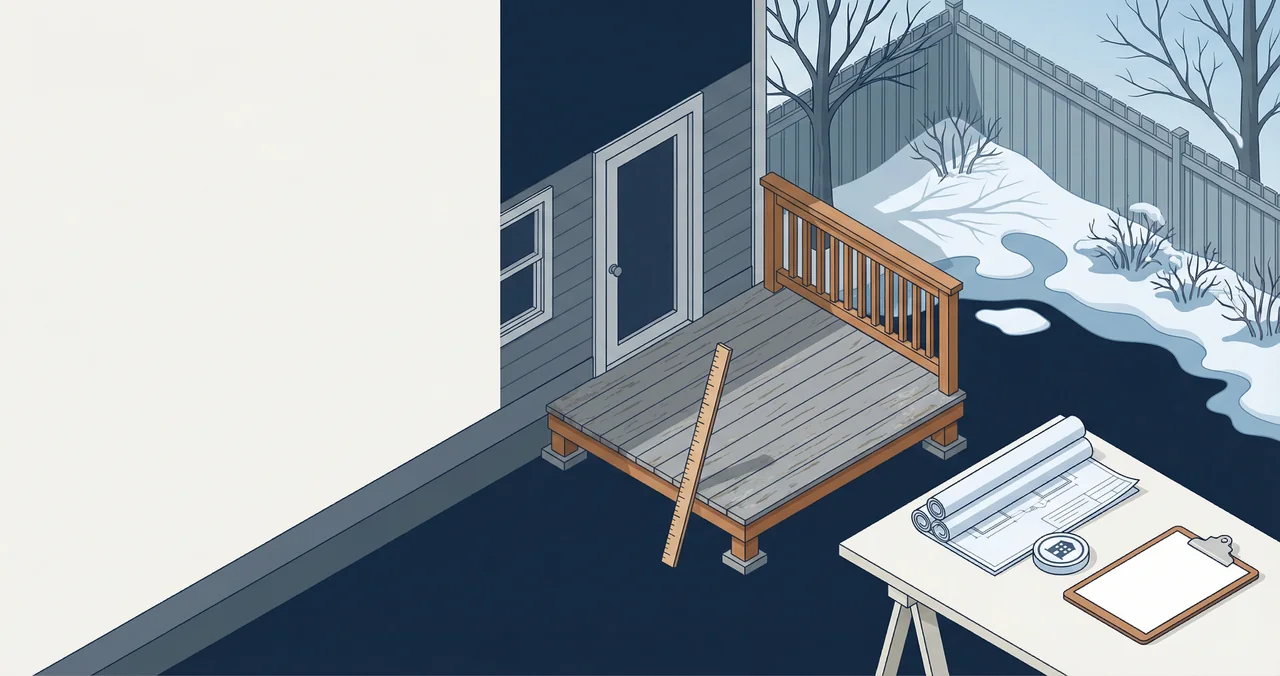
Deck Permits in Pittsburgh: Requirements, Costs & How to Apply in 2026
Planning a new deck in Pittsburgh? Before you pick out materials or call a contractor, there's one step you can't skip: figuring out whether you need a permit. Pittsburgh's permitting process isn't complicated, but getting it wrong can cost you thousands in fines, forced teardowns, or problems when you sell your home.
🏗️ Planning a deck project?
Get a free manual project review, or visualize your dream deck with AI before requesting quotes.
📋 Tool Alert: Permit Checker
Do you really need a permit? Check the exact rules for your city or township.
Check Permits →Here's everything you need to know about deck permits in Pittsburgh for 2026 — the actual requirements, real costs, and how to get through the process without delays.
<!-- slot:after-intro -->
Do You Need a Deck Permit in Pittsburgh?
Yes, in most cases. The City of Pittsburgh requires a building permit for any deck that meets either of these thresholds:
- Over 200 square feet in area
- More than 30 inches above grade at any point
If your deck is both under 200 square feet *and* under 30 inches above grade, you likely don't need a permit. But here's the catch — most useful decks exceed at least one of those limits. A modest 12×16 deck is already 192 square feet, and any deck attached to a home with a raised foundation will almost certainly clear 30 inches.
What About Replacing an Existing Deck?
This trips up a lot of Pittsburgh homeowners. If you're replacing an existing deck with the same footprint and height, you may not need a new permit — but you should confirm this with the city's Bureau of Building Inspection (BBI) before starting work. If you're changing the size, shape, height, or structural design, you'll need a permit.
Freestanding Decks Still Need Permits
Don't assume a freestanding (detached) deck lets you skip the permit. The same size and height thresholds apply regardless of whether the deck is attached to your house. The only difference is that freestanding decks have different structural requirements — but the permit requirement stays the same.
When a Permit Is Required
To be specific, Pittsburgh requires a residential building permit when your deck project involves any of the following:
- Total deck area exceeds 200 square feet
- Any portion of the deck is more than 30 inches above finished grade
- The deck is attached to the house (ledger board connection to the structure)
- You're adding a roof, pergola, or screened enclosure to the deck
- The project includes electrical work (outlets, lighting circuits) — this requires a separate electrical permit
- Stairs with more than three risers
- Any hot tub or spa installation on the deck (additional structural load considerations)
Projects That Typically Don't Need a Permit
- Ground-level patios and paver installations
- Small platforms under 200 sq ft and under 30 inches high with no roof
- Minor cosmetic repairs (replacing individual boards, refinishing)
- Adding freestanding furniture, planters, or portable fire pits
When in doubt, call the Bureau of Building Inspection at (412) 255-2175. A five-minute phone call beats a stop-work order.
Permit Fees & Processing Time
Pittsburgh's permit fees are based on the estimated project cost. Here's what to expect in 2026:
Residential Building Permit Fees
| Project Value | Permit Fee (Approx.) |
|---|---|
| Up to $5,000 | $75–$100 |
| $5,001–$25,000 | $150–$300 |
| $25,001–$50,000 | $300–$500 |
| Over $50,000 | $500+ (scaled by value) |
Most residential deck projects in Pittsburgh fall in the $8,000–$30,000 range for a standard 300–400 sq ft deck, so you're typically looking at $150–$350 in permit fees. That's a small fraction of the total project cost.
What Does a Deck Actually Cost in Pittsburgh?
For context, here's what Pittsburgh homeowners are paying in 2026 for installed decks:
| Material | Installed Cost (per sq ft) |
|---|---|
| Pressure-treated wood | $25–$45 |
| Cedar | $35–$55 |
| Composite | $45–$75 |
| Trex (premium composite) | $50–$80 |
| Ipe (hardwood) | $60–$100 |
A typical 16×20 pressure-treated deck runs $8,000–$14,400 installed. Composite pushes that to $14,400–$24,000. These prices include labor, materials, and basic railing — but not the permit fee or any site prep.
Given Pittsburgh's harsh winters and freeze-thaw cycles, composite and PVC materials tend to outperform wood over time. Wood decks need annual sealing to stand up to moisture and road salt tracked from driveways. That ongoing maintenance cost adds up fast.
Processing Time
Standard residential deck permits in Pittsburgh take 2–4 weeks from submission to approval. Plan reviews account for most of this time. Some factors that affect the timeline:
- Simple, standard designs (rectangular, under 400 sq ft): closer to 2 weeks
- Complex designs (multi-level, cantilevered, roofed): 3–4 weeks or longer
- Incomplete applications: sent back for corrections, adding 1–2 weeks each time
- Peak season submissions (March–May): the queue gets longer as everyone tries to start building in spring
Pro tip: Submit your permit application in January or February. Pittsburgh's prime deck-building window is May through October, and contractor schedules fill up fast. If you wait until April to start the permit process, you might not break ground until June or July. Book your contractor by March.
<!-- slot:mid-content -->
Building Codes & Setback Rules
Pittsburgh follows the International Residential Code (IRC) as adopted by the Commonwealth of Pennsylvania, with local amendments. Here are the specific code requirements that matter for deck construction:
Structural Requirements
- Frost line depth: 36 inches minimum in the Pittsburgh area (Allegheny County). Some areas may require footings down to 42–48 inches depending on soil conditions. This is non-negotiable — shallow footings will heave during freeze-thaw cycles and compromise the entire structure.
- Minimum footing size: Typically 16–20 inches in diameter for concrete piers, depending on the load they carry.
- Beam and joist sizing: Must comply with IRC span tables. Your plans need to show lumber species, grade, and dimensions.
- Ledger board attachment: Must be lag-bolted or through-bolted to the house rim joist with proper flashing. This is one of the most common failure points inspectors flag.
- Post-to-beam connections: Require approved metal connectors (no notching alone).
Railing Requirements
- Railings are mandatory on any deck surface 30 inches or more above grade
- Minimum railing height: 36 inches (42 inches in some jurisdictions — verify with BBI)
- Baluster spacing: No more than 4 inches between balusters (the "4-inch sphere" rule — a 4-inch ball shouldn't pass through)
- Graspable handrail required on stairs
For railing options that meet code, check out the best deck railing systems — many of the same products are available to Pittsburgh builders.
Setback Rules
Setbacks determine how close your deck can be to property lines and other structures:
- Side yard setback: Typically 5 feet minimum from the property line (varies by zoning district)
- Rear yard setback: Usually 15–25 feet, depending on your zoning classification (R1, R2, R3, etc.)
- Front yard: Decks are generally not permitted in the front yard setback area
- Easements: Your deck cannot encroach on any utility or drainage easements. Check your property survey — building near an easement creates serious complications
Pittsburgh uses zoning overlays in many neighborhoods, including historic districts like the Mexican War Streets, Deutschtown, and parts of Lawrenceville. If your home is in a City-designated historic district or a national register district, you may need additional design review from the Historic Review Commission. This adds time and may restrict deck placement, materials, or visibility from the street.
Snow Load Requirements
This is a big one for Pittsburgh. The city falls in a snow load zone requiring decks to support at least 30 pounds per square foot (psf) of ground snow load — and your structural design needs to account for this. Contractors familiar with Pittsburgh's climate build for this automatically, but if you're pulling plans yourself or working with a designer from outside the region, make sure snow loads are explicitly addressed in the engineering.
Pittsburgh-Specific Climate Considerations
Pittsburgh's weather is rough on outdoor structures. When designing your deck, account for:
- Freeze-thaw cycles: Pittsburgh averages 100+ freeze-thaw cycles per year. This is the single biggest threat to deck longevity. Footings must extend below the frost line, and materials need to handle repeated expansion and contraction.
- Annual rainfall: Around 38 inches. Proper drainage under and around the deck prevents water pooling and premature rot.
- Snow accumulation: Budget for snow removal or design with drainage gaps. Low-maintenance composite materials handle snow and ice far better than untreated wood.
- Ice dam potential: Where a deck roof meets the house, ice dams can cause water intrusion. Proper flashing and drainage design are critical.
Use PaperPlan to visualize different decking materials on your own home before committing — it's especially useful for comparing how composite vs. wood options look against your siding and trim.
How to Apply for a Deck Permit in Pittsburgh
Here's the step-by-step process to get your deck permit approved:
Step 1: Gather Your Documents
You'll need:
- Site plan / plot plan showing your property boundaries, the house footprint, and the proposed deck location with dimensions and setback measurements. You can usually get your property survey from your closing documents or order one from Allegheny County.
- Construction drawings showing the deck design, including plan view, elevation view, and structural details (post spacing, beam sizes, joist layout, railing details, stair details).
- Foundation details showing footing type, depth (must meet frost line requirements), and diameter.
- Ledger board attachment details if the deck is attached to the house.
- Material specifications — what lumber species and grade, what fasteners, what connectors.
For straightforward rectangular decks, many Pittsburgh contractors provide permit-ready drawings as part of their quote. For complex designs, you may need a structural engineer — expect to pay $300–$800 for engineered drawings.
Step 2: Submit Your Application
You can apply through:
- In person at the Bureau of Building Inspection, 200 Ross Street, Pittsburgh, PA 15219 (City-County Building, 3rd floor)
- Online through the City of Pittsburgh's PLI (Permits, Licenses & Inspections) portal — check the city's website for current online submission options
Include all required documents, your completed application form, and the permit fee payment.
Step 3: Plan Review
The city reviews your plans for code compliance. This is where the 2–4 week wait happens. If they find issues, you'll get a correction notice. Common reasons for rejection:
- Insufficient footing depth (anything less than 36 inches in Pittsburgh)
- Missing structural connection details
- Setback violations
- Missing railing or stair details
- Incomplete or unclear drawings
Step 4: Receive Your Permit
Once approved, you'll receive your building permit. Post it visibly at the job site — this is required by code.
Step 5: Schedule Inspections
Most deck projects require two inspections:
1. Footing/foundation inspection — before pouring concrete or backfilling. The inspector verifies depth, diameter, and soil conditions.
2. Final inspection — after the deck is complete. The inspector checks structural connections, railing height and spacing, stair compliance, and overall construction quality.
Do not cover footings or close up structural connections before the footing inspection. If you pour concrete and backfill before the inspector signs off, you may be required to dig it all up.
What Happens If You Build Without a Permit
Some Pittsburgh homeowners are tempted to skip the permit — especially for smaller projects. Here's why that's a bad idea:
Fines and Penalties
The City of Pittsburgh can issue fines for unpermitted construction. These vary but can run $500–$2,500 or more, plus daily penalties if you don't come into compliance.
Stop-Work Orders
If a city inspector or a neighbor reports unpermitted construction, you'll receive a stop-work order. All construction halts until you obtain the proper permit — which now involves retroactive plan review and potentially higher fees.
Forced Removal
In the worst case, the city can require you to tear down the unpermitted structure. This is rare for small deck projects, but it happens — especially when setback violations or safety issues are involved.
Problems When Selling Your Home
This is the one that bites most people. When you sell your home, the buyer's inspector and title company will identify unpermitted structures. This can:
- Kill the sale entirely
- Require you to retroactively permit the deck (with inspections that may reveal code violations)
- Reduce your home's appraised value
- Create liability issues if the deck causes injury
The permit fee is a tiny fraction of your total deck investment. Skipping it creates far more risk than it's worth.
Insurance Implications
Your homeowner's insurance may deny claims for injuries or damage related to an unpermitted deck. If someone falls through a railing on your unpermitted deck and gets injured, you could be personally liable for medical costs and legal damages.
<!-- slot:before-faq -->
🎨 Not sure which material to pick?
Upload a photo of your backyard and see exactly how Trex, TimberTech, or cedar would look — free and instant.
Frequently Asked Questions
How much does a deck permit cost in Pittsburgh?
Most Pittsburgh deck permits cost between $150 and $350, depending on the estimated project value. Small projects under $5,000 may be as low as $75–$100. The fee is based on a percentage of the total construction cost and is paid when you submit your application to the Bureau of Building Inspection.
Can I build a small deck without a permit in Pittsburgh?
Only if the deck is both under 200 square feet and under 30 inches above grade at all points, with no roof or enclosure. Even then, you must still comply with all zoning setback requirements. If you're unsure whether your project qualifies, contact Pittsburgh's Bureau of Building Inspection at (412) 255-2175 before starting work.
How deep do deck footings need to be in Pittsburgh?
At least 36 inches — that's the frost line depth for the Pittsburgh/Allegheny County area. Some soil conditions or specific locations within western Pennsylvania may require depths of 42–48 inches. Your footing depth will be verified during the footing inspection before you can pour concrete. Shallow footings are the number one cause of deck failure in freeze-thaw climates like Pittsburgh's.
How long does it take to get a deck permit approved in Pittsburgh?
Plan on 2–4 weeks from submission to approval. Simple, standard deck designs get reviewed faster. Complex or multi-level decks, or applications submitted during peak season (March–May), may take longer. Incomplete applications get sent back for corrections, which adds 1–2 weeks each round. Submit clean, complete plans the first time to avoid delays.
Do I need a permit to repair or resurface my existing deck in Pittsburgh?
Cosmetic repairs generally don't require a permit — replacing worn deck boards, refinishing, staining, or adding non-structural elements like planters. However, if you're replacing structural components (posts, beams, joists, ledger board) or changing the deck's footprint or height, you'll need a permit. When the scope of repairs approaches a full rebuild, the city will treat it as new construction. If your deck needs significant work, it may be worth comparing best time to build a deck versus patching an aging structure.
<!-- slot:end -->
📋 Planning a deck project?
Get a free manual project review from our team — no obligation, no spam.
Get Free Project Review →Upload a backyard photo and preview real decking materials with AI — free, instant, no sign-up.
Permits, costs, material comparisons, and questions to ask before requesting quotes — delivered to your inbox.