
Deck Permits in Victoria (2026)
Need a deck permit in Victoria, BC? Learn requirements, fees, setback rules, and how to apply. Avoid costly fines — get your 2026 permit guide here.
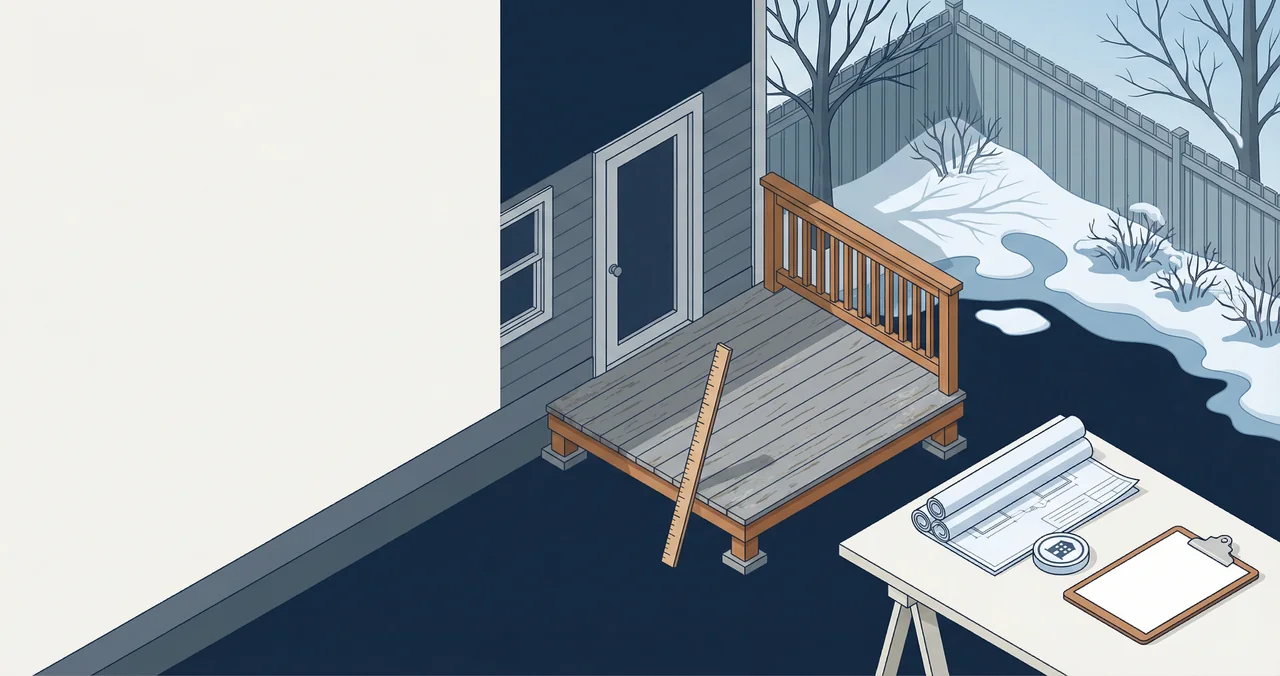
Planning a new deck in Victoria? Before you pick out decking boards or get quotes from builders, there's one step you can't skip: figuring out whether you need a building permit. Get it wrong, and you could face fines, forced removal, or serious headaches when you try to sell your home.
Here's everything Victoria homeowners need to know about deck permits in 2026 — the actual requirements, what it costs, and how to get through the process without delays.
📋 Tool Alert: Permit Checker
Do you really need a permit? Check the exact rules for your city or township.
Check Permits →Do You Need a Deck Permit in Victoria?
Short answer: probably yes.
🏗️ Planning a deck project?
Get a free manual project review, or visualize your dream deck with AI before requesting quotes.
The City of Victoria requires a building permit for most deck construction. The general thresholds that trigger a permit requirement are:
- Decks higher than 24 inches (600 mm) above finished grade
- Decks larger than 100 square feet (9.3 square metres)
- Any deck attached to your house
A small, ground-level platform under 100 sq ft that sits less than 24 inches off the ground may be exempt — but don't assume. Victoria's Building & Development Services department has the final say, and the rules can vary depending on your property's zoning, lot coverage limits, and proximity to property lines.
Always confirm with the City of Victoria's Building Department before starting work. A quick phone call or email can save you thousands of dollars in fines or rework.
When a Permit Is Required
Let's get specific. You need a deck permit in Victoria when:
- Your deck will be more than 24 inches above grade at any point
- The deck area exceeds 100 square feet
- The deck attaches to your home's structure (ledger board connection)
- You're adding a roof, pergola, or covered structure over the deck
- The deck includes built-in electrical, gas lines, or plumbing (hot tub hookups, outdoor kitchen gas lines)
- You're building over or near a municipal easement or right-of-way
When You Might Not Need a Permit
A permit is generally not required for:
- Freestanding ground-level decks under 24 inches high and under 100 sq ft
- Replacing deck boards only on an existing permitted structure (no structural changes)
- Minor repairs that don't alter the deck's size, height, or structural support
Even for exempt projects, you still need to follow setback requirements and lot coverage limits. Exempt from a permit doesn't mean exempt from zoning rules.
Permit Fees & Processing Time
How Much Does a Deck Permit Cost in Victoria?
Deck permit fees in Victoria are based on the estimated construction value of your project. As of 2026, expect:
| Project Value | Approximate Permit Fee |
|---|---|
| Under $5,000 CAD | $150–$250 |
| $5,000–$15,000 CAD | $250–$500 |
| $15,000–$50,000 CAD | $500–$900 |
| Over $50,000 CAD | $900+ (scaled by value) |
Additional fees may apply for:
- Plan review fees — typically included in the base permit fee
- Re-inspection fees — if your work fails an inspection and needs a follow-up ($100–$200 per re-inspection)
- Variance applications — if you need relief from setback or lot coverage rules ($500–$1,500+)
To put this in context: a typical 300 sq ft composite deck in Victoria runs $15,000–$25,500 CAD installed, so the permit fee usually represents about 2–4% of the total project cost. If you're exploring material costs for a larger build, check out what a composite deck costs across Canada for a broader pricing breakdown.
How Long Does Permit Approval Take?
Plan on 2 to 6 weeks for a standard residential deck permit in Victoria. Timelines depend on:
- Completeness of your application — missing documents are the #1 cause of delays
- Time of year — applications spike in spring as everyone rushes to build before summer. Submit in January or February and you'll face shorter queues
- Complexity — a simple attached deck processes faster than a multi-level structure with a hot tub and covered section
Pro tip: Victoria builders routinely advise scheduling your build for June through September — the driest months with the most reliable weather. That means your permit application should go in by March or April at the latest. Dry season bookings fill fast, so planning in winter for a summer build is the smart move.
Building Codes & Setback Rules
Victoria decks must comply with the British Columbia Building Code (BCBC) as well as the City of Victoria's zoning bylaws. Here are the key requirements:
Structural Requirements
- Footings must extend below the frost line — in Victoria, that's 12 to 24 inches deep depending on soil conditions. Victoria's milder climate means shallower frost penetration than the BC Interior, but your footings still need to reach undisturbed soil
- Joist spacing: Typically 16 inches on centre for most decking materials; some composite products allow 12-inch spacing for diagonal installations
- Beam and post sizing must match span tables in the BCBC
- Ledger board connections to the house require lag bolts or through-bolts with proper flashing — this is a critical inspection point. Improperly flashed ledger boards are the leading cause of deck collapses across Canada
- Guard rails are required when the deck surface is more than 24 inches above grade — minimum 42 inches high with balusters spaced no more than 4 inches apart
Setback Rules
Setbacks define how close your deck can be to property lines, and they vary by zone. Typical Victoria residential setbacks include:
- Rear yard setback: 4.5 to 7.6 metres (roughly 15–25 feet), depending on your zone
- Side yard setback: 1.2 to 3.0 metres (4–10 feet)
- Front yard setback: Generally no decks permitted in front yard setbacks
These numbers vary significantly across Victoria's neighbourhoods. A property in Fairfield may have different zoning than one in Fernwood or James Bay. Always check your specific zoning designation on the City of Victoria's zoning map or contact the Planning Department directly.
Lot Coverage
Your deck counts toward your property's total lot coverage — the percentage of your lot that can be covered by structures. Many Victoria residential zones cap lot coverage at 40–50%. If your home, garage, and shed already use most of that allowance, your deck size may be limited.
Victoria's Climate and Your Deck Design
Victoria's frequent rain and mild year-round temperatures create specific challenges that smart permit plans address upfront:
- Drainage: Your plans should show adequate slope (minimum 1/8 inch per foot away from the house) and proper gap spacing between deck boards for water drainage
- Moisture protection: Building inspectors will look closely at joist tape, flashing details, and ventilation under the deck
- Mold and algae resistance: Victoria's damp climate accelerates mold growth. Composite and PVC decking resist moisture far better than wood, which needs frequent cleaning and sealing to survive here
- Foundation stability: Victoria's clay-heavy soils in some neighbourhoods (particularly Oaklands and parts of Hillside-Quadra) can shift with seasonal moisture changes — your footing design may need to account for this
Use PaperPlan to visualize different decking materials on your own home before committing — it's especially helpful for comparing how composite vs. wood options look against Victoria's typically green, lush backyard settings.
How to Apply for a Deck Permit in Victoria
Here's the step-by-step process:
Step 1: Gather Your Documents
You'll need:
- Site plan showing your property boundaries, existing structures, and the proposed deck location with dimensions and setback distances
- Construction drawings including a plan view, cross-section, and elevation showing structural details (footings, posts, beams, joists, decking, railings)
- Engineering details for footings, post-to-beam connections, and ledger board attachment
- Material specifications — decking type, lumber grades, fastener types
- Property survey (if you don't have one, the City may require it for setback confirmation)
Most Victoria deck builders will prepare these drawings as part of their quote — or they'll refer you to a residential designer. For complex or elevated decks, you may need stamped engineered drawings, which typically cost $500–$2,000 CAD.
Step 2: Submit Your Application
The City of Victoria accepts permit applications through their online permitting portal or in person at City Hall. You'll need to:
- Complete the Building Permit Application Form
- Upload or submit all required drawings and documents
- Pay the application fee
Online submissions are faster and let you track the status of your application.
Step 3: Plan Review
A building official reviews your plans for compliance with the BCBC and Victoria's zoning bylaws. They'll check:
- Structural adequacy
- Setback compliance
- Lot coverage calculations
- Drainage and grading
If your plans need revisions, you'll receive written comments. Respond quickly — revision delays are the biggest time killer in the permit process.
Step 4: Receive Your Permit
Once approved, you'll receive your building permit. Post it visibly on your property during construction — it's legally required.
Step 5: Schedule Inspections
Victoria typically requires two inspections for a standard deck:
- Footing/foundation inspection — before pouring concrete or backfilling
- Final inspection — once the deck is complete, including railings and stairs
Your permit will specify exactly which inspections are required. Don't cover up footing work before the first inspection — you'll have to dig it up.
Step 6: Get Final Approval
After passing the final inspection, you'll receive a completion certificate. Keep this with your property records. You'll need it if you ever sell your home or refinance.
What Happens If You Build Without a Permit
This is where things get expensive. Building a deck without a required permit in Victoria can result in:
- Stop-work orders — the City can halt construction immediately
- Fines of $500 to $10,000+ per infraction under Victoria's building bylaw
- Forced removal — in worst cases, you may be ordered to demolish the deck entirely
- Retroactive permit fees — typically double the original permit fee
- Insurance issues — your homeowner's insurance may deny claims related to an unpermitted structure
- Problems selling your home — buyers' home inspectors and lawyers will flag unpermitted structures. You may need to obtain a retroactive permit, have the deck professionally inspected, or remove it before closing
Can You Get a Retroactive Permit?
Yes, but it's painful. You'll need to:
- Apply for a permit after the fact (with double fees)
- Possibly expose structural elements for inspection — that might mean removing deck boards, skirting, or even concrete to show footings
- Bring the entire structure up to current code — if your deck was built to older standards, this could mean significant modifications
It's far cheaper and easier to get the permit first. For a typical Victoria deck project in the $15,000–$30,000 range, the permit cost is a small fraction of your total investment.
If you're comparing what deck projects cost at various sizes, our cost guide for larger builds breaks down material and labour pricing in detail.
🎨 Not sure which material to pick?
Upload a photo of your backyard and see exactly how Trex, TimberTech, or cedar would look — free and instant.
Frequently Asked Questions
How much does a deck permit cost in Victoria, BC?
$150 to $900+ CAD depending on your project's estimated construction value. A typical backyard deck in the $10,000–$25,000 range will cost roughly $250–$500 for the permit. Budget an additional $100–$200 for potential re-inspection fees if anything needs correction.
Do I need a permit for a ground-level deck in Victoria?
It depends on size and height. A freestanding deck under 24 inches high and under 100 sq ft generally doesn't require a permit. But it still must meet setback and lot coverage requirements. If your deck is attached to the house or exceeds either threshold, you need a permit. When in doubt, call Victoria's Building Department — it's a free phone call that could save you thousands.
How long does it take to get a deck permit approved in Victoria?
Expect 2 to 6 weeks for a standard residential deck. Submitting a complete application with accurate drawings speeds things up. Spring is the busiest time, so applying in winter gives you faster processing and positions your project for a summer build window when Victoria's weather cooperates.
What are the setback requirements for decks in Victoria?
Setbacks vary by zoning district. Typical residential setbacks are 1.2–3.0 metres from side property lines and 4.5–7.6 metres from the rear. Your specific requirements depend on your property's zoning designation. Check the City of Victoria's zoning bylaw or contact the Planning Department with your property address for exact numbers.
Can I build a covered deck or pergola without a separate permit?
No. Adding a roof, pergola, or any overhead structure to your deck requires its own permit — or must be included in your original deck permit application. Covered structures affect lot coverage calculations, may have additional structural requirements, and could impact your neighbours' light and privacy. Some areas of Victoria, like Burnaby and Surrey, have similar requirements across the metro region if you're comparing options in Greater Victoria or the Lower Mainland.
What materials work best for decks in Victoria's climate?
Victoria's constant moisture makes material choice critical. Composite and PVC decking ($50–$90/sq ft installed) resist mold, algae, and rot without annual sealing. Pressure-treated wood ($30–$55/sq ft installed) is the budget option but needs cleaning and resealing every 1–2 years in Victoria's wet climate. Cedar ($40–$65/sq ft installed) looks beautiful but demands similar maintenance. For a deeper comparison of composite decking brands available in Canada, we've reviewed the top options by durability, warranty, and price.
📋 Planning a deck project?
Get a free manual project review from our team — no obligation, no spam.
Get Free Project Review →Upload a backyard photo and preview real decking materials with AI — free, instant, no sign-up.
Permits, costs, material comparisons, and questions to ask before requesting quotes — delivered to your inbox.