
Composite Decking vs Wood Cost in Canada: 10-Year Comparison
Compare composite vs wood deck costs over 10 years in Canada. Real numbers on upfront pricing, maintenance, repairs, and total ownership costs.
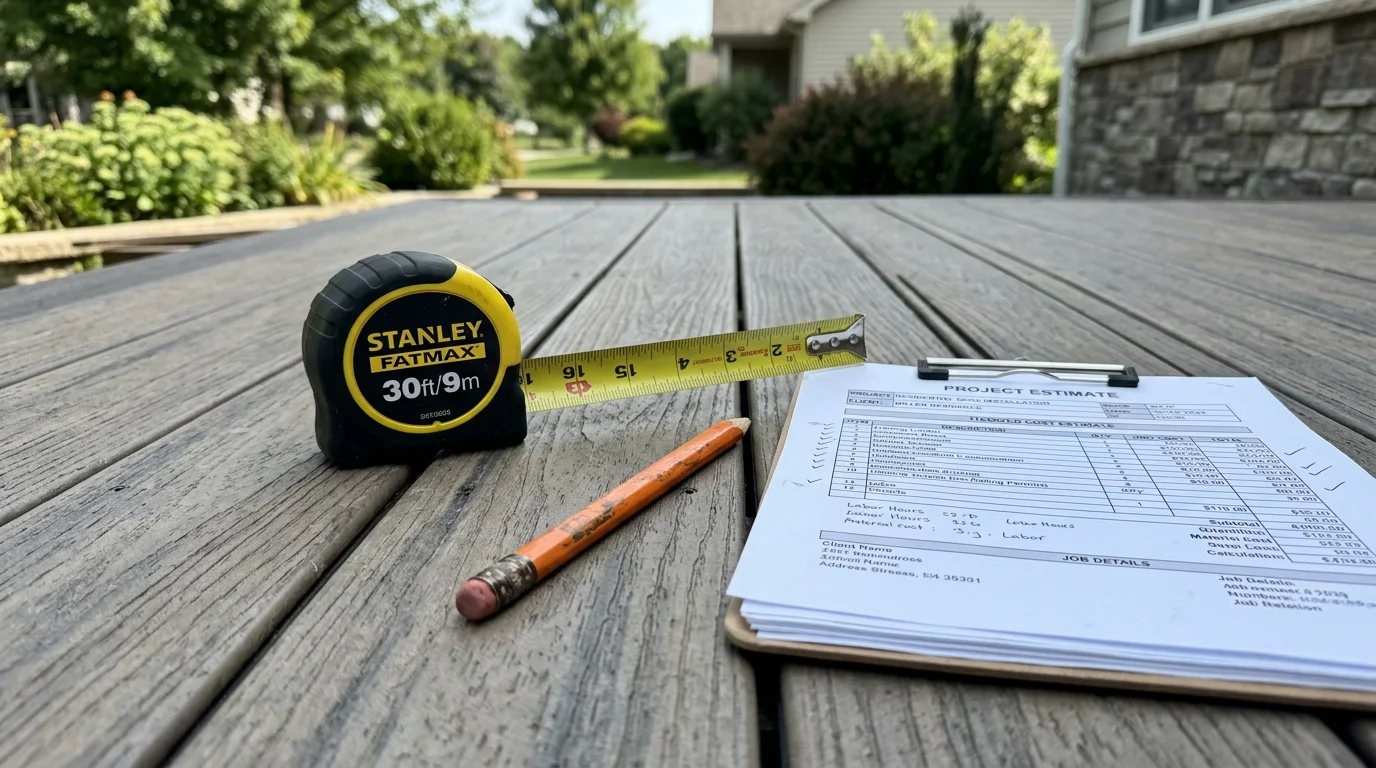
You're choosing deck materials, and the price gap between composite and wood looks huge. A 300 sqft pressure-treated deck in KWC runs $13,500-19,500 installed, while the same deck in composite costs $19,500-28,500. That's a $6,000-9,000 difference upfront.
But initial cost tells only part of the story. Wood decks need annual staining, constant repairs, and often full board replacement by year 12-15. Composite decks? Wash them once a year and replace a few boards if something heavy gets dropped.
Here's what ownership actually costs over a decade, using real 2026 Canadian pricing.
Year One: Upfront Installation Costs
Pressure-Treated Wood Deck
For a 300 sqft deck (12x25) in Kitchener-Waterloo-Cambridge:
🏗️ Planning a deck project?
Get a free manual project review, or visualize your dream deck with AI before requesting quotes.
- Materials: $2,100-3,600 (5/4x6 decking, 2x10 joists, hardware)
- Labour: $7,500-13,500 (framing, decking, railing)
- Railings: $2,400-4,800 (40 linear feet at $60-120/ft)
- Permit: $200-350
- Total installed: $13,500-19,500 ($45-65/sqft)
Composite Deck (Mid-Range Brand)
Same 300 sqft deck with capped composite boards:
- Materials: $4,800-7,200 (boards, hidden fasteners, matching fascia)
- Labour: $9,000-15,000 (slower installation, specialized cuts)
- Railings: $3,200-6,000 (composite or aluminum)
- Permit: $200-350
- Total installed: $19,500-28,500 ($65-95/sqft)
Year 1 difference: Composite costs $6,000-9,000 more upfront.
Learn more about composite installation pricing in the Waterloo region.
Years 2-10: Maintenance and Repair Costs
Pressure-Treated Wood Maintenance Schedule
Annual costs (homeowner labour):
- Power washing: $0 (DIY) or $250-400 (professional)
- Stain/sealer: $300-600 every 2-3 years (materials + labour if hired)
- Fastener replacement: $50-150/year (popped nails, loose screws)
- Board replacement: $200-800/year after year 5 (warped, split, rotted boards)
10-year maintenance total: $5,500-9,500
Breakdown:
- Power washing (10 years): $2,500-4,000
- Staining (4 applications): $1,200-2,400
- Fasteners/repairs: $500-1,500
- Board replacements (years 5-10): $1,200-4,800
Composite Deck Maintenance Schedule
Annual costs:
- Soap and water cleaning: $0-100 (DIY or professional)
- Mold/mildew treatment: $50-150 every 2-3 years (shaded areas)
- Fastener tightening: $0-50 (hidden fasteners rarely need adjustment)
- Board replacement: $100-300/year (rare, only from impact damage)
10-year maintenance total: $800-2,200
Breakdown:
- Cleaning (10 years): $0-1,000
- Mold treatment: $200-600
- Fasteners: $0-200
- Board replacements: $500-1,500
Maintenance savings with composite: $4,700-7,300 over 10 years
See detailed composite maintenance requirements for Ontario's climate.
Hidden Costs: Time and Labour
Wood decks demand 20-40 hours of maintenance per year:
- Power washing: 3-5 hours
- Staining prep and application: 12-20 hours
- Repairs and replacements: 5-15 hours
Over 10 years, that's 200-400 hours of work. At even $25/hour (your time value), that's $5,000-10,000 in opportunity cost.
Composite decks need 2-5 hours per year for basic cleaning—20-50 hours over 10 years. Value: $500-1,250.
Time savings: $4,500-8,750 over a decade.
10-Year Total Cost Comparison Table
| Cost Category | Pressure-Treated Wood | Composite Decking | Difference |
|--------------|----------------------|-------------------|------------|
| Initial install | $13,500-19,500 | $19,500-28,500 | +$6,000-9,000 |
| Maintenance (materials) | $5,500-9,500 | $800-2,200 | -$4,700-7,300 |
| Time value (DIY) | $5,000-10,000 | $500-1,250 | -$4,500-8,750 |
| Total 10-year cost | $24,000-39,000 | $20,800-32,000 | -$3,200-7,000 |
Break-even point: Composite becomes cheaper around year 6-8 for most homeowners.
Regional Factors That Affect Cost
Ontario Climate Impact on Wood
KWC sees -20°C winters and 30°C summers with high humidity. Pressure-treated wood expands, contracts, and absorbs moisture constantly.
Expect faster degradation:
- Board cupping/warping: Years 4-6 (vs 8-10 in drier climates)
- Fastener failure: Years 3-5 (frost heaving, expansion)
- Rot in high-moisture areas: Years 6-9 (under planters, near house)
Composite Performance in Freeze-Thaw Cycles
Capped composite boards handle Ontario winters better than wood:
- No moisture absorption: Boards don't swell or crack from freeze-thaw
- Stable dimensions: Less expansion/contraction than wood
- No rot or fungus: Synthetic cap resists biological decay
But composite has its own issues:
- Fading: UV degrades uncapped or budget composites faster
- Scratching: Heavy furniture, ice choppers, snow shovels cause permanent marks
- Ice dams: Smooth surface can be slippery in winter (add traction strips)
Read about composite vs wood durability in Ontario conditions.
Premium Composite vs Budget Composite
Not all composite is equal. Budget composite ($3-5/sqft) skips the protective cap—expect more fading, staining, and mold.
Capped composite ($5-8/sqft) like Trex, TimberTech, or Fiberon adds a polymer shell that resists:
- UV fading (25-year fade warranties)
- Staining from food, grease, mildew
- Scratching from pets, furniture
Over 10 years, budget composite maintenance costs approach $2,500-4,000 (more cleaning, board replacements, potential re-capping or refinishing attempts). Capped composite stays under $1,500.
Price difference: $600-900 upfront on a 300 sqft deck. Long-term savings: $1,000-2,500.
Compare top composite brands available in Canada.
When Wood Still Makes Financial Sense
Choose pressure-treated wood if:
1. You're selling within 5 years: You won't hit the break-even point. Wood's lower upfront cost wins.
2. You enjoy maintenance: If you like refinishing projects, wood's labour isn't a cost—it's a hobby.
3. Budget is extremely tight: Composite's $6,000-9,000 upfront premium may not be feasible even with long-term savings.
4. You're building a temporary structure: Deck will be torn out for addition, pool, or landscaping in 3-5 years.
When Composite Wins
Go composite if:
1. You're staying 7+ years: You'll capture the full financial benefit.
2. You value your weekends: Eliminating 20-40 hours/year of maintenance is worth the upfront cost.
3. You have kids or pets: Less splinters, no toxic stain chemicals, fewer repairs.
4. Your deck gets heavy use: BBQs, planters, furniture—composite handles wear better than soft wood.
Learn about composite deck costs across Canada.
Cedar and Other Wood Options
Cedar decks ($55-80/sqft installed) sit between pressure-treated and composite on initial cost. They're naturally rot-resistant and look beautiful, but:
- Still need annual sealing ($400-700 every 2 years)
- Fade to grey without treatment (some homeowners like this)
- Softer than composite—dent and scratch more easily
- 10-year maintenance: $4,000-7,000
10-year cedar total: $20,500-31,000 (similar to composite, slightly higher than pressure-treated).
Resale Value Consideration
Canadian real estate appraisers typically assign:
- Pressure-treated deck: 50-70% of install cost at year 5 (needs maintenance)
- Composite deck: 70-85% of install cost at year 5 (still looks new)
For a $22,000 composite deck vs $16,000 wood deck:
- Wood deck value at year 5: $8,000-11,200
- Composite deck value at year 5: $15,400-18,700
If you sell before year 10, composite holds more equity—offsetting some of the upfront premium.
Regional Labour Cost Differences
These comparisons use Kitchener-Waterloo-Cambridge pricing. Adjust for your region:
- Toronto/GTA: Add 15-25% to all labour costs
- Ottawa: Similar to KWC
- London/Windsor: Subtract 5-10%
- Northern Ontario: Add 10-20% (material shipping, shorter season)
Check deck costs for Cambridge specifically.
Warranty Considerations
Wood Warranties
Pressure-treated lumber typically carries:
- Lifetime warranty against rot and insect damage (residential use)
- But: Doesn't cover cupping, twisting, splitting, checking (cosmetic)
- And: Requires proper installation, ventilation, maintenance
Realistically, warranty claims are rare. Most damage is "normal wear" or improper installation.
Composite Warranties
Premium composite brands offer:
- 25-50 year limited warranties against fading, staining, material defects
- 25-year fade/stain warranty (material cost only, not labour)
- 50-year structural warranty (boards won't rot or structurally fail)
Key limit: Warranties cover material replacement only. If a board fails in year 15, you pay labour to remove and reinstall (~$100-200/board).
Review specific brand warranties like Trex's Canadian coverage.
🎨 Not sure which material to pick?
Upload a photo of your backyard and see exactly how Trex, TimberTech, or cedar would look — free and instant.
Common Questions
Is composite decking worth the extra cost in Canada?
Yes, if you're staying in your home 7+ years. Composite saves $4,700-7,300 in maintenance and 200-400 hours of labour over 10 years. The $6,000-9,000 upfront premium pays back by year 6-8, and composite retains higher resale value.
How much cheaper is wood decking upfront?
Pressure-treated wood costs $45-65/sqft installed vs $65-95/sqft for composite. On a 300 sqft deck, wood is $6,000-9,000 cheaper initially. But over 10 years, wood's maintenance costs ($5,500-9,500) close that gap entirely.
Do composite decks last longer than wood in Ontario?
Yes. Capped composite decks last 25-30+ years with minimal maintenance in Ontario's freeze-thaw climate. Pressure-treated wood decks need major repairs or full replacement at 12-18 years due to rot, warping, and fastener failure from moisture cycling.
What's the break-even point for composite vs wood?
Most homeowners break even around year 6-8. If you include time value (DIY labour), break-even happens by year 4-5. Selling before year 6? Wood's lower upfront cost wins. Staying longer? Composite is cheaper over time.
Does composite decking increase home value more than wood?
Appraisers value composite decks at 70-85% of install cost after 5 years, while wood decks drop to 50-70% due to maintenance needs. A $22,000 composite deck retains $15,400-18,700 vs a $16,000 wood deck retaining $8,000-11,200—a $7,400-7,500 difference in equity.
Upload a backyard photo and preview real decking materials with AI — free, instant, no sign-up.
Permits, costs, material comparisons, and questions to ask before requesting quotes — delivered to your inbox.