
Concrete vs Interlock Patio in Ontario
Concrete vs interlock patio in Ontario: Compare costs, durability, freeze-thaw performance, and maintenance for your KWC backyard project.
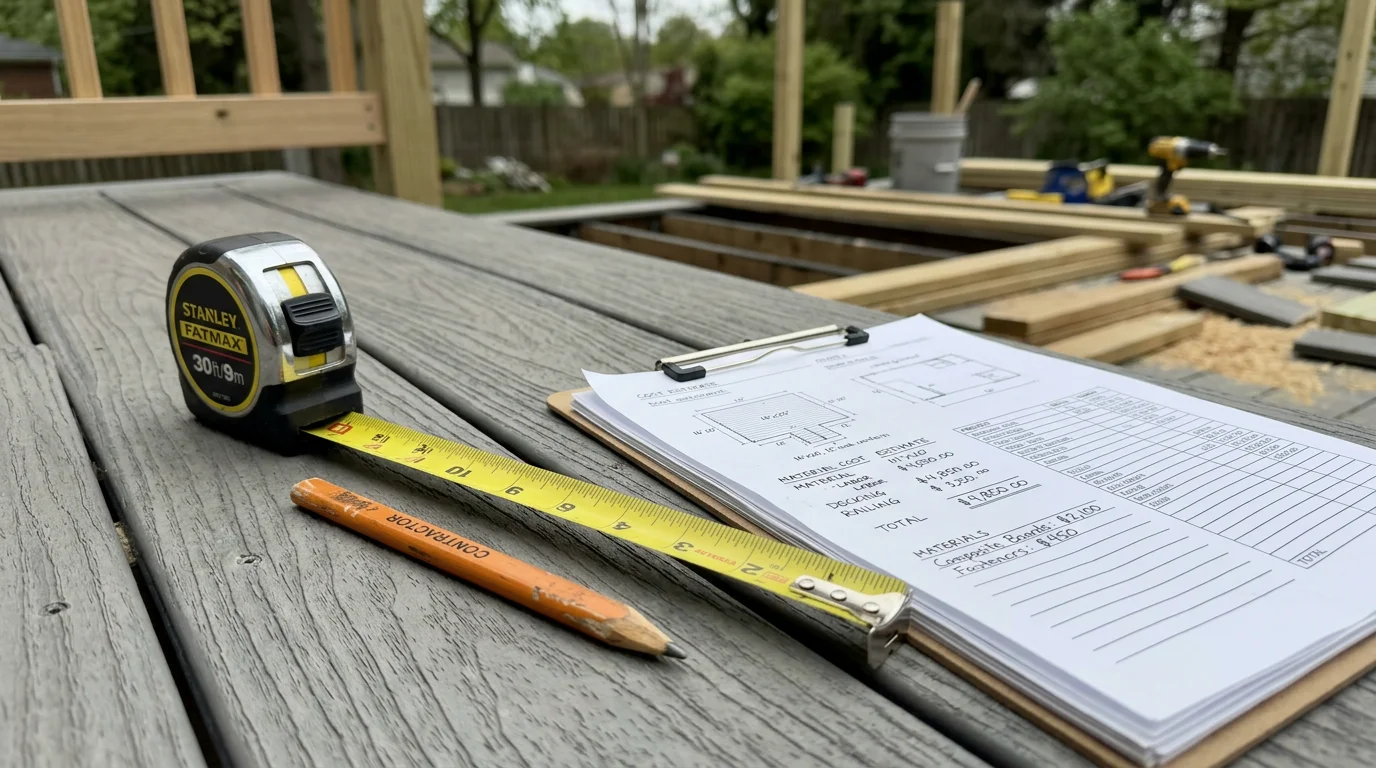
You're choosing between concrete and interlock for your backyard patio. Both work in Ontario's freeze-thaw climate, but they differ significantly in cost, longevity, repair options, and what happens when our clay soil shifts.
Cost Comparison: Installed Price
Concrete patios run $12-25 per square foot installed in the KWC area. A 200 sq ft patio costs $2,400-5,000.
🏗️ Planning a deck project?
Get a free manual project review, or visualize your dream deck with AI before requesting quotes.
Interlock patios cost $20-40 per square foot installed. That same 200 sq ft patio runs $4,000-8,000.
Concrete is cheaper upfront. Interlock costs 40-60% more initially but offers advantages that may justify the premium.
What Drives the Price Gap
Concrete is faster to install—a typical patio takes 1-2 days for pouring and finishing. Interlock requires excavation, base preparation, sand leveling, and hand-placing individual pavers, often taking 3-5 days.
Interlock's material cost is also higher: quality concrete pavers cost $3-8 per square foot before installation, while concrete mix is significantly cheaper per square foot of coverage.
Stamped or decorative concrete splits the difference at $15-30 per square foot, giving you pattern options while keeping costs below interlock.
Ontario Freeze-Thaw Performance
Both materials handle Ontario winters, but they respond differently to freeze-thaw cycles.
Concrete is a monolithic slab. When water seeps into micro-cracks and freezes, it expands and can cause cracking. Once a crack starts, it tends to grow each winter. Clay soil movement under the slab amplifies this—our region's expansive clay heaves in winter and settles in spring, creating stress points in rigid concrete.
Interlock pavers are individual units with sand joints. They move independently as the ground shifts. This flexibility means freeze-thaw cycles rarely damage the pavers themselves. If the base settles unevenly, pavers may dip or rise, but you can lift and re-level affected sections without replacing anything.
Drainage Differences
Interlock has built-in drainage—water drains through the joints between pavers. Concrete must be sloped correctly (minimum 2% grade) to shed water to the edges. Poor drainage accelerates concrete deterioration.
Both need proper base preparation: 4-6 inches of compacted granular A or clear stone. Without this, both will settle poorly in Ontario's clay soil.
Durability and Lifespan
Concrete patios last 20-30 years if properly installed with control joints and adequate base prep. Cracks often appear within 5-10 years, even with good installation. Surface spalling (flaking) from de-icing salt is common after 10-15 years.
Interlock patios last 25-40+ years. Individual pavers occasionally crack from impact, but you replace one paver instead of patching or resurfacing the entire area. The paver material itself is more dense and durable than poured concrete.
Color retention differs too. Concrete fades and stains accumulate over time. Interlock pavers have color throughout the entire unit—wear and weathering don't reveal a different color underneath.
Repair and Maintenance
This is where interlock shows its biggest advantage.
Concrete repairs are permanent and visible. Cracks can be filled but always show. Sunken sections require mudjacking (pumping material underneath to lift the slab) or full replacement. Either way, repairs rarely match the original appearance.
If you need to access utilities or add a gas line under your patio, you're cutting through concrete and patching—it will look like a repair forever.
Interlock repairs are invisible. You lift the affected pavers, fix the base, and relay the same pavers. If a paver cracks, you pop it out and drop in a new one. For utility access, you remove pavers, do your work, and replace them—no one can tell afterward.
This matters in Ontario, where frost heaving and settling are normal. You'll likely address minor settling at some point, and interlock makes this a 2-hour DIY task instead of a contractor call.
Annual Maintenance
Concrete needs sealing every 2-3 years to prevent water penetration and surface damage. Power washing is straightforward. Weeds don't grow through concrete, but you'll clean the edges where the patio meets soil or grass.
Interlock needs occasional joint sand replenishment (every 3-5 years) and polymeric sand re-application if you use it. Weeds can grow in joints if you use regular sand—polymeric sand prevents this. Power washing works but can remove joint sand, requiring immediate replacement.
Sealed concrete: 1-2 hours annually plus resealing costs every few years.
Interlock: 2-3 hours annually for cleaning and joint maintenance.
Both are low-maintenance compared to wood decks. See composite deck maintenance in Ontario for another low-maintenance option if you're also considering a deck.
Design Flexibility
Concrete offers limited patterns unless you go with stamped concrete. Standard brushed finish is functional but plain. Stamped concrete can mimic stone, brick, or tile patterns at $15-30/sqft—cheaper than interlock but locked in permanently. You can't change your mind later or update the look.
Color options exist (integral color or stain) but are limited compared to interlock.
Interlock comes in dozens of colors, shapes, sizes, and patterns. Herringbone, running bond, circular patterns, borders, accent bands—all possible. You can create defined seating areas, pathways, or borders using different colors or sizes.
You can also expand an interlock patio later and match the original pavers (if you kept extras or they're still manufactured). Expanding concrete means a visible seam or full replacement.
For curved edges or irregular shapes, interlock adapts easily. Concrete requires forming or saw-cutting curves after the pour.
Installation Timeline
Concrete: 1-2 days for most residential patios. Pour, finish, and wait 7 days for full cure before furniture placement.
Interlock: 3-5 days for excavation, base prep, and paver installation. Usable immediately after installation—no cure time needed.
Both require dry weather. Concrete can't be poured in freezing temperatures or heavy rain. Interlock installation stops in rain (wet base won't compact properly) but resumes faster once conditions improve.
The best time to build a patio in Ontario is May through September. See best time to build a deck in Ontario for seasonal considerations that apply similarly to patio work.
Which Makes Sense for Your Situation
Choose concrete if:
- Budget is tight and you need the lowest upfront cost
- You want a clean, modern look with minimal pattern
- The patio location has stable soil and good drainage
- You're comfortable with eventual cracking as normal wear
- No underground utilities will need future access through the patio
Choose interlock if:
- You want flexibility for future repairs or expansion
- Design options matter—you want patterns, borders, or color variety
- Your yard has drainage issues or unstable soil
- You value long-term durability and invisible repairs
- Utility lines run under the patio area
- You plan to stay in the home long-term and want the patio to last decades
For most Ontario homeowners, interlock wins despite the higher cost. The repair advantage alone justifies the premium—one frost heave repair on concrete can cost $500-1,500, while fixing the same issue with interlock costs $0-200 in sand and your time.
Permits and Code Requirements
Most Ontario municipalities don't require permits for ground-level patios without structural elements. If you're adding a retaining wall over 1 meter high or changing grade significantly, check with your local building department.
In Kitchener, Waterloo, and Cambridge, typical backyard patios under 200 sq ft don't need permits. Larger patios or those near property lines may trigger setback requirements.
If you're building a deck with stairs or elevated structure, permit rules differ significantly—review deck permit requirements in KWC separately.
Installation Best Practices for Ontario
Both materials need proper base preparation for Ontario's clay soil:
1. Excavate 10-12 inches below finished patio height
2. Install landscape fabric to prevent clay from migrating into base material
3. Add 6-8 inches of clear stone (3/4" or crusher run)
4. Compact thoroughly with a plate tamper—this step is critical
5. Add 1-2 inches of HPB (high-performance bedding) for interlock, or pour directly on compacted stone for concrete
Skipping base prep leads to settling within 2-3 years regardless of surface material. This matters more in Ontario than drier climates—our freeze-thaw cycles and clay soil demand proper base work.
For drainage around your patio, the same principles apply as deck drainage management—slope away from your house and ensure water has somewhere to go.
DIY vs. Contractor Installation
Concrete is difficult to DIY unless you have experience. Pouring, screeding, and finishing require specific skills and timing. A bad pour is permanent. Most homeowners hire contractors for concrete patios.
Interlock is DIY-friendly for smaller patios (under 150 sq ft) if you're willing to do the excavation and base prep work. Laying pavers is straightforward—the challenge is getting the base right. Larger patios justify hiring contractors for speed and base preparation equipment.
Expect to spend $800-1,200 in tool rental (excavator, plate tamper) and materials for a DIY interlock patio. Factor in 3-5 full days of physical work.
Professional installation guarantees proper base prep and usually includes a warranty. For concrete, this matters enormously—a poorly poured slab will crack prematurely no matter what. For interlock, professionals work faster and achieve better compaction with commercial equipment.
When comparing deck quotes in KWC, many builders also do interlock work—ask for patio quotes alongside deck estimates if you're deciding between the two.
🎨 Not sure which material to pick?
Upload a photo of your backyard and see exactly how Trex, TimberTech, or cedar would look — free and instant.
Common Questions
Can you pour concrete over existing interlock pavers?
Technically yes, but it's rarely recommended. You lose interlock's repair advantages and create a thick, heavy slab that will settle differently than the original paver base. If your interlock is failing, repair the base and relay pavers—it costs less and works better long-term.
How thick should a concrete patio be in Ontario?
4 inches minimum for residential patios. Add 6 inches if vehicles will drive over it (RV pad, extended driveway). Include rebar or wire mesh for crack resistance. Proper base preparation matters more than slab thickness—a 6-inch slab on poor base will fail faster than 4 inches on proper stone.
What's the best interlock paver thickness for Ontario winters?
60mm (2.4 inches) is standard for residential patios. This thickness handles freeze-thaw cycles and foot traffic without cracking. Thinner pavers (50mm) work but crack more easily. Driveways need 80mm pavers for vehicle loads—don't use patio pavers where cars will drive.
Does stamped concrete crack like regular concrete?
Yes. Stamping adds visual texture but doesn't prevent cracking from freeze-thaw or settling. Stamped concrete costs more than plain concrete but still cracks—it's the inherent nature of a monolithic slab on Ontario clay soil. Cracks in stamped patterns are often more visible than in plain brushed concrete.
Can you install interlock or concrete in winter?
Not reliably. Concrete won't cure properly below 5°C and can be damaged by freezing before it sets. Interlock base material won't compact when frozen. Both require ground excavation through frozen soil. Install patios between May and October in Ontario. Emergency repairs can happen in winter, but avoid new installations until spring.
Related: Patio Heater Guide for Ontario: Gas, Electric, and Infrared.
Upload a backyard photo and preview real decking materials with AI — free, instant, no sign-up.
Permits, costs, material comparisons, and questions to ask before requesting quotes — delivered to your inbox.