
Composite Decking Colours in Canada: What's Trending in 2026
Explore the most popular composite decking colours in Canada for 2026. From warm greys to rich browns, find the perfect shade for your Ontario deck project.
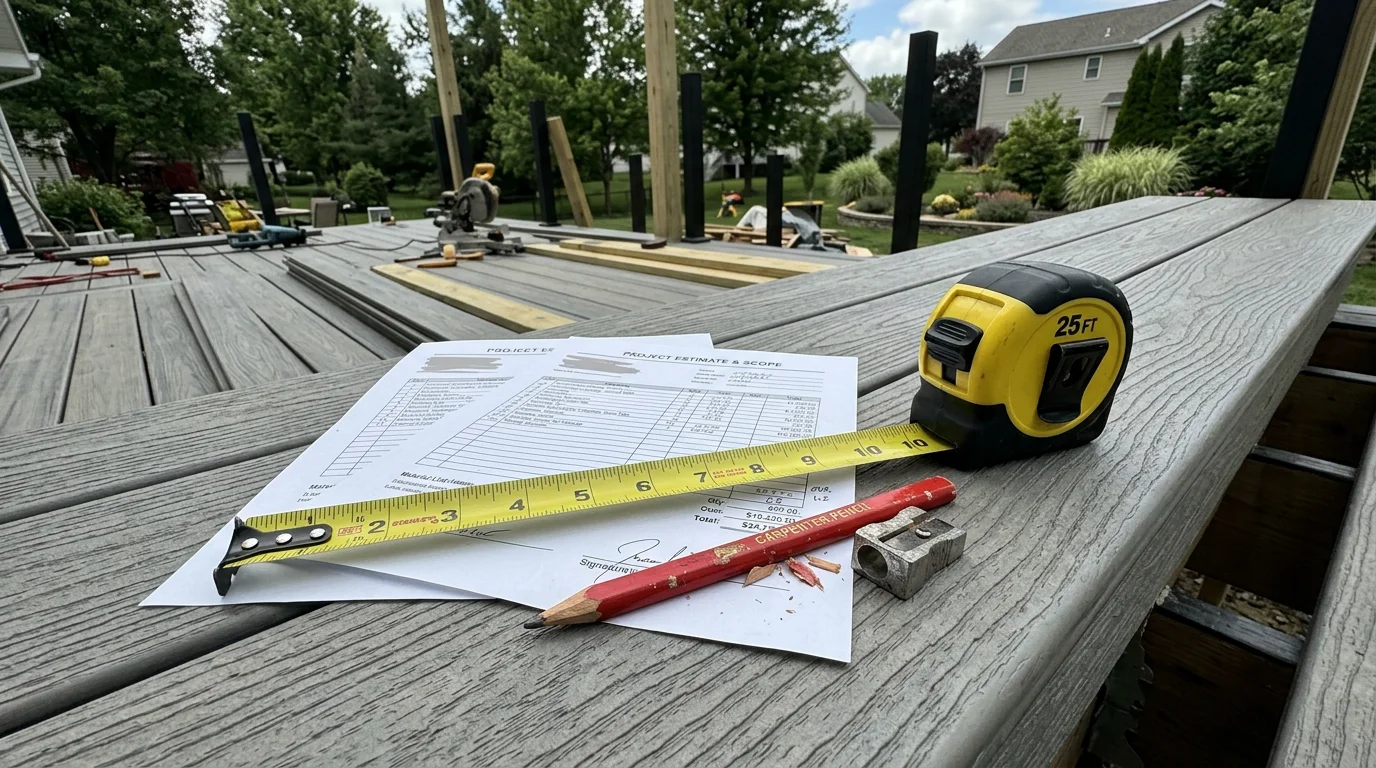
Choosing a composite decking colour affects your home's resale value, backyard aesthetics, and how much heat your deck absorbs during Ontario summers. In 2026, the colour palette has shifted dramatically from the honey-toned boards of the 2010s.
Here's what KWC homeowners are actually installing, which colours cost more, and how Ontario's freeze-thaw climate affects your choices.
What Colours Are Ontario Homeowners Choosing in 2026?
The dominance of grey composite decking continues, but warmer tones are making a comeback.
🏗️ Planning a deck project?
Get a free manual project review, or visualize your dream deck with AI before requesting quotes.
Top 5 colours installed in KWC (2026):
1. Charcoal grey — 32% of installations
2. Driftwood grey (grey-brown blend) — 24%
3. Walnut brown (rich chocolate) — 18%
4. Cedar tone (warm reddish-brown) — 14%
5. Weathered grey (light silver-grey) — 12%
Cool greys peaked in 2022-2023. Now, homeowners want warmth without returning to the orange-toned composite boards from 15 years ago.
Why the shift? Grey decks photograph beautifully but can feel cold in Ontario's long winters. Warmer greys and brown tones create cozier outdoor spaces while still looking modern.
How Much Do Premium Colours Cost?
Most manufacturers charge $0.50 to $2.00 more per linear foot for specialty colours compared to standard offerings.
Pricing tiers for Trex, TimberTech, and Fiberon (2026 KWC market):
| Colour Category | Price Premium | Example Colours |
|-----------------|---------------|-----------------|
| Standard colours | Baseline | Gravel Path, Saddle, Tiki Torch |
| Premium colours | +$0.50-1.00/lf | Island Mist, Spiced Rum, Rope Swing |
| Designer colours | +$1.50-2.00/lf | Lava Rock, Toasted Sand, Coastal Bluff |
For a 300 sqft deck (approximately 600 linear feet of boards), choosing a premium colour adds $300 to $600 to material costs alone.
Most KWC builders order premium colours without upcharges if you're buying a complete deck package. Ask your contractor if colour selection affects your composite deck cost in Waterloo.
Do Darker Colours Get Too Hot in Summer?
Yes. Surface temperature varies by 30-40°F between light and dark composite boards on a sunny July day.
Measured temperatures (KWC, 85°F ambient, full sun):
- Weathered grey composite: 105-110°F
- Driftwood grey: 115-120°F
- Walnut brown: 125-130°F
- Charcoal grey: 135-140°F
Charcoal decks in direct sun become uncomfortably hot for bare feet. If your deck faces south or west with no shade cover, avoid the darkest colours unless you plan to add a pergola or shade structure.
Solutions for hot deck boards:
- Install a pergola or covered section over high-traffic areas
- Use outdoor rugs in seating zones
- Choose heat-resistant composite lines (TimberTech AZEK, Trex Transcend Lineage)
- Pick medium-tone greys or browns instead of charcoal
Heat absorption matters less if your deck is shaded by trees or north-facing. Many KWC homeowners still choose dark greys for shaded backyards without issues.
Which Colours Hide Dirt, Pollen, and Stains Best?
Medium-toned variegated colours outperform solid light or dark shades.
Best for low-maintenance appearance:
- Driftwood grey (hides pollen, leaf tannins, and clay soil splatter)
- Walnut brown (disguises tree debris and natural weathering)
- Rope Swing or Spiced Rum (multi-tonal boards hide inconsistencies)
Worst for visible staining:
- Pure white or light grey (shows pollen, mildew, tannins immediately)
- Solid charcoal (shows dust, pollen, and salt residue from winter)
Ontario's spring pollen season turns light-coloured decks visibly yellow within days. If you have oak, maple, or pine trees nearby, skip the lightest shades.
For maintenance expectations across all composite types, see our guide on composite deck maintenance in Ontario.
Do Some Colours Fade Faster in Ontario Weather?
Modern capped composite decking resists fading far better than older co-extruded or uncapped boards, but colour shift still happens.
Expected colour change over 5-10 years:
- Grey tones: Minimal fading (5-10% lighter)
- Brown tones: Moderate fading (10-15% lighter, may develop grey undertones)
- Cedar/reddish tones: Most noticeable fading (15-20% lighter, shifts toward grey-brown)
Trex, TimberTech, and Fiberon all offer 25-year fade and stain warranties on capped composite lines. The warranty typically covers colour change beyond manufacturer-specified limits (usually 10-15% Delta E in colour science terms).
UV exposure matters more than freeze-thaw cycles. A south-facing deck in full sun fades faster than a north-facing shaded deck, regardless of winter severity.
If you're installing in a high-UV location, choose colours from the brand's top-tier line. Budget composite (uncapped or first-generation capped) fades noticeably faster, even in the same colour family.
What About Colour Matching With Your Home?
Your deck colour should complement your home's exterior, not match it exactly.
Pairing guide for common KWC home styles:
| Home Exterior | Best Deck Colours | Avoid |
|---------------|-------------------|-------|
| Red brick | Charcoal, walnut brown, weathered grey | Cedar tones (too much warmth) |
| Grey siding | Driftwood grey, walnut, rope swing | Cool greys (too monochromatic) |
| White/cream | Any colour works | Pure white (shows dirt) |
| Natural stone/beige | Cedar tone, driftwood, coastal bluff | Charcoal (too stark) |
| Dark brown trim | Walnut, spiced rum, lava rock | Light greys (washes out) |
Contrast creates depth. If your home is light, a medium-dark deck grounds the space. If your home is dark brick, a lighter deck prevents the backyard from feeling heavy.
Visit a local supplier with composite samples and hold them against your home's exterior in natural light. Photos on manufacturer websites rarely match real-world appearance.
How Do Multi-Tonal vs Solid Colours Compare?
Multi-tonal boards (variegated grain patterns) dominate 2026 installations. Solid-colour boards look dated unless you're going for a sleek, modern aesthetic.
Multi-tonal advantages:
- More realistic wood grain appearance
- Hides scratches, stains, and wear patterns
- Each board looks slightly different (natural variation)
- Ages more gracefully
Solid-colour advantages:
- Clean, contemporary look
- Easier to match replacement boards years later
- Lower price point (sometimes)
Most premium composite lines now offer only multi-tonal finishes because homeowners prefer the depth and realism.
For traditional homes in neighbourhoods like Stanley Park Kitchener or Westmount Waterloo, multi-tonal boards blend seamlessly. For ultra-modern builds, solid charcoal or weathered grey can work.
Should You Match Decking and Railing Colours?
No. Contrasting railing colours create visual interest and make deck boundaries safer.
Popular combinations in KWC (2026):
- Walnut brown decking + black aluminum railing — most requested
- Charcoal decking + white composite railing — modern coastal look
- Driftwood grey decking + bronze aluminum railing — warm contemporary
- Cedar tone decking + stainless cable railing — preserves sightlines
Matching deck and railing colours creates a monochromatic slab effect. Breaking up the field with contrasting rails adds dimension.
Black aluminum railing costs $40-70/linear foot installed in KWC. Composite railing runs $60-90/linear foot. Cable railing sits at $80-120/linear foot. Budget accordingly when planning your deck railing in Ontario.
Do Colour Trends Affect Resale Value?
Moderately. Choosing a wildly trendy colour today may look dated in 10 years, but neutral tones hold value.
Safe choices for resale:
- Any grey tone (light to dark)
- Walnut brown
- Cedar tone
Higher-risk choices:
- Exotic colours (beach dune, coastal bluff, island mist)
- Extremely light or white boards
- Bright reddish tones
Real estate agents report that well-maintained composite decks add $8,000 to $15,000 to home value in KWC, regardless of colour, as long as the deck looks current. A grey deck from 2020 still looks modern in 2026. A honey-toned deck from 2010 looks outdated.
If you're building in the next 1-2 years before selling, stick to grey or brown. If you're staying long-term, choose what you love.
Are There Canadian-Specific Colour Lines?
Some manufacturers offer regional colour palettes or Canada-exclusive shades, but most composite brands sell the same colours across North America.
Canadian market notes:
- Fiberon — some colours distributed differently in Canada vs USA
- Deckorators — limited availability in Ontario (mostly western Canada)
- Timbertech/AZEK — same colour lineup as USA
The bigger factor is local supplier inventory. KWC-area suppliers stock popular greys and browns but may special-order exotic tones, adding 2-4 weeks to lead times.
If you're on a tight timeline for deck construction in Ontario, confirm your colour choice is in-stock before signing contracts.
For Canadian-made options, see our breakdown of composite decking made in Canada.
How Does Colour Choice Affect Winter Performance?
Composite decking colour doesn't impact structural performance in freeze-thaw cycles, but it affects snow melt rates and salt residue visibility.
Dark colours (charcoal, walnut):
- Melt snow faster in sunny winter days
- Show salt stains and white residue more visibly
- May develop ice patches from uneven melting
Light colours (weathered grey, coastal bluff):
- Slower snow melt
- Hide salt residue better
- Maintain more consistent surface temperature
If you plan to use your deck year-round and shovel regularly, light-to-medium greys hide winter wear better than dark browns or charcoals.
For winter care specifics, read our guide on winter deck maintenance in Ontario.
What About Colour Matching Between Brands?
Don't assume "grey" means the same shade across Trex, TimberTech, and Fiberon.
Example: Trex Gravel Path is a cool medium grey. TimberTech Coastline is a warm grey-brown. Fiberon Horizon Cinnabar is a reddish-grey. All three are marketed as "grey."
Best practice:
- Request physical samples from your deck builder
- View samples in your backyard (not under showroom lighting)
- See installed decks in your neighbourhood if possible
- Don't rely on website photos (colour accuracy varies by screen)
Some KWC builders keep sample boards from recent projects. Ask to see real-world installations before committing.
Mixing brands mid-project is nearly impossible due to colour and profile differences. Stick with one manufacturer for decking and fascia boards.
Can You Mix Colours on One Deck?
Yes, but it requires planning.
Common multi-colour designs:
- Border pattern — perimeter in contrasting colour (adds $400-800 for a 300 sqft deck)
- Diagonal inlay — accent stripe running diagonally (adds $600-1,200)
- Picture frame — dark border with lighter field (classic look)
Multi-colour layouts increase labour costs by $3-8/sqft due to additional cuts and layout complexity. Most KWC builders charge a flat fee ($500-1,500) depending on pattern intricacy.
Material waste increases by 10-20% when mixing colours because you're cutting from two separate board inventories.
If budget is tight, stick to a single colour. If you want a custom look and have room in the budget, borders and inlays add significant visual appeal.
What's the Best Colour for Pool Decks?
Lighter tones outperform dark colours for pool surrounds.
Top choices:
- Weathered grey
- Coastal bluff
- Light driftwood
Why light colours win for pools:
- Lower surface temperature (safer for wet bare feet)
- Better contrast with water (easier to see pool edge)
- Hide chlorine and water splashes better than dark boards
Avoid charcoal or walnut near pools unless you're installing under a covered structure. Dark boards become dangerously hot and show every water spot.
For more on pool deck material choices, see our comparison of pool deck options in Ontario.
Should You Consider Colour When Choosing Board Direction?
Board orientation affects how colour and grain pattern appear.
Horizontal/perpendicular boards (most common):
- Emphasizes grain lines running lengthwise
- Multi-tonal colours show more variation board-to-board
- Standard installation (lowest cost)
Diagonal boards (45° angle):
- Creates visual interest with colour striping
- Increases material waste by 10-15%
- Adds $2-5/sqft in labour
Herringbone or parquet patterns:
- Best with solid colours or low-variance grain
- Multi-tonal boards create busy, chaotic look
- Custom labour adds $8-15/sqft
If you're choosing a highly variegated colour (driftwood, rope swing), keep the layout simple. Complex patterns fight with busy grain.
🎨 Not sure which material to pick?
Upload a photo of your backyard and see exactly how Trex, TimberTech, or cedar would look — free and instant.
Common Questions
Do composite deck colours look different when wet?
Yes. Most composite boards darken by 1-2 shades when wet and return to original colour as they dry. Greys shift toward charcoal, browns deepen toward chocolate. This is normal and doesn't indicate damage. If you live in a rainy area or have heavy tree cover, view samples wet and dry before deciding.
Can I change my deck colour after installation?
No. Composite decking cannot be stained, painted, or refinished. The colour is permanent. Some homeowners flip boards if one side shows heavy wear, but this only works if the opposite side hasn't faded differently. Choose carefully—you're locked in for 25+ years unless you replace boards.
Do I need to order extra boards in the same colour for future repairs?
Yes. Manufacturers discontinue colours every 3-5 years. If you need replacement boards in 10 years, your exact colour may be unavailable. Order 5-10% extra and store indoors. Composite doesn't rot, so storing extra boards is feasible. Alternatively, document your exact product name and colour code for closest future match.
Which composite decking colour is best for Kitchener-Waterloo climate?
Medium-toned greys and browns perform best in KWC's freeze-thaw cycles and variable UV exposure. Driftwood grey and walnut brown balance heat absorption, dirt hiding, and fade resistance. Avoid pure white (shows dirt instantly) and solid charcoal (gets dangerously hot in summer). For shaded north-facing decks, darker colours work fine. For south-facing sun exposure, stick to medium tones.
How do I see composite deck colours in person before buying?
Request samples from your deck builder or visit local suppliers like Home Depot, Lowe's, or specialty deck retailers in KWC. Most suppliers have display decks showing popular colours. Better yet, ask your builder to show you completed projects in your target colour. Photos on manufacturer websites rarely match real-world appearance due to screen calibration and lighting differences.
Upload a backyard photo and preview real decking materials with AI — free, instant, no sign-up.
Permits, costs, material comparisons, and questions to ask before requesting quotes — delivered to your inbox.