
Does Your Deck Builder Need WSIB? Ontario Requirements
Learn when deck builders need WSIB coverage in Ontario, how to verify clearance, and what happens if your contractor isn't covered when injuries occur.
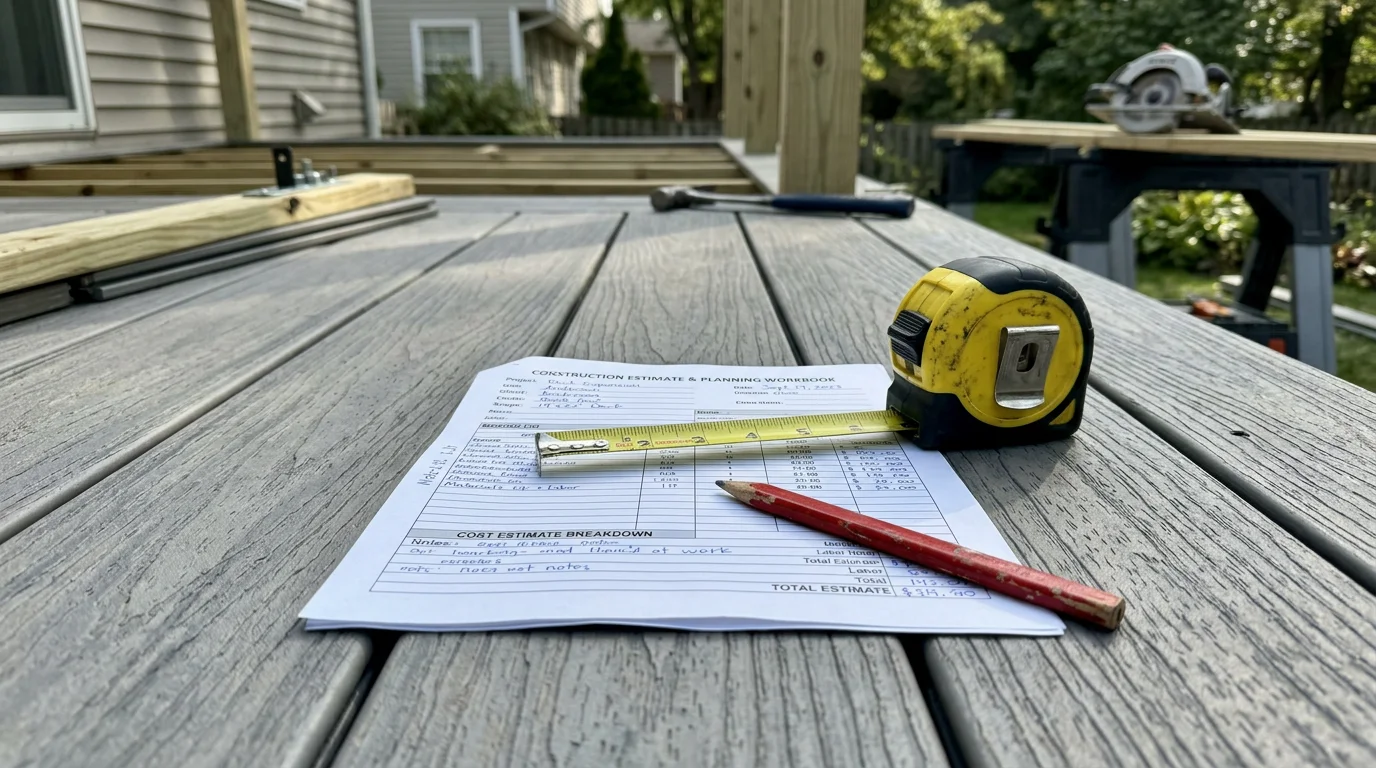
When you're hiring a deck builder in Ontario, WSIB coverage isn't just bureaucratic red tape—it's the difference between a protected project and potential liability if someone gets hurt on your property.
Here's what matters: if your deck builder has employees or subcontractors, they need WSIB coverage. If they're a true sole proprietor working alone, they don't. But verifying this isn't always straightforward, and the consequences of getting it wrong fall on you.
What WSIB Covers (and Why You Care)
The Workplace Safety and Insurance Board covers medical costs, lost wages, and rehabilitation for workers injured on the job. When your deck builder has active WSIB coverage, any workplace injury is handled through the insurance system—not through your homeowner's insurance or personal liability.
🏗️ Planning a deck project?
Get a free manual project review, or visualize your dream deck with AI before requesting quotes.
Without WSIB coverage, you're exposed. If a worker falls from your second-story deck framing, breaks a leg on your stairs, or suffers any injury during construction, they can sue you directly as the property owner. Your homeowner's insurance may cover some claims, but policies often exclude contractor injuries or have coverage limits that don't match the actual cost of serious injuries.
WSIB premiums for construction trades in Ontario run $5.75 to $8.20 per $100 of insurable earnings (2026 rates, depending on classification). For a deck builder paying a framer $28/hour, that's roughly $1.25/hour in WSIB costs. Legitimate builders factor this into their quotes; those who skip coverage can undercut pricing but leave you holding the risk.
When Deck Builders Need WSIB Coverage
Ontario law requires WSIB coverage for any business with employees or most independent contractors. Here's how it breaks down:
Required coverage:
- Deck building companies with employees (framers, labourers, apprentices)
- Builders who regularly hire subcontractors (railing installers, concrete crews)
- Partnerships with multiple working partners
- Incorporated businesses performing construction work
Not required:
- True sole proprietors working alone with no subcontractors
- Executive officers of a corporation (they can opt in voluntarily)
The grey area is subcontractors. Many deck builders operate as sole props but hire occasional help for big jobs or specialized tasks. Technically, if they're directing and paying other workers, those workers need coverage—either through the sub's own WSIB account or through the builder's. This is where many smaller operators fail to comply.
How to Verify WSIB Clearance
Before you sign a deck builder contract, request a WSIB Clearance Certificate. This document proves the builder has an account in good standing with no outstanding premiums.
Builders can generate clearance certificates instantly through their WSIB online account. The certificate includes:
- Business name and WSIB account number
- Confirmation of good standing
- Valid date range (typically 30 days)
Red flags:
- Refuses to provide clearance ("I don't need WSIB, I work alone")
- Shows an expired certificate
- Certificate is under a different business name than the contract
- Says they'll "get it later" or "after the deposit"
If a builder claims sole proprietor status and truly works alone, ask directly: "Will you be bringing anyone else on site during this project—helpers, subs, apprentices?" If the answer is yes, they need WSIB coverage for those workers.
You can verify clearance yourself by calling WSIB at 1-800-387-0750 with the builder's account number. WSIB will confirm active coverage but won't disclose payment history or claim details.
What Happens If Your Builder Isn't Covered
When an injury occurs on a project where the builder should have had WSIB but didn't, the costs cascade quickly.
Immediate consequences:
- Injured worker can sue you (the homeowner) and the builder
- Your homeowner's insurance may deny the claim or cancel your policy
- You're responsible for medical costs, lost wages, legal fees
- Project stops while legal issues are resolved
WSIB enforcement:
- Audits construction sites and can issue stop-work orders
- Bills homeowners directly for premiums the builder should have paid
- Charges penalties up to 200% of owed premiums for non-compliance
- Pursues legal action for serious violations
In a 2024 case in Guelph (just outside KWC), a homeowner paid $18,000 out-of-pocket after a deck framer fell and broke his wrist. The builder had claimed sole proprietor status but was hiring workers under the table. WSIB denied coverage, the framer sued, and the homeowner's insurance excluded the claim because the contractor wasn't properly insured.
The homeowner eventually recovered some costs from the builder, but the legal fees alone exceeded $8,000. The deck project—originally quoted at $22,000—ended up costing over $40,000 total.
Sole Proprietors vs. Incorporated Builders
The business structure affects WSIB requirements and your risk exposure.
Sole proprietors working alone:
- No WSIB requirement if they genuinely work solo
- Higher personal liability risk for you if they're injured
- Often lower quotes because no WSIB premiums
- Can opt into WSIB voluntarily (many don't)
Incorporated businesses:
- Must have WSIB for all workers except executive officers
- Corporate structure provides some liability separation
- Executive officer (owner-operator) can choose personal coverage
- More likely to carry proper insurance across the board
When you're comparing deck quotes in KWC, a sole prop quoting $48/sqft for pressure-treated vs. an incorporated builder at $55/sqft isn't necessarily price gouging. The difference often includes WSIB premiums, liability insurance, and proper worker classification—costs that are baked into the numbers in our full Ontario deck cost breakdown.
Ask directly: "Are you incorporated or a sole proprietor, and will you have anyone else on my property during the build?" Match the answer to the WSIB clearance certificate and contractor agreement.
Optional Coverage and Voluntary Accounts
Some sole proprietors and executive officers open voluntary WSIB accounts even when not required. This signals professional operation and reduces your liability exposure.
Voluntary WSIB costs (2026):
- Minimum annual premium: ~$1,000
- Based on declared insurable earnings
- Same coverage as mandatory accounts
- Can be cancelled but not retroactively
A sole proprietor deck builder who opts into WSIB at their full earnings—say $80,000/year—pays roughly $5,500/year in premiums. That's $450/month in overhead. Many sole props skip this to stay competitive on price, which is legal if they truly work alone but increases your risk.
Multiple Subcontractors and General Contractors
Large deck projects—especially multi-level designs or hot tub installations—often involve several trades: excavation, concrete, framing, railing, electrical, gas. Each subcontractor needs their own WSIB coverage or must be covered under the general contractor's account.
As the homeowner, you have the right to request:
- WSIB clearance for the primary contractor
- WSIB clearance for each subcontractor who steps on your property
- Written confirmation that all workers are covered under one account or another
General contractors sometimes run into issues when a subcontractor's coverage lapses mid-project. If that sub's worker gets injured on your property, WSIB will investigate who's responsible. If neither the sub nor the GC had active coverage for that worker, you're in the liability chain.
For projects over $50,000 or involving structural work requiring engineered drawings, consider adding a contract clause: "Contractor shall maintain active WSIB coverage for all workers and subcontractors throughout the project duration and provide updated clearance certificates upon request."
WSIB and Deck Permits in KWC
When you apply for a deck permit in Kitchener, Waterloo, or Cambridge, the municipality doesn't verify WSIB coverage as part of permit approval. That's between you and your contractor.
However, municipal inspectors can report suspected WSIB violations if they observe non-compliance during framing or final inspections. WSIB has the authority to audit construction sites independently of municipal permits.
Some municipalities include language in permit conditions requiring contractors to comply with all applicable workplace safety laws, but enforcement is complaint-driven. If a neighbour reports workers on your site without proper coverage, WSIB can investigate and issue stop-work orders.
The permit process timeline in KWC—typically 2-6 weeks—gives you plenty of time to verify WSIB clearance before construction starts. Don't wait until framing day to ask for documentation.
What to Include in Your Contract
Your written contractor agreement should explicitly address WSIB:
Key contract clauses:
- "Contractor warrants they maintain active WSIB coverage for all workers and subcontractors performing work under this agreement."
- "Contractor shall provide a current WSIB clearance certificate before work begins and upon request during the project."
- "Contractor indemnifies homeowner from all claims, costs, and liabilities arising from workplace injuries on the property."
- "Failure to maintain WSIB coverage constitutes material breach and grounds for contract termination."
Payment holdback protection:
- Consider withholding 10% of final payment until you receive a final WSIB clearance certificate dated after project completion
- This protects you from premium assessments if the builder let coverage lapse during your job
On a $35,000 deck project, a 10% holdback is $3,500—enough to cover potential WSIB bills if the builder wasn't compliant. Release the holdback only after confirming clearance and verifying no liens have been filed.
Insurance Beyond WSIB
WSIB covers workplace injuries, but it's not the only insurance your deck builder needs. Comprehensive protection includes:
Commercial General Liability (CGL):
- Covers property damage (e.g., contractor breaks your gas line during excavation)
- Third-party injury (e.g., falling lumber hits a neighbour)
- Completed operations (e.g., deck railing fails after installation)
- Minimum $2 million coverage is industry standard
WSIB:
- Covers worker injuries only
- No property damage coverage
- No coverage for injuries to homeowners or third parties
A deck builder with WSIB but no CGL leaves you exposed if they damage your home during construction. Both coverages should be verified before work begins. Ask for a Certificate of Insurance naming you as an additional insured for the project duration.
For a typical 200-sqft deck costing $11,000-$13,000 in KWC, builders should carry liability insurance and WSIB if they have workers. The combined cost of both is usually built into the per-square-foot pricing at around $2-4/sqft of the total quote.
🎨 Not sure which material to pick?
Upload a photo of your backyard and see exactly how Trex, TimberTech, or cedar would look — free and instant.
Common Questions
Can I be fined if my deck builder doesn't have WSIB?
You won't be fined directly, but WSIB can bill you for premiums the builder should have paid, plus penalties up to 200% of those premiums. You're also liable for workplace injury costs if the builder wasn't covered. WSIB enforcement prioritizes recovering costs, and homeowners are considered part of the liability chain when contractors are non-compliant.
What if my builder works alone but brings a helper for one day?
The moment your builder directs another worker—even for a single day—that worker needs WSIB coverage. Either the helper has their own WSIB account (if they're an independent contractor), or your builder must cover them through a WSIB account. Casual labour doesn't exempt anyone from coverage requirements. If the helper gets injured, you're exposed to liability.
How do I verify a WSIB clearance certificate is real?
Check the certificate for a WSIB account number, business name matching your contract, and a valid date range. Call WSIB at 1-800-387-0750 with the account number to confirm active coverage. WSIB will verify status over the phone. Fake certificates are rare but possible—always verify before releasing deposits or allowing work to begin.
Do deck builders need separate WSIB coverage for different projects?
No. WSIB coverage is account-based, not project-based. Once a builder has an active WSIB account, it covers all their projects and workers until the account lapses or is cancelled. A single clearance certificate confirms coverage across all jobs during the valid period. You should still request a current certificate for your specific project to ensure coverage is active when your work begins.
What happens if a subcontractor without WSIB gets hurt on my deck project?
If the general contractor hired the sub and the sub doesn't have WSIB, the GC is responsible for coverage. If the GC also doesn't have coverage, WSIB can pursue you (the homeowner) for costs. You'd also face potential lawsuits from the injured sub. This is why your contract should require the GC to verify all subcontractor WSIB clearances and provide you with copies before those trades start work.
Upload a backyard photo and preview real decking materials with AI — free, instant, no sign-up.
Permits, costs, material comparisons, and questions to ask before requesting quotes — delivered to your inbox.